Flying Cashews

The near fail of the Leaning Marina Tower of Chicago left me determined to prove that brownies could successfully be used to create an Architectural Dessert Masterpiece. All I needed was a subject.

Looking back on 2019, the most significant architectural moment for me was the fire of Notre Dame Cathedral. I felt gratitude that I had the opportunity in 2005 to see inside the cathedral from the vantage point of the organ loft; disappointment that all I really remember from the experience was how dark it was; curiosity about what they would do with the remaining structure (perhaps put a glass roof on it to increase the light?); and amazement that neither the cathedral nor Paris had experienced any major fires before in their centuries of existence.

The Great Fire of London in the 17th Century cleared the way for the construction of St. Paul’s Cathedral. One third of Pittsburgh burned in 1845. According to legend, the Great Chicago Fire of the 1870s was started when a cow kicked over a lantern. This fire destroyed approximately 17,500 buildings. Paris, Texas, experienced three major fires between 1877 and 1916. Yet, Paris, France, remained unscathed by significant fires until 2019.

To commemorate the incident, I reached for my brownie pan, only to stop short at the challenge of creating the flying buttresses. While I believed that brownies were structurally sound enough to use as building blocks, I did not trust them to fly. In the spirit of the season, I briefly considered candy canes. However, their shape didn’t really match the flying buttresses of Notre Dame. I also hesitated to use candy as I have become more sugar conscious since my first Architectural Dessert Masterpiece. Sugary candy on top of sugar-heavy brownies seemed like a bad idea. I began to think I would have to give up on making Notre Dame as I didn’t have time for the meticulous, but safe process of designing and cutting out numerous pieces of gingerbread for the cathedral. Before I gave up completely, I walked the bulk foods aisle of the grocery store searching for inspiration. I found it between the candies and the grains. Nuts of all shapes, sizes, and flavors sparked my imagination. They go well with brownies and would counterbalance the sugar. I compared the shapes of the peanuts, walnuts, Brazil nuts, and cashews and determined that cashews were made to fly.

After selecting my materials, there were several more moments of anxiety that my walls and towers would collapse. I am pleased to say that like the cathedral it was based on, my structure stood through the test of time (eight hours from construction to consumption).

IMG_20191224_160442

‘Tis the Season

…for gingerbread!

Pittsburgh’s Annual Gingerbread House Competition moved this year from the PPG Winter Garden to the City-County Building. For several years, I’ve enjoyed making the time to go down to the Winter Garden for the gingerbread houses, santas from around the world, music, and ambiance. This year, I am finding it harder to identify a time to browse the entries. I changed my mind multiple times as I remembered the new location requires passing through the metal detectors and it just didn’t seem the right time to go through that annoying and unreliable process.  In my travels through other downtown buildings, I am finding other gingerbread house displays to enjoy. Perhaps, I will get to the big competition at some point this season, but if not, I will at least have enjoyed some hassle-free displays.

BNY Mellon Building Gingerbread Houses

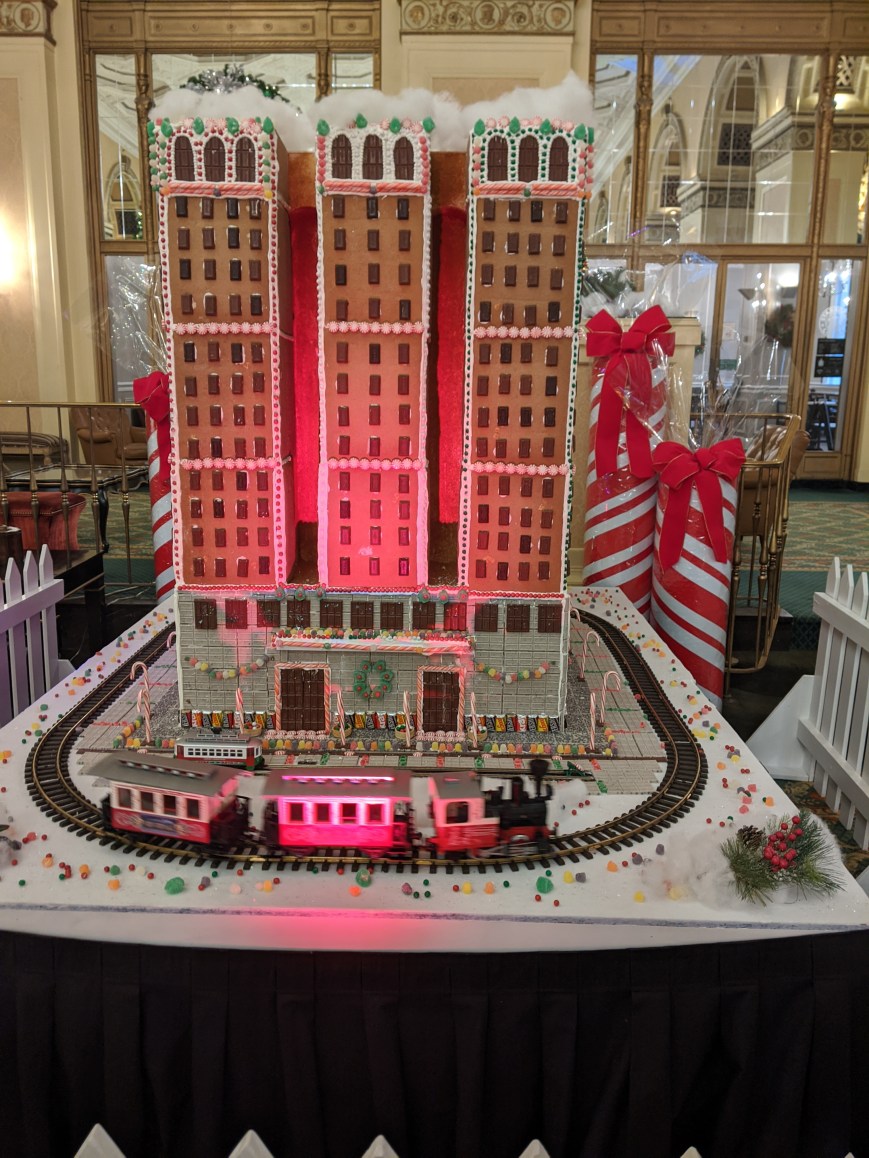
Omni William Penn Gingerbread Hotel

Keeping an Eye on Uptown: Nov. 2019


Keeping an Eye on Uptown: Introduction

Inspired by my post from this summer, I decided to start a photographic series of Pittsburgh’s Uptown neighborhood. This neighborhood is a hodgepodge of abandoned and renovated townhomes, parking lots, car-oriented businesses, corner stores, industrial uses, and new construction residential buildings. It is predicted to be on a tipping point from being mostly ignored to experiencing intense growth fueled by activities in and around the neighborhood. These activities include:

  • UPMC Mercy hospital is currently building a 410,000 sq ft vision and rehabilitation center in the middle of Uptown.
  • The Penguins hockey team is supposed to be finally getting off the ground with their redevelopment of the Lower Hill neighborhood, which is adjacent to Uptown.
  • June 2019 saw the groundbreaking for the CAP project to reconnect the Lower Hill to Downtown over the freeway that bisected the two in the 1960s.
  • The Bus Rapid Transit system currently in the planning stage will one day connect Downtown and Oakland through Uptown.

As these projects move forward, there will likely be more investment and changes to Uptown. This photographic series is intended to capture these changes by revisiting the same sites at regular intervals over the next several years.

In the coming months, I intend to release two related series to record the progress of the CAP and the Lower Hill redevelopment.

Visualizing the Wealth Gap: Halloween Edition

Every year, I look forward to the giant, inflatable dragon airing its wings in Beechview. It is the largest decoration in a small yard overflowing with inflatable ghosts and a giant spider, a witch on a broom, lights, pumpkins, and leaves. Many neighborhoods vie for the best and most prolific displays of Christmas lights. If there were a similar contest for Halloween, this modest-sized house with the dragon seems to me the cream of the crop in a neighborhood with a prolific smorgasbord of Halloween lights and decorations.

This year, I discovered a possible competitor for the title in Shadyside along Pittsburgh’s most intact millionaire’s row. On a lawn that is probably bigger than the footprint of the dragon house is an elaborate, customized ghost wedding. Across the street on a slightly smaller lawn, an 8-10 ft high, gleaming, ceramic clown holds court over a multitude of companions (minions?) of similar sinister and expensive cast.

On seeing these displays, my stomach sank. I felt a loss and a disappointment that this neighborhood may steal the crown for best Halloween decorations due to the unfair advantage of having more disposable wealth. I suppose it really comes down to what is the measure for determining the winning neighborhood: quantity, quality, per capita, density, creativity, or exuberance.

Inclusionary Wealth

Amid writing my posts about how the wealth gap manifests itself in the built environment and the morality of unequal economic investment in cities, I took another trip to Chicago. I spent most of my stay in the downtown areas within a mile of Grant Park. I love the old stone buildings, established green parks, ornate fountains, and modern glass skyscrapers with interesting architectural embellishments. Yet this trip, I felt hypocritical as I walked around soaking it all in. All these elements that I enjoy are the result of significant financial outlay that I know is not evenly distributed throughout the city. So where was my moral indignation at this display of deeply entrenched wealth unequally spread?

Chicago’s display of wealth isn’t gaudy like Tijuana or Las Vegas. The message I absorb in places like those with their flashing lights is “come on in, so we can suck all the money out of your pockets.” Chicago businesses identified their presence on the street with regular signs leaving it up to the passers to decide whether to engage.

One bar did add a layer of enticement to their sidewalk advertising. I was searching for a place for dinner, with this bar in mind as the one that looked most appealing from Google maps. I was looking around to see if there were any other better options. The smell of the burgers from this first bar convinced me that it was the best option in that vicinity. It was only after I had sat down and ordered that I realized the smell wasn’t coming from the open window, but rather it came from pipes pumping the kitchen smells to the sidewalk. Still it was a subtle inducement and unlike flashing lights it did not have a nefarious undertone.

By pumping out the smell to the sidewalk, it also felt indiscriminate. Anyone passing was invited to enjoy. This was unlike my experience in Cardiff where if I couldn’t afford the items in the business, I felt I shouldn’t be walking past in the public space. I never felt like I didn’t belong in Chicago. There were economic barriers to certain experiences, but those places that I encountered still did not feel exclusionary. One example is the lounge on the 96th floor of Chicago’s Hancock Building. The stunning views are only accessible to those who can afford a $17 cocktail, but those who can afford one only once in a blue moon were just as welcome as those who can afford one or more every night.

In Chicago, I never saw that strong line, as in Tijuana and Cardiff, that divided those with and those without financial resources.  Everywhere I went, there was a mix of people with different economic statuses, skin colors, and first languages. This diversity gave me the feeling that anyone is welcome to enjoy the well-maintained investment in public spaces with or without hitting a minimum financial threshold.

Moral Economics

The strongest impression from my last trip to Cardiff was the feeling that it is morally wrong to invest heavily in touristy neighborhoods while skipping the neighborhoods of the residents. Tourists may provide a bigger return per touch point, but residents have many more touch points (including voting). Perhaps I have become jaded since that trip, but I now accept that economics and morals rarely work together.

Pittsburgh’s Uptown neighborhood is trying a different approach to see if economic investment can be leveraged for the greater good. Uptown experienced disinvestment and decay for decades, despite being located between and within walking distance of Oakland and downtown, two of the largest economic engines in the state. Not to mention the main roads connecting these prosperous and growing areas run directly through Uptown. Zipping down Fifth Avenue from Oakland to downtown, it is easy to overlook or ignore the ruined home foundations turning back to forest, the wide-spread vacant lots and parking lots, and the intricate architectural details on the remaining old structures.

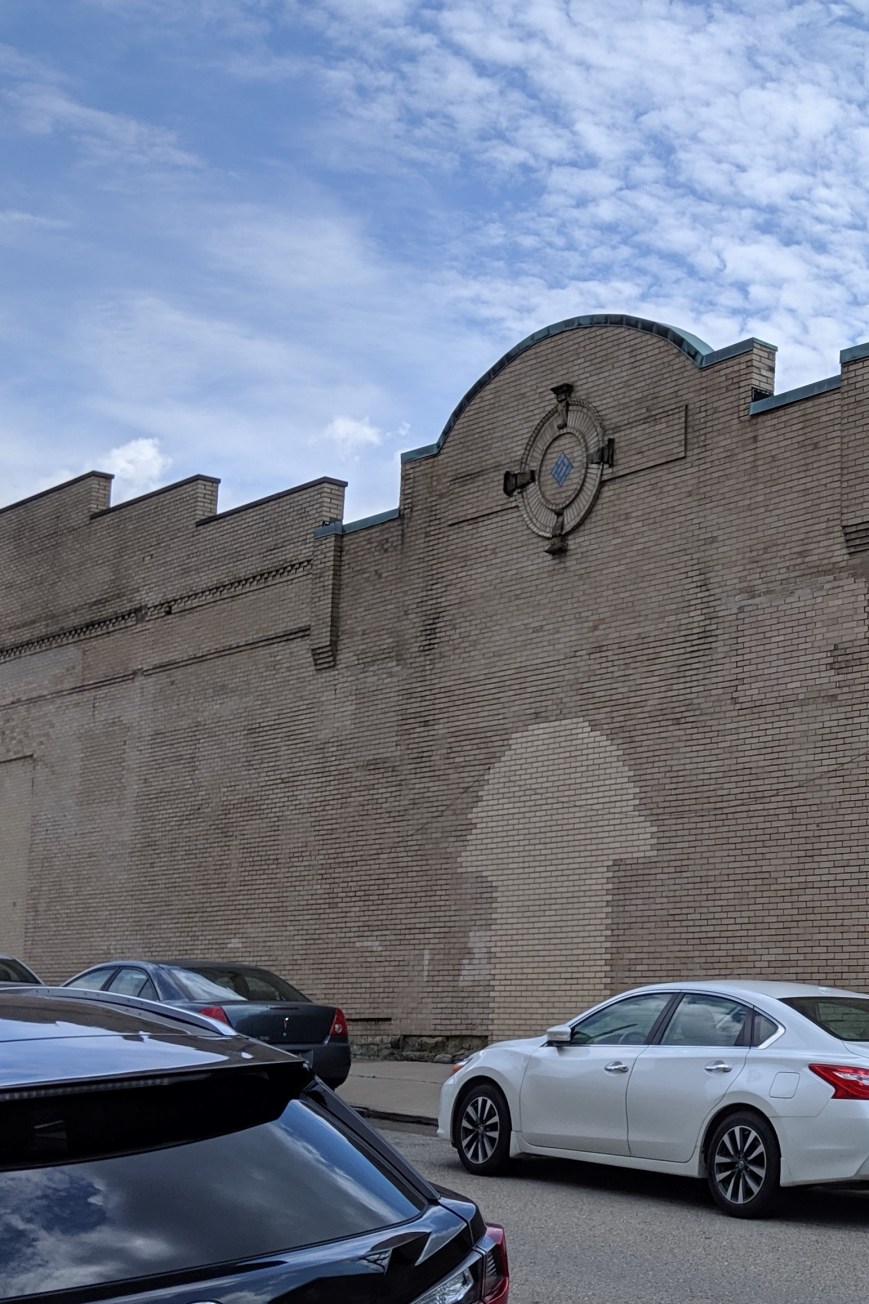
Former Rialto Theatre

The bland brick and glass facade on Fifth Avenue identifies this building as another mid-century warehouse. Turning the corner, the decorative parapet wall and bricked over arched opening tell the story of an older, more interesting building.

One such structure was one of the many movie theaters dotting the city in the 1920s. In the 1950s, the adjacent buildings were demolished, and an addition was added to the theater to turn it into a storeroom. After a time as a plasma center in the 1980s and 1990s, the building sat vacant and dusty for many years. Now, it is undergoing renovations for its next life. This is just one of the many signs that investment is coming to Uptown.

The community of Uptown that held on through the economically rough times prepared for this moment. In collaboration with many partners, including local institutions such as Duquesne University and UPMC Mercy as well as the City of Pittsburgh, the community created a new neighborhood plan. This designated Uptown and West Oakland as an EcoInnovation District. One of the first actions from this plan developed a new zoning district, the first progressive zoning district in Pittsburgh. The goal of the plan and the zoning district is to leverage the coming economic investment to create an inclusive and environmentally sustainable neighborhood.

It will be interesting to watch this neighborhood over the next few years to see if the plans are successful at introducing some moral components to the economic investment.