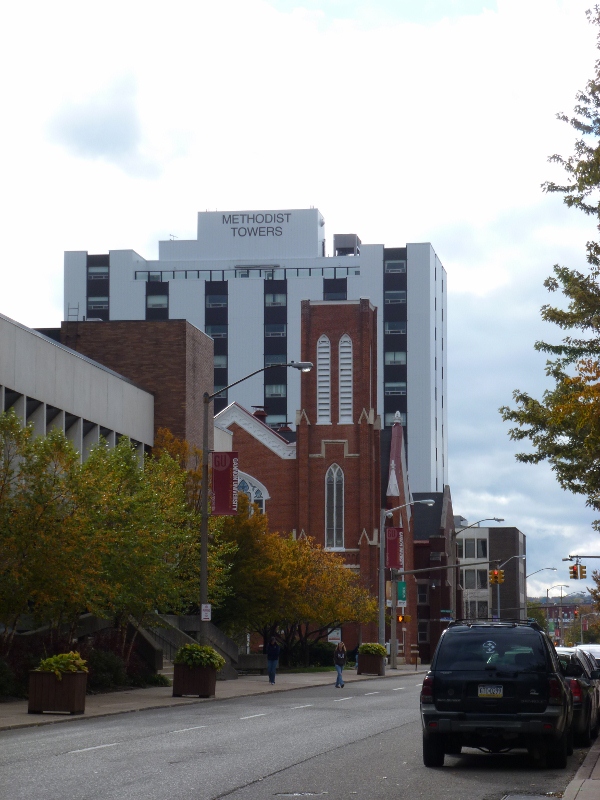
The Story of the Spires – Buffalo

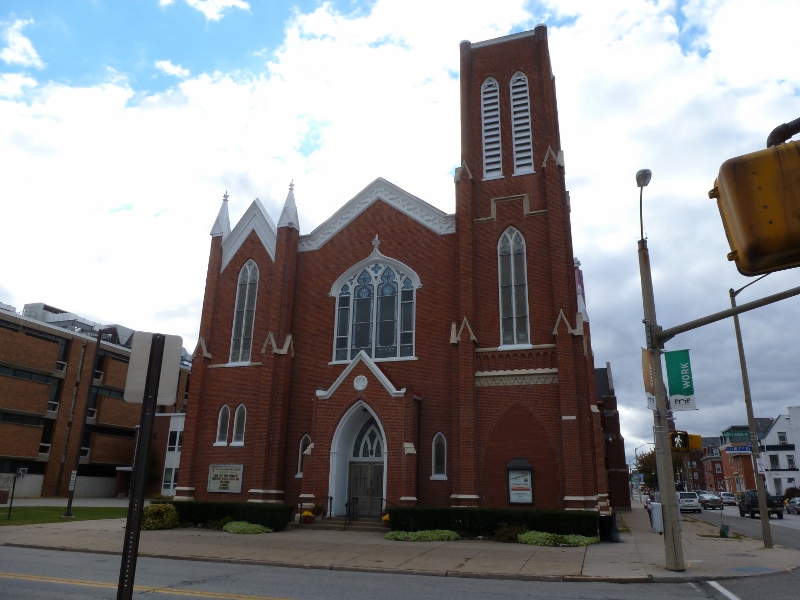
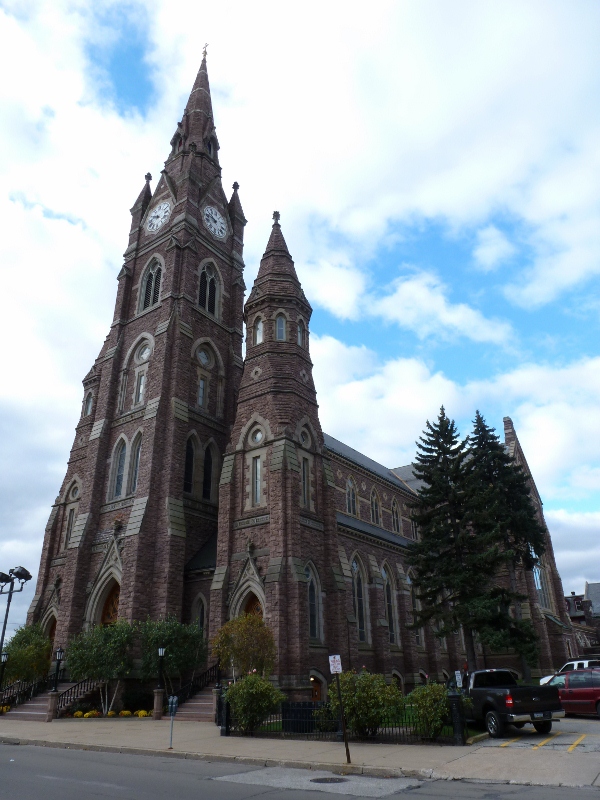
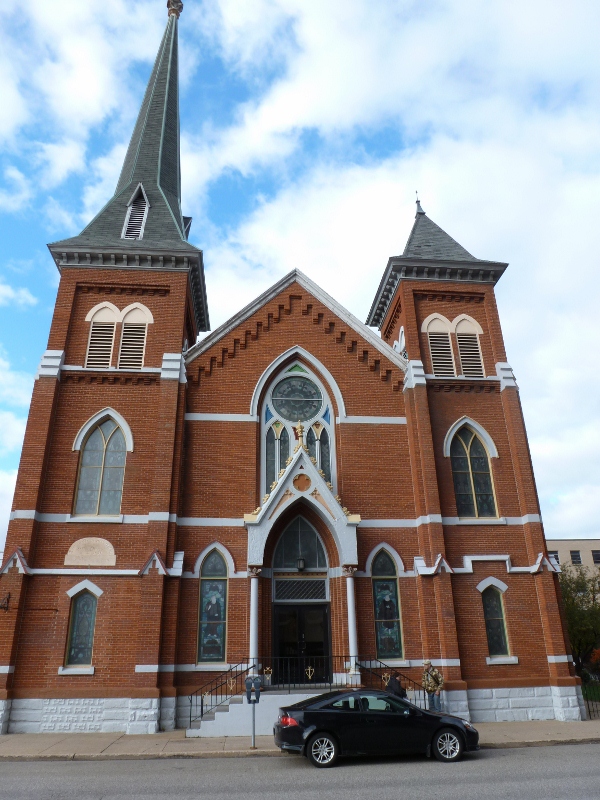
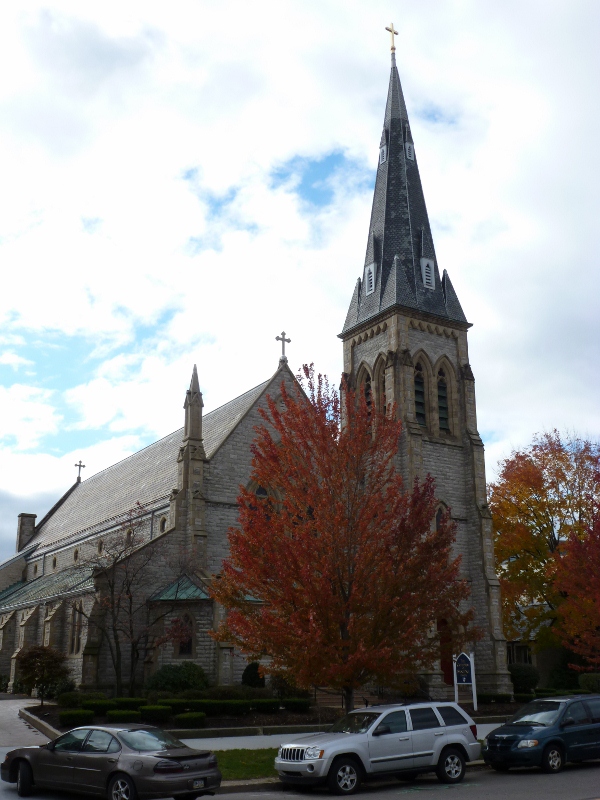
When I visit a town, I have a habit of searching out the bridges and the spires to get a feel for the place. Buffalo is one of the most recent places where I applied this approach. Given the size of Buffalo (52 square miles with a population over 275,000), I wasn’t able to explore enough of the city on this trip to add to observations of population trends and adaptive reuse of the religious buildings. So instead, I focused on the spires I could see in downtown. Comparing this to Pittsburgh, where the downtown also has several spires and where I have done a pretty thorough survey of the entire city, I realized that neither Pittsburgh’s nor Buffalo’s downtowns would be indicative of the city-wide trends of adaptive reuse of sacred buildings. The development pressures of a downtown are significantly different from the outlying neighborhoods. In both cities, the religious buildings that survived the development pressures of a downtown have remained in active use.

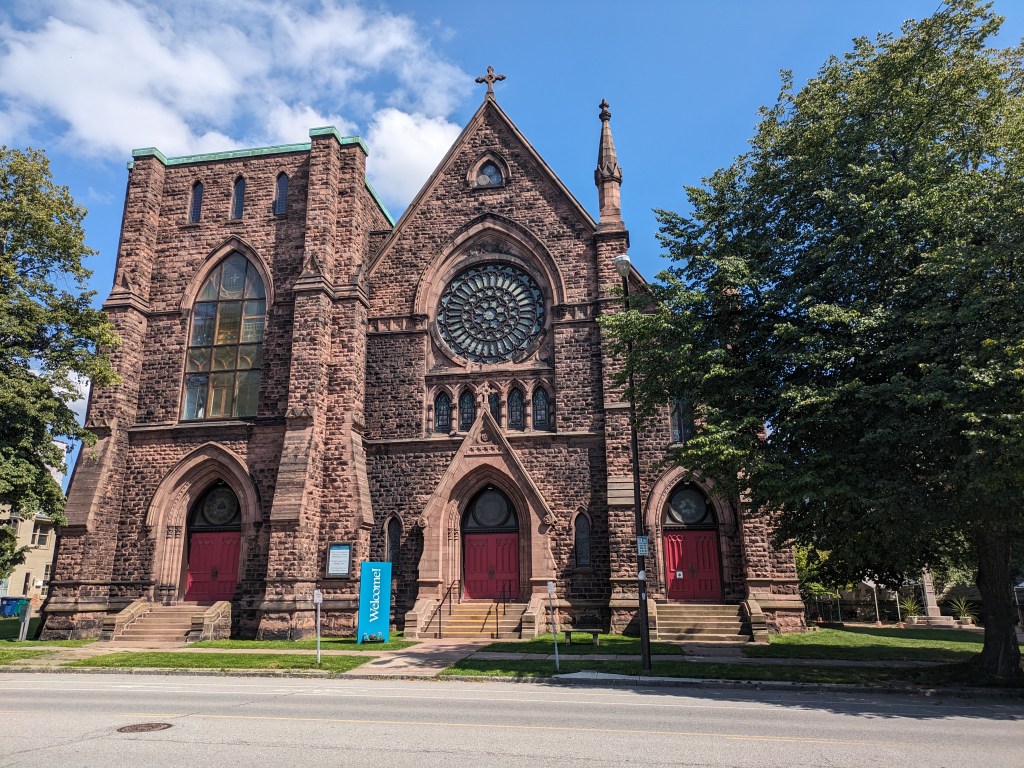
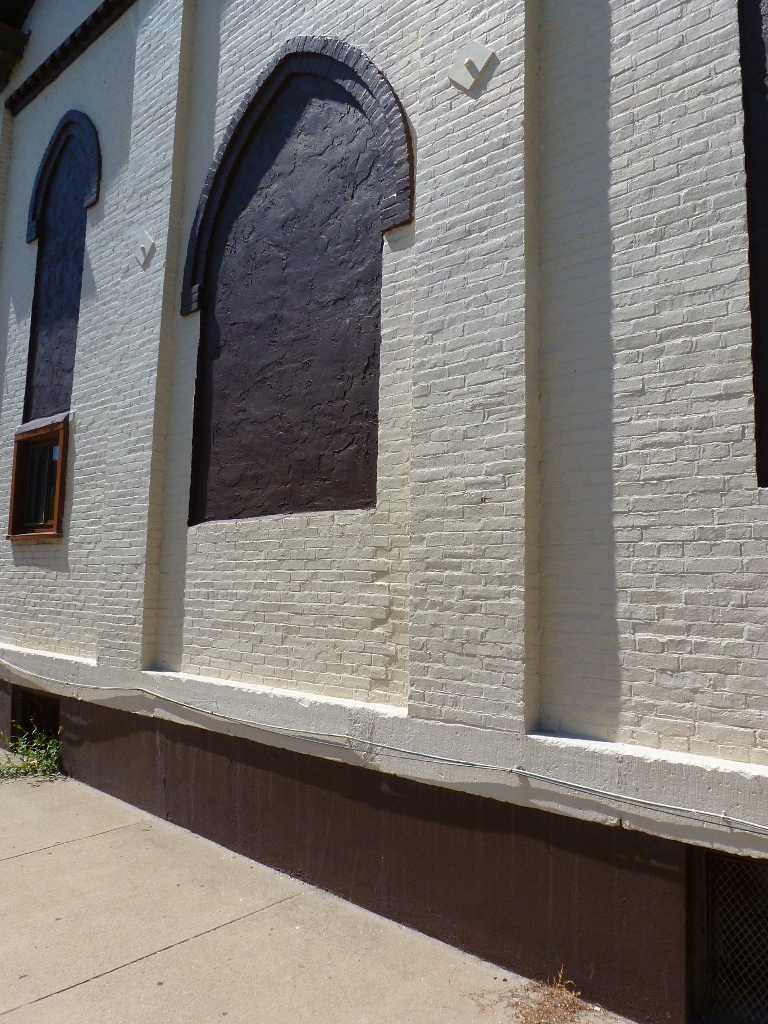
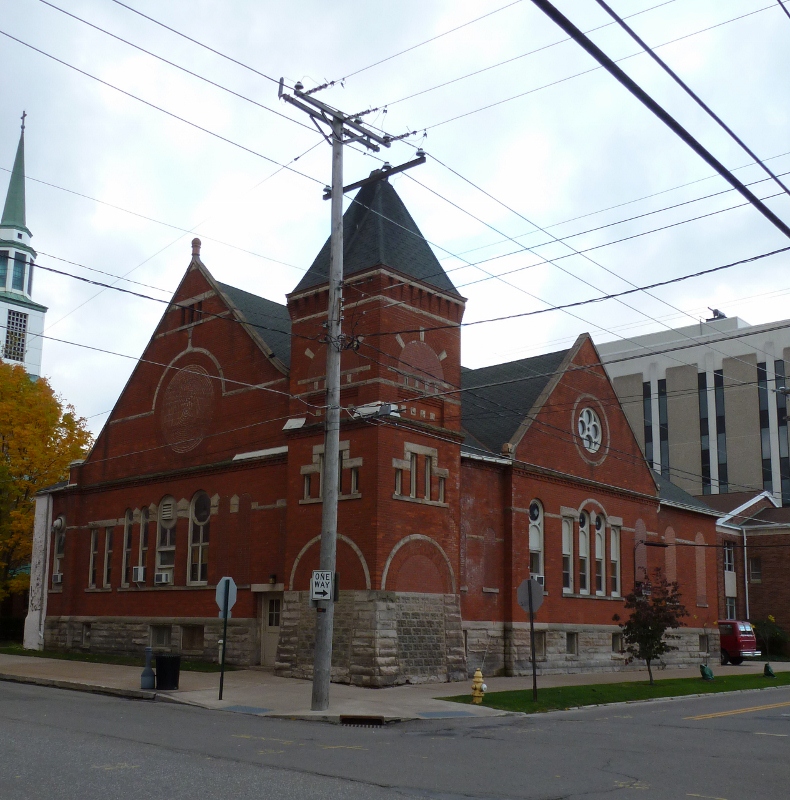
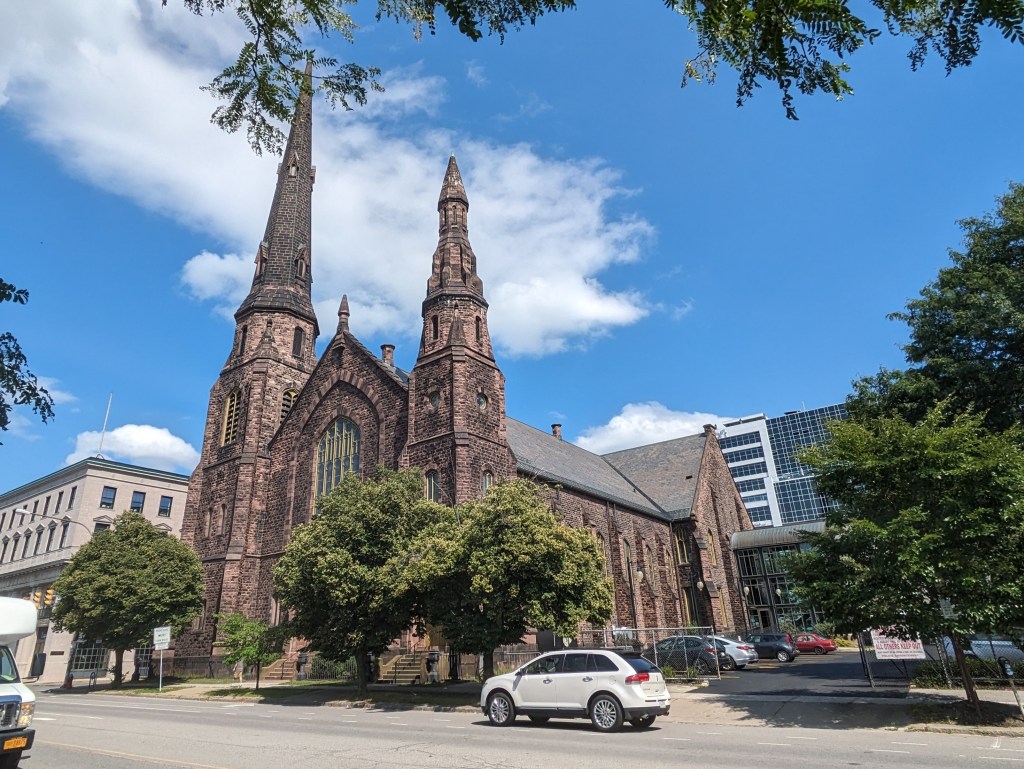
What struck me while walking toward the spires in downtown Buffalo was how I typically eliminate or discount spires for secular buildings that I find while on these searches. In Buffalo, I felt that if I’m calling my approach “the story of the spires” leaving out the secular spires leaves out a part of the story.1 The secular spires that caught my eye were for buildings across a spectrum of uses. The Erie County building (1872); a former US Post Office (1901), now a part of SUNY Buffalo’s campus; and the former headquarters of the Buffalo General Electric Company (1912), now an office building, were the three secular spires that caught my eye. These three buildings underscore the larger trend in monumental architecture passing from religious to government to corporate buildings.

Below, I share photos of both the sacred and the secular spires that I found in downtown Buffalo.

Sacred Spires
Secular Spires

  1. For those of you who are word nerds, I double checked the definition of spire as I typically only use it when talking about religious buildings, so I wanted to make sure that the term applies to the same kind of structure whatever the building’s use is. In doing this, I got the confirmation I wanted, but also discovered that Merriam-Webster’s #1 definition for spire is: “a slender tapering blade or stalk (as of grass).” ↩︎
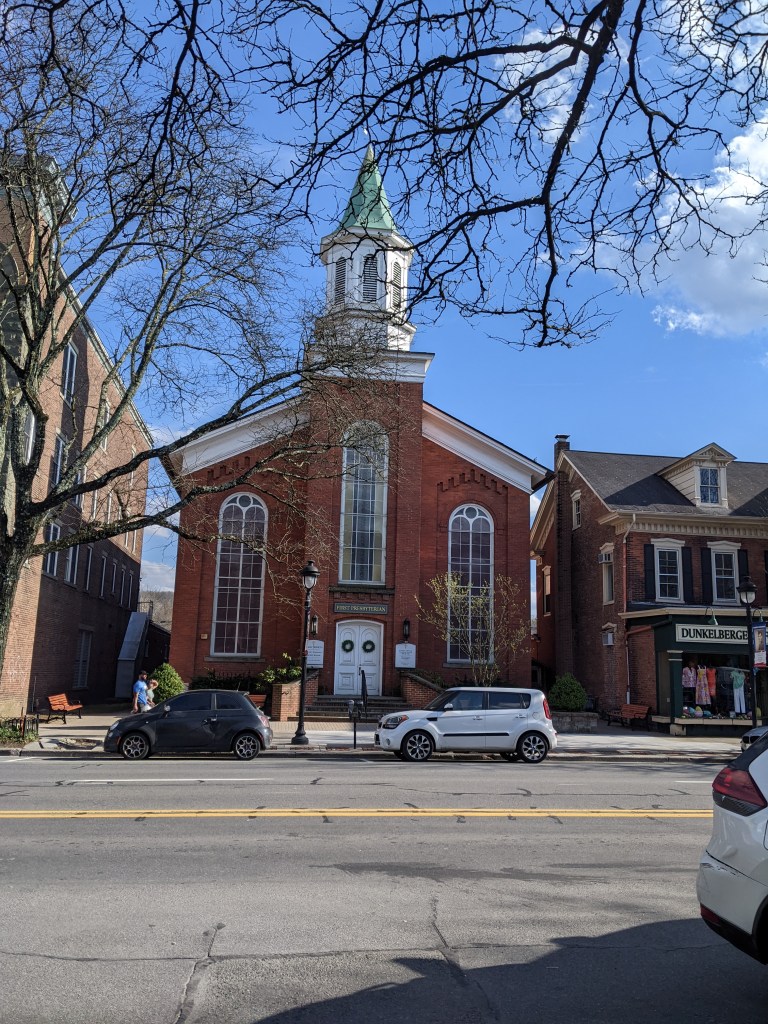
The Story of the Spires – Stroudsburg

One of the key ingredients for the stability component of “home” is safety. In the aftermath of 9/11, there was a concern about the safety of living in cities and living in New York in particular. The Pennsylvania boroughs of Stroudsburg and East Stroudsburg were among the places considered safe by those leaving New York City. Knowing this going in and comparing it to the lessons learned from Bethlehem, I assumed that the religious buildings would reflect a sense of stability.

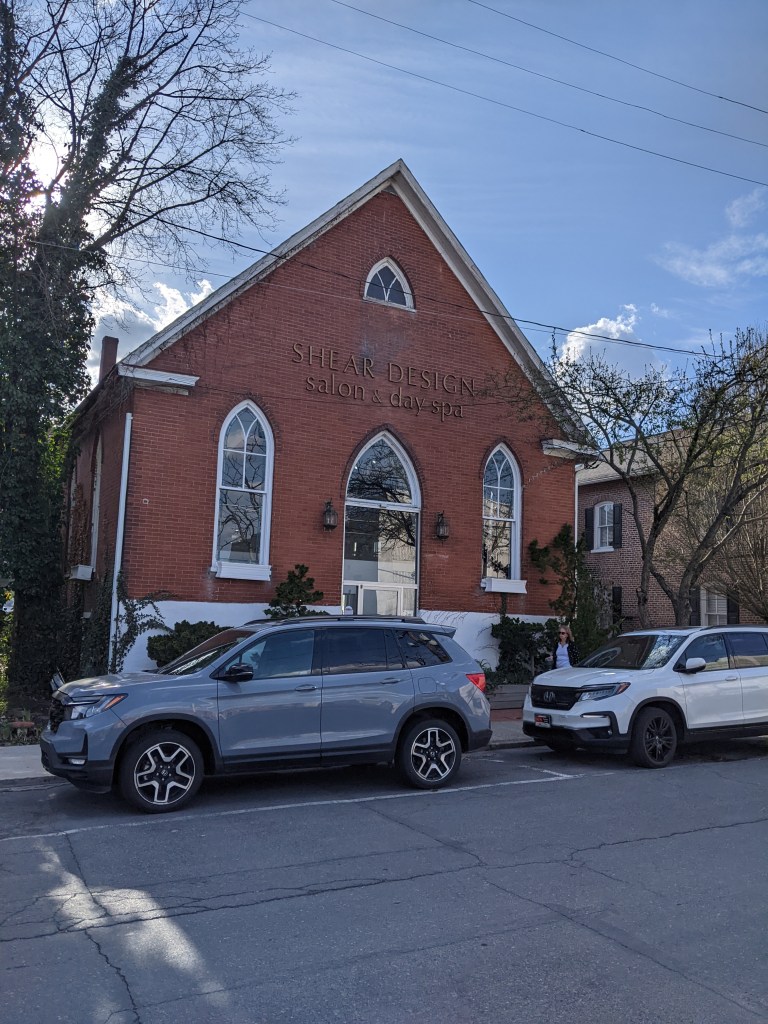
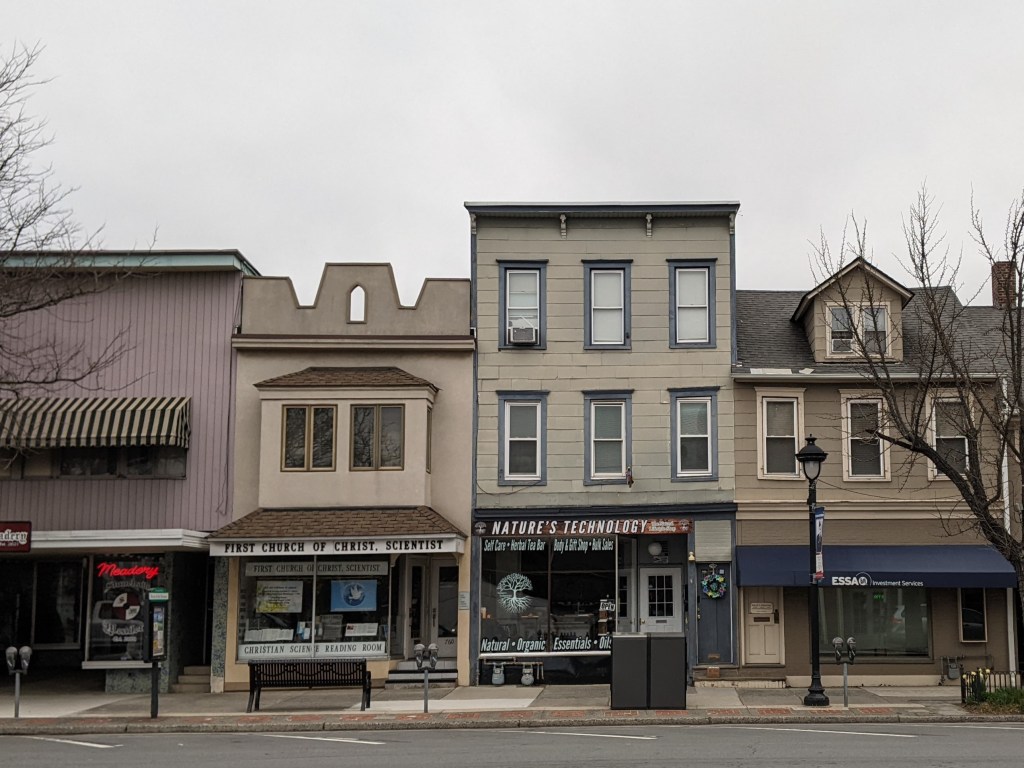
Of the two boroughs, Stroudsburg has a more centralized concentration of religious buildings that was easy for me to explore on foot within the limitations of my post-injury recovery phase. The results of this survey confirmed my hypothesis. Of the seven buildings I found, only one was converted to a secular use. Another one appeared to be having a renovation of it’s primary entrance but was still looked actively used as a church. (Facebook confirmed that it is still active with a video of the Polish language mass from a few days before the date I looked it up.) A third building was a storefront that is a First Church of Christ, Scientist.

Comparing Stroudsburg with other Pennsylvania towns where I’ve explored the status of religious buildings, it fits the pattern well. Stroudsburg’s peak population was in 1950, the same as Pittsburgh and Wilkinsburg. Below is an updated chart of the population loss for these cities and a broad impression of the state of their religious buildings.

CityPopulation Loss Since Peak (Peak Year)Status of Religious Buildings
Bethlehem1% (1960)Primarily active sacred uses
Erie26% (1960)Primarily active sacred uses
Homestead85% (1920)Significant numbers closed or converted to secular uses
Pittsburgh55% (1950)Significant numbers closed or converted to secular uses
Stroudsburg14% (1950)Primarily active sacred uses
Wilkinsburg49% (1950)Significant numbers closed or converted to secular uses

The Story of the Spires – Bethlehem

While exploring Bethlehem’s bridges, my eye was caught by the numerous spires rising above the surrounding buildings of South Bethlehem. Instead of resting upon returning to the hotel, I felt compelled to go back out and take a survey of religious buildings within walking distance. Due to the topography, those on the slopes of South Bethlehem were the easiest to spot, but I also located some in Bethlehem’s historic district and in West Bethlehem. I found twenty-three buildings in all.

As with my experience in Erie, I was surprised that the vast majority of these buildings were still open for use as religious worship. Bethlehem Steel Company was the main employer in Bethlehem for most of the 20th Century. Like steel mills elsewhere in the northeast, its business declined. In the early 2000s, the company went bankrupt. This makes it seem like the town should have experienced the classic rise and decline of other Rust Belt Cities.

One of the typical landmarks of this change is an abundance of vacant or adaptively reused religious buildings. In Pittsburgh, I have found over 50 former churches and synagogues now being used for secular purposes or in the process of being converted to secular purposes. Many more are vacant and boarded. Wilkinsburg, a town adjacent to Pittsburgh, has so many closed churches that its zoning code incorporates guidelines for converting church buildings to secular uses. Homestead, PA, the former home to US Steel and the site of the famous Homestead Steel Strike, has several shuttered churches. Bethlehem’s religious buildings did not fit this pattern.

In searching for an answer to what made Bethlehem different than other steel towns, I realized that the business districts and residential areas I passed through were mostly intact. There were few vacant buildings and no vacant and abandoned grass lots. This suggested that Bethlehem did not experience the same decline as the other former steel towns that I have explored. The historical population data corroborated this hypothesis. Bethlehem and Erie experienced their peak populations in 1960; Pittsburgh and Wilkinsburg in 1950; and Homestead in 1920. In 2010, the cumulative population loss from each city’s peak was:

CityPopulation Loss
Bethlehem1%
Erie26%
Pittsburgh55%
Wilkinsburg49%
Homestead85%

The stable population of Bethlehem explains why so many religious institutions are still operating. It doesn’t explain why the people stayed when the jobs left.

I picked up Jeffrey A Parks’s “Stronger than Steel: Forging a Rust Belt Renaissance” to look for clues to what made Bethlehem different from other Rust Belt cities. For the most part, it seems to have pursued the same actions and initiatives as elsewhere. Bethlehem’s leaders even hired consultants from Pittsburgh in the 1950s to learn how to do Urban Renewal. Other similarities include the creation of a redevelopment authority, the use of eminent domain to force people out of their homes for commercial development, the building of a highway through town, and the change of traffic patterns to prioritize the regional over the local.

The one thing mentioned in Parks’s book that was different from other cities was the school district. In the 1960s, the Bethlehem School District expanded to incorporate two rural townships. These townships later became wealthy suburbs that combined with the population of Bethlehem to create a racially and economically diverse district. Parks’s implication seemed to be that the result was a school district with better funding and resources than its neighbors. Perhaps, as a result, families did not have the conversation about moving to the suburbs for better schools as their children approached school age.

A decent inner-city school district may reduce the flight to the suburbs. It also may attract new residents. Yet, I wonder if it is enough to prevent hemorrhaging population loss as a region’s major employer cuts jobs in the decades before it closes.

Flying Cashews

The near fail of the Leaning Marina Tower of Chicago left me determined to prove that brownies could successfully be used to create an Architectural Dessert Masterpiece. All I needed was a subject.

Looking back on 2019, the most significant architectural moment for me was the fire of Notre Dame Cathedral. I felt gratitude that I had the opportunity in 2005 to see inside the cathedral from the vantage point of the organ loft; disappointment that all I really remember from the experience was how dark it was; curiosity about what they would do with the remaining structure (perhaps put a glass roof on it to increase the light?); and amazement that neither the cathedral nor Paris had experienced any major fires before in their centuries of existence.

The Great Fire of London in the 17th Century cleared the way for the construction of St. Paul’s Cathedral. One third of Pittsburgh burned in 1845. According to legend, the Great Chicago Fire of the 1870s was started when a cow kicked over a lantern. This fire destroyed approximately 17,500 buildings. Paris, Texas, experienced three major fires between 1877 and 1916. Yet, Paris, France, remained unscathed by significant fires until 2019.

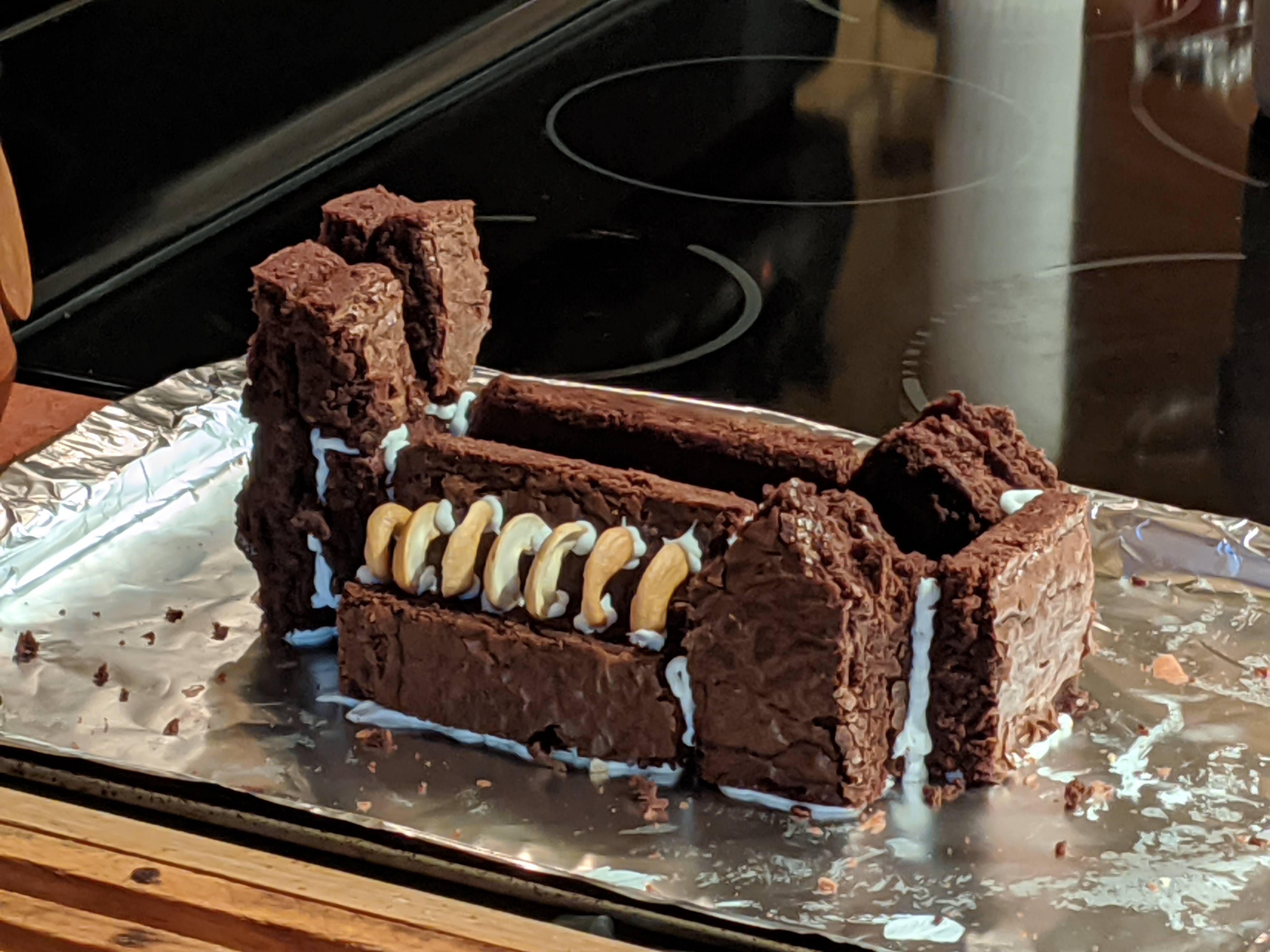
To commemorate the incident, I reached for my brownie pan, only to stop short at the challenge of creating the flying buttresses. While I believed that brownies were structurally sound enough to use as building blocks, I did not trust them to fly. In the spirit of the season, I briefly considered candy canes. However, their shape didn’t really match the flying buttresses of Notre Dame. I also hesitated to use candy as I have become more sugar conscious since my first Architectural Dessert Masterpiece. Sugary candy on top of sugar-heavy brownies seemed like a bad idea. I began to think I would have to give up on making Notre Dame as I didn’t have time for the meticulous, but safe process of designing and cutting out numerous pieces of gingerbread for the cathedral. Before I gave up completely, I walked the bulk foods aisle of the grocery store searching for inspiration. I found it between the candies and the grains. Nuts of all shapes, sizes, and flavors sparked my imagination. They go well with brownies and would counterbalance the sugar. I compared the shapes of the peanuts, walnuts, Brazil nuts, and cashews and determined that cashews were made to fly.

After selecting my materials, there were several more moments of anxiety that my walls and towers would collapse. I am pleased to say that like the cathedral it was based on, my structure stood through the test of time (eight hours from construction to consumption).

IMG_20191224_160442

Layers of the City: Chicago Edition

The first place to show me how a city can be stacked like a layer cake, Chicago provided ample opportunities to explore all levels of the city. The experience of noticing the expansion joints in roads that I assumed were on solid ground opened my eyes to the possibilities of stacking uses.

Underground Life

A vacant lot two stories below street level solved the mystery of the expansion joints, by exposing the inner guts.  Two more roads sit below street level to segregate trash pick-up and deliveries from the flow of traffic.  These lover levels also provide some opportunities for parking without monopolizing valuable real estate above.  Retail shops connected by pedestrian passageways are also interspersed in these layers.

River Life

At the same elevation as the “underground life,” the Chicago River flows through the heart of the city.  On and along the river are a variety of activities.  Pedestrian paths, cafes, housing, parks, industrial uses, and homeless encampments line the shores.  Meanwhile, the river abounds with ducks, boat tours, water taxis, construction staging, and marinas.

Street Level

Back up on the street level, life buzzes.  Vehicular and pedestrian traffic rush passed, occasionally pealing off to visit the numerous shops, offices, museums, restaurants, cafes, parks, and trails.

Pie in the Sky

Yet, more life looms above.  Several of the skyscrapers have penthouse, or nearly penthouse, restaurants.  Others have rooftop observation platforms.  Between these and the street are many other opportunities for enjoying life including a religious sanctuary, the “L”, gardens, art, pedestrian bridges, and of course, offices, apartments, hotel rooms, and shops.

Unlike Pittsburgh, in Chicago, the public is welcome in some form on every level to gain a full experience of the city.

Sacred Row

P1050644 (1024x768)

This is a fascinating structure I discovered on the South Side Flats. A friend and I were going around the neighborhood looking at adaptively reused church buildings. While going from one building we knew of to another location, we stumbled upon this building. From what I’ve pulled together so far, this building was built sometime between 1876 and 1884 as four rowhouses. In 1926, the Second Greek Catholic St John the Baptist Church of the South Side purchased the property. The deed described the structure as four 4-room houses. When the Second Greek Catholic St John the Baptist Church sold the property in 1959, the deed described the property as four 2-story brick party wall houses.

P1050646 (768x1024)

However, when you look at the side of the building facing 23rd St, it appears that at one time, this property was used as a church. The middle of the three boarded up openings on this side looks like it used to be a door for an entrance into a church that has been partially bricked up. From this I assume that while the Second Greek Catholic St John the Baptist Church owned the property, they renovated to use as their place of worship with a main front door and two windows.

I look forward to learning more about this structure and its history. I suspect there is an interesting story that connects this building to the 1st St John the Baptist Greek Church which is still in operation at the corner of E Carson St and 7th and the 2nd St John the Baptist Greek Church that set up just down the block at 615 E Carson St before moving to Jane St. From the pieces I’ve found so far there was a severe split in the South Side congregation that involved boycotts and arrests of arguing members and former members.  I’m not sure yet how this rowhouse/church may have fit into that struggle.


The World’s Tallest Church Building

Chicago Temple

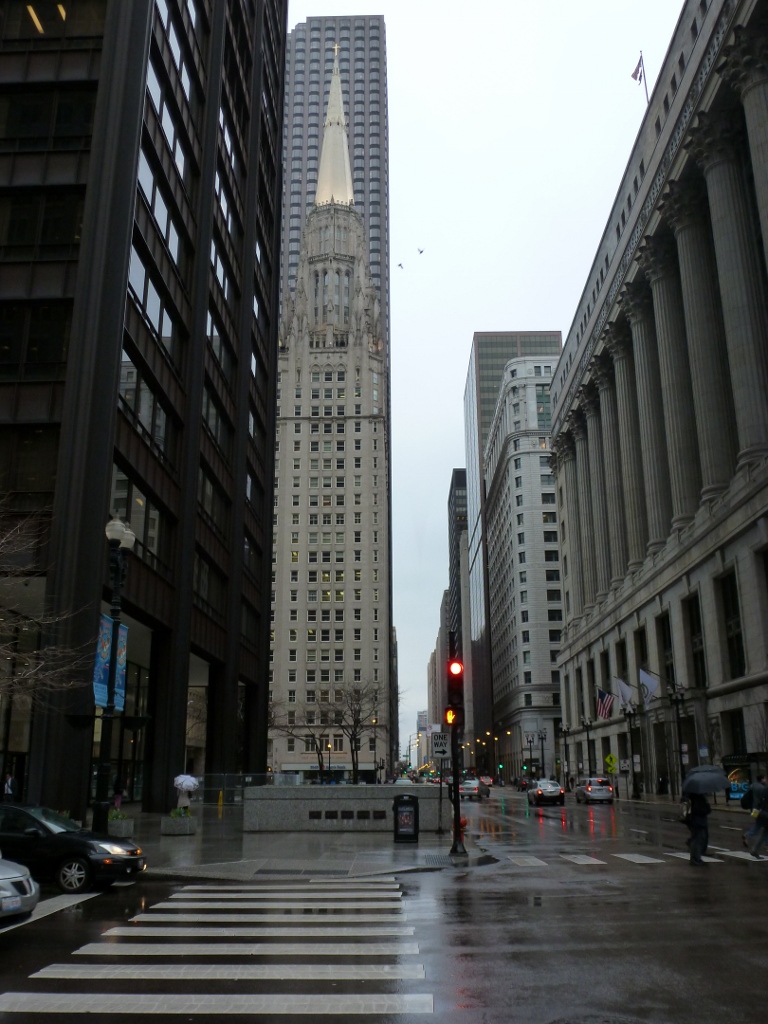
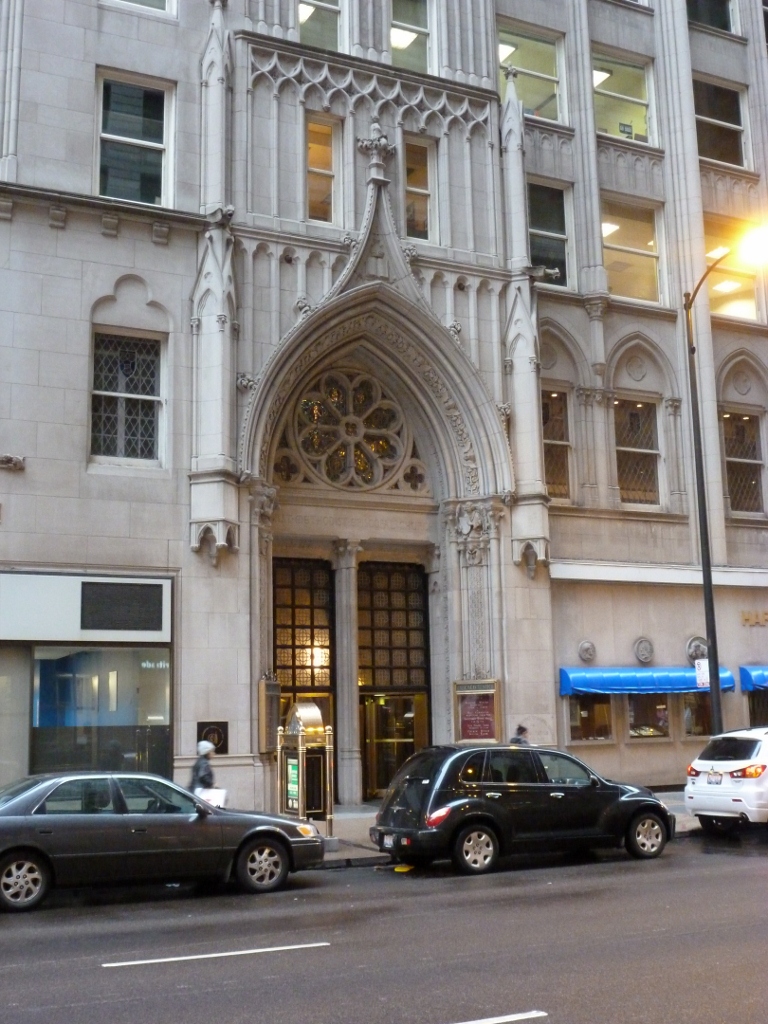
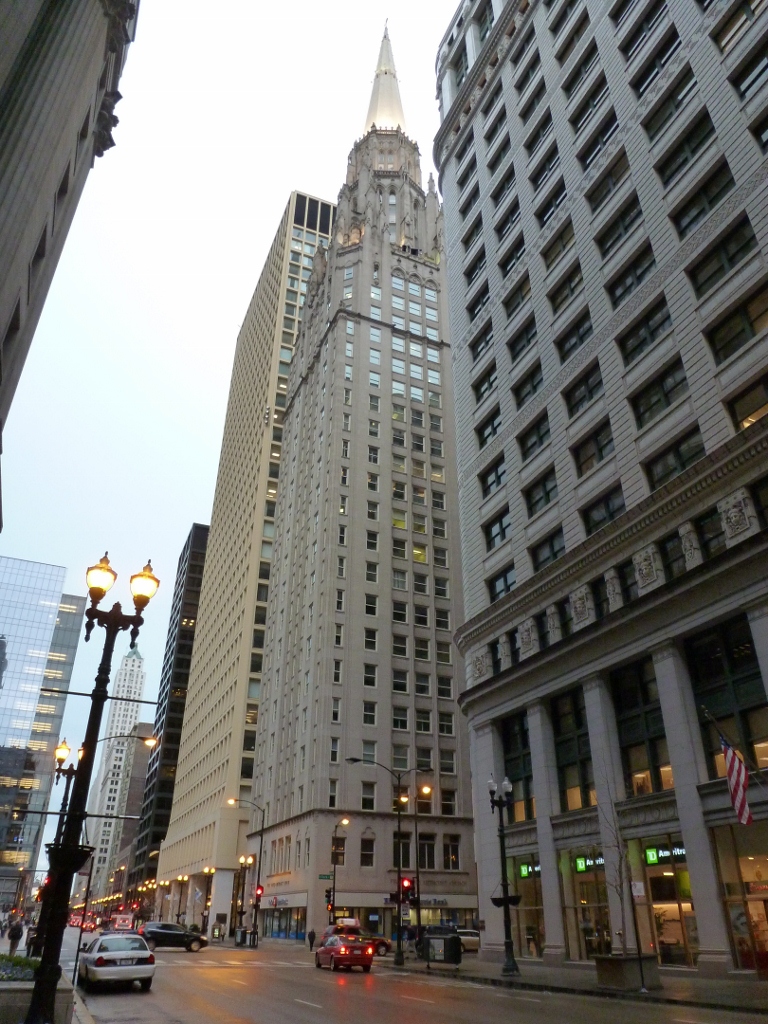
Everything in Chicago is stretched–even churches.  My eye was caught by this building as I looked to cross a street in Chicago and saw the steeple on top of this skyscraper a couple blocks down.  I was very confused at first, trying to figure out why an office building had a steeple on top of it.  Then I saw the name of the church, First United Methodist Church, carved into the side of the building.  The only other indication on the exterior visible from a distance that suggested the religious use of the interior was the doorway.

Chicago Temple Doorway

This building is also known as the Chicago Temple.  The congregation was founded in 1831 and has been worshiping at this site since 1838.  The current building was built in 1924 and has 23 floors.

One of my souvenirs from Chicago was the book “City of the Century” by Donald L. Miller, which describes the history of Chicago up to the 1893 World’s Fair.  So it doesn’t talk about the building of this church building, but it does describe the building of the Auditorium–Chicago’s multipurpose Opera House.  The book notes “there was no government support of the arts in the United States, so the Auditorium would have to pay for itself” (361).  As a result the theater was enclosed in a office/hotel complex.

It seemed like there might have been similar thinking in the design of this church building–as real estate was expensive downtown, covering the church with office space could help it afford its location.  However, if that is why the building is mixed-use, it was not inspired by the Auditorium, which was built in the late 1880s.  According the history page of the church’s website, there has been a multipurpose church building on this site since 1858.  The first one was a 4-story structure with stores and businesses on the first two floors and the church above.

First Methodist Church

The new building has a two-story sanctuary on the first floor.  Accounts differ as to how many this can hold (500, 1000, 1200 people).  The second floor has another smaller sanctuary.  Floors three and four hold the accessory rooms–classrooms, meeting rooms, etc.  The parson’s house is also located in the building.  The remaining floors are office space.  The crowning jewel, is a small chapel underneath the steeple.

I regret that I did not take the time to stop and investigate whether I could explore the inside of the building.  As I was focused on a specific task when I came upon the building, I did not even think about trying to see inside.  If you are interested, I found a YouTube video that shows what I take to be the first floor sanctuary and the small chapel under the steeple.

A Lofty Location

St. John German Evangelical Lutheran Church

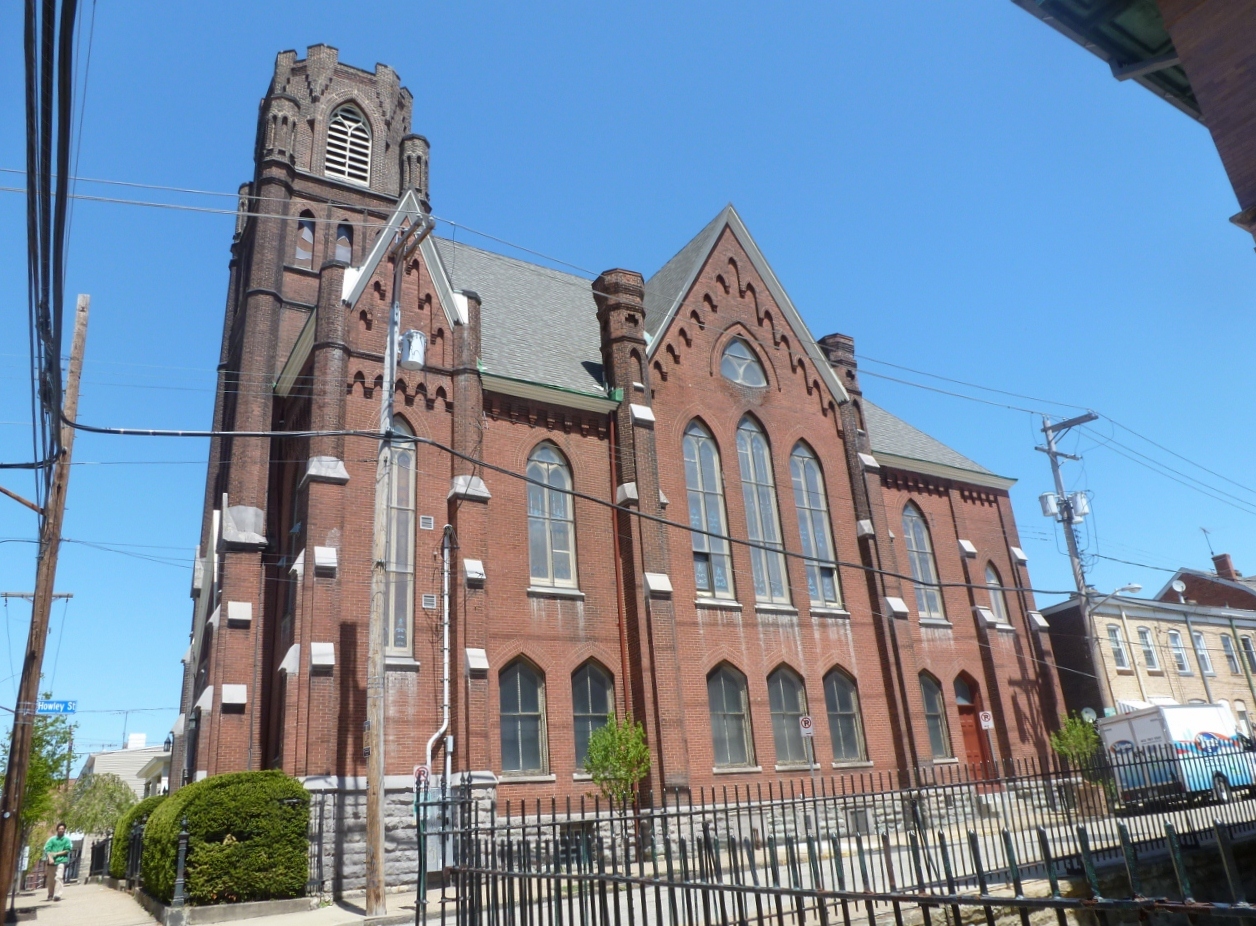
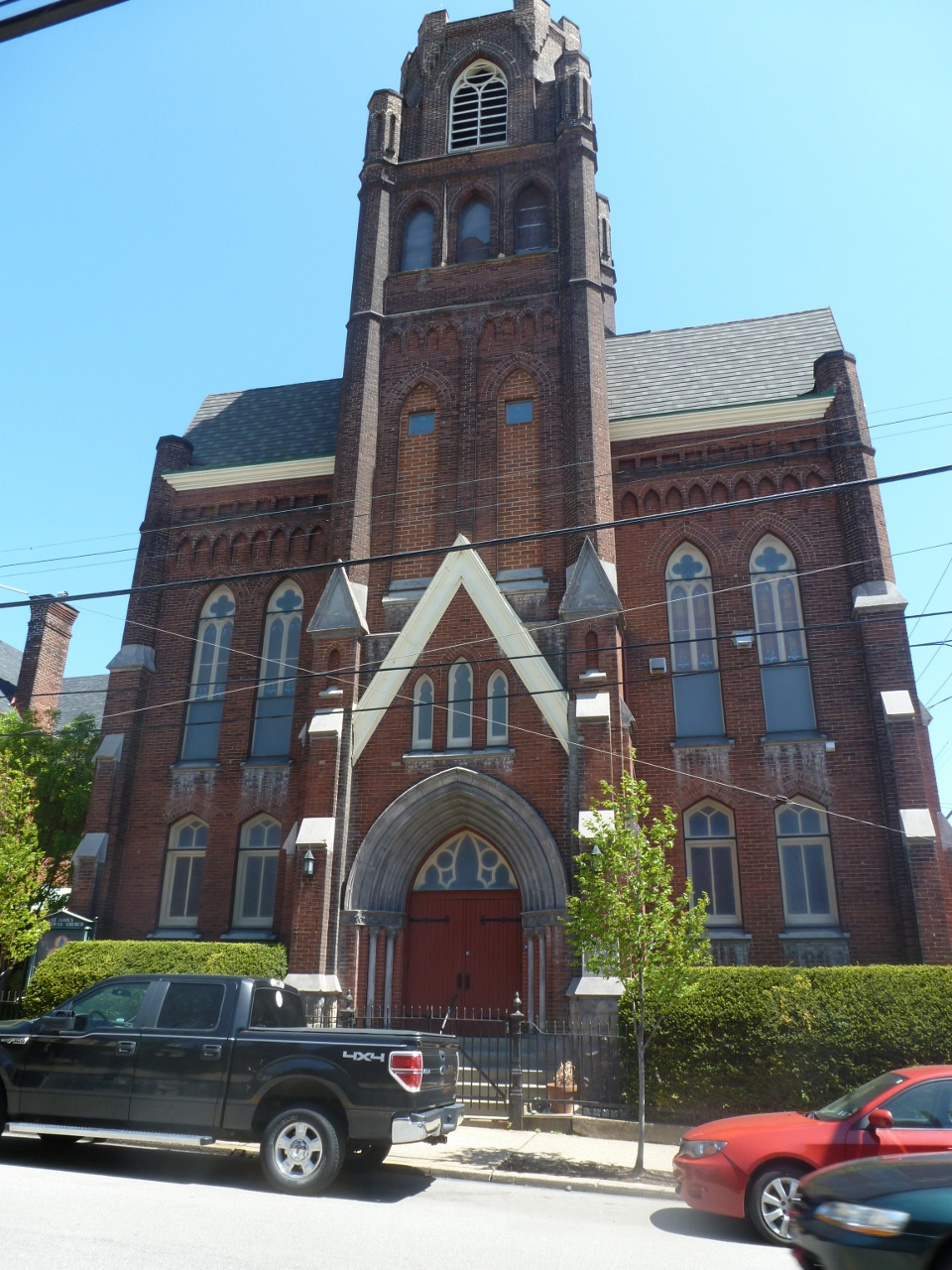
This little gem in Pittsburgh’s Lawrenceville neighborhood is full of surprises.  In the 20-some years I’ve been passing through this area, I never noticed the building.  It was brought to my attention a few years ago when I began researching adapted church buildings in Pittsburgh.  If you are in the nearby vicinity, the building blends into its surroundings.  But from other parts of the city it stands out (see 31st Street Bridge, Bloomfield Bridge, Busway Bridges: Herron Street, Busway Bridges: 28th Street).  It is also visible standing out along the ridge in the second photo in my Washington’s Crossing Bridge post.

40th Street Rise

There are two characteristics that make it stand out from a distance.  The first is its location at the highest point on 40th Street in Lawrenceville.

St John's/Choir Loft Condominiums

The second characteristic is one of the most intriguing parts of this building: the fellowship hall is at ground level and the sanctuary is above, reached by a flight of stairs.  This is the only church building I have been in where the sanctuary is a full flight of stairs above ground level.  I’m very curious to know if there are any others–please share, if you’ve come across one!

St John's Evangelical Lutheran Church Choir Loft Condominiums

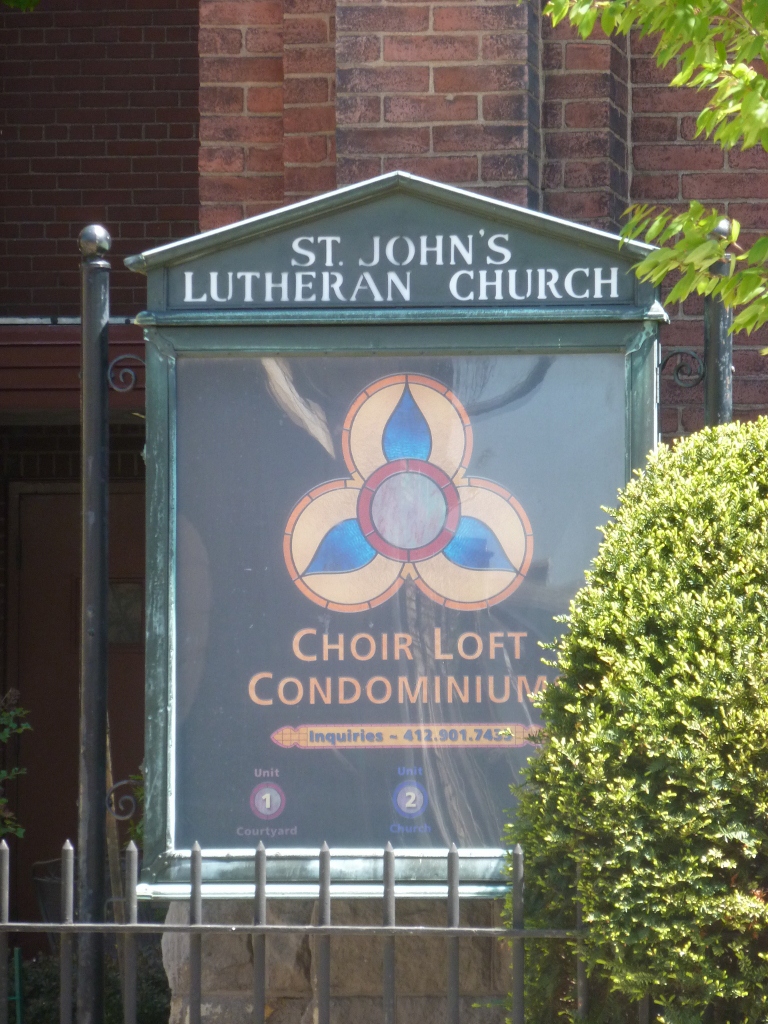
The building was built in 1896-97 for the German Evangelical Lutheran St. John’s Congregation, which later became St. John’s German Evangelical Lutheran Church.  In 2002, the congregation merged with St. Andrew’s Lutheran Church and closed the doors on this location.  A real estate agent purchased the property and prepped it for conversion into 3 condominiums–one unit each for the sanctuary, fellowship hall, and parish house–before the current owners purchased the property and completed most of the rehab work creating the Choir Loft Condominiums.  (A side note that may be of interest is that the current owners considered purchasing the building that is now the Union Project but chose this one instead.)

The owner reported that the building was essentially empty for nearly 2 years before he acquired it.  The floors were in bad condition–the pews had been ripped out, tearing the sanctuary’s floor, and the choir loft’s floor was completely missing.  He said his goal in renovating the building was to “not destroy the architecture and the interior.  We wanted it to feel like a church still because it is a church.”

Having gotten a tour of the interior of the sanctuary unit, I’d say they succeeded in this goal.  The former sanctuary space is an open loft configuration with hardwood floors.  The raised steps for the altar area were kept and made into the kitchen.  The choir loft remained open and served as the bedroom.  The gorgeous stained glass windows were also intact.  While I was there on a winter evening after sunset, I loved the description of how the colored pattern from the stained glass gradually moves across the floor like a very colorful sundial.  My other favorite part was that there was still a bell in the tower, which the owner rang for me.  While inside the sound was muffled, it sounded like it could have woken sleeping neighbors.

Erie Churches

Erie has a variety of attractive church buildings.  As I walked around admiring them, I was surprised to see that they were all still used as churches.  I did not find a single adaptively reused church building.  Given Erie’s location, relatively close to Cleveland, Buffalo, and Pittsburgh, I assumed it had similar significant population loss creating a need to either abandon, demolish or adapt some church buildings.  It turns out, that at least on the county level, this assumption was false.  Since 1900, the population of Erie County has grown every decade, except from 1980 to 1990 when there was a slight (1.5%) population loss, from 98,509 to 280,843 (2000’s population).  Allegheny County (Pittsburgh’s county), on the other hand saw growth from 775,058 in 1900 to 1,628,587 in 1960 after which the population has declined steadily to 1,223,348 in 2010.

I could not find statistics for the population change of the city of Erie; it is possible that there was a different trend within the city.  There were signs of abandonment and decay in other buildings and aspects of the town.  Yet the churches are still intact and appear to be thriving.  In fact, one of the larger churches was undergoing a major renovation while I was there.

Whatever the reason for the churches’ continued use, I enjoyed my treasure hunt chasing down as many steeples as I could in two hours:

Unknown

St. Patrick's Church 1903

Russian Old Believers Church of the Holy Trinity 1984

Russian Orthodox Church of the Nativity of Christ (Old Rite) 1987

Unknown

St. Peter Cathedral 1872

Cathedral School

St. Paul's United Church of Christ

Unknown

Methodist Church

First United Presbyterian Church of the Covenant 1929

The Union Project: Engaging Community

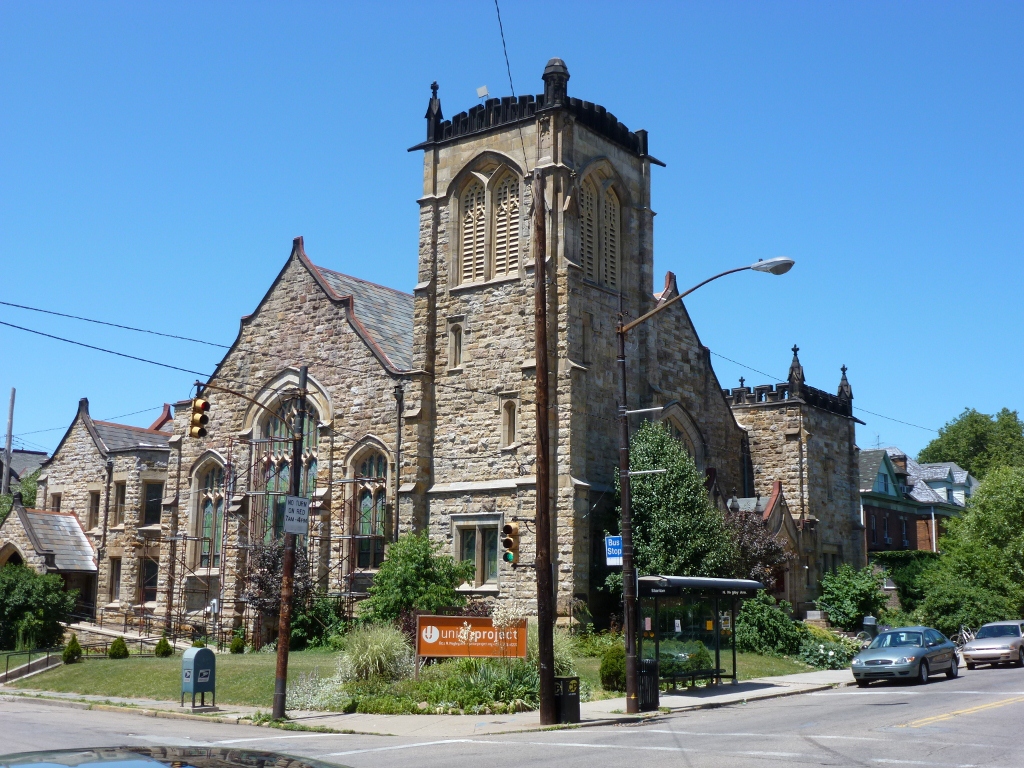
The Union Project

Every adapted church building I’ve come across has something that makes it unique.  Of all the ones I’ve come across so far, the Union Project used the most creative method in restoring/adapting the building.

In the late 1990s, a small group of people came together and said that they wanted a “space for art and faith” in their neighborhood.  (The quotes in this post are from one of the founding members, who I interviewed for a school project.)  By 2001, this group and this sentiment had grown and they purchased the vacant, former Union Baptist Church at the intersection of Negley and Stanton Avenues, two major roads in the East End of Pittsburgh, to convert it into a community center.

When the community center acquired it, the church was still considered active, but it had not been used regularly for two to four years.  The building was in very poor condition: the roof leaked, there were broken windows, and pigeons and rodents lived inside.  It took four years to prepare the building for occupancy and an additional six years to completely restore the structure.

The part that I like the most about how this building was adapted, was the alternative method they came up with for restoring the stained glass windows of the structure.  All the windows needed restoration, which I’m sure would have added up to a colossal expense.  Instead of giving up or attempting to raise all the funds to pay for a professional restoration, they offered community classes in stained glass restoration using the church’s windows as the class materials.  Some of the windows needed to be completely reconstructed in which case the instructor, a stained glass professional, created the new windows.  Beside these, all the windows were restored by community members at the classes.

Stain Glass Restoration

Stain Glass Restoration

I took one of the classes a few summers ago.  It was a lot of fun and quite interesting to learn how stained glass windows are put together.  At least a couple of the people in my class were taking the course so they would be able to restore the stained glass windows in their homes.  Much of the housing stock in the neighborhoods surrounding the building feature at least one stained glass window, so this was a useful skill for the local homeowners to learn.  A 2012 article in the Post-Gazette announces the completion of this restoration project.

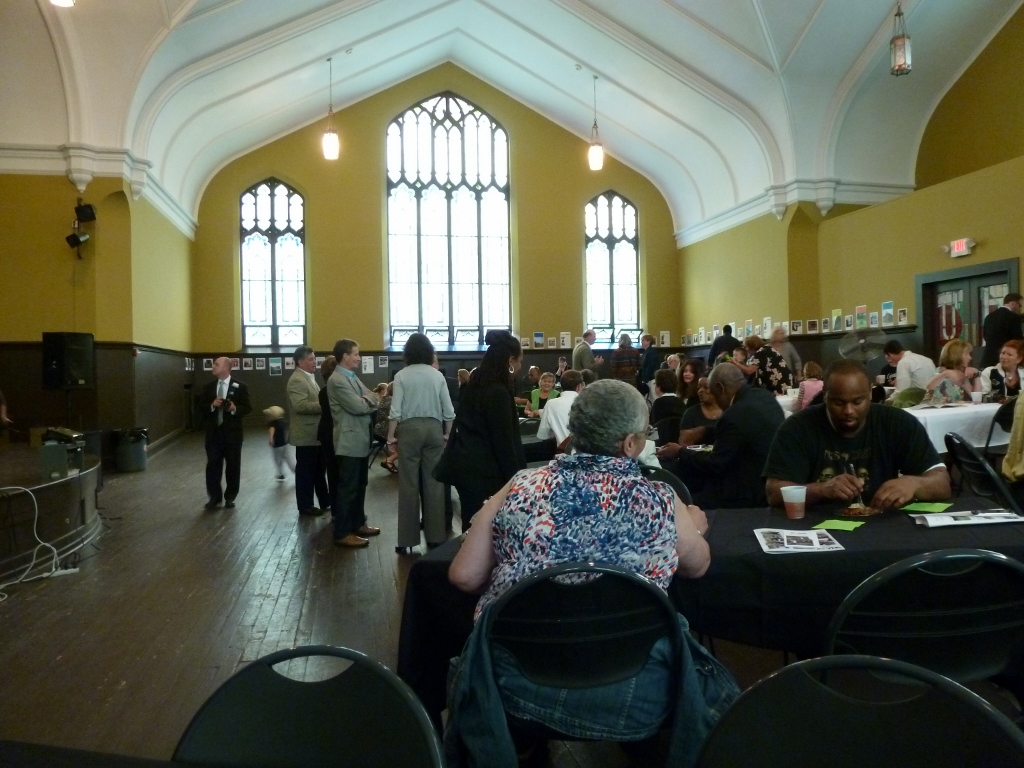
Over the years since the Union Project began, the building has slowly been restored one piece at a time.  The former classrooms behind the sanctuary were restored first and converted into office space.  Several of these offices are used for the administration of the Union Project, while the rest are rented out to other community groups including a church group.  The basement was converted into an art space.  This is where the stained glass restoration classes were held.  There is also a pottery studio which offers classes.  Hula-hooping classes are held in the atrium, or out on the lawn in nice weather.  The sanctuary is used as a rental hall for receptions, community events and the like.  The narthex is a little coffee shop.

Restored Sanctuary

By the summer 2012, the building finally looked like a completed project: the stained glass windows were restored, the sanctuary was finally completely repainted, and the black soot was cleaned off the stone façade.  Because of Pittsburgh’s past as a major industrial city, all stone façade buildings collected black soot–many of these buildings have been cleaned in the last ten to twenty years.  In cleaning the soot off the Union Project, the crenellations on top of the towers were left black, leaving a respectful reminder of the past, while the change from a black building to white brightened up this corner of the neighborhood.

This is a project that showed me, and the group who completed it, that “anything is possible.”