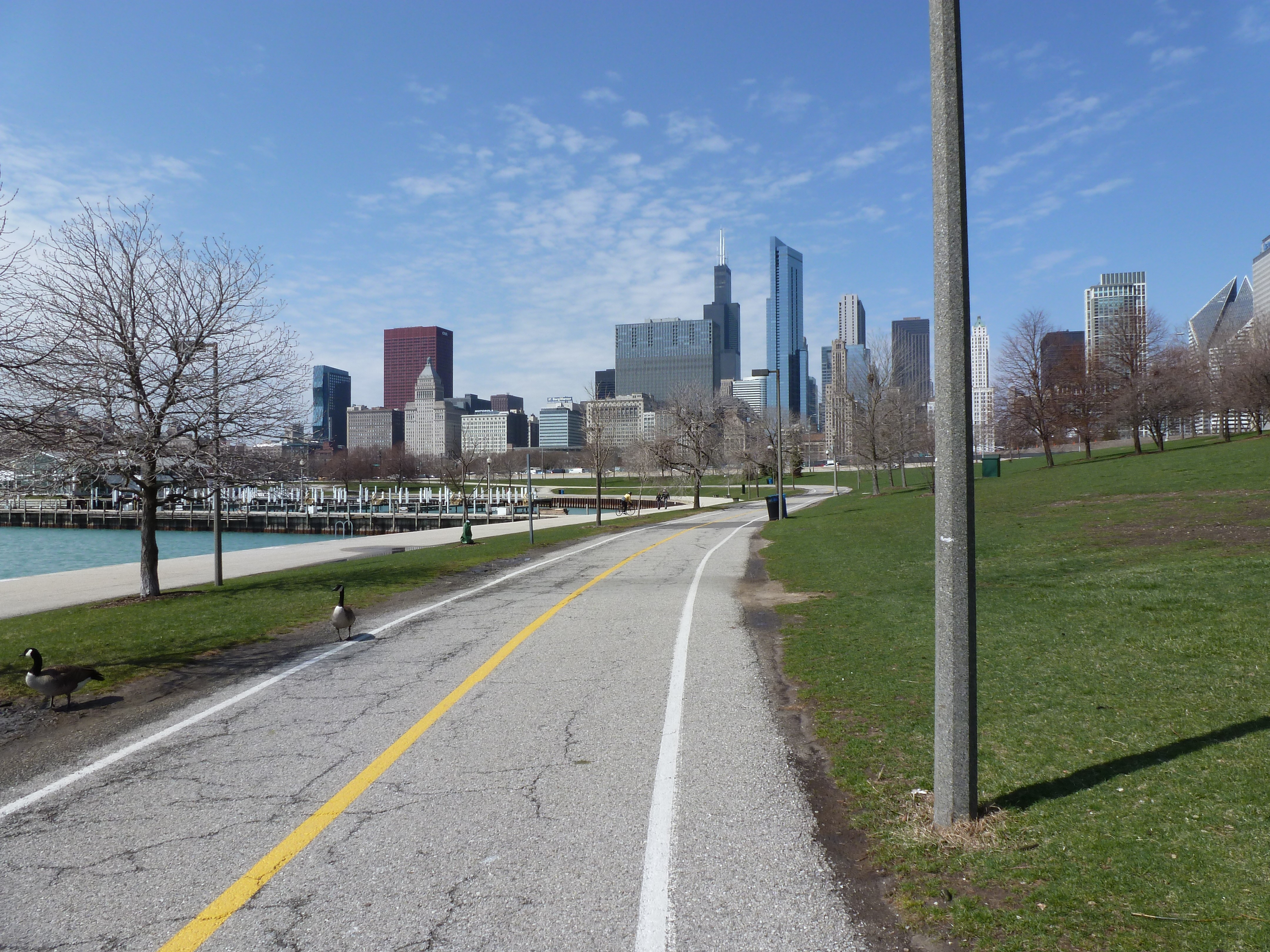
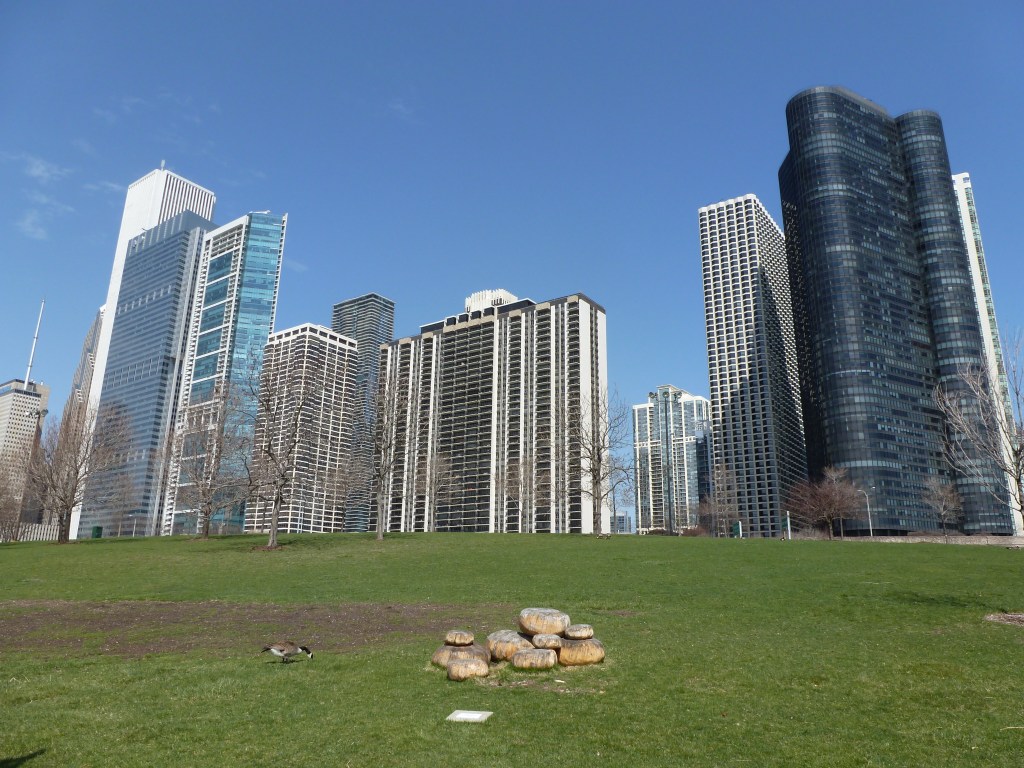
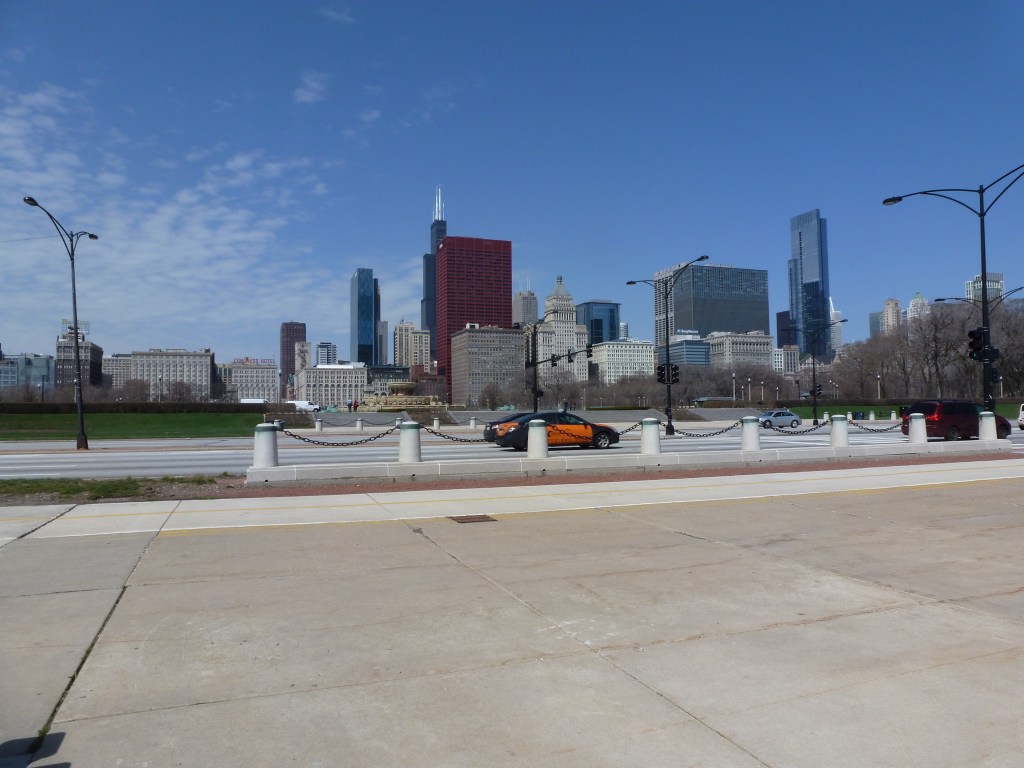
I’ve had multiple aborted experiences in Chicago. In 2013, I aborted an attempt to bike to the 1893 World’s Fair site. In 2019, I aborted an attempt to reach the waterfront. But during the eventually aborted bike ride, I experienced several miles of interesting waterfront. I don’t recall how I got to and from the waterfront for the bike ride as Chicago has the classic US urban problem of using highways to divide the waterfront from the rest of city. Once I was on the waterside, I enjoyed a variety of natural, architectural, and sculptural sights. I even unknowingly captured the remaining buildings from Chicago’s other World’s Fair (post pending).
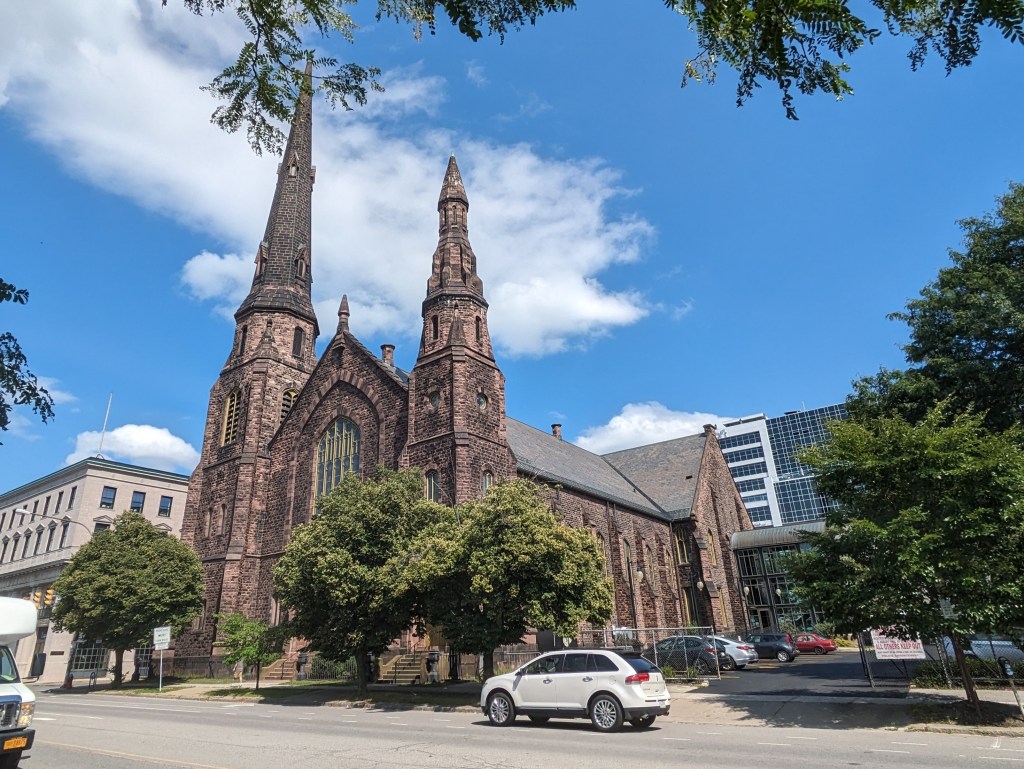
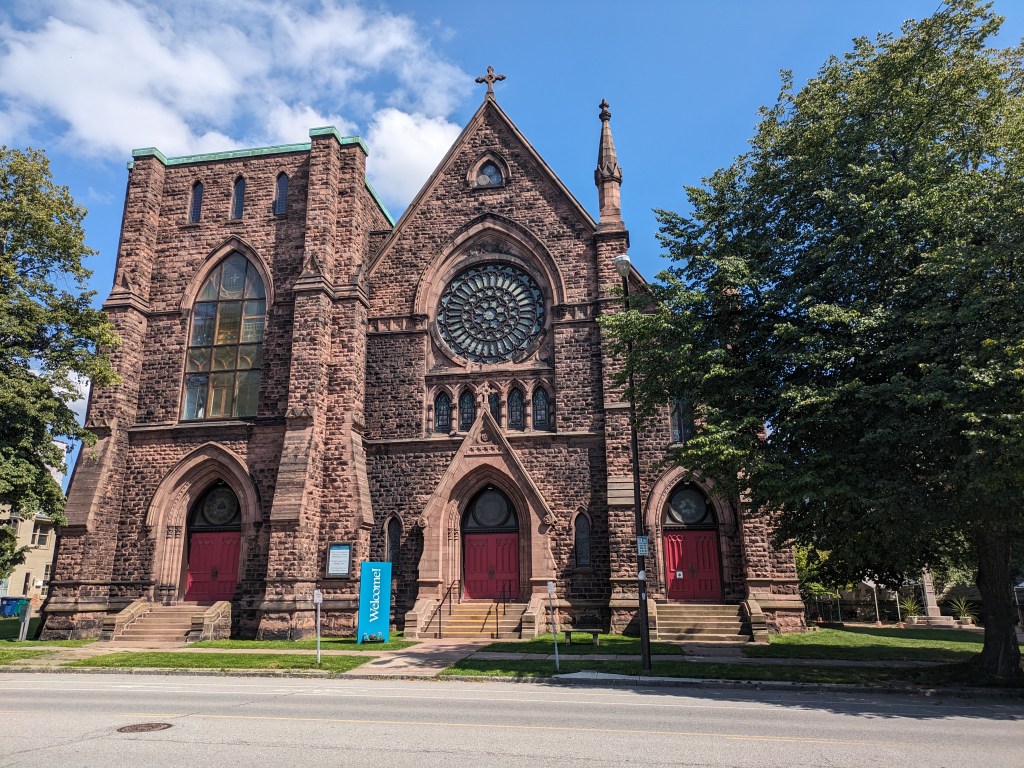
When I visit a town, I have a habit of searching out the bridges and the spires to get a feel for the place. Buffalo is one of the most recent places where I applied this approach. Given the size of Buffalo (52 square miles with a population over 275,000), I wasn’t able to explore enough of the city on this trip to add to observations of population trends and adaptive reuse of the religious buildings. So instead, I focused on the spires I could see in downtown. Comparing this to Pittsburgh, where the downtown also has several spires and where I have done a pretty thorough survey of the entire city, I realized that neither Pittsburgh’s nor Buffalo’s downtowns would be indicative of the city-wide trends of adaptive reuse of sacred buildings. The development pressures of a downtown are significantly different from the outlying neighborhoods. In both cities, the religious buildings that survived the development pressures of a downtown have remained in active use.
What struck me while walking toward the spires in downtown Buffalo was how I typically eliminate or discount spires for secular buildings that I find while on these searches. In Buffalo, I felt that if I’m calling my approach “the story of the spires” leaving out the secular spires leaves out a part of the story.1 The secular spires that caught my eye were for buildings across a spectrum of uses. The Erie County building (1872); a former US Post Office (1901), now a part of SUNY Buffalo’s campus; and the former headquarters of the Buffalo General Electric Company (1912), now an office building, were the three secular spires that caught my eye. These three buildings underscore the larger trend in monumental architecture passing from religious to government to corporate buildings.
Below, I share photos of both the sacred and the secular spires that I found in downtown Buffalo.
Sacred Spires
Secular Spires
For those of you who are word nerds, I double checked the definition of spire as I typically only use it when talking about religious buildings, so I wanted to make sure that the term applies to the same kind of structure whatever the building’s use is. In doing this, I got the confirmation I wanted, but also discovered that Merriam-Webster’s #1 definition for spire is: “a slender tapering blade or stalk (as of grass).” ↩︎
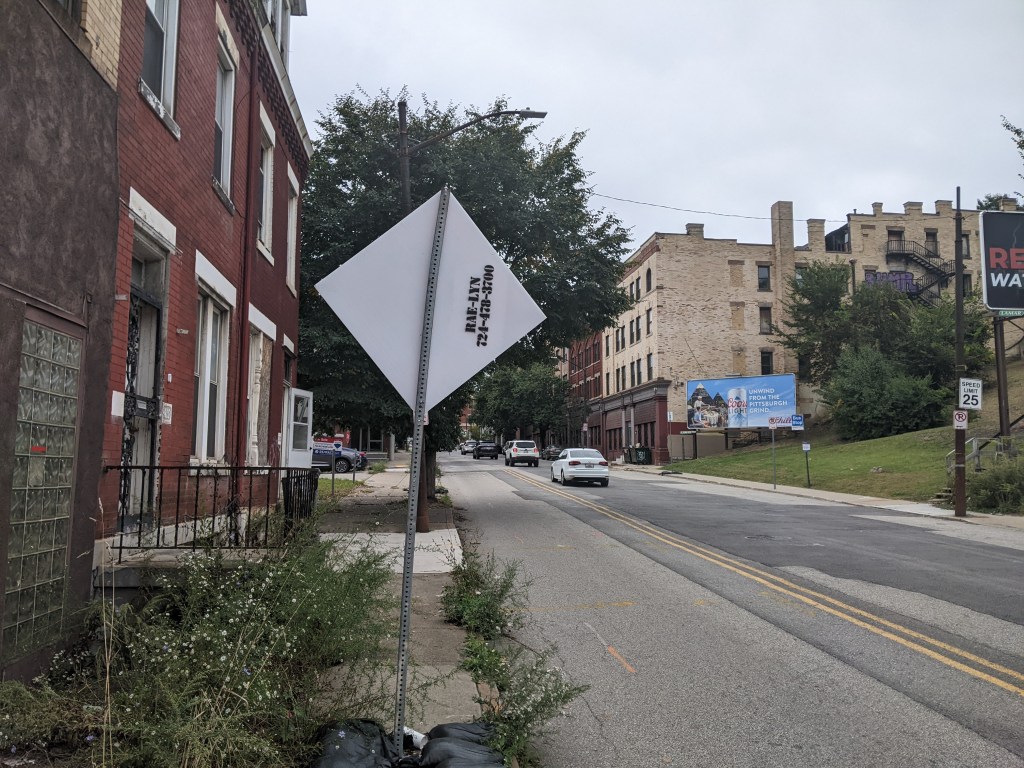
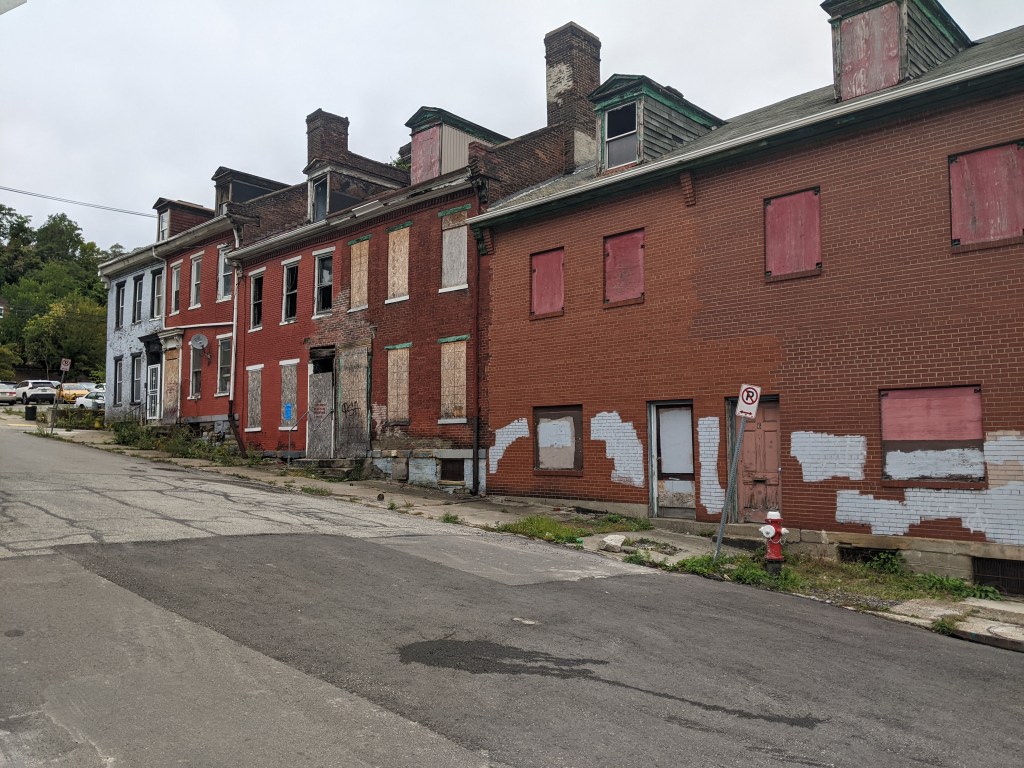
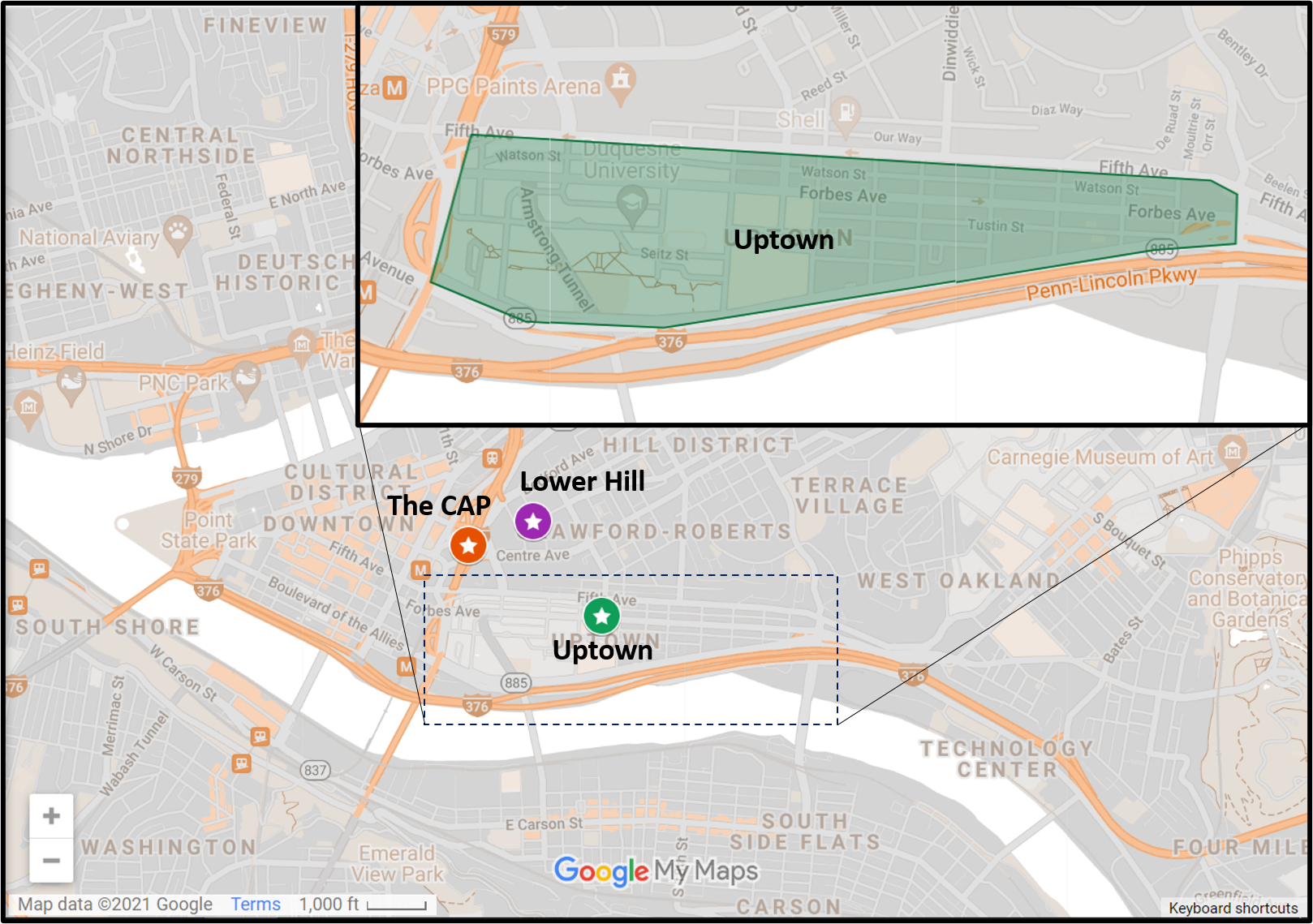
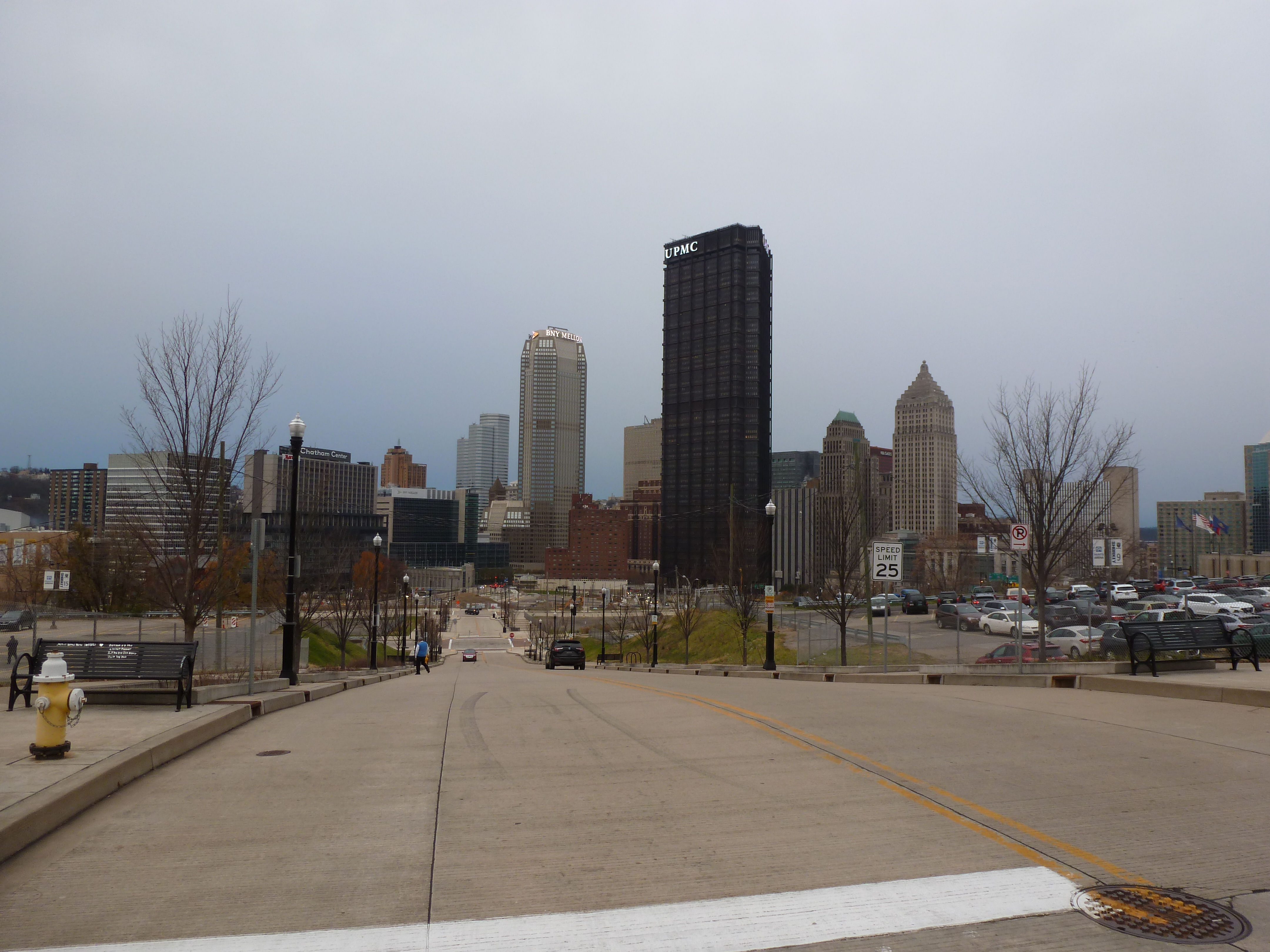
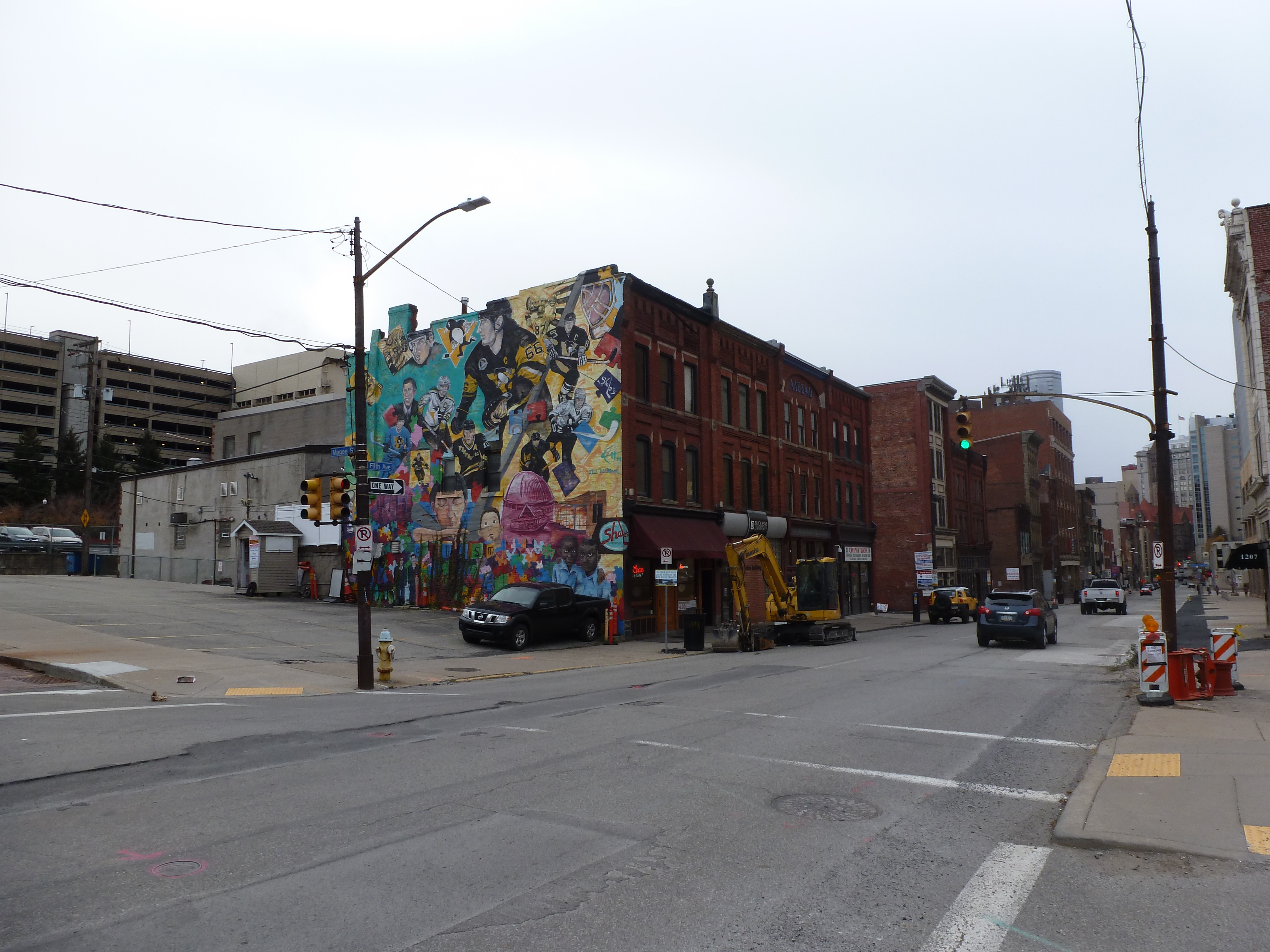
Uptown is one of the many neighborhoods in Pittsburgh that experienced decades of neglect. For this neighborhood, the neglect was despite Uptown being sandwiched between Oakland and downtown, two places among the state’s strongest economic regions. Zipping through Uptown from Oakland to downtown on Fifth Avenue or from downtown to Oakland on Forbes Avenue, it is easy to overlook or dismiss the hodgepodge of ruined home foundations turning back to forest; scattered vacant lots, parking lots, and industrial uses; and the intricate architectural details on abandoned and renovated townhomes.
In recent years, new buildings started springing up here and there. Some of these new projects are the work of the two institutions in the neighborhood: UPMC Mercy Hospital and Duquesne University. Others are the work of a variety of commercial and residential developers. Two reasons for this recent investment are the proposed Bus Rapid Transit system, which will eventually run through the neighborhood, and the in-progress redevelopment of the Lower Hill, an adjacent neighborhood.
The Uptown community saw these changes coming and prepared. Between 2015 and 2017, the community organization Uptown Partners collaborated UPMC Mercy, Duquesne University, the City of Pittsburgh, and others to create the EcoInnovation District Plan and the Uptown Public Realm zoning district. The plan and new zoning district are intended to guide future development and leverage their economic investment for the greater good of the neighborhood. Ideally, this will reduce the number of those who will be left behind.
This blog post is part of an on-going series watching the changes in Uptown. Periodically, approximately once a year, I return to the neighborhood to take new photographs of the same areas. In addition, I include links to articles about the project that I’ve encountered since the previous post in the series. At the end of the post, there is a map showing the location of the neighborhood and links to the previous posts in the series.
What’s new
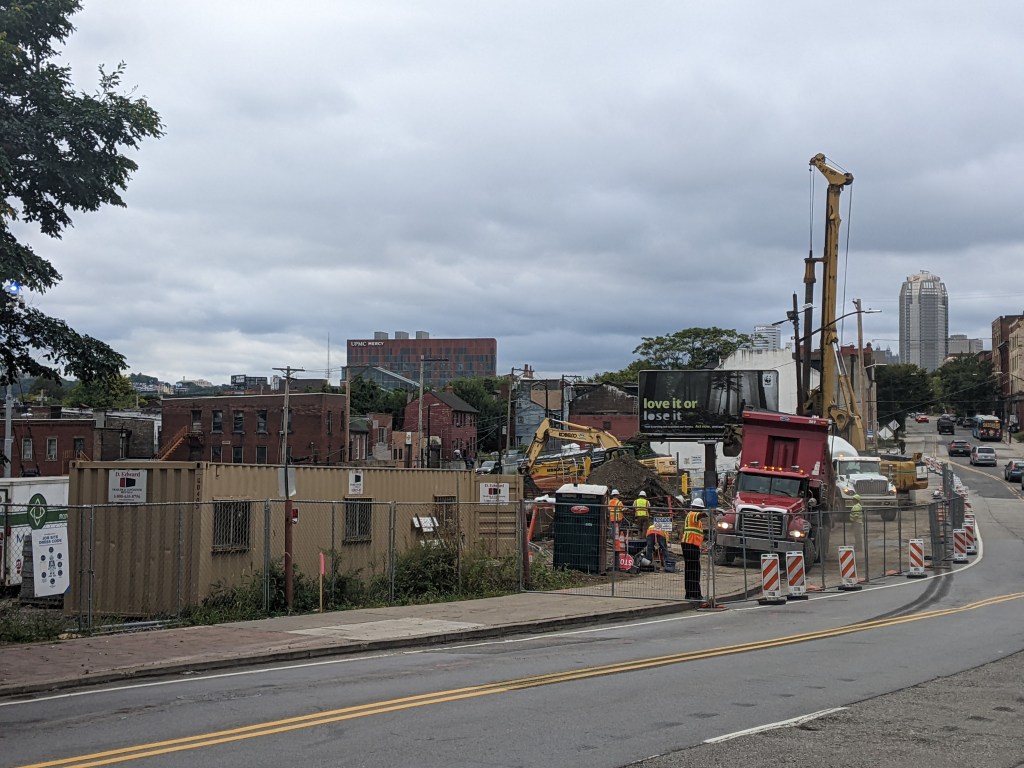
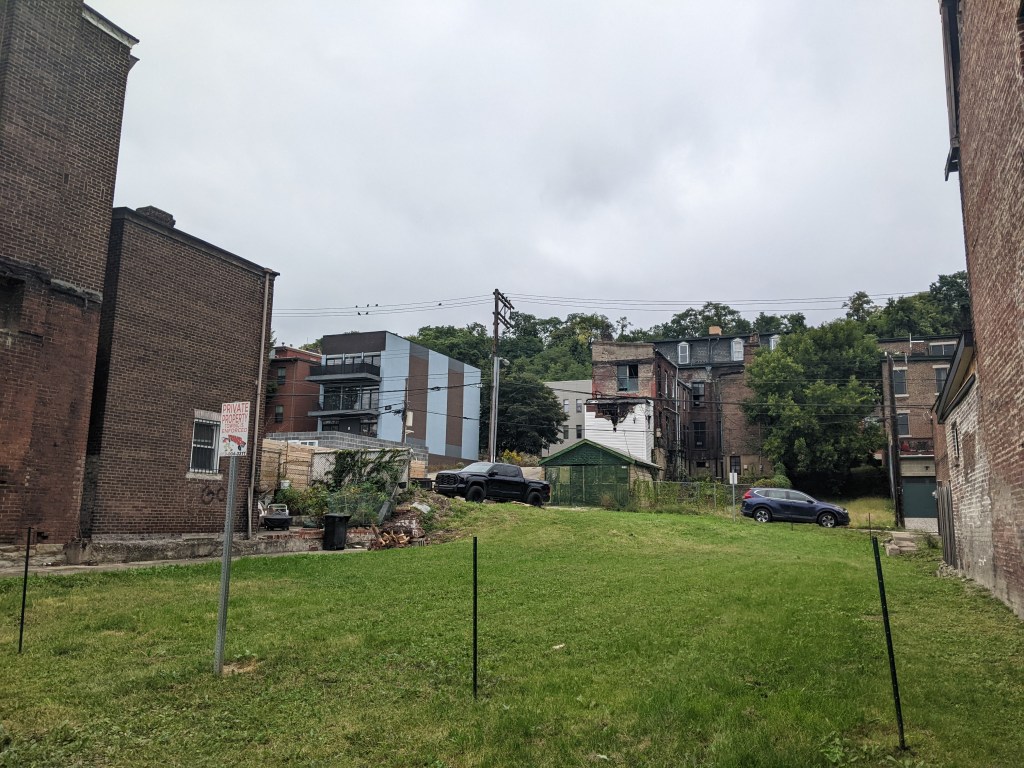
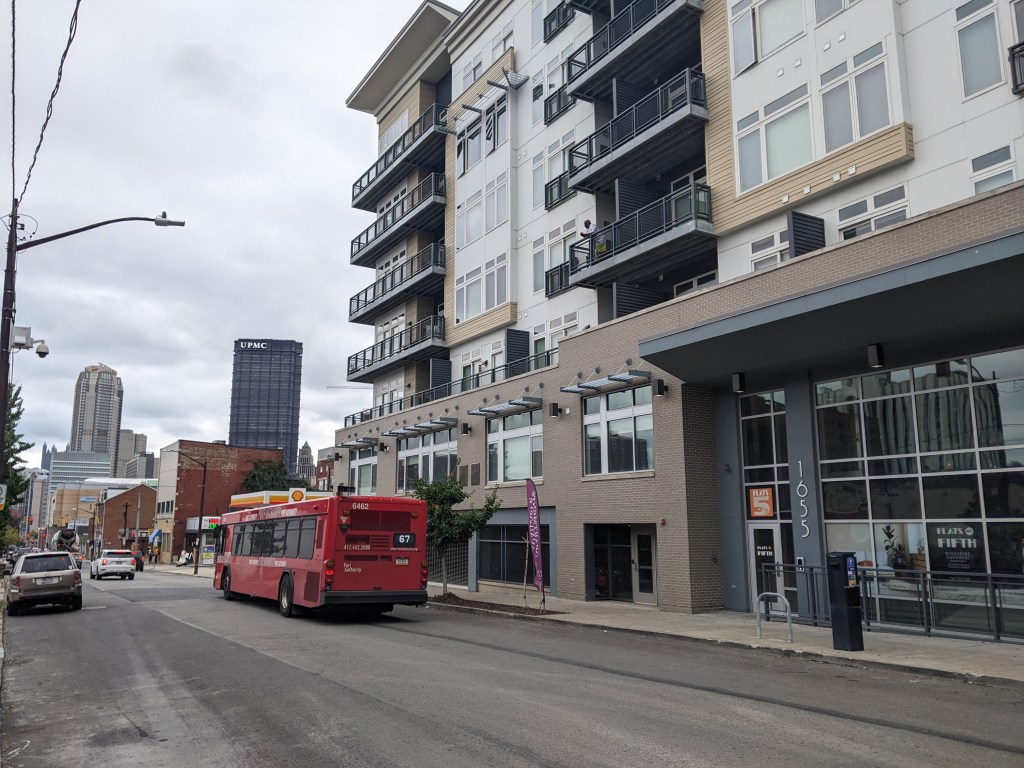
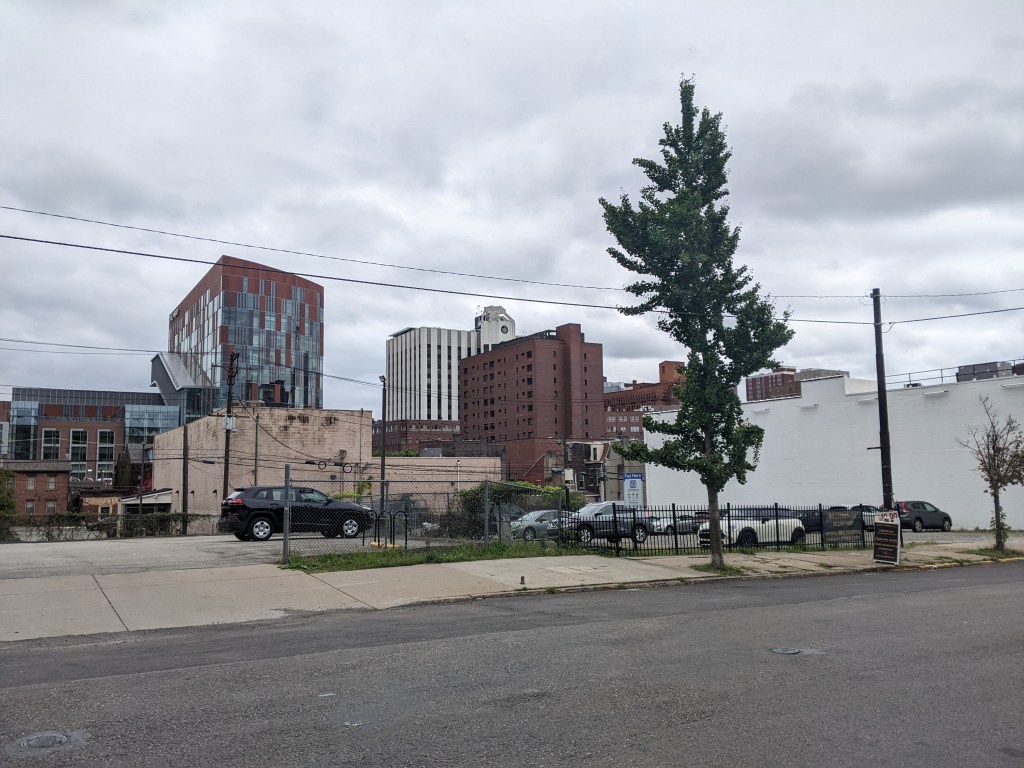
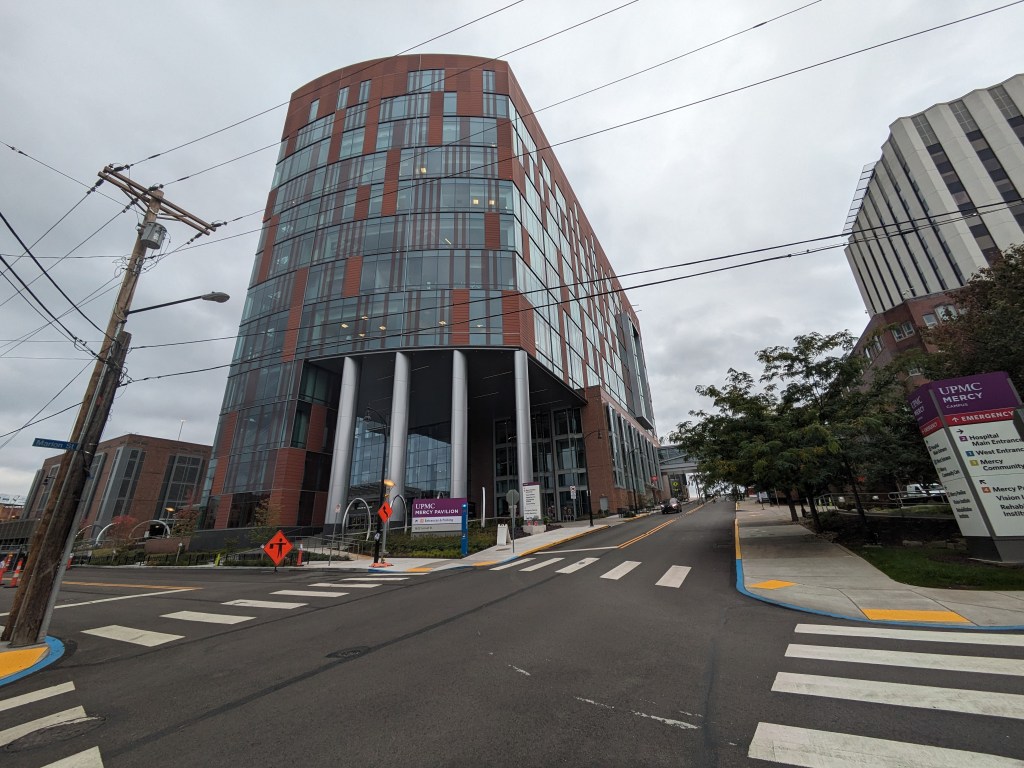
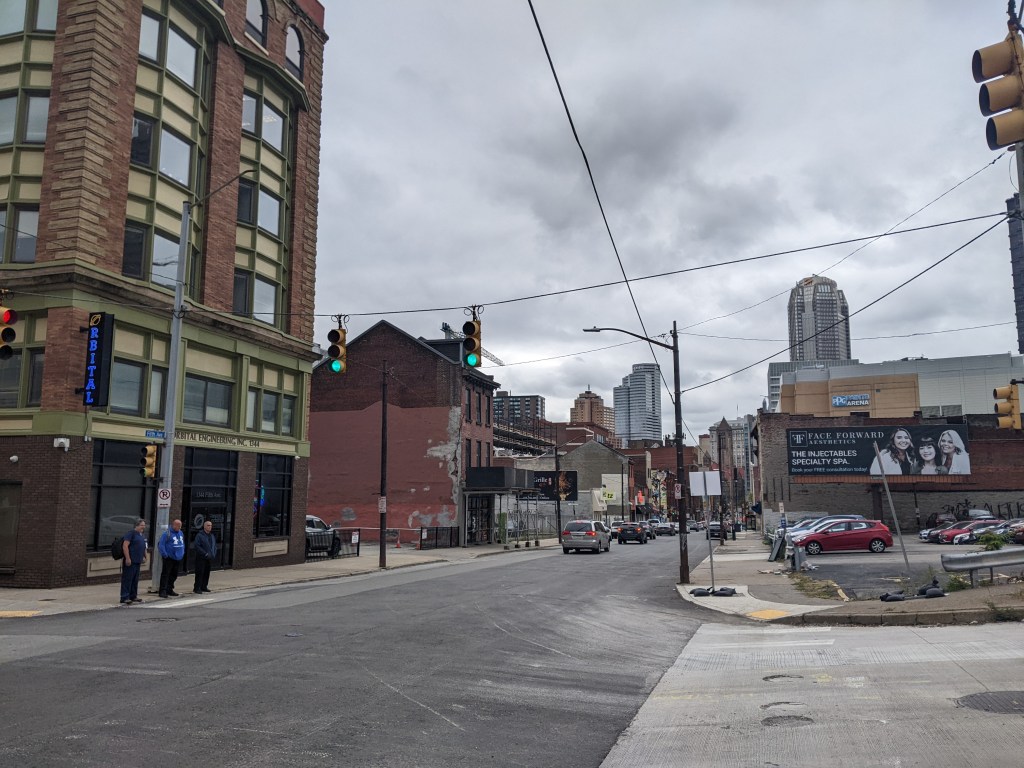
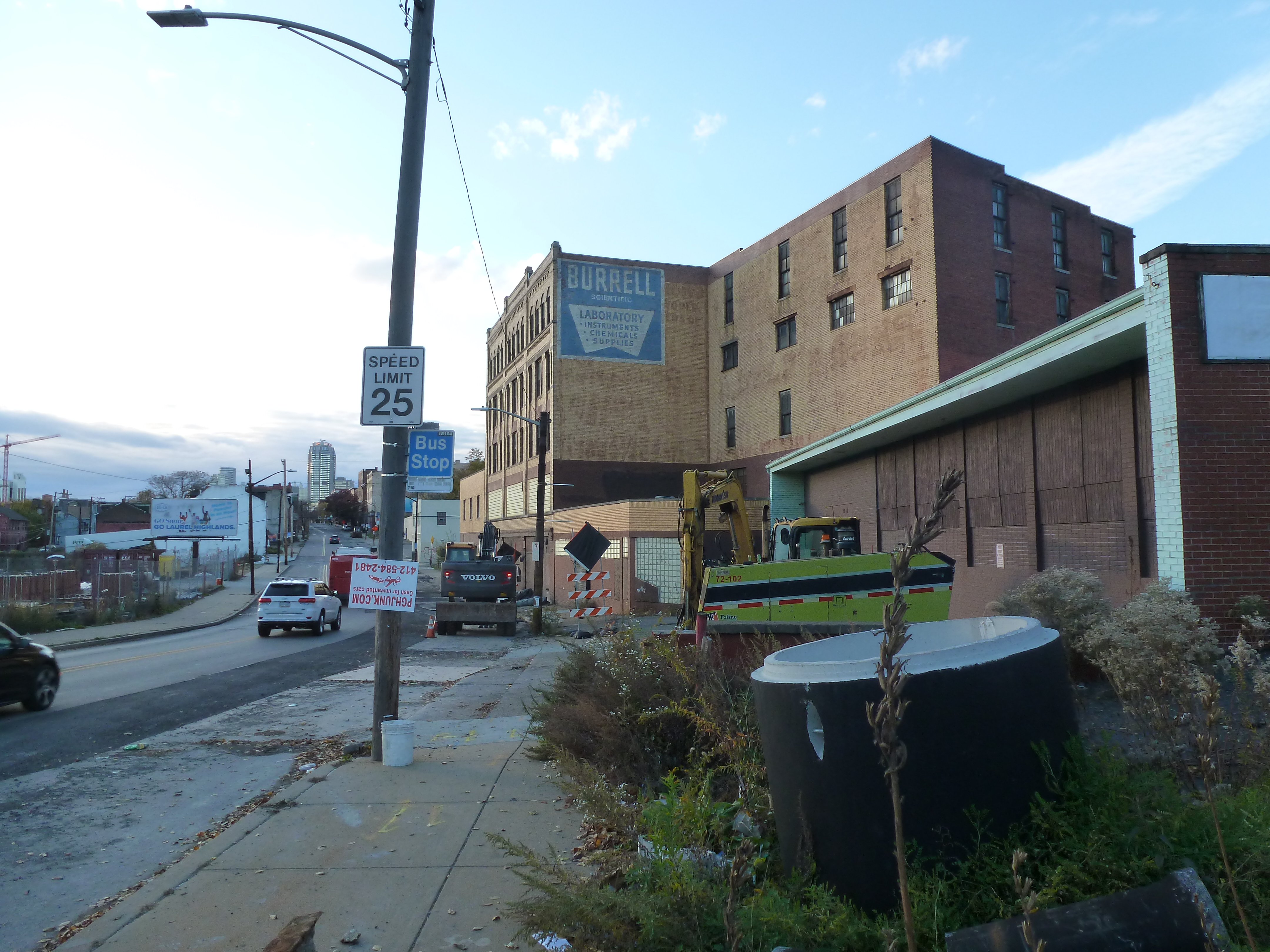
There’s been a lot of development in Uptown since the last on-the-ground photographs from December 2021. Several projects that were in progress at that time have since been completed (or at least appear completed) including the UPMC Mercy Pavilion for the new vision rehabilitation center. Many more projects have broken ground, including one near the Birmingham Bridge on a vacant lot that has an extreme grade change. The near cliff that ran through the middle of this site made me guess that it would take longer to develop that property than the vacant building across the street with the Burrell sign painted on the side. This suggests that it may be easier to develop a environmentally challenged site than to reuse an existing building – which is a disturbing thought.
In addition to the projects we can see developing in the photo series, several more have been announced for the neighborhood, which can be seen in the news section.
A small aside, as a picture tells a 1,000 words, the photo this year of the Shephard’s Heart Fellowship suggests an unfortunate story (slightly embellished from having ridden the bus past the building over the course of several months). While there is no good time to have a fire, it appears that Shephard’s Heart had a fire shortly after they finished putting a fresh coat of paint on their building. As it’s been at least four months since I first notice the damage and no exterior repairs are apparent, it seems they might be having difficulty in resolving the after affects.
The Photos
Uptown in the News & on the Web
Two projects in Uptown are listed in Next Pittsburgh‘s list of 8 major development projects to watch in 2023: UPMC Mercy’s Vision Rehabilitation Center and Duquesne University’s new 12-story student housing (January 11, 2023). The Pittsburgh Business Times got a first look at the new UPMC Mercy Pavilion – the home of the vision rehabilitation center – prior to its May 1 opening (April 19, 2023) and the University of Pittsburgh Health Sciences provided an description of the services that will be provided (May 10, 2023).
The Tito-Mecca-Zazza House continued to make the news. The developer and Uptown Partners reached an agreement that would donate the house to the nonprofit for restoration while the new construction multi-unit building would be built on the remaining parcels, including the one with the garage that is part of Rolling Rock’s origin story (Pittsburgh Business Times, July 21, 2023). A descendant of the Tito family has filed a lawsuit protesting the proposed demolition of the garage (Pittsburgh Business Times, August 28, 2023).
The Bethlehem Haven women’s shelter in Uptown sought and received approval from Planning Commission on its plans to renovate and expand (Public Source, April 4, 2023; TribLIVE, April 4, 2023; TribLIVE, April 19, 2023).
Several other housing projects received approvals or are moving forward in the neighborhood including:
a formerly stalled 110-unit mixed-use apartment building got an infusion of new funds from the URA (Pittsburgh Business Times, January 19, 2023)
a 240-unit apartment building proposed for a block that is primarily a parking lot today (Pittsburgh Business Times, February 21, 2023)
an affordable/workforce housing development that received approval from Planning Commission (Public Source, July 25, 2023)
Panelists were interviewed by the Pittsburgh Business Times prior to their talk about the projects and opportunities coming to Uptown and the Lower Hill and another Pittsburgh Business Times article focused on the prominent role of Black developers in these projects (both articles: June 8, 2023). Another article discusses the panel (Pittsburgh Business Times, June 13, 2023).
Tech companies are also interested in Uptown with a tech venture studio taking over part of the former Paramount Building in Uptown (Pittsburgh Business Times, March 31, 2023).
Uptown is one of the many neighborhoods in Pittsburgh that experienced decades of neglect. For this neighborhood, the neglect was despite Uptown being sandwiched between Oakland and downtown, two places among the state’s strongest economic regions. Zipping through Uptown from Oakland to downtown on Fifth Avenue or from downtown to Oakland on Forbes Avenue, it is easy to overlook or dismiss the hodgepodge of ruined home foundations turning back to forest; scattered vacant lots, parking lots, and industrial uses; and the intricate architectural details on abandoned and renovated townhomes.
In recent years, new buildings started springing up here and there. Some of these new projects are the work of the two institutions in the neighborhood: UPMC Mercy Hospital and Duquesne University. Others are the work of a variety of commercial and residential developers. Two reasons for this recent investment are the proposed Bus Rapid Transit system, which will eventually run through the neighborhood, and the in-progress redevelopment of the Lower Hill, an adjacent neighborhood.
The Uptown community saw these changes coming and prepared. Between 2015 and 2017, the community organization Uptown Partners collaborated UPMC Mercy, Duquesne University, the City of Pittsburgh, and others to create the EcoInnovation District Plan and the Uptown Public Realm zoning district. The plan and new zoning district are intended to guide future development and leverage their economic investment for the greater good of the neighborhood. Ideally, this will reduce the number of those who will be left behind.
This blog post is part of an on-going series watching the changes in Uptown. Periodically, approximately once a year, I return to the neighborhood to take new photographs of the same areas. In addition, I include links to articles about the project that I’ve encountered since the previous post in the series. At the end of the post, there is a map showing the location of the neighborhood and links to the previous posts in the series.
What’s new
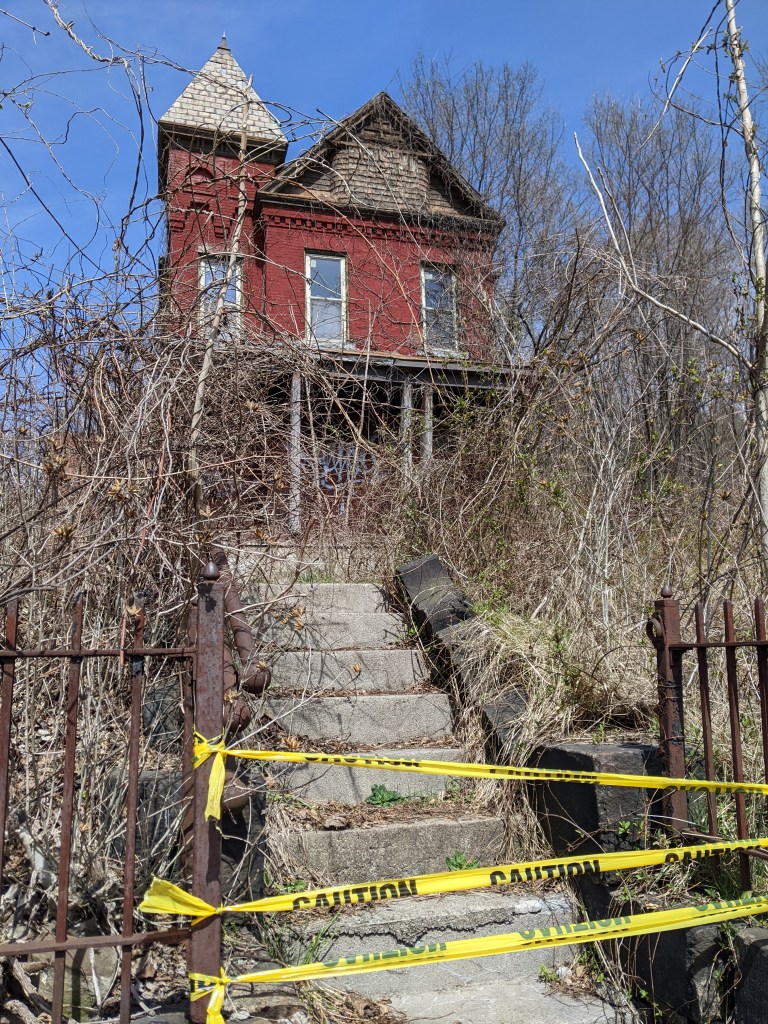
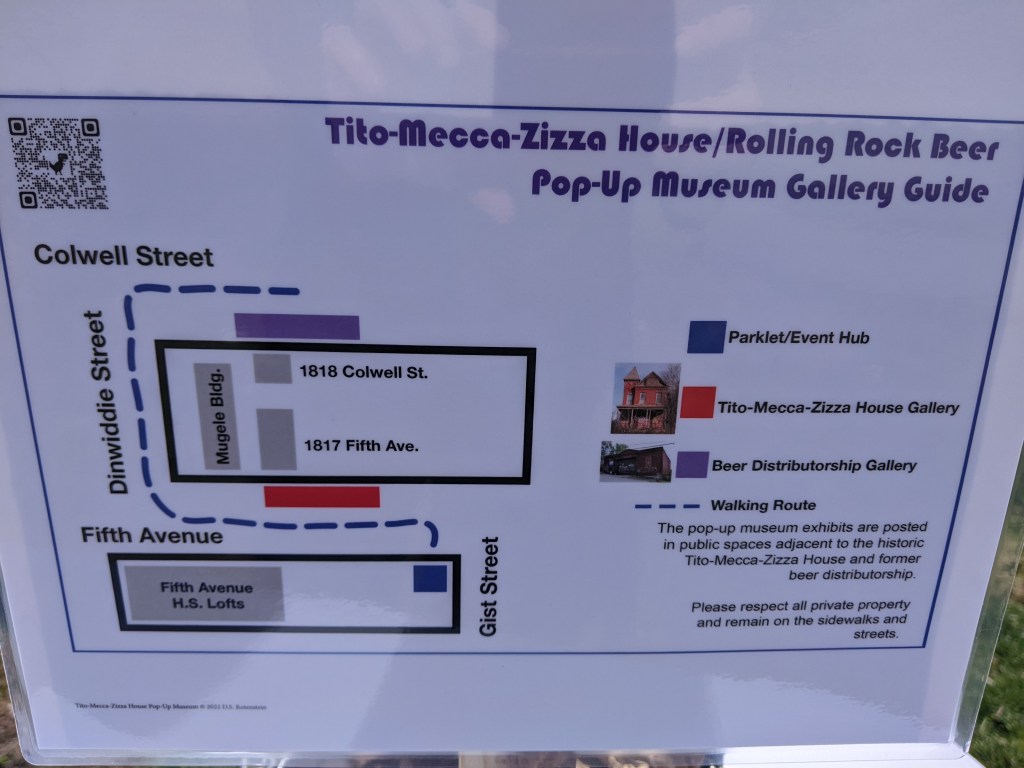
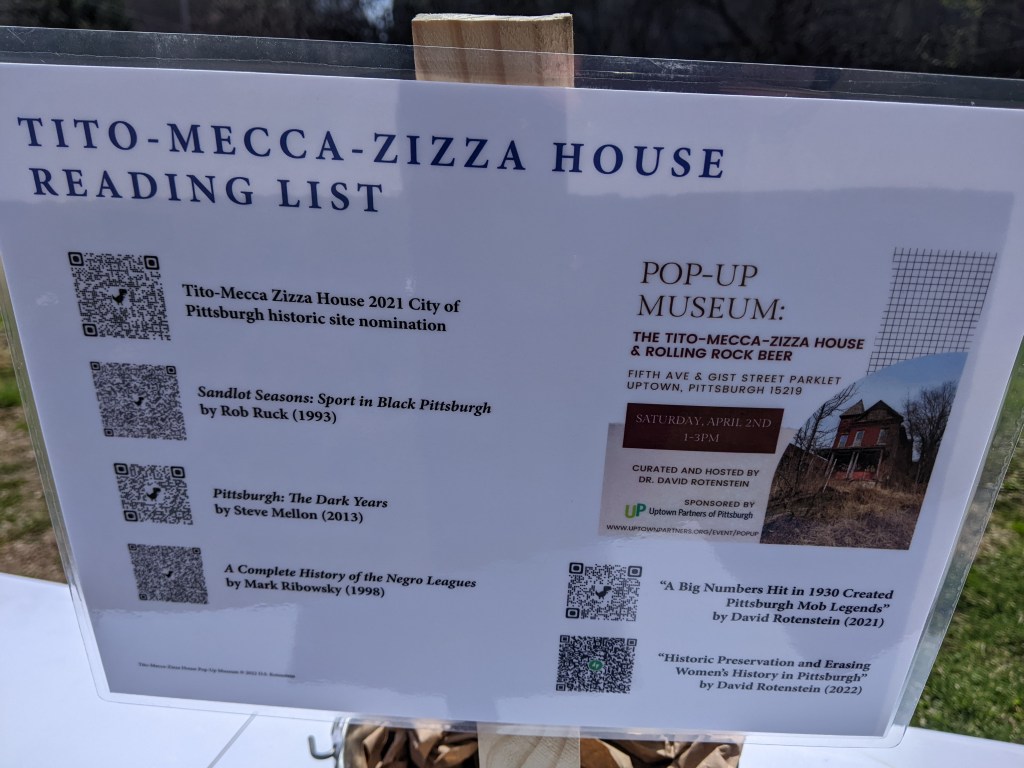
The big news of 2022 was the successful nomination of the Tito-Mecca-Zizza House for historic preservation. Despite a rocky road, in June, City Council voted to designate the house as a historic property. The property owners were vehemently opposed to the nomination throughout the process. The process to nomination involved two meetings at each of the Historic Commission, Planning Commission, and City Council. The Historic Commission did not recommend the nomination to City Council, but the Planning Commission did. The property is considered architectural significant and unique and it has ties to Rolling Rock beer, the Negro League, and the American-Italian community of Pittsburgh. I attended a pop-museum event at the site during the nomination process and include photos below.
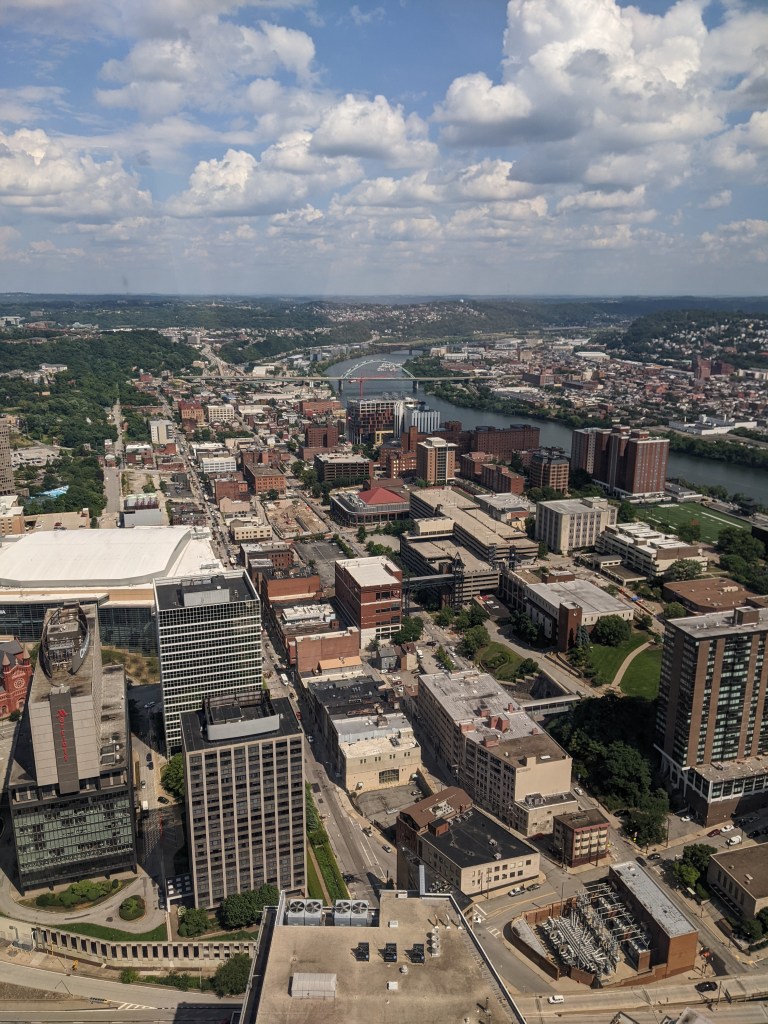
While this house is clearly unique – long before I knew its history, it had caught my eye as something completely different from its surroundings – I did not include it in the photographs I’ve been taking of the neighborhood in the this series. This is a clear illustration of one of the challenges of Keeping an Eye on a neighborhood – predicting which portions are going to be most illustrative of changes over time. Unfortunately, I was not able to get out in the neighborhood for the usual photos this year, though I do have a few bird’s eye view photos to share.
A developer proposed a project on 1.8 acres including the Tito House site that would be a new construction mixed-use project including 260 apartments (Pittsburgh Business Times, February 11, 2022) and another developer proposed a 51-unit building at the western end of the neighborhood (Pittsburgh Business Times, December 9, 2022)
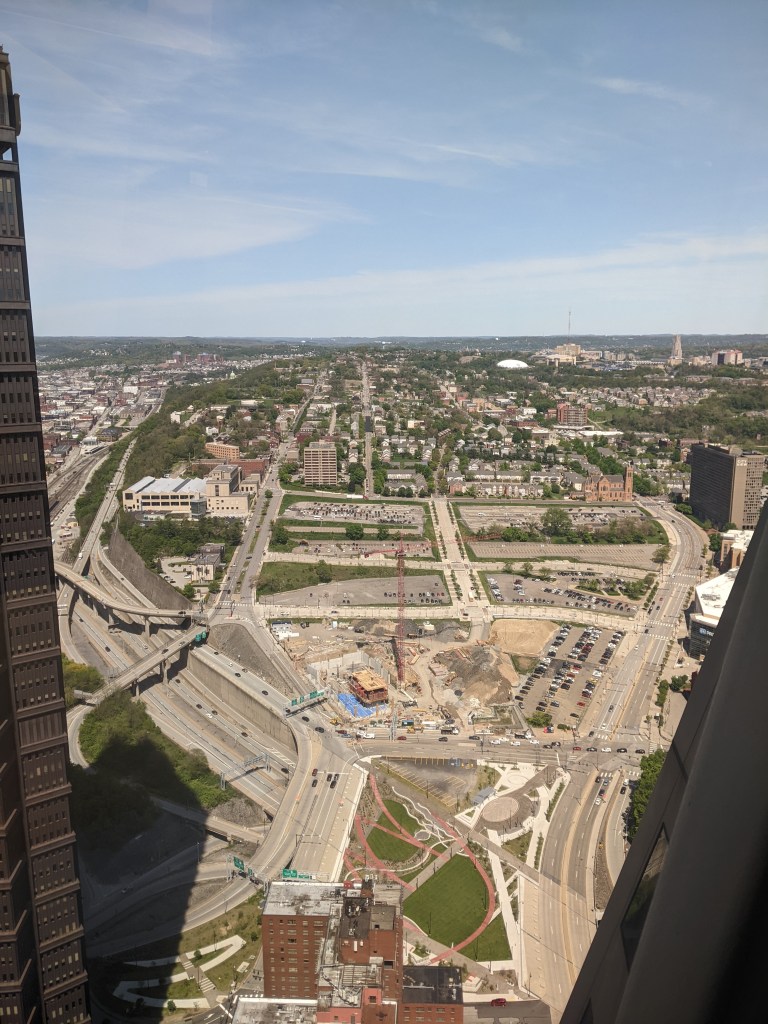
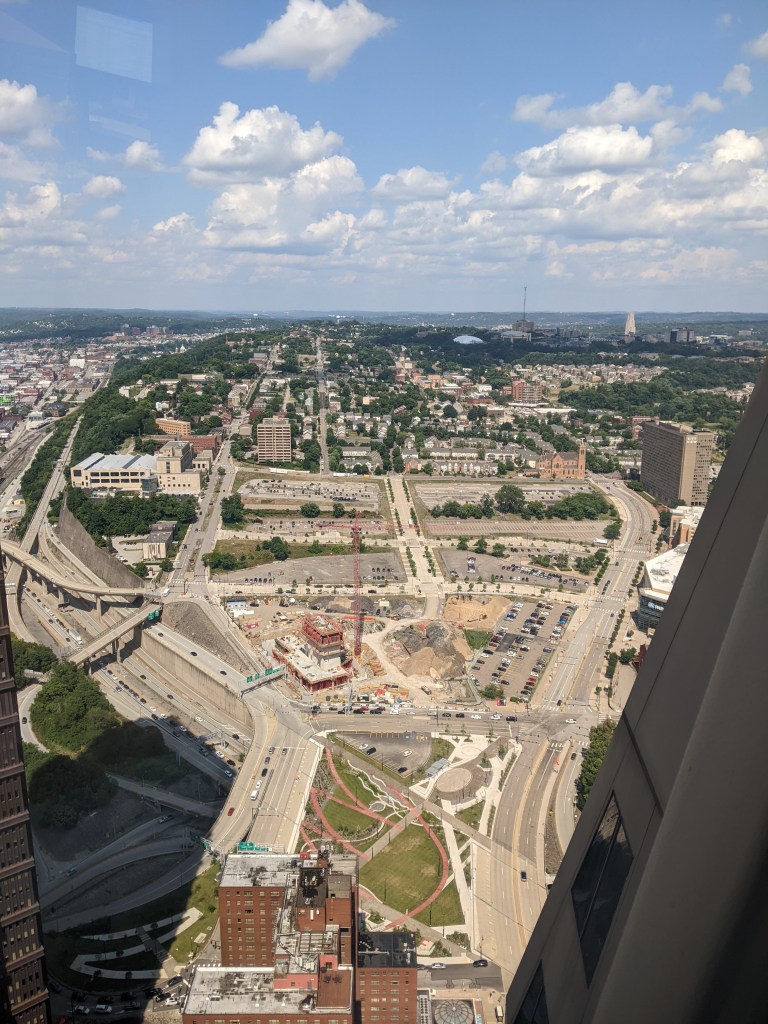
The Lower Hill is a notorious site in Pittsburgh, a scar on the city from the height of Urban Renewal. A vibrant (but poor and predominately Black) neighborhood was demolished in the 1950s so the City could build a cultural mecca centered on a Civic Arena, most of which ended up not being built and was left as parking lots.
Now that the arena has been demolished and replaced adjacent to the former location, the Penguins hockey team has the development rights to rebuild the Lower Hill, stitching back together the fabric of the city and reconnecting the remainder of the Hill District neighborhoods with downtown.
However, grand language describing the wonderful benefits to a city are part and parcel of any major development project, including the 1950’s Urban Renewal of the Lower Hill. Fifty years later, the Urban Renewal of the Lower Hill is rarely, if ever described as a good thing. In fact the current redevelopment is sometimes described as undoing the mistakes of that project. However, can the negative financial, social, and emotional repercussions of the original demolition and decades of disconnect be undone simply by reinstating (most of) the former street grid?
This blog post is part of an on-going photographic series to watch the redevelopment of the Lower Hill. Periodically, approximately once every six months, I return to the site to take new photographs. In addition, I include links to articles about the project that I’ve encountered since the previous post in the series. At the end of the post, there are links to all the previous posts in the series.
What’s New
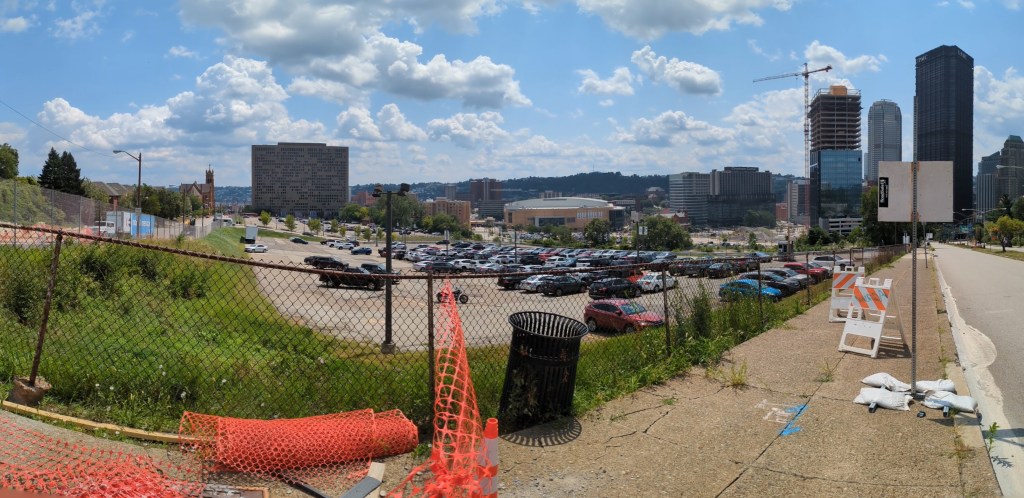
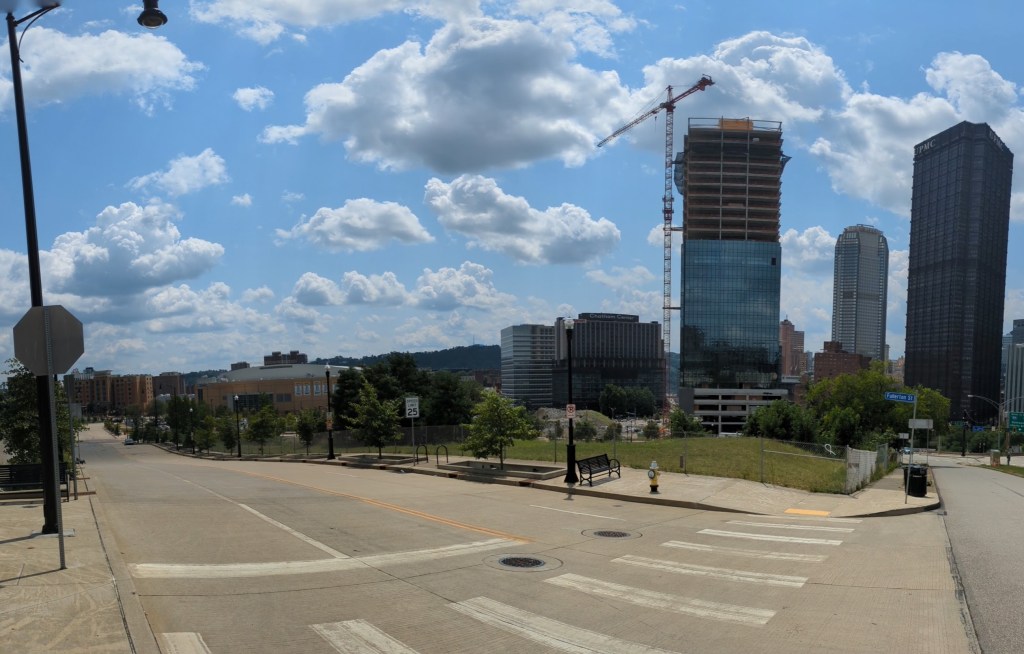
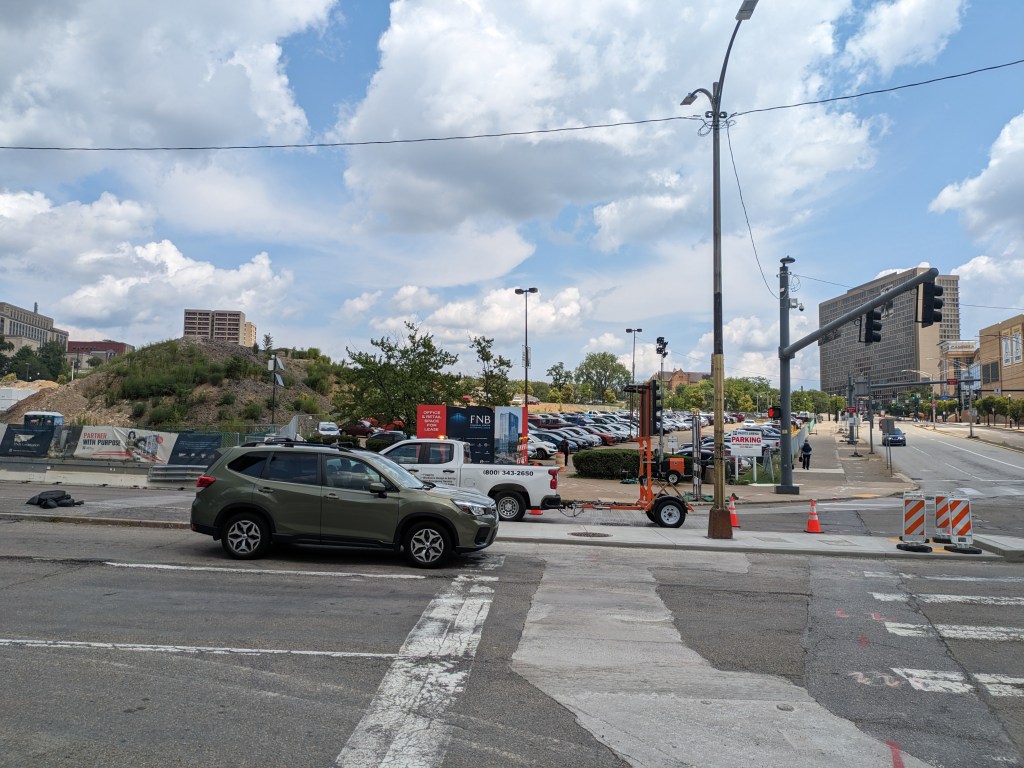
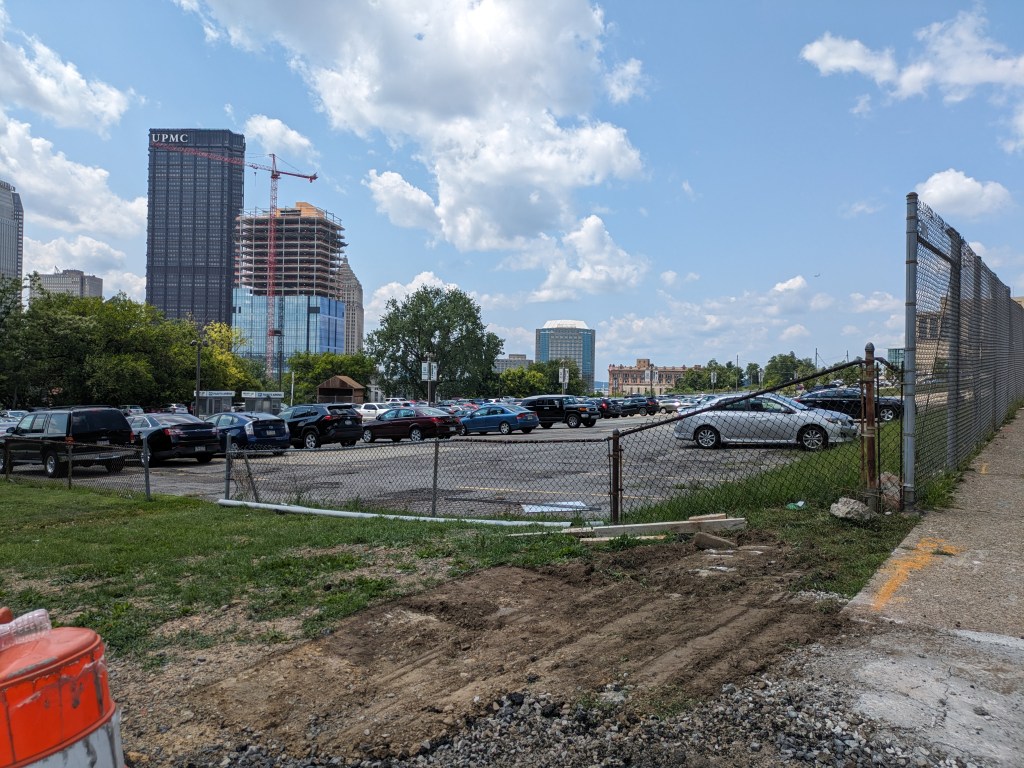
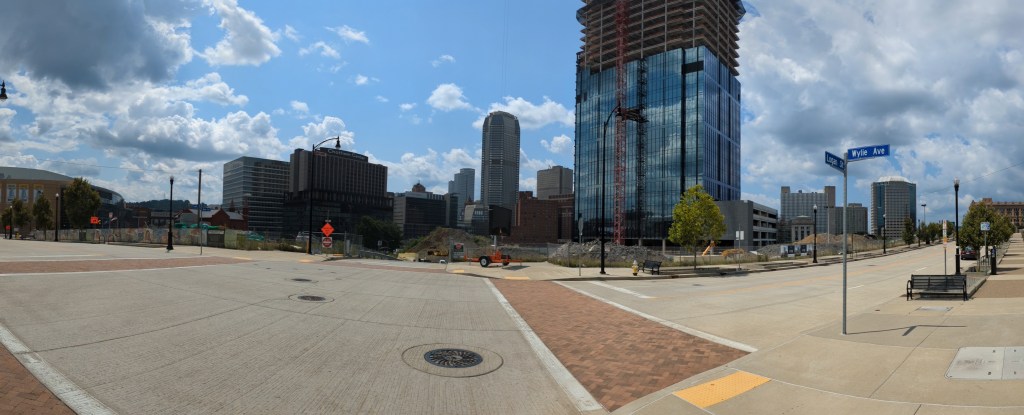
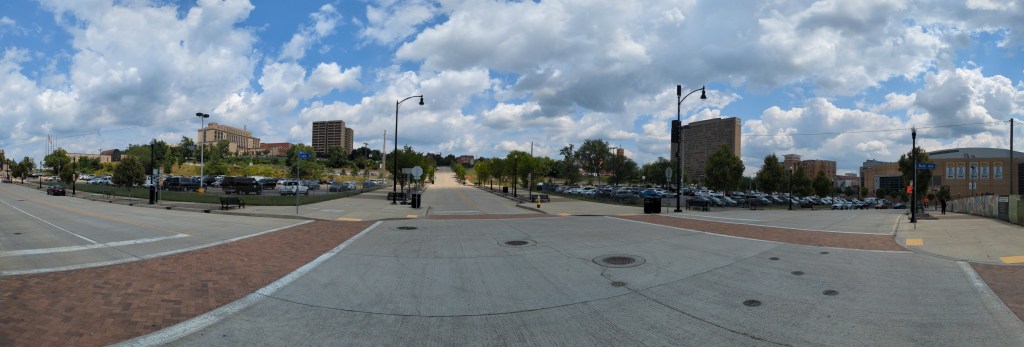
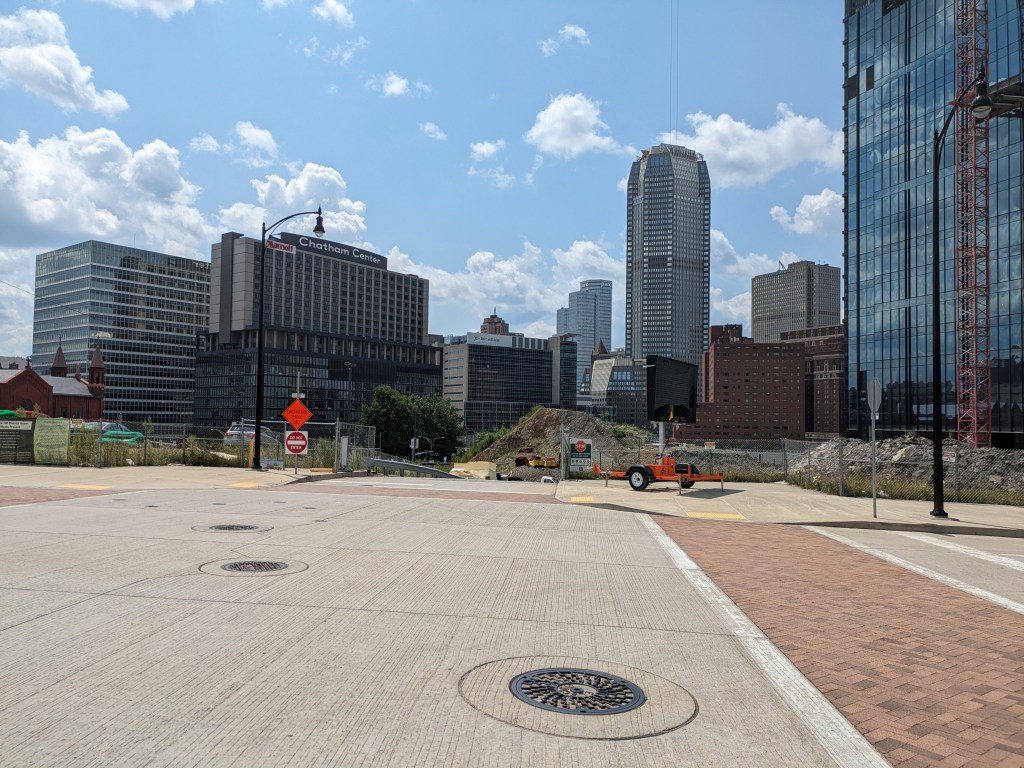
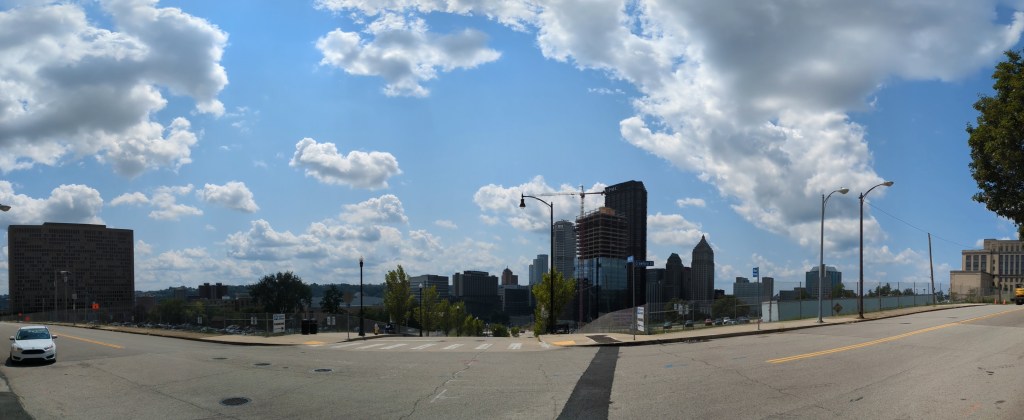
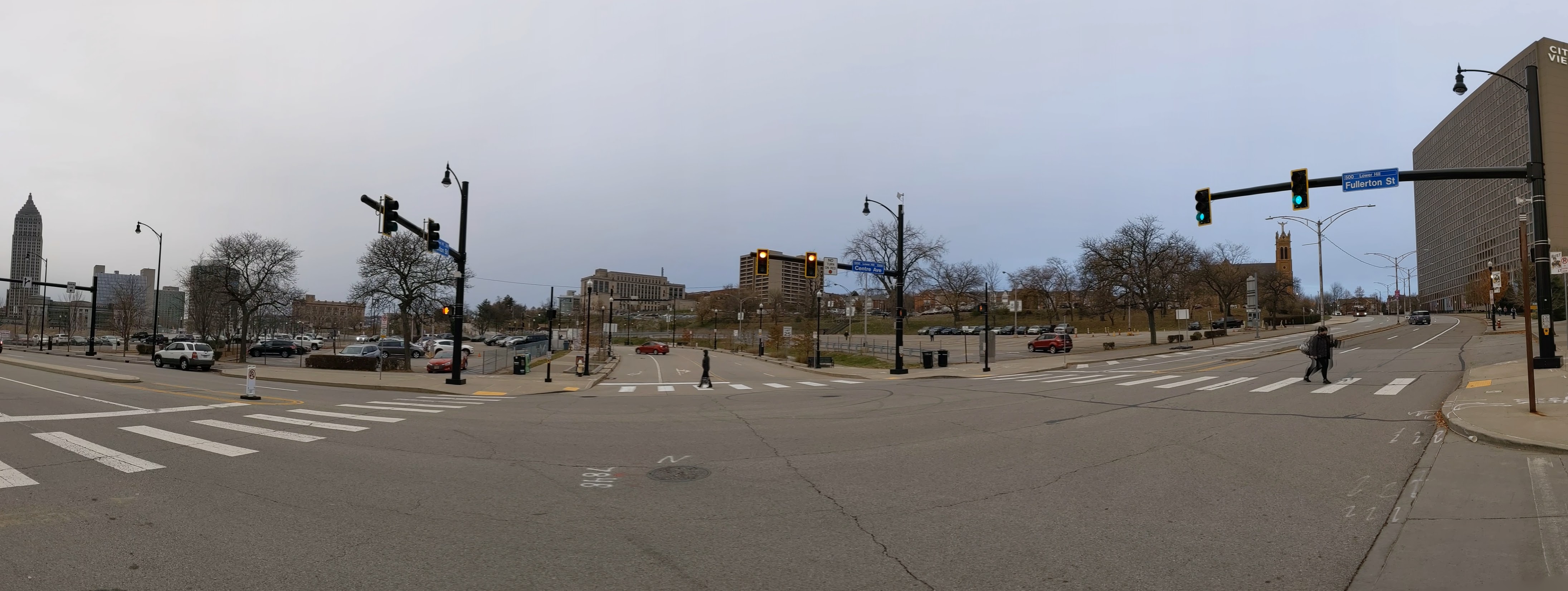
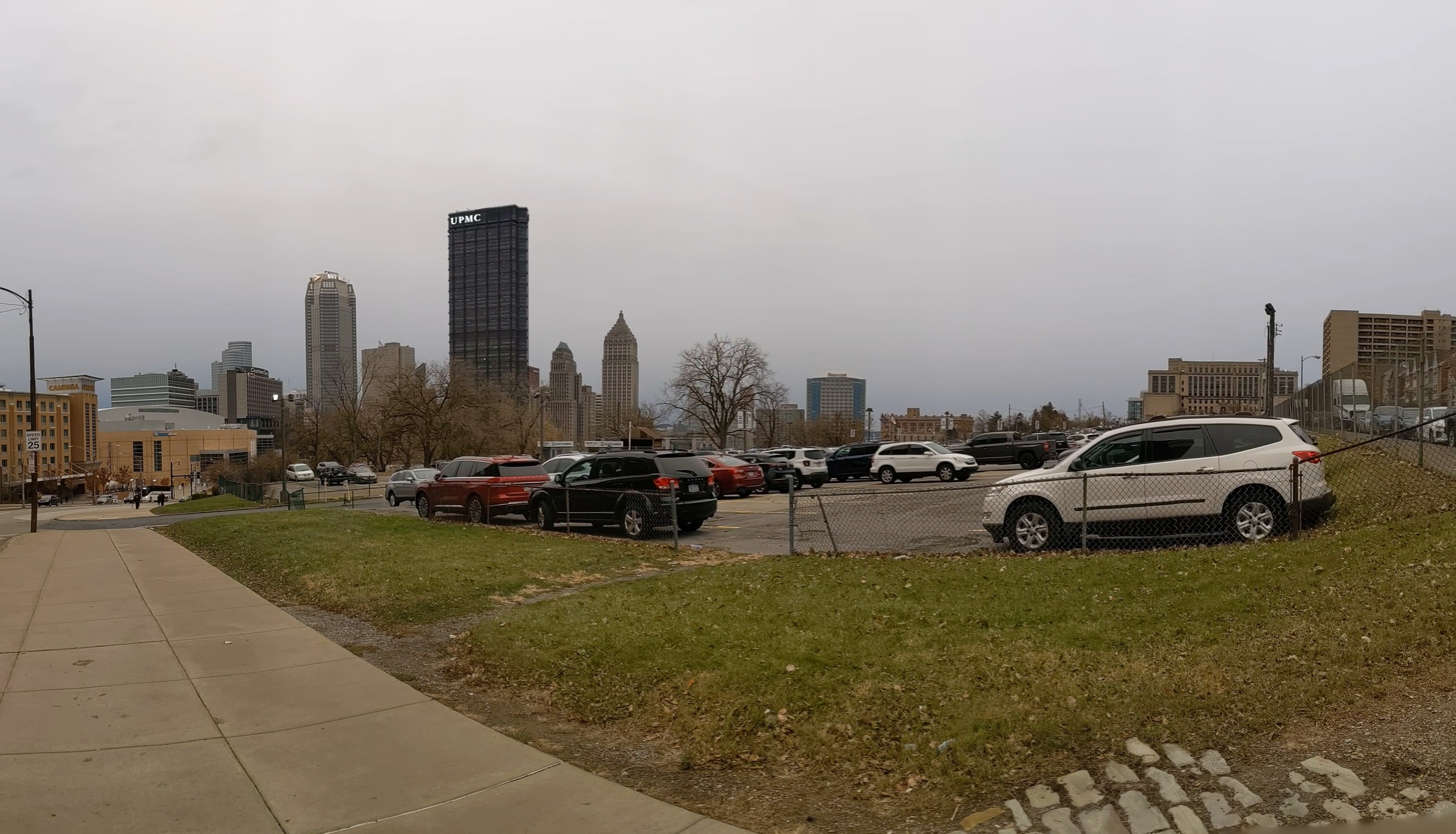
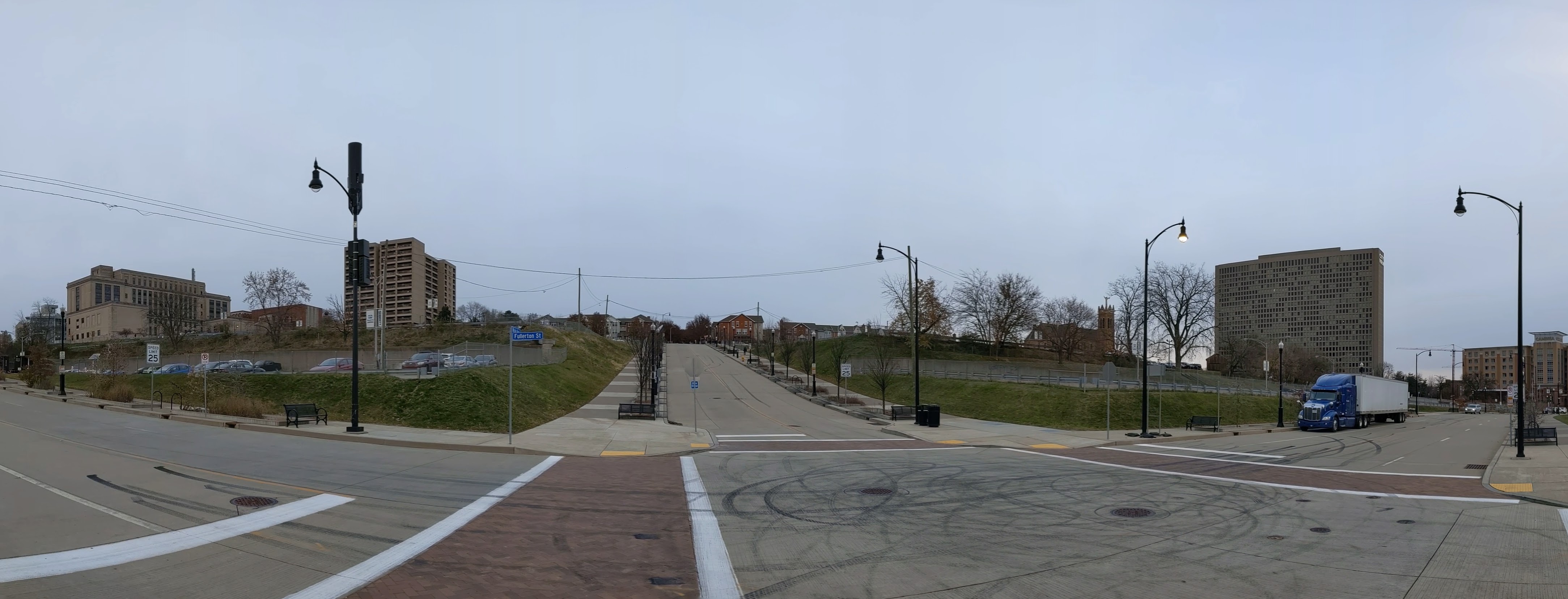
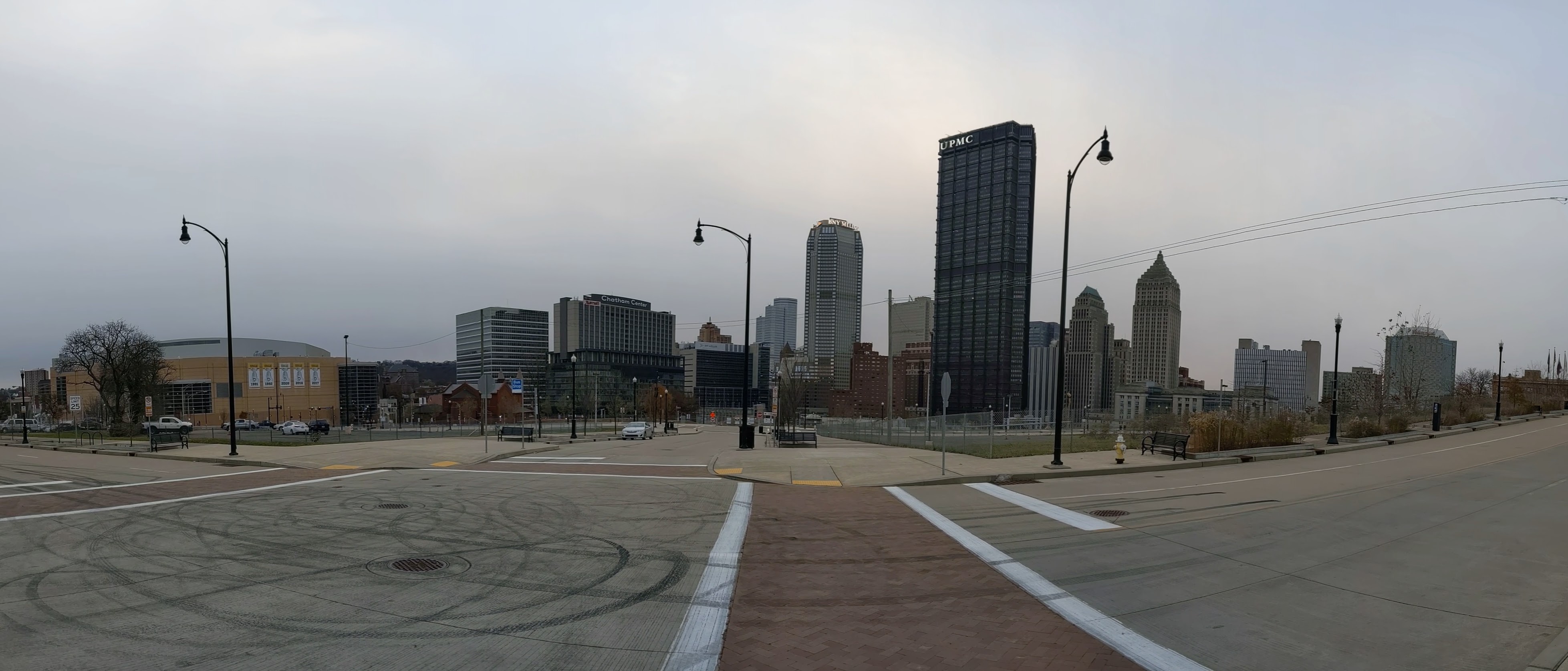
While still primarily a sea of parked cars, there have been a few changes on the site:
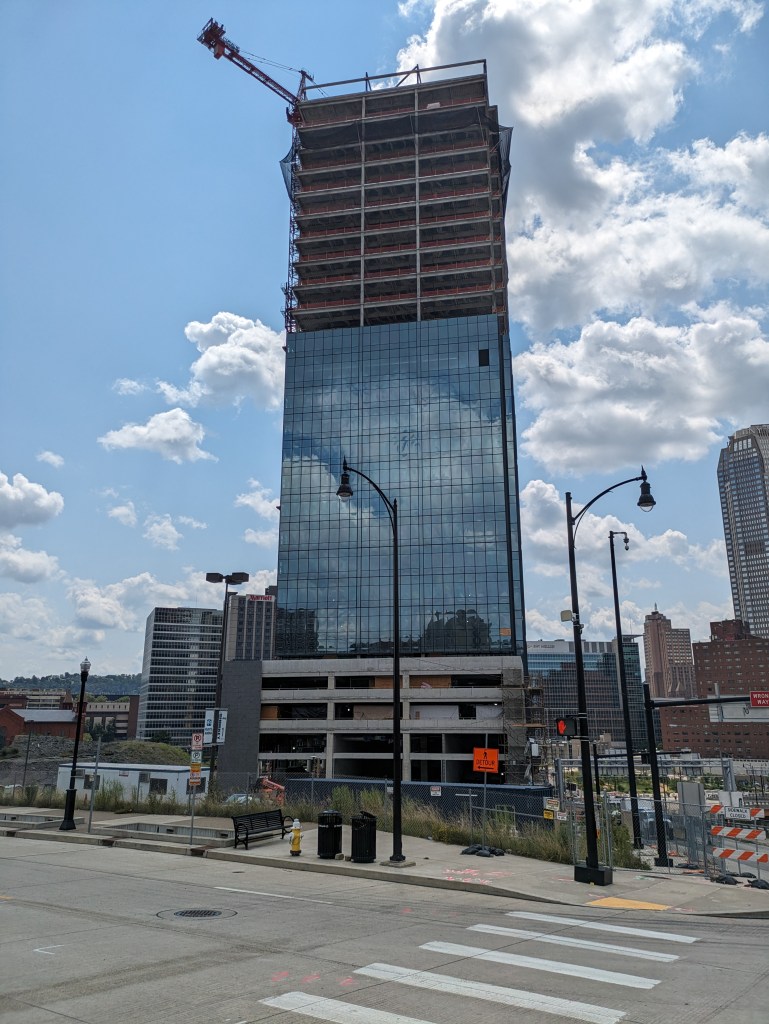
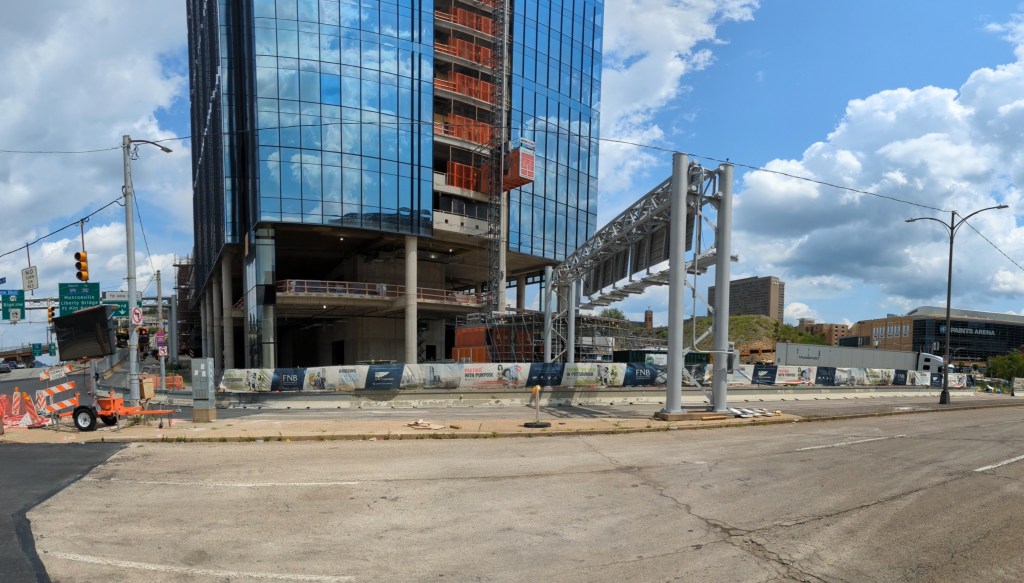
After months of the FNB Tower seemingly stuck at 5 or so stories despite activity on the site, the building shot up to what I assume is its full height.
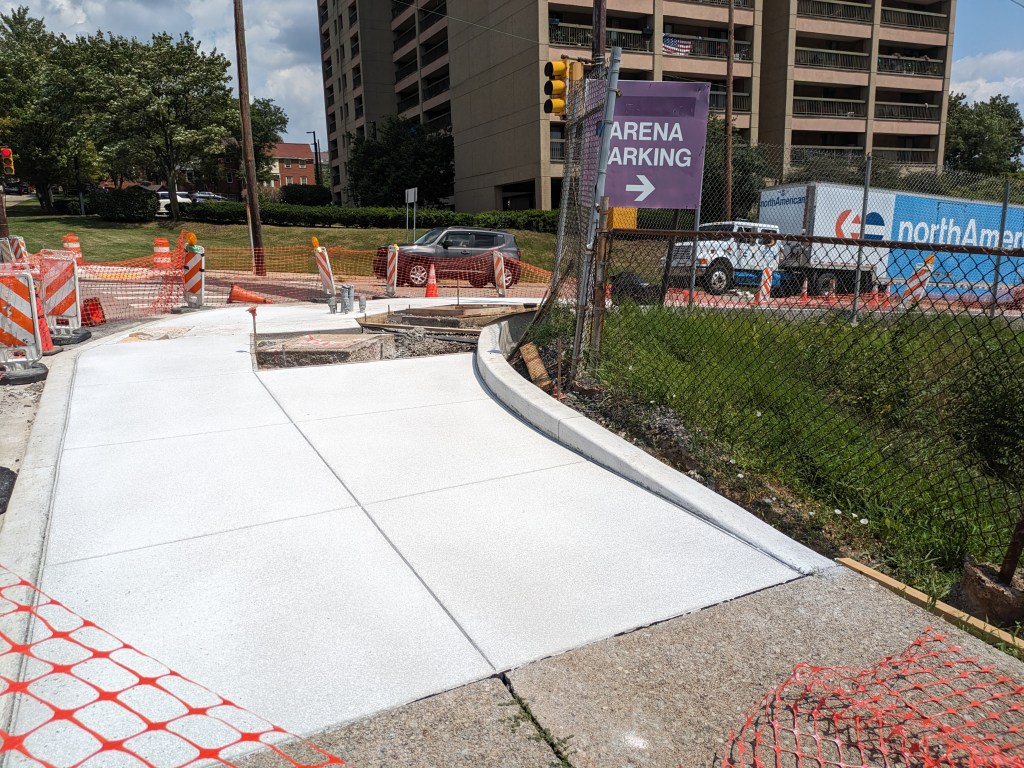
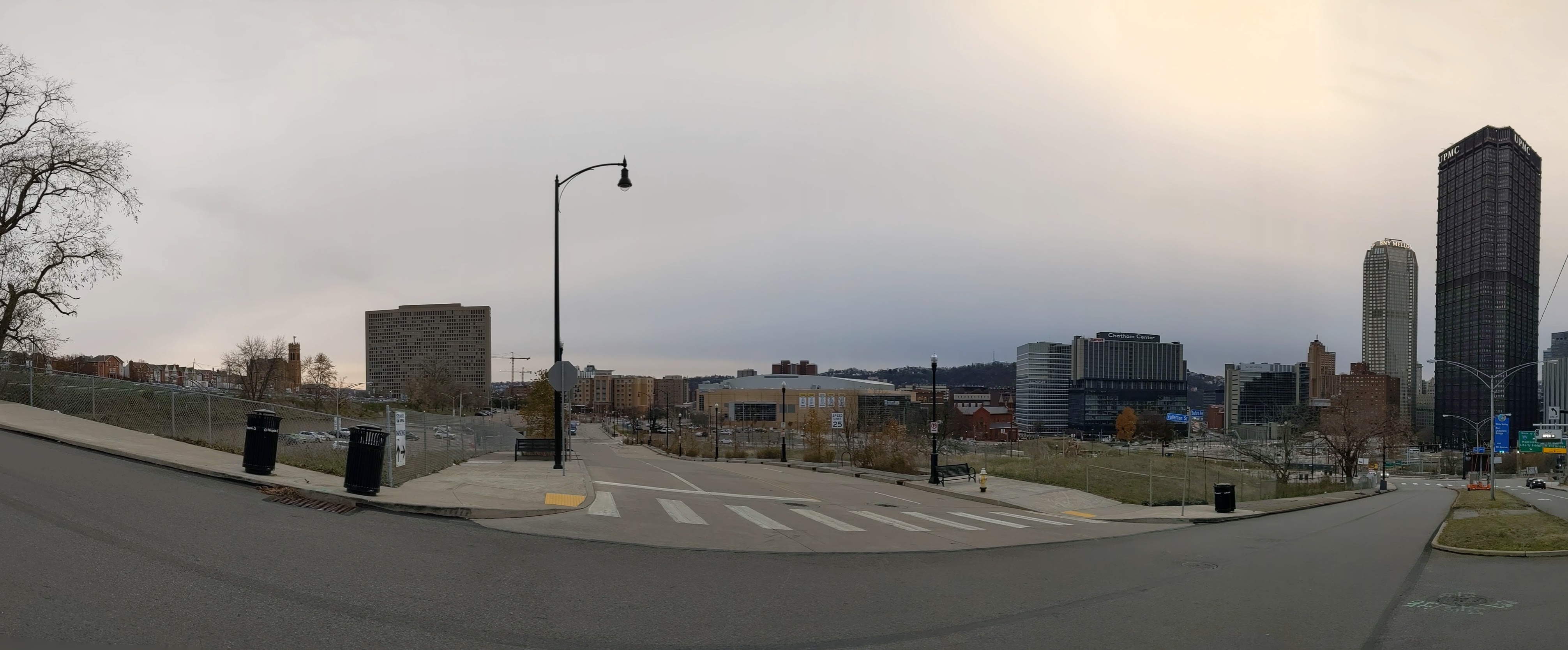
There was some sidewalk restructuring on the older sections – though as that’s happening around the city, it may not indicate anything special in regards to the redevelopment of the Lower Hill.
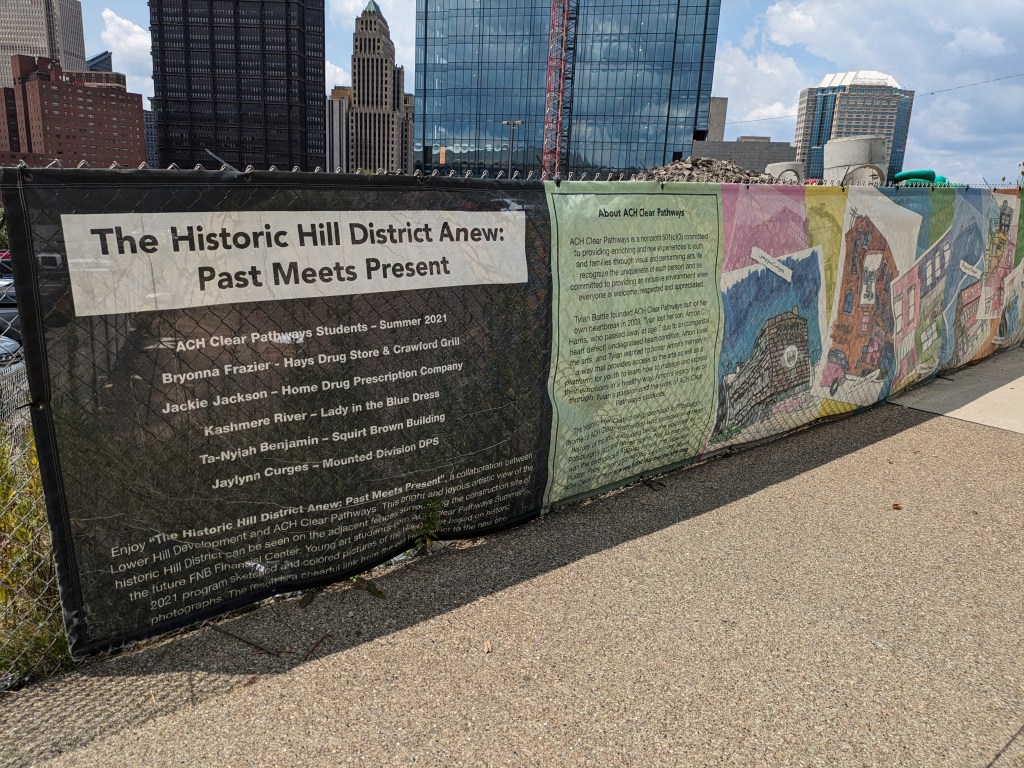
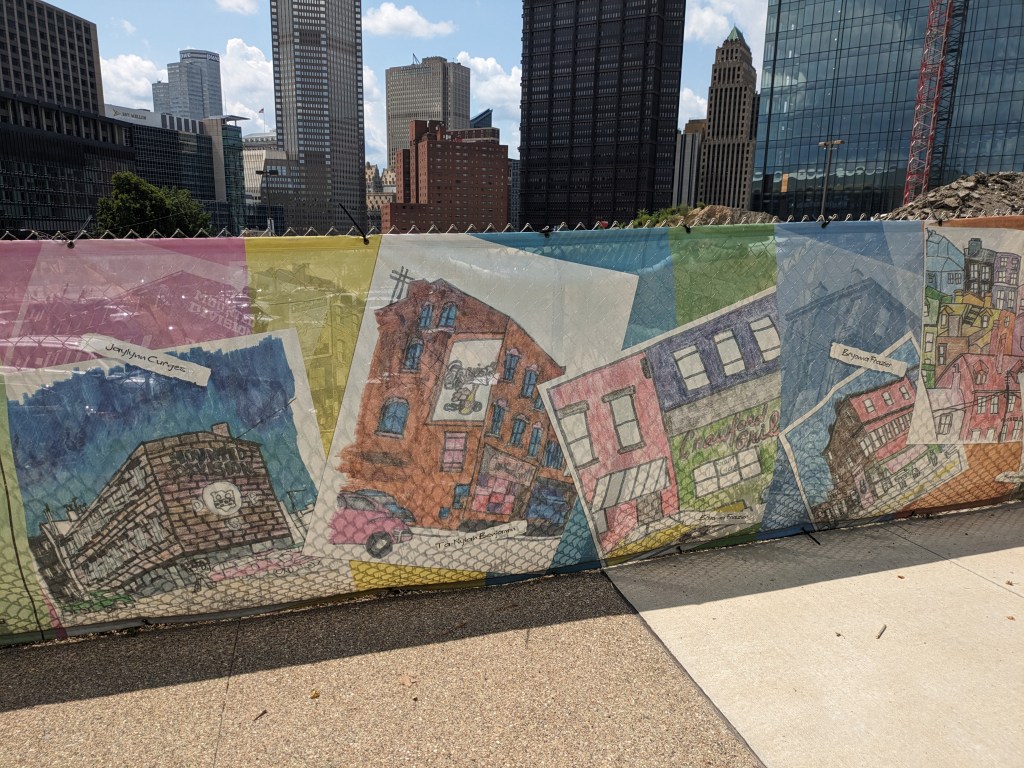
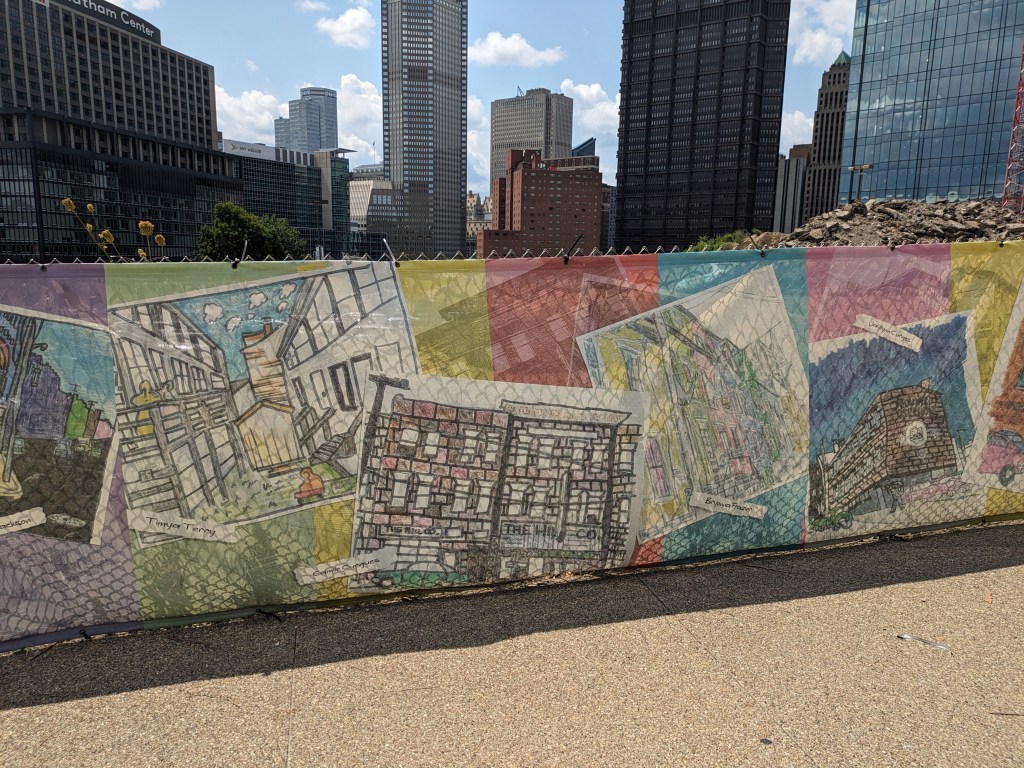
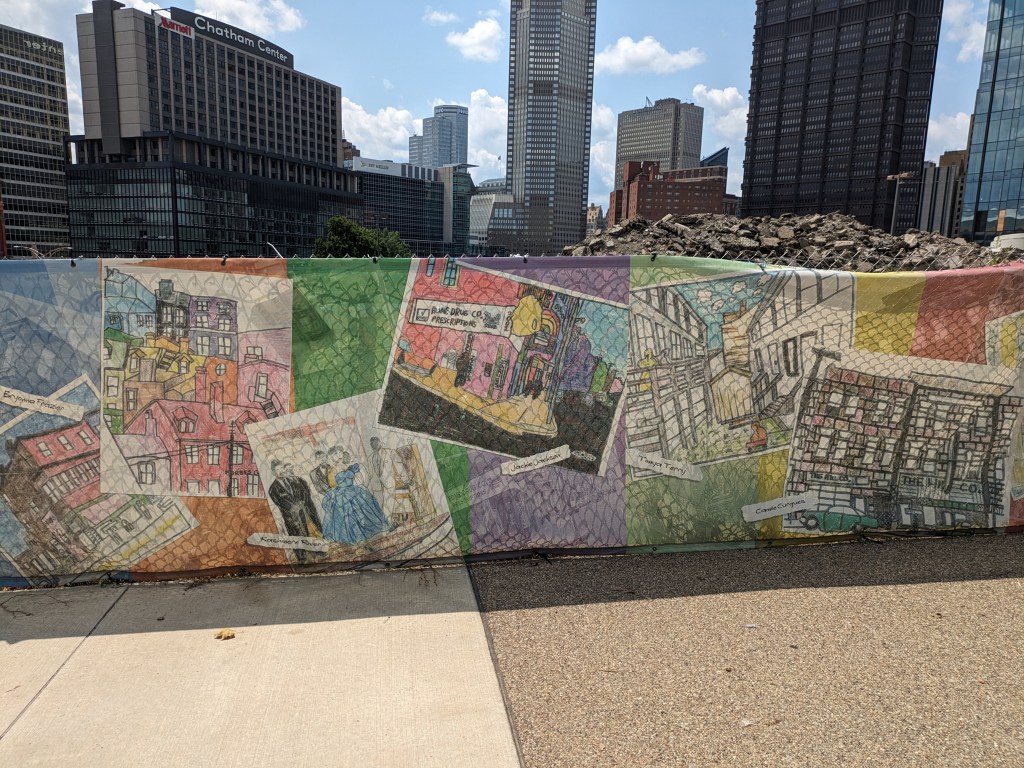
The construction fencing now has a temporary art installation by a non-profit that based in the Hill District and focused on connecting youth with arts.
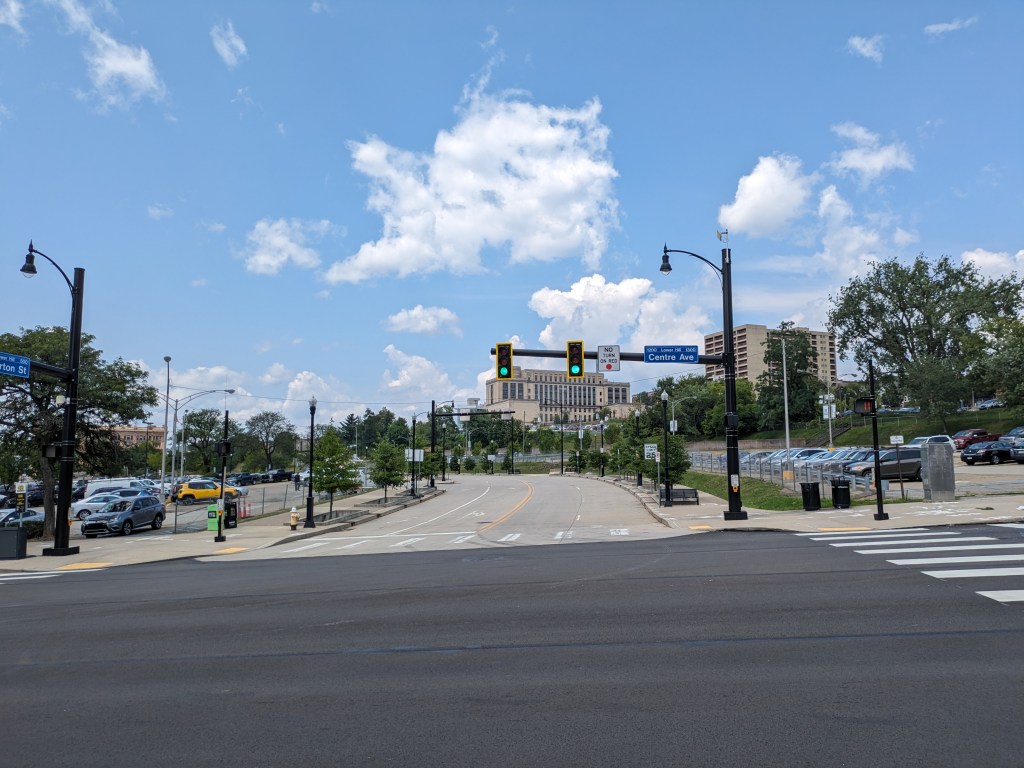
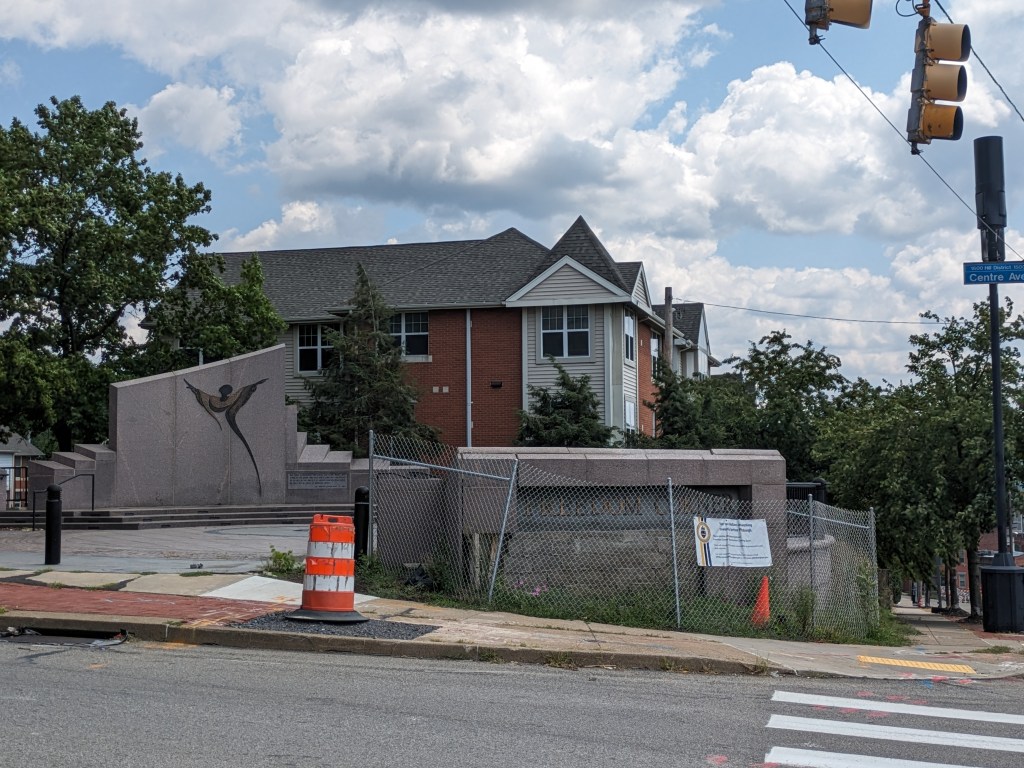
The hedges along Centre Ave were noticeably taller than the last time I photographed them.
Other than that, the site remains much the same. But there has been LOTS of news about it and other developments in the Hill District (see below).
Photos
Lower Hill in the News
Next Pittsburgh named the Lower Hill redevelopment as one of the top 8 developments to watch in Pittsburgh in 2023 (January 11, 2023). Throughout the year, there have been conversations on the development opportunities happening and projected in the Lower Hill and beyond (Pittsburgh Business Times, June 7, 2023; Pittsburgh Business Times, June 8, 2023; Pittsburgh Business Times, June 13, 2023).
The question of how to equitably develop the Lower Hill and other areas of the city that have long seen disinvestment is a hot topic this year (Public Source, January 23, 2023). The community continues to express concern about the deals and process in the redevelopment of the Lower Hill (Next Pittsburgh, January 25, 2023; Public Source, April 22, 2023; Pittsburgh Business Times, May 15, 2023; City Paper, May 16, 2023). The proposed concert venue that is one of the subprojects generating concern in the community moved forward (Pittsburgh Business Times, January 10, 2023; Public Source, January 10, 2023; Public Source, January 24, 2023; Pittsburgh Business Times, May 11, 2023; Public Source, May 11, 2023).
A project website dedicated to construction bidding opportunities shows the most recent bid opportunity was for the controversial concert venue.
Bethel AME is Pittsburgh’s oldest Black congregation. They were one of the organizations forced out of the Lower Hill neighborhood to make way for what became the Civic Arena and a sea of parking lots. They are now seeking reparations and the ability to return to the neighborhood (Public Source, April 14, 2023). An agreement between Bethel AME and the Penguins was reached (Public Source, April 14, 2023; Pittsburgh Business Times, April 14, 2023).
The funding announced last year for the redevelopment of the Housing Authority’s Bedford Dwelling apartments has been augmented by an additional $50 million grant (Pittsburgh Business Times, July 21, 2023; Public Source, July 21, 2023; Pittsburgh Business Times, July 28, 2023) and Planning Commission approval of the plans (Pittsburgh Business Times, July 11, 2023; Public Source, July 25, 2023). The Pittsburgh Business Times also ran a profile of Michele Beener (May 11, 2023), who helped with the grant application for Bedford Dwellings that received funding in 2022.
The New Granada Theater is a historic building with strong ties to the cultural wealth of the Hill District about 0.5 miles from the Lower Hill. The community has put in decades of advocacy, planning, fundraising, and more around redeveloping this building in a meaningful way. Fruits of their labors are starting to ripen with the groundbreaking for new life for the theater (Pittsburgh Business Times, May 25, 2023; Post-Gazette, May 26, 2023) and a ribbon cutting for a new affordable housing development adjacent to the theater (Post-Gazette, September 1, 2023).
The grocery store that the Hill District advocated for many years, was built, and closed after a few years in business is getting new life. A local multi-ethnic market purchased the site earlier this year (Pittsburgh Business Times, April 13, 2023; Public Source, April 13, 2023).
For more information on the community that lives and has lived in the Hill District, Ralph Proctor Jr. published a book describing his memories and experience living in the Hill District (Next Pittsburgh, June 20, 2023) and Next Pittsburgh published an article on the influence of the Burke family on the bar and entertainment scene in the Lower Hill from the 1920s to 1960s (January 19, 2023).
The Lower Hill is a notorious site in Pittsburgh, a scar on the city from the height of Urban Renewal. A vibrant (but poor and predominately Black) neighborhood was demolished in the 1950s so the City could build a cultural mecca centered on a Civic Arena, most of which ended up not being built and was left as parking lots.
Now that the arena has been demolished and replaced adjacent to the former location, the Penguins hockey team has the development rights to rebuild the Lower Hill, stitching back together the fabric of the city and reconnecting the remainder of the Hill District neighborhoods with downtown.
However, grand language describing the wonderful benefits to a city are part and parcel of any major development project, including the 1950’s Urban Renewal of the Lower Hill. Fifty years later, the Urban Renewal of the Lower Hill is rarely, if ever described as a good thing. In fact the current redevelopment is sometimes described as undoing the mistakes of that project. However, can the negative financial, social, and emotional repercussions of the original demolition and decades of disconnect be undone simply by reinstating (most of) the former street grid?
This blog post is part of an on-going photographic series to watch the redevelopment of the Lower Hill. Periodically, at least once a year, I return to the site to take new photographs. In addition, I include links to articles about the project that I’ve encountered since the previous post in the series. At the end of the post, there are links to all the previous posts in the series.
What’s New
In 2022, construction of the FNB Tower progressed. Not much else changed on the ground, but the news shared some of the negotiations and deals being made to move the rest of the site forward.
Photos
Lower Hill in the News
Next Pittsburgh named the Lower Hill redevelopment as one of the top 10 developments to watch in Pittsburgh in 2022 (January 3, 2022).
Bethel AME, Pittsburgh’s Oldest Black Church (Public Source, January 31, 2022) who’s building was taken through eminent domain and demolished in the 1950s to build the Civic Arena, has been in talks with the Penguins about reparations as part of the redevelopment of the Lower Hill (Next Pittsburgh, October 3, 2022). In October 2022, it appeared a preliminary agreement had been reached (Public Source, October 17, 2022; Next Pittsburgh, October 17, 2022), but in November the talks stalled according to Bethel AME (City Paper, November 18, 2022).
The plans for “Block E” were presented to the Planning Commission in the first of two hearings (Planning Commission Agenda & Application; Public Source, December 13, 2022; Pittsburgh Business Times, December 13, 2022). In the months prior to this hearing, this plan, which is a revision from the original Preliminary Land Development Plan, was presented to the community amid concerns about process and the Community Collaborative Implementation Plan (Pittsburgh Business Times, October 14, 2022).
Funding announcements for the greater Hill District included infrastructure funding from a federal RAISE Grant (City Paper, August 11, 2022) and Housing Authority funds allocated toward the redevelopment of the Bedford Dwelling apartments along with the intention to apply for a Choice Neighborhoods grant (Public Source, December 15, 2022).
A car crashed into Freedom Corner damaging the monument on the site (City Paper, August 3, 2022). This is an important neighborhood location for many social justice actions including as a marker at the demarcation line of the redevelopment of the Lower Hill, which did not spread beyond that line due to community resistance.
In other Hill District development new, the redevelopment of the former Miller School into apartments was moving forward (Pittsburgh Business Times, November 30, 2022).
The Lower Hill is a notorious site in Pittsburgh, a scar on the city from the height of Urban Renewal. A vibrant (but poor and predominately Black) neighborhood was demolished in the 1950s so the City could build a cultural mecca centered on a Civic Arena, but most of the site ended up not being built and was left as parking lots.
Now that the arena has been demolished and replaced adjacent to the former location, the Penguins hockey team has the development rights to rebuild the Lower Hill, stitching back together the fabric of the city and reconnecting the remainder of the Hill District neighborhoods with downtown.
However, grand language describing the wonderful benefits to a city are part and parcel of any major development project, including the 1950’s Urban Renewal of the Lower Hill. Fifty years later, the Urban Renewal of the Lower Hill is rarely, if ever, described as a good thing. In fact, the current redevelopment is sometimes described as undoing the mistakes of that project. However, can the negative financial, social, and emotional repercussions of the original demolition and decades of disconnect be undone simply by reinstating (most of) the former street grid?
This blog post is part of an on-going photographic series to watch the redevelopment of the Lower Hill. Periodically, approximately once every six months, I return to the site to take new photographs. In addition, I include links to articles about the project that I’ve encountered since the previous post in the series. At the end of the post, there are links to all the previous posts in the series.
What’s New
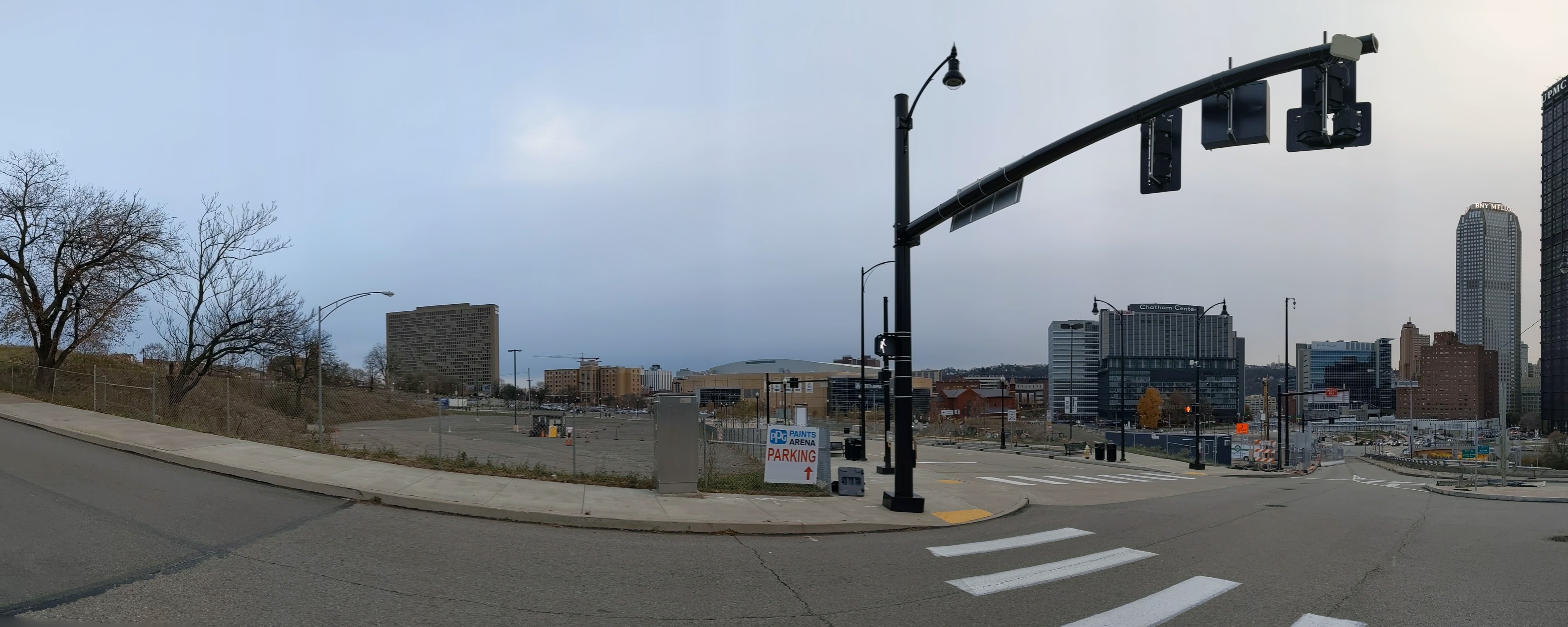
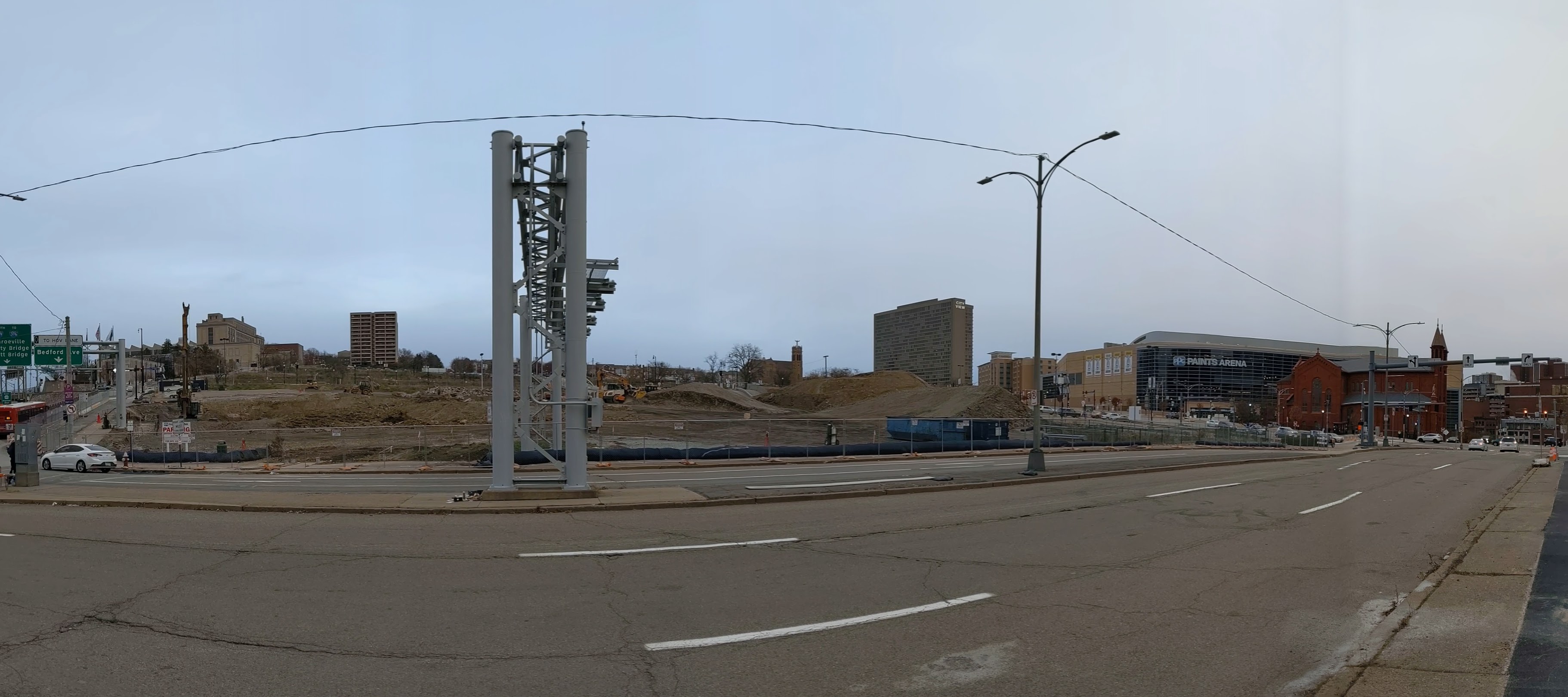
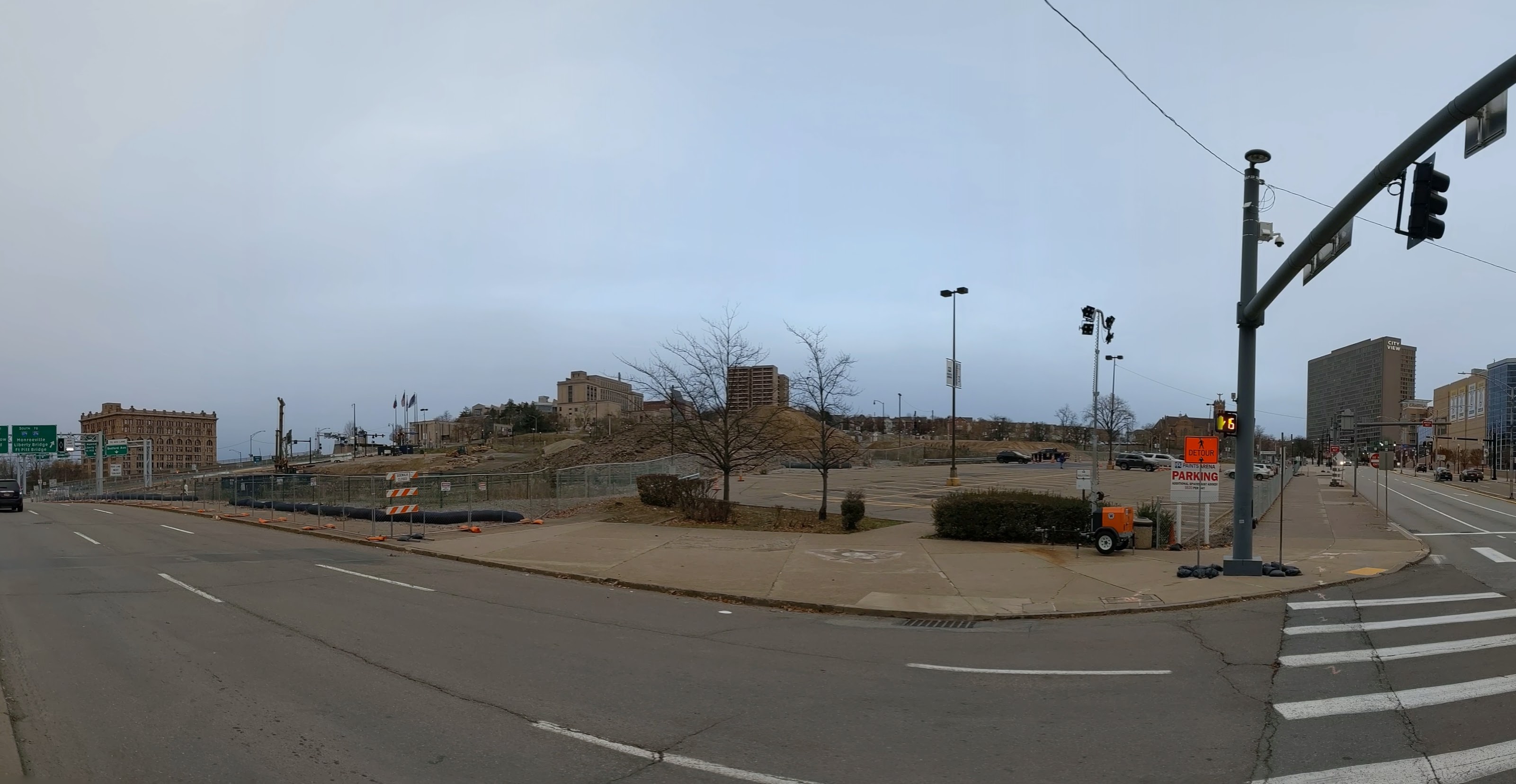
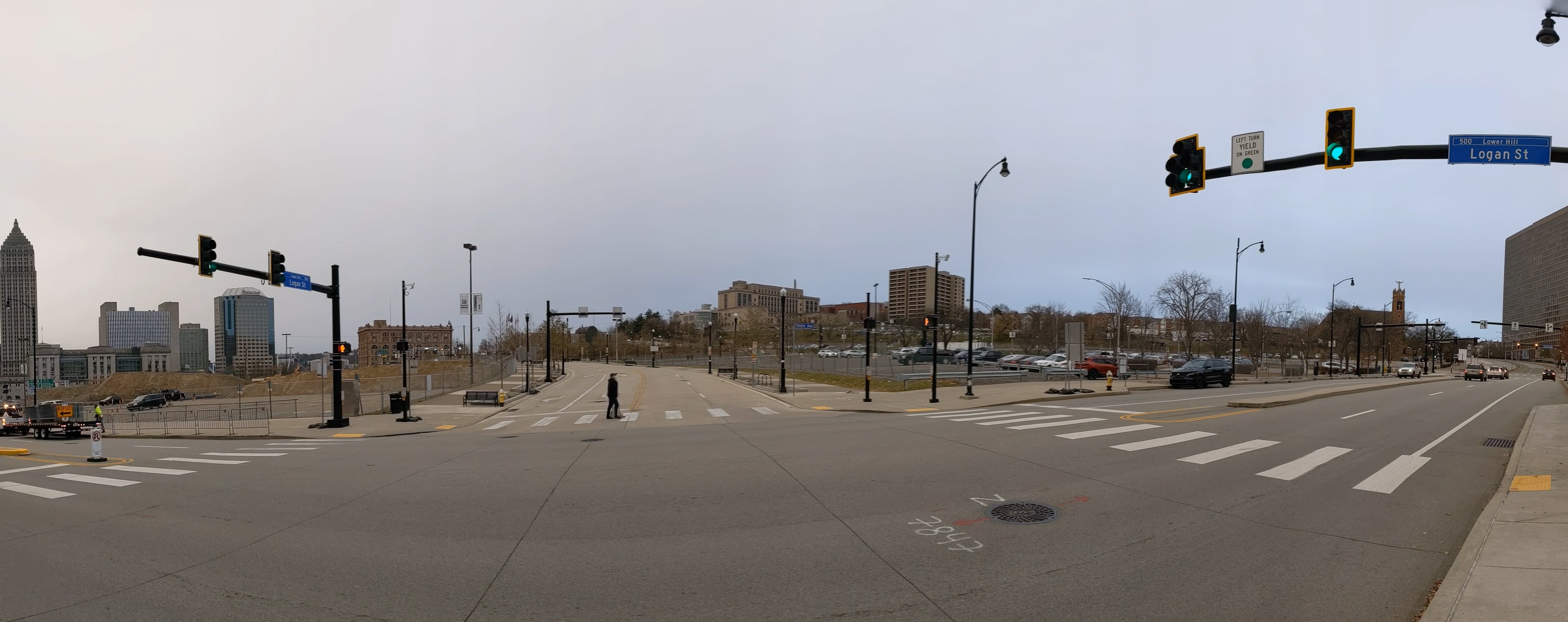
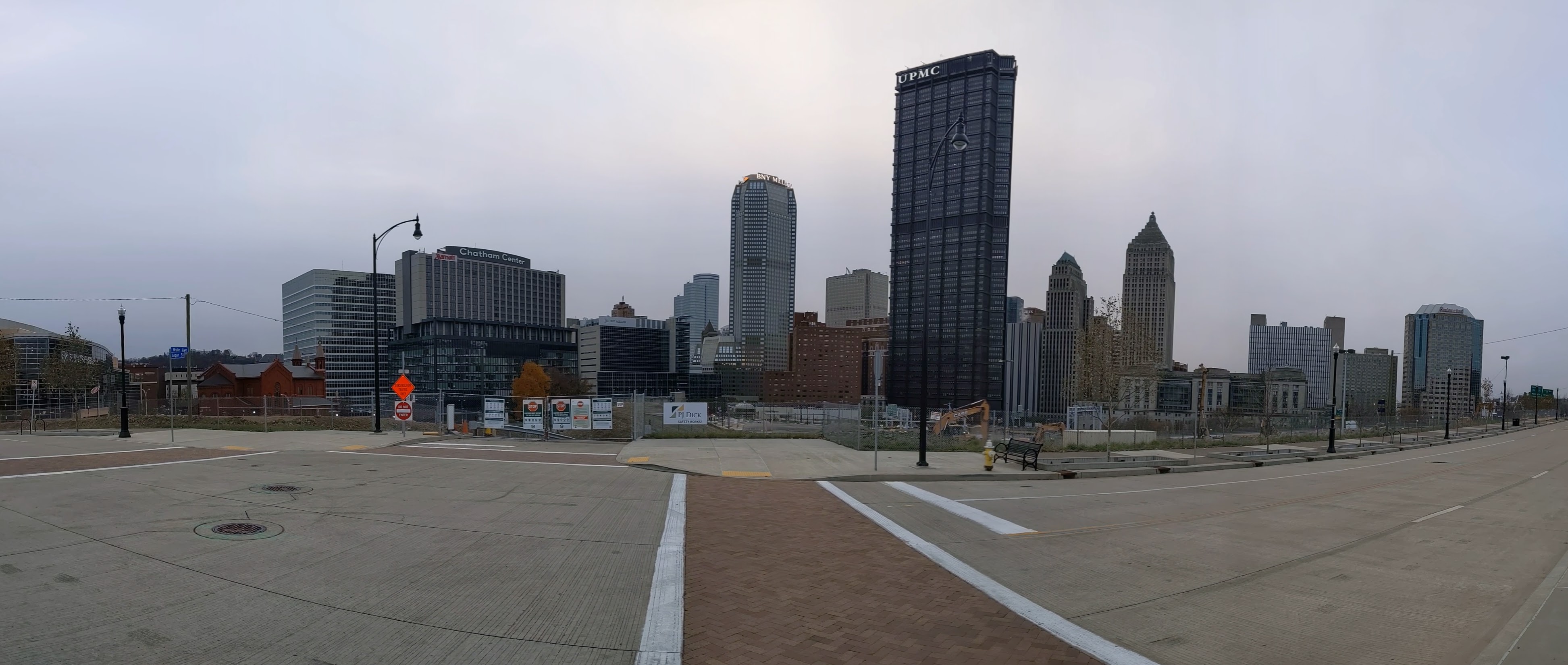
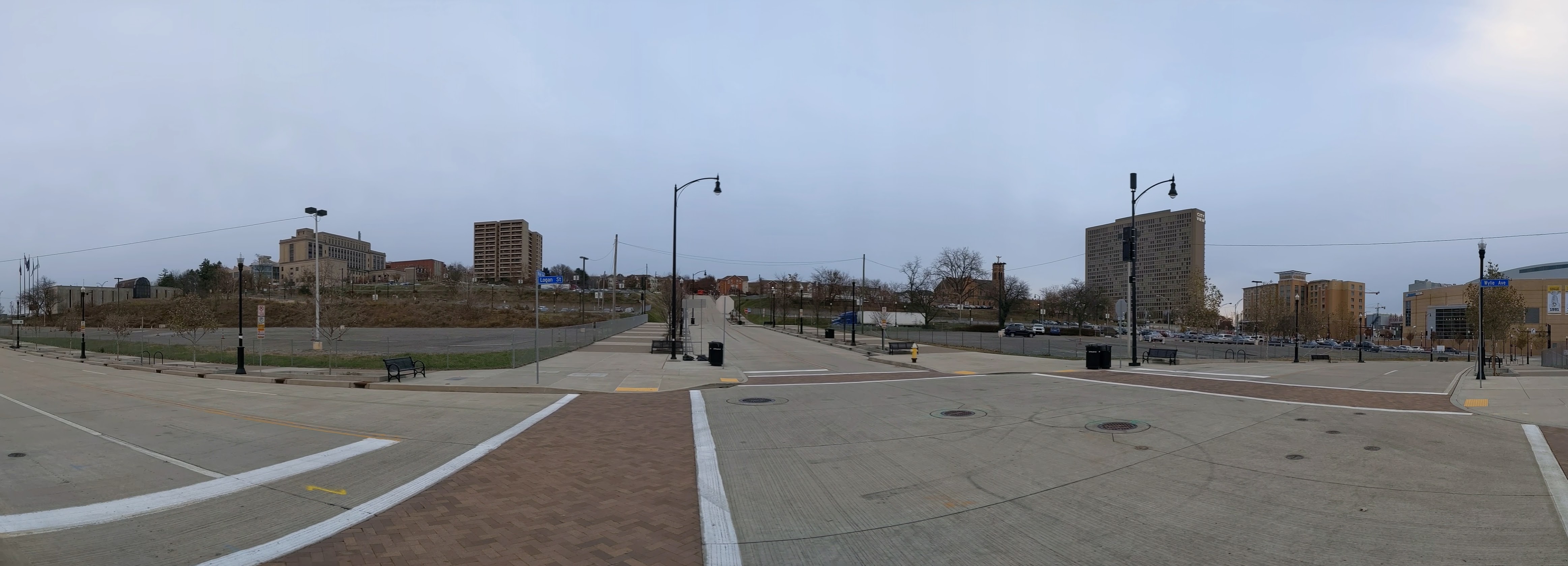
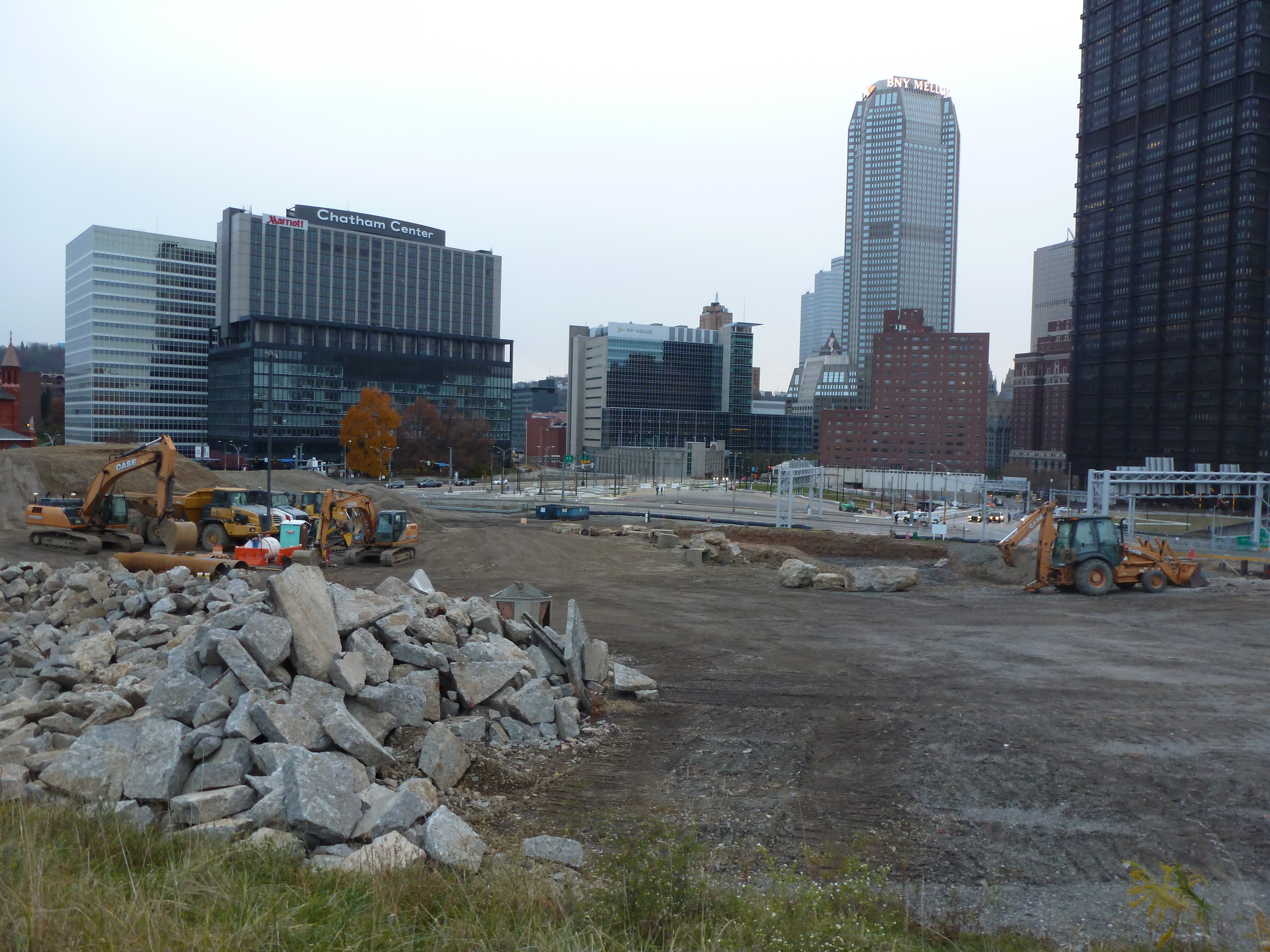
Ground has broken! There are a large hole, giant piles of dirt and debris, and closed sidewalks as construction begins for the new FNB Tower, the first building to be built on the site.
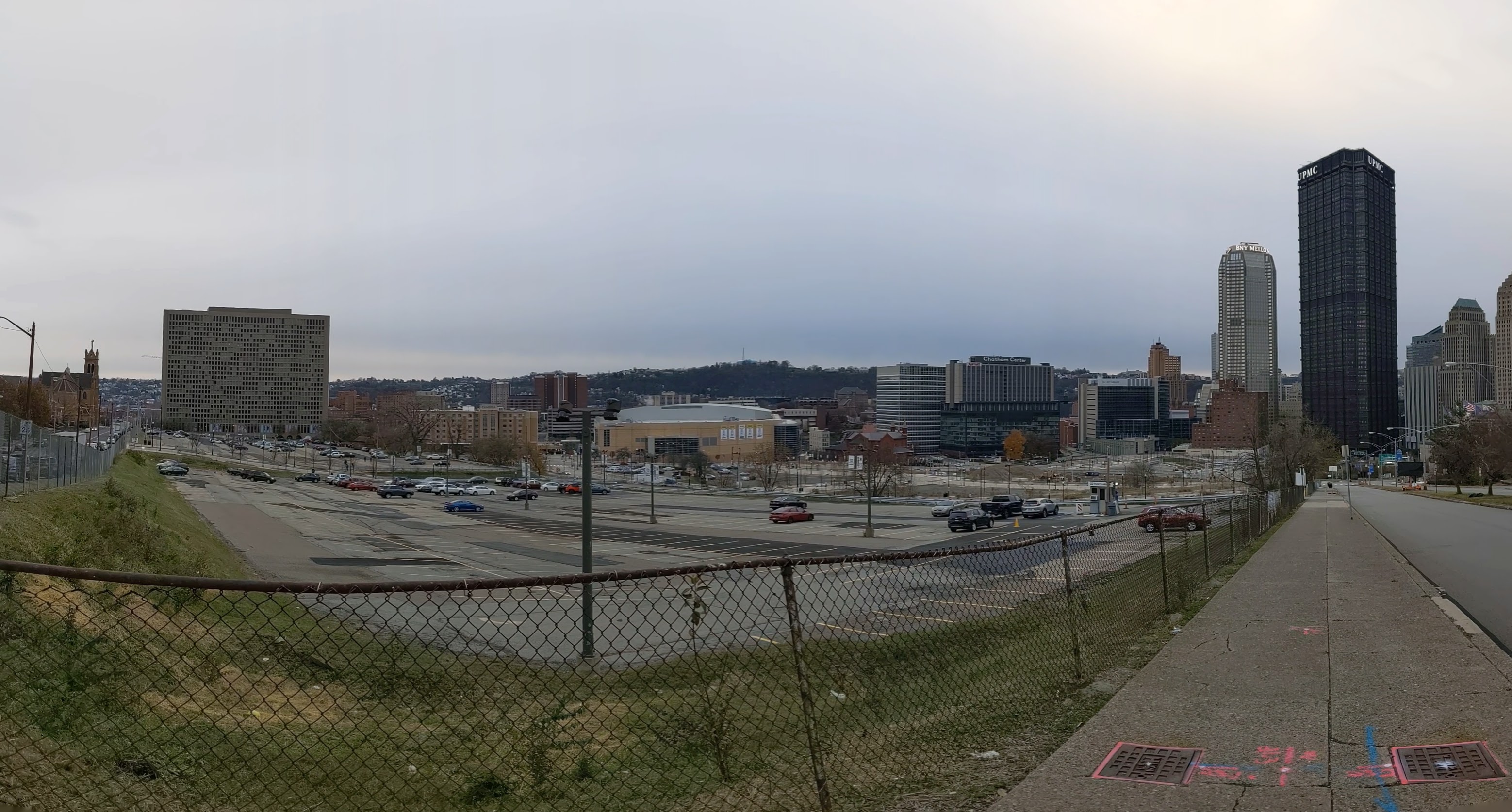
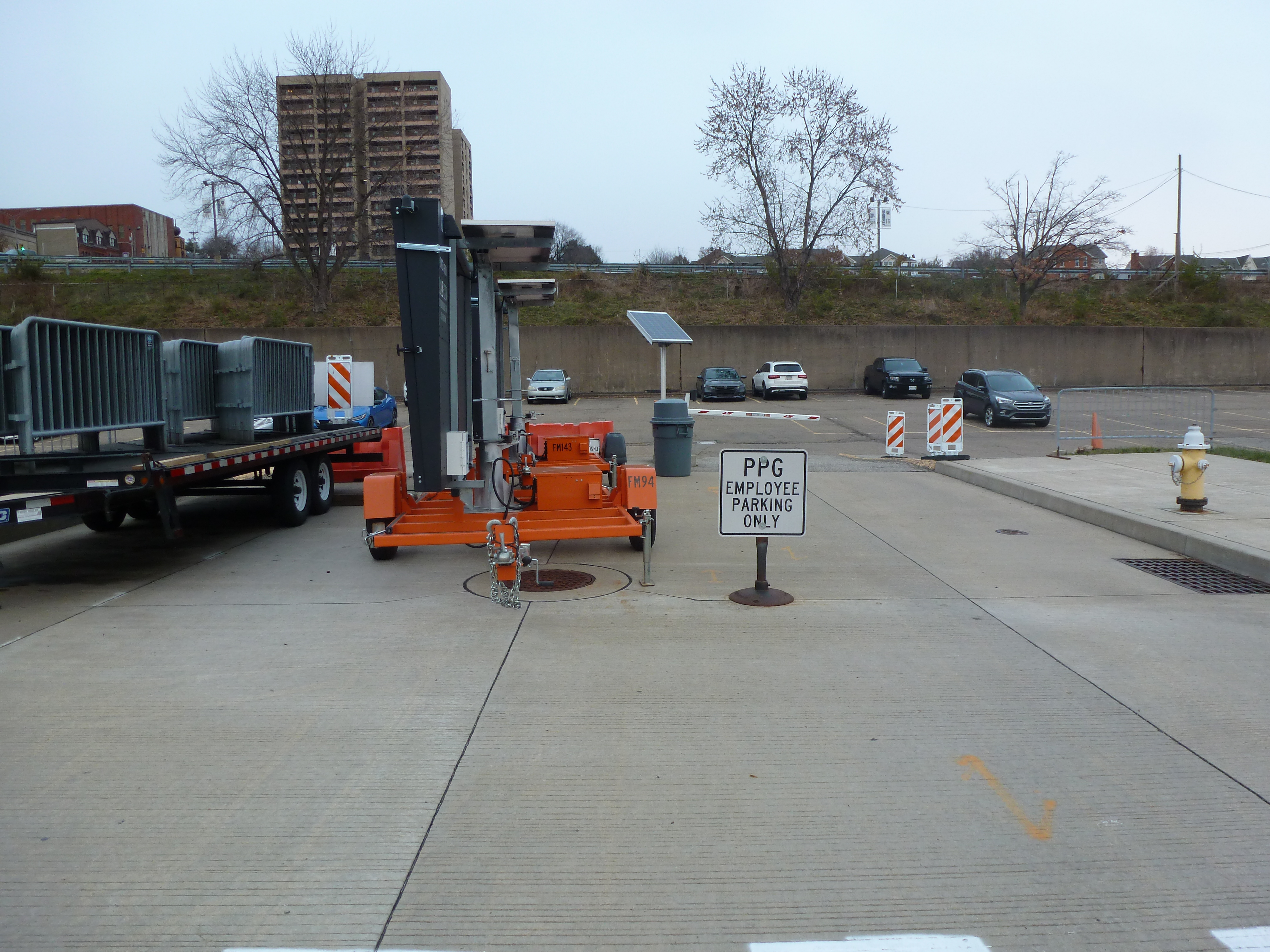
This was also the first time that I’ve visited the site on the day of a Penguins game, which was interesting to see how the sea of parking lots get used for events. At least one of the lots is reserved for employees only during events. There is also a slight price differential, the lot closet to the arena costs $30 to park for the event, while the one at the top of the hill is “only” $25.
Photos
Lower Hill in the News
Controversy and concerns continue over the redevelopment of the Lower Hill from the Executive Management Committee that was appointed to answer how the redevelopment would benefit the entire Hill District in private meetings (September 17, 2021, Public Source, & September 23, 2021, NextPittsburgh) to the impact of a pending change in owner of the Penguins (November 23, NextPittsburgh) and the pending registration of a second community organization in the Lower Hill, which would then also participate in the Lower Hill development activities meetings (November 19, 2021, Public Source). The potential new owner has previously been involved in real estate development around sports arenas (November 21, 2021, Post-Gazette).
Uptown is one of the many neighborhoods in Pittsburgh that experienced decades of neglect. For this neighborhood, the neglect was despite Uptown being sandwiched between Oakland and downtown, two places among the state’s strongest economic regions. Zipping through Uptown from Oakland to downtown on Fifth Avenue or from downtown to Oakland on Forbes Avenue, it is easy to overlook or dismiss the hodgepodge of ruined home foundations turning back to forest; scattered vacant lots, parking lots, and industrial uses; and the intricate architectural details on abandoned and renovated townhomes.
In recent years, new buildings started springing up here and there. Some of these new projects are the work of the two institutions in the neighborhood: UPMC Mercy Hospital and Duquesne University. Others are the work of a variety of commercial and residential developers. Two reasons for this recent investment are the proposed Bus Rapid Transit system, which will eventually run through the neighborhood, and the in-progress redevelopment of the Lower Hill, an adjacent neighborhood.
The Uptown community saw these changes coming and prepared. Between 2015 and 2017, the community organization Uptown Partners collaborated UPMC Mercy, Duquesne University, the City of Pittsburgh, and others to create the EcoInnovation District Plan and the Uptown Public Realm zoning district. The plan and new zoning district are intended to guide future development and leverage their economic investment for the greater good of the neighborhood. Ideally, this will reduce the number of those who will be left behind.
This blog post is part of an on-going series watching the changes in Uptown. Periodically, once or twice a year, I return to the neighborhood to take new photographs of the same areas. In addition, I include links to articles about the project that I’ve encountered since the previous post in the series. At the end of the post, there is a map showing the location of the neighborhood and links to the previous posts in the series.
What’s new
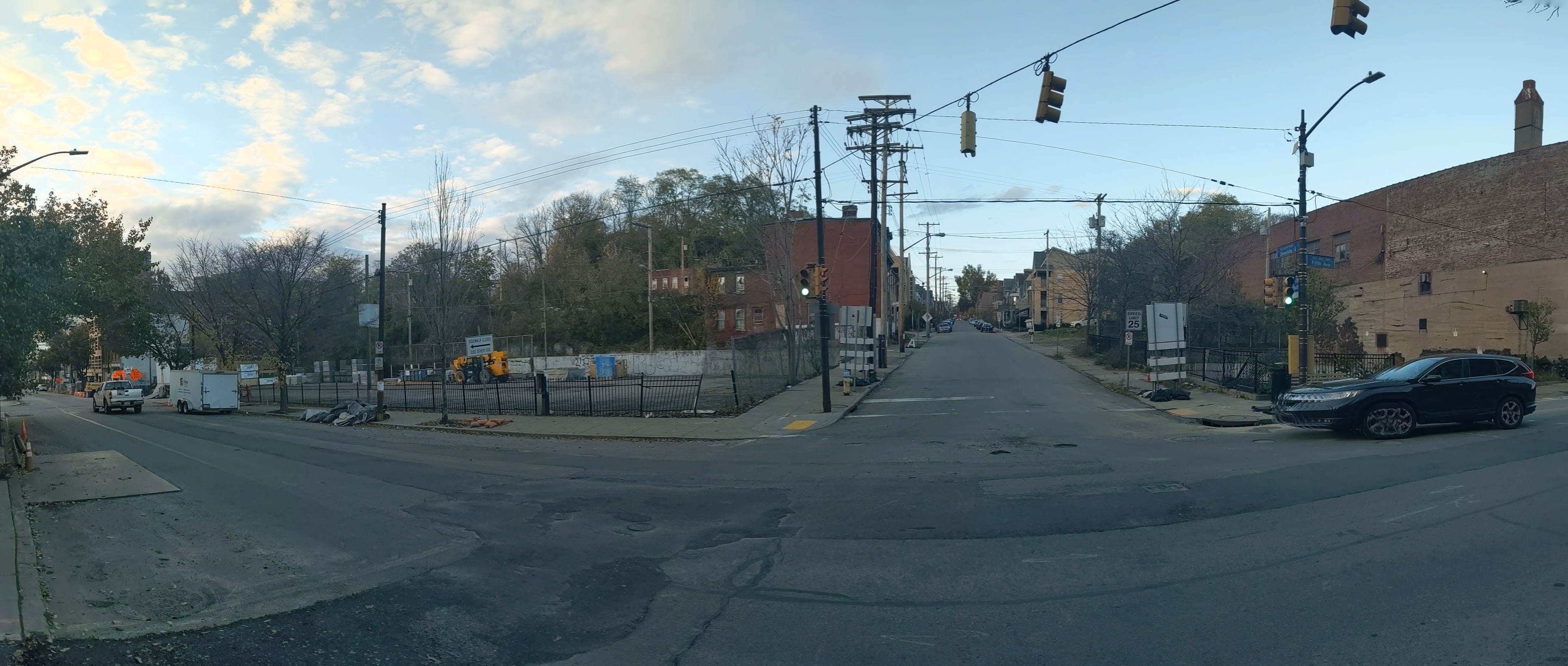
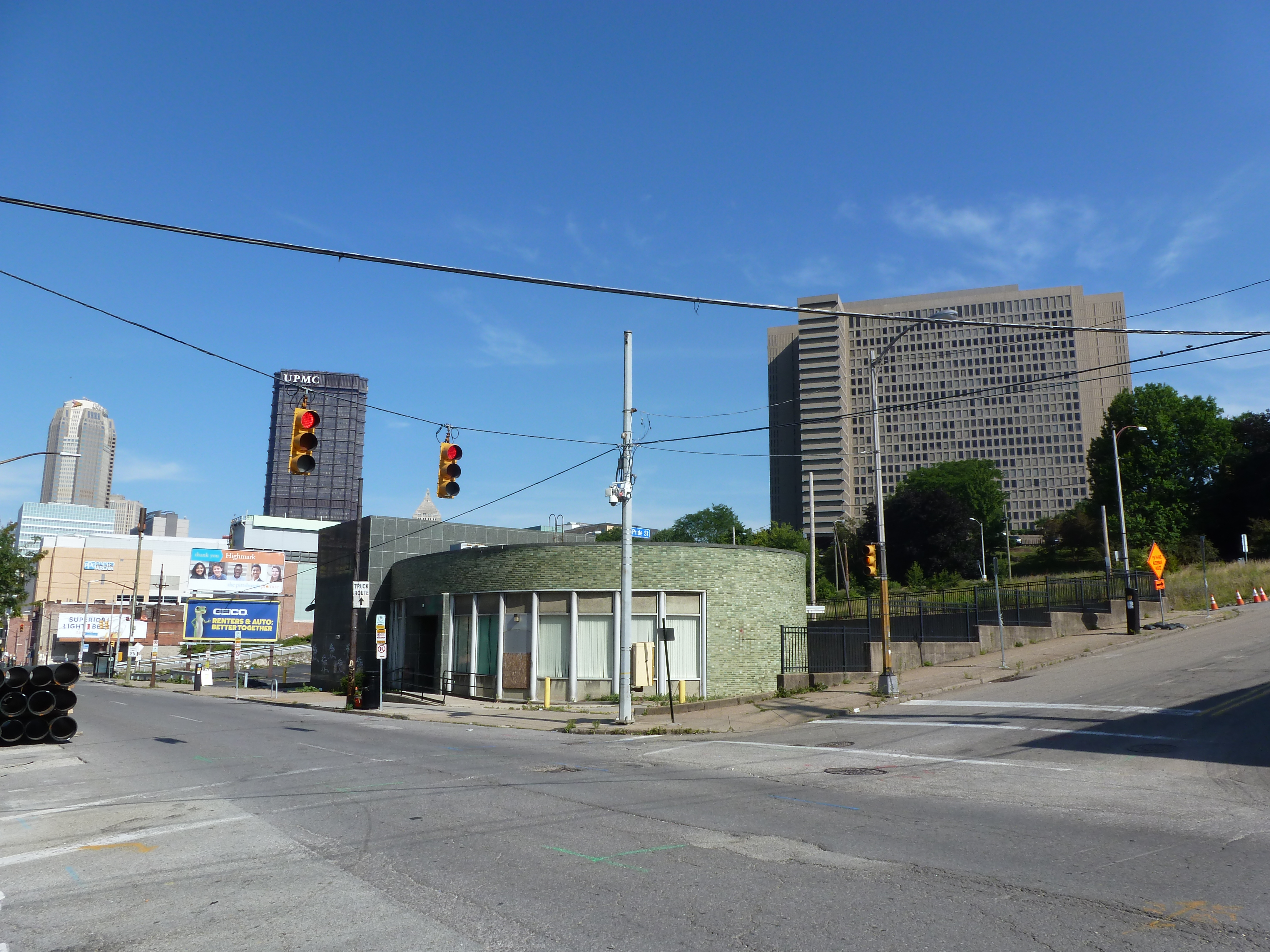
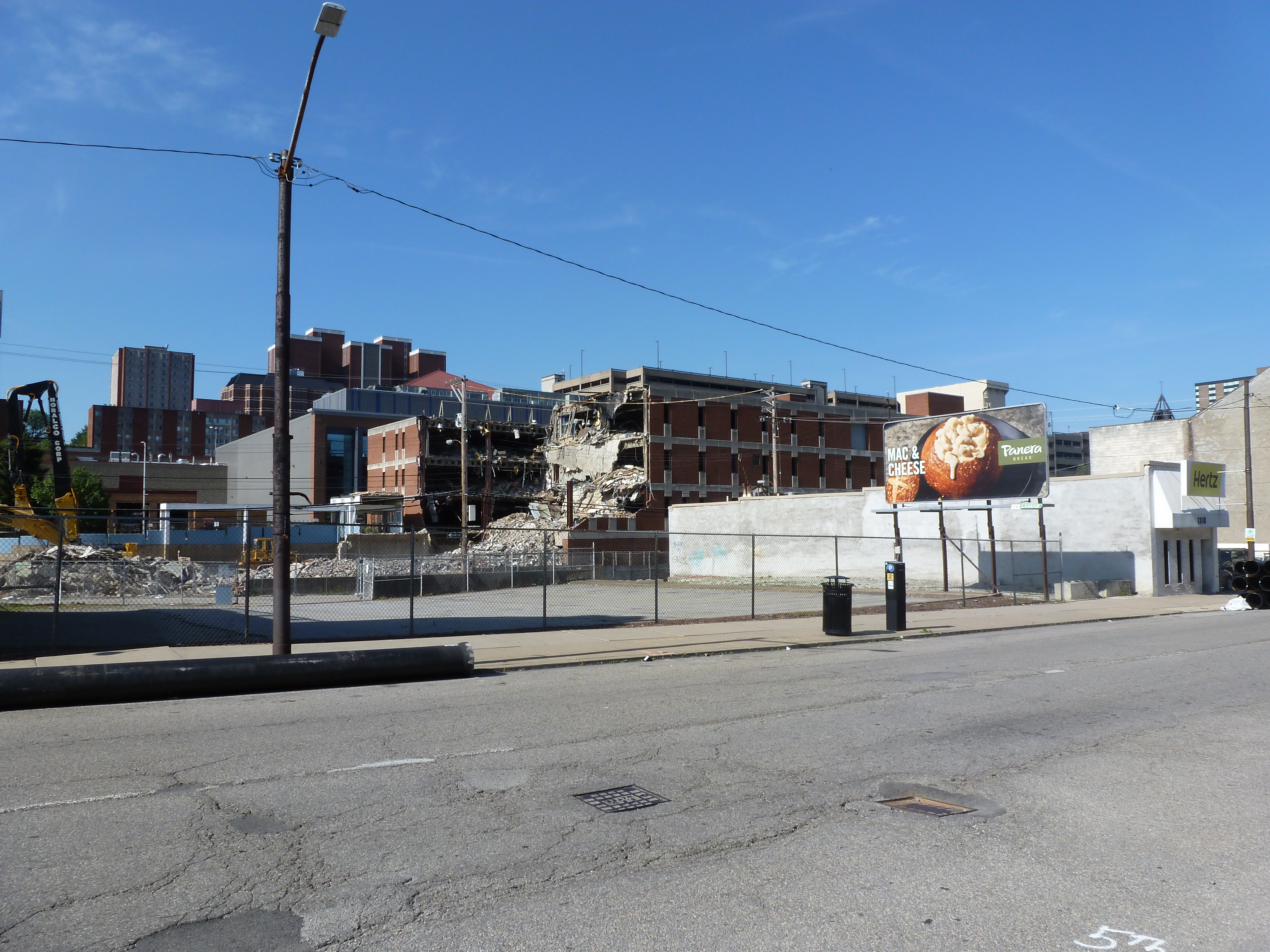
Since the last walk through the neighborhood, several buildings have been demolished while those that have been under construction continue to make progress. Progress also continues on a handful of housing renovations in the neighborhood.
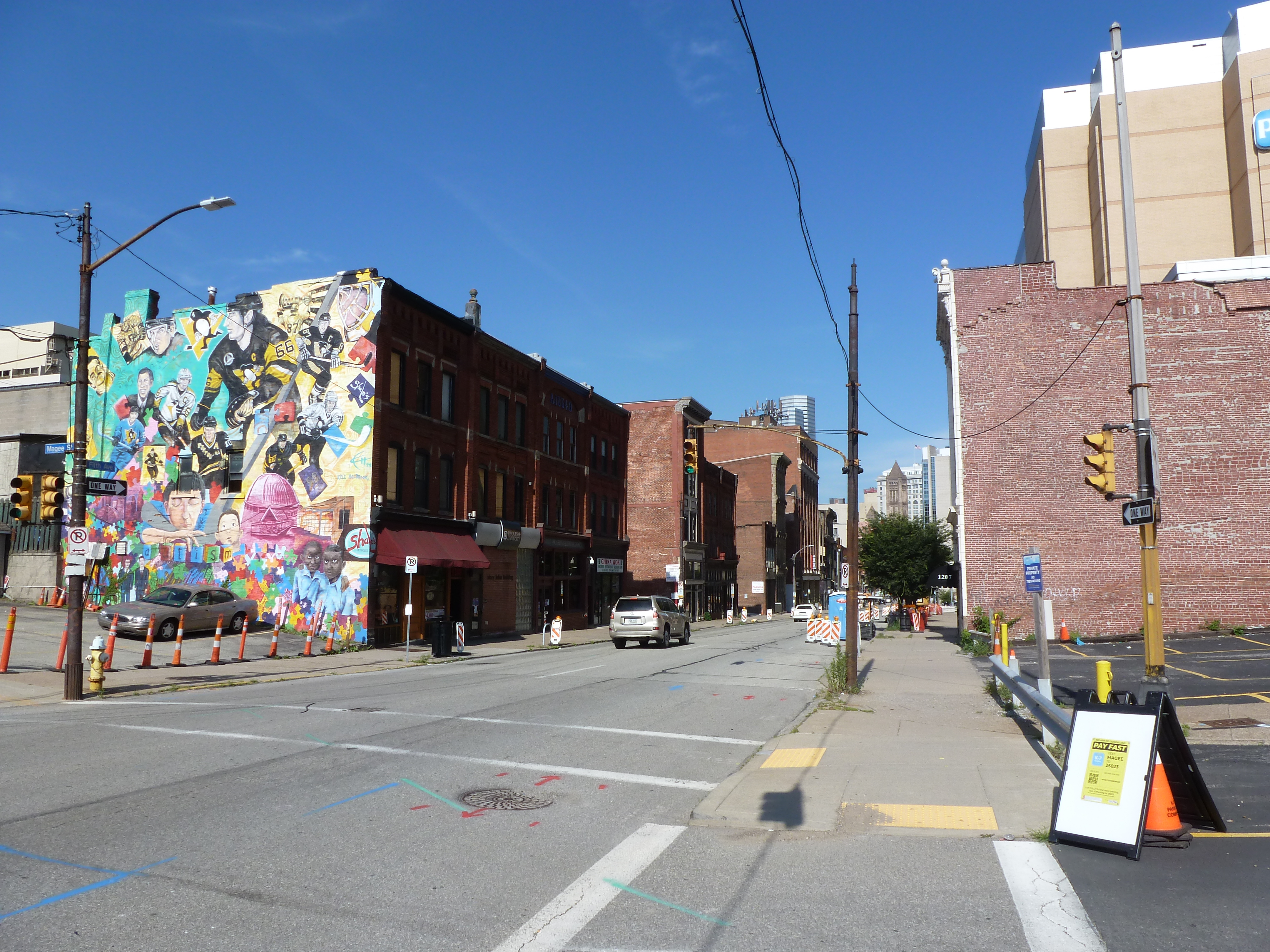
The roads and sidewalks were even more rough and patched from the utility line replacements started this spring. According to a recent press release from the Mayor’s office, this utility work will continue next year, so a temporary repaving will be happening shortly to smooth out the roads for the winter season.
While I believe that this utility work is part of the Pittsburgh Water and Sewer Authority’s lead line replacement project, there were new signs up in the neighborhood apologizing for the mess as the neighborhood prepares for the Bus Rapid Transit (BRT). The utility replacement mess has happened in various neighborhoods throughout the city including those that are not part of the BRT routes. However, there was no other obvious mess, yet, that would be more directly associated with the construction of a BRT and need signs of apology.
The Photos
Uptown in the News & on the Web:
The pending Fifth and Dinwiddie development (image 8 above) proposes to be Passive House certified, include double the number of affordable housing units required by the URA as a condition of sale, and provide training on clean energy jobs. (September 20, 2021: NextPittsburgh)
UPMC’s Vision and Rehabilitation Center (images 19, 9, 12 above) is on track to open in 2023 despite construction disruptions, supply shortages, and the pressure placed on existing healthcare systems by COVID. (November 16, 2021: Pittsburgh Business Times, Tribune Review)
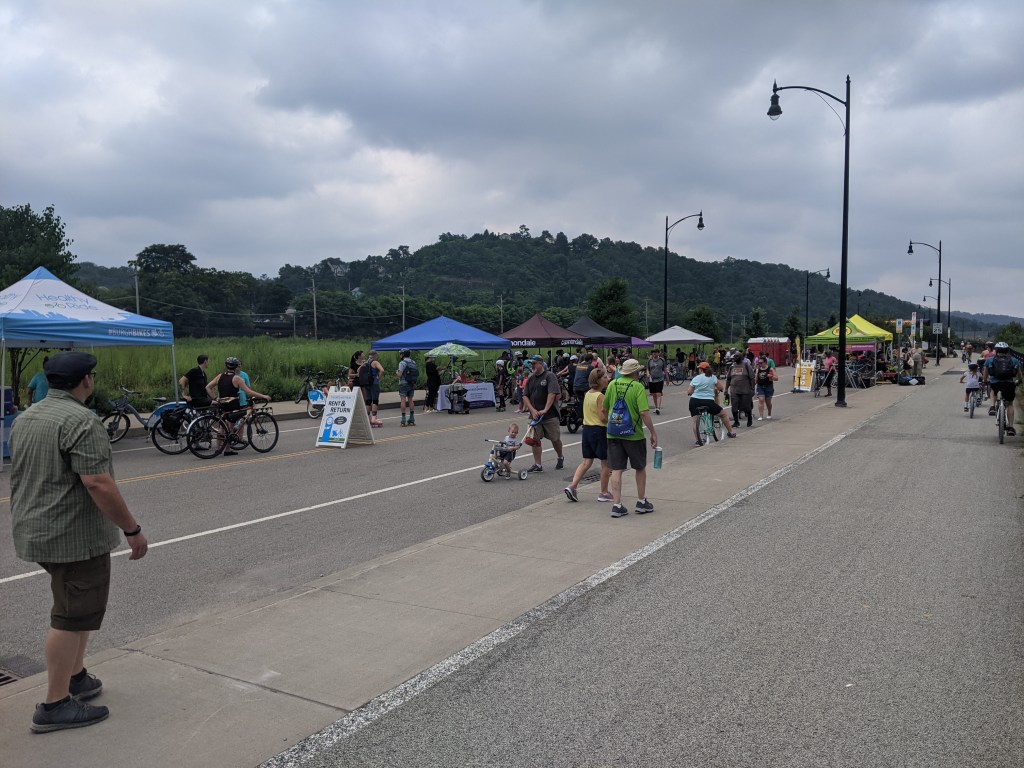
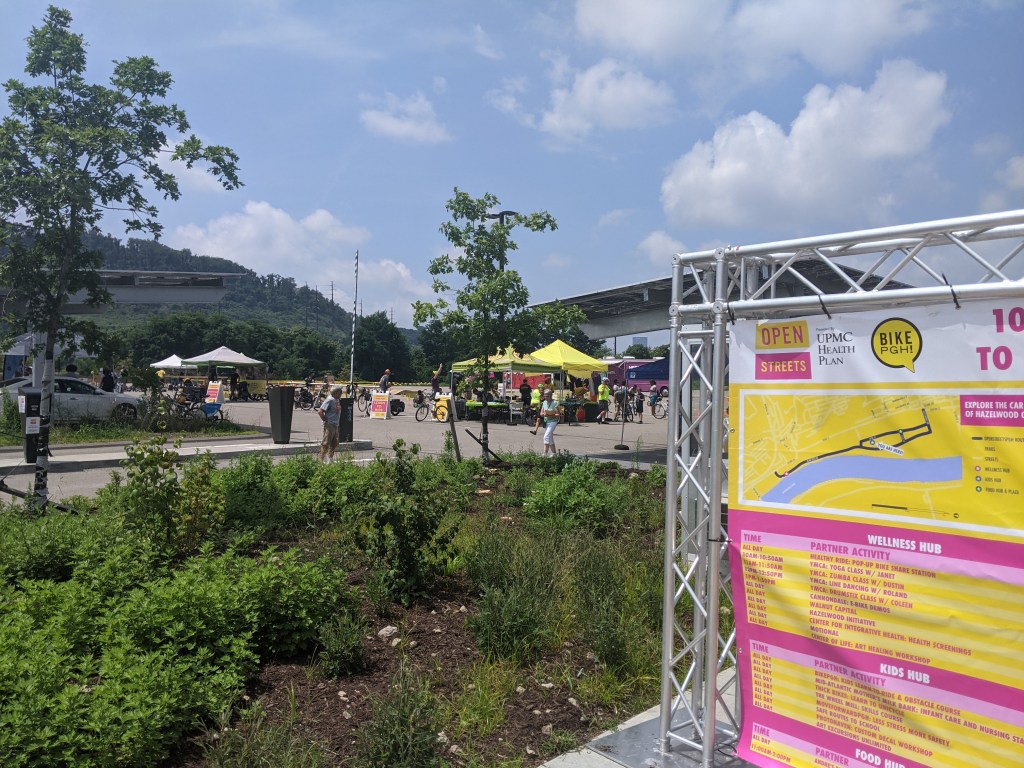
I was confused when Open Streets Pittsburgh announced that it was closing the streets in Hazelwood Green to cars and opening them to bicycles, roller skates, walkers, etc. Unlike the other locations they’ve done, not many cars use these streets and there aren’t any businesses on the site that people would come back to patronize after the festival.
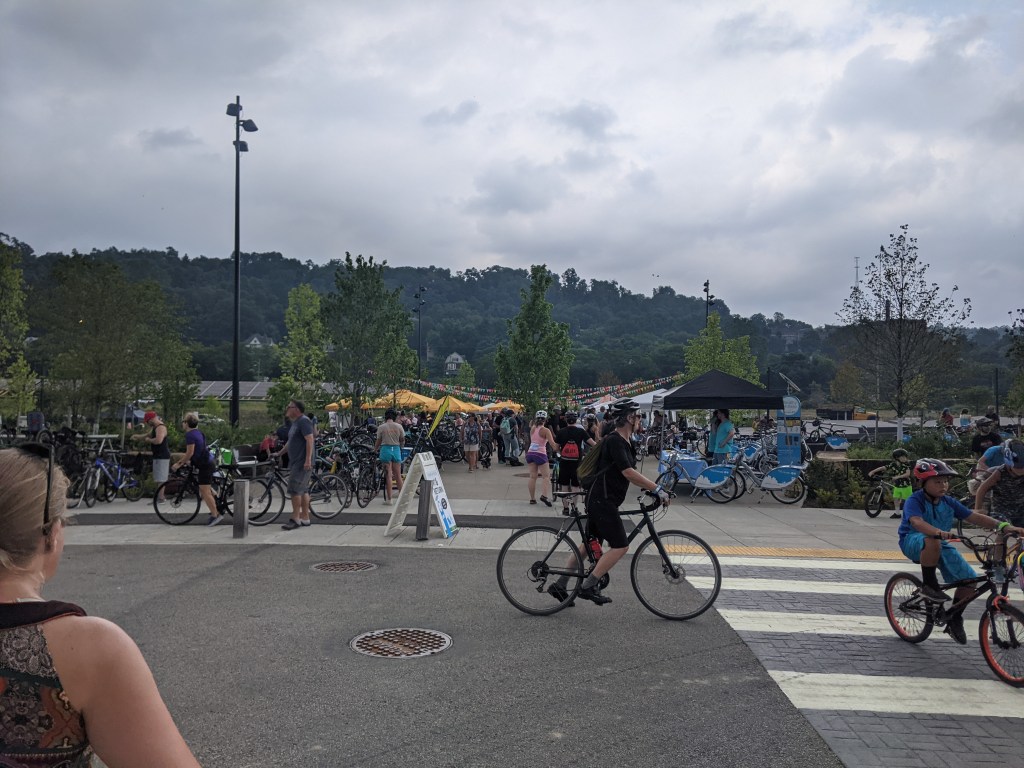
However, it worked as a vehicle to increase awareness of the bike trail, plaza, and repurposed industrial buildings on the site. People who never or rarely come to Hazelwood, but come to Open Streets, came and participated. There were far more people than I’ve seen congregated in a single location since the beginning of the pandemic, which is also an exponential increase in the number of people I’ve seen in Hazelwood Green either pre-, post-, or during pandemic.
It was great to see the new plaza put to one of its intended uses as a concert venue with vendors on the paved portion. I arrived in time to grab some lunch from the tent for C&D’s Kitchen, a local Hazelwood restaurant, before finding a good seat to enjoy Jimmy Adler’s Blues Band and people watch. A young girl unconsciously stopped in her tracks to swing her hips to the music (not having the muscle coordination yet to do both). Across the green, a man kicked off his shoes to boogie on the grass.
I hope to enjoy many more such sights at events in this plaza.
Uptown is one of the many neighborhoods in Pittsburgh that experienced decades of neglect. For this neighborhood, the neglect was despite Uptown being sandwiched between Oakland and downtown, two places among the state’s strongest economic regions. Zipping through Uptown from Oakland to downtown on Fifth Avenue or from downtown to Oakland on Forbes Avenue, it is easy to overlook or dismiss the hodgepodge of ruined home foundations turning back to forest; scattered vacant lots, parking lots, and industrial uses; and the intricate architectural details on abandoned and renovated townhomes.
In recent years, new buildings started springing up here and there. Some of these new projects are the work of the two institutions in the neighborhood: UPMC Mercy Hospital and Duquesne University. Others are the work of a variety of commercial and residential developers. Two reasons for this recent investment are the proposed Bus Rapid Transit system, which will eventually run through the neighborhood, and the in-progress redevelopment of the Lower Hill, an adjacent neighborhood.
The Uptown community saw these changes coming and prepared. Between 2015 and 2017, the community organization Uptown Partners collaborated UPMC Mercy, Duquesne University, the City of Pittsburgh, and others to create the EcoInnovation District Plan and the Uptown Public Realm zoning district. The plan and new zoning district are intended to guide future development and leverage their economic investment for the greater good of the neighborhood. Ideally, this will reduce the number of those who will be left behind.
This blog post is part of an on-going series watching the changes in Uptown. Periodically, approximately every six months, I return to the neighborhood to take new photographs of the same areas. In addition, I include links to articles about the project that I’ve encountered since the previous post in the series. At the end of the post, there is a map showing the location of the neighborhood and links to the previous posts in the series.
What’s new
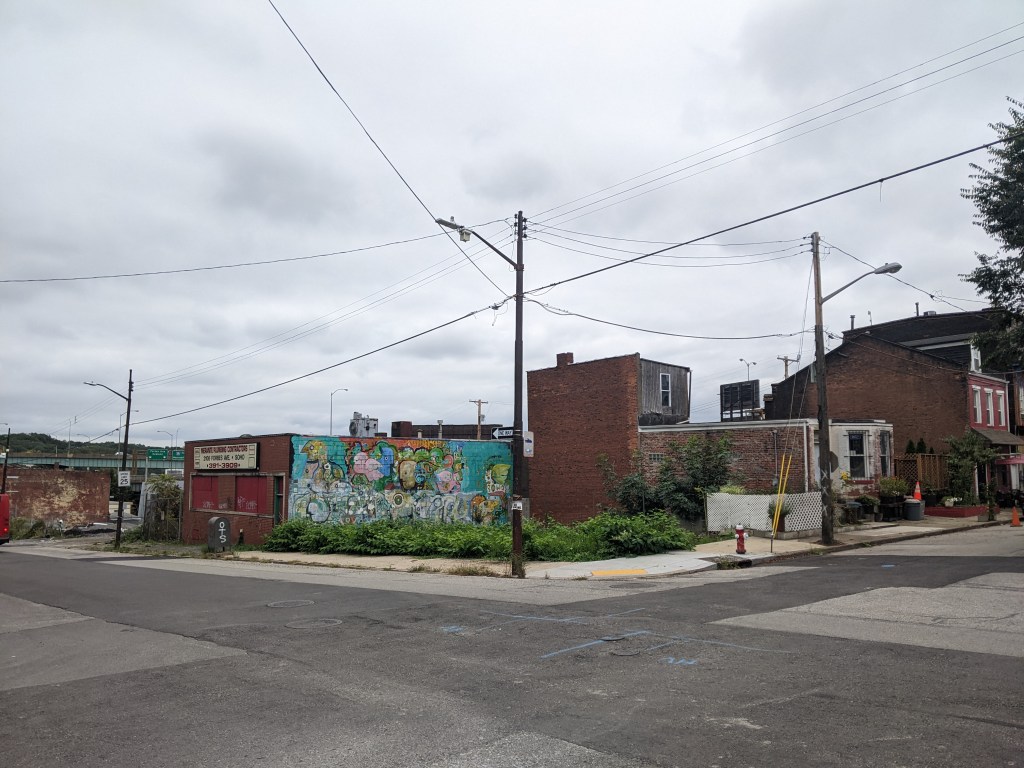
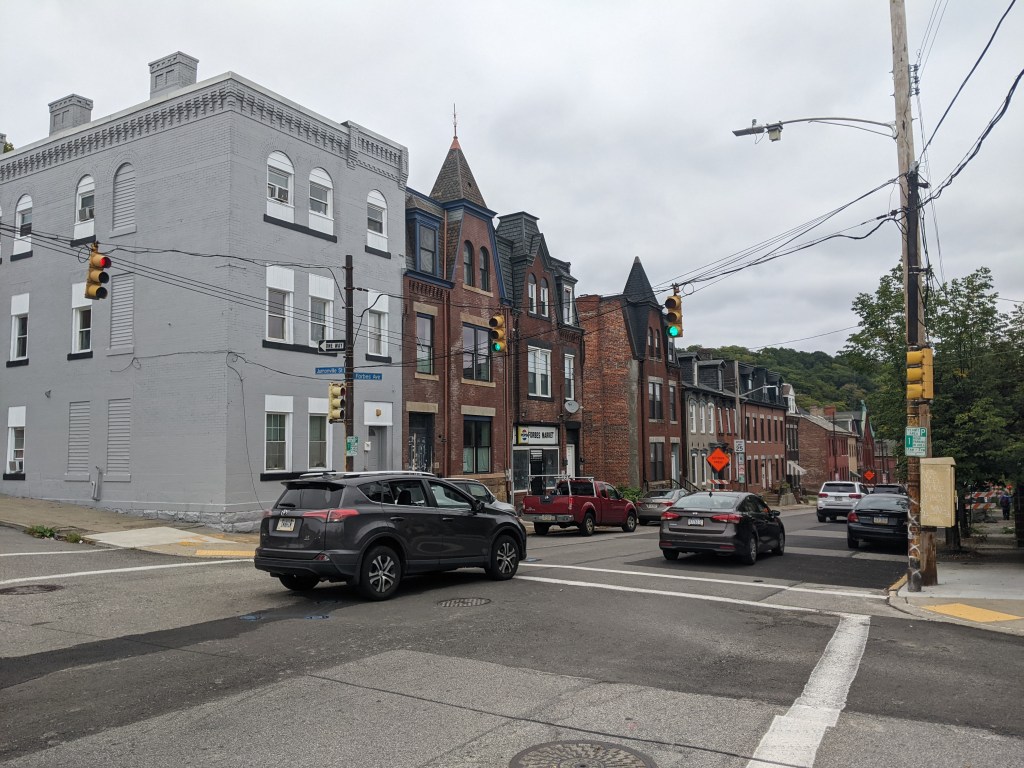
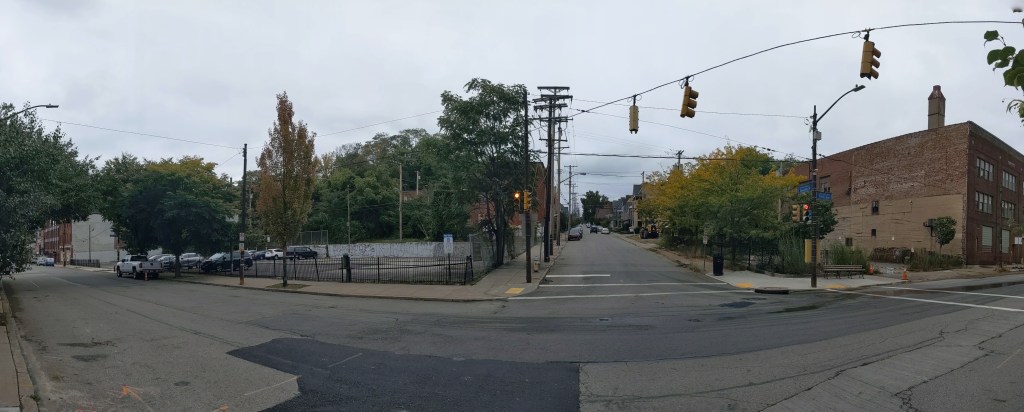
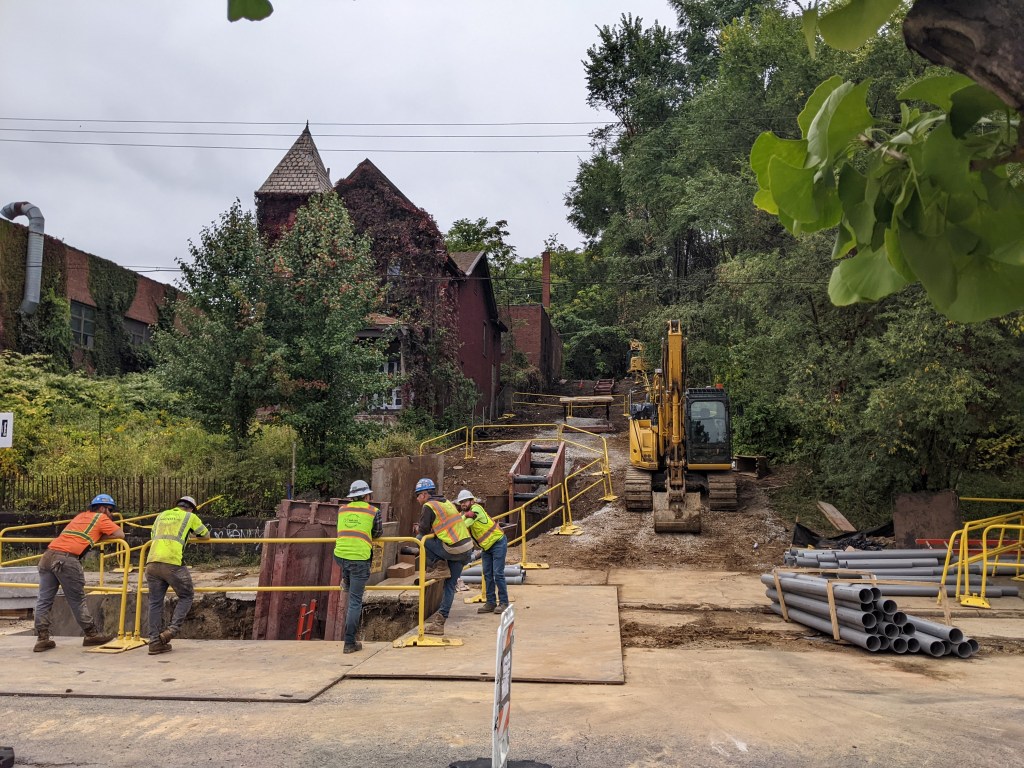
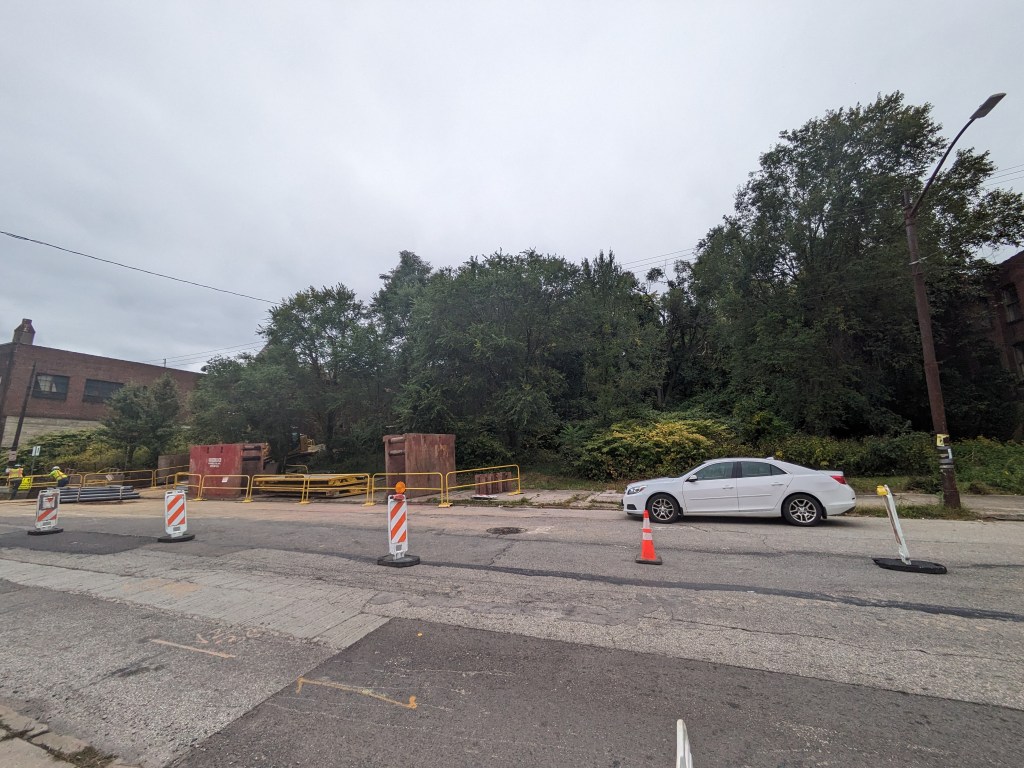
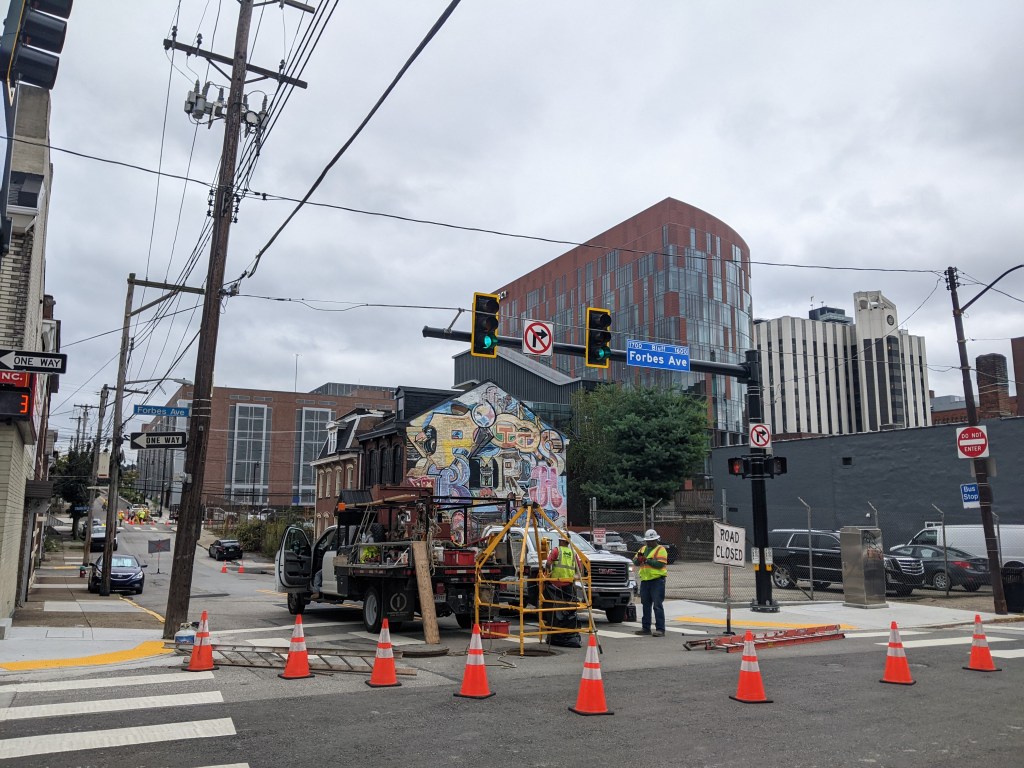
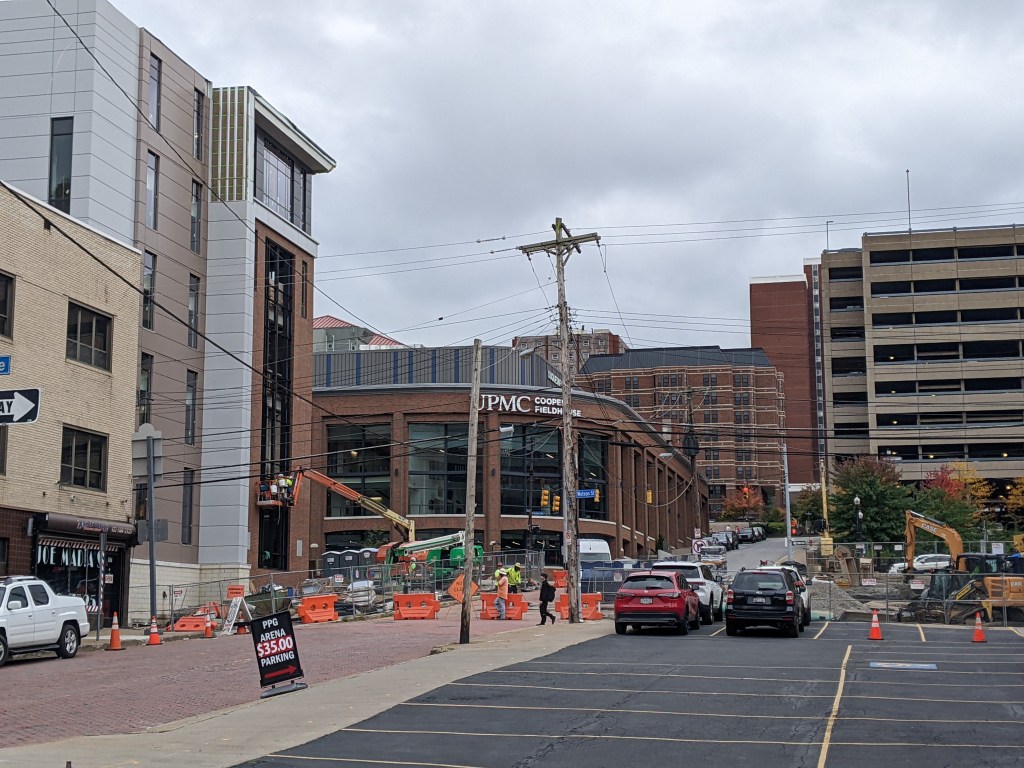
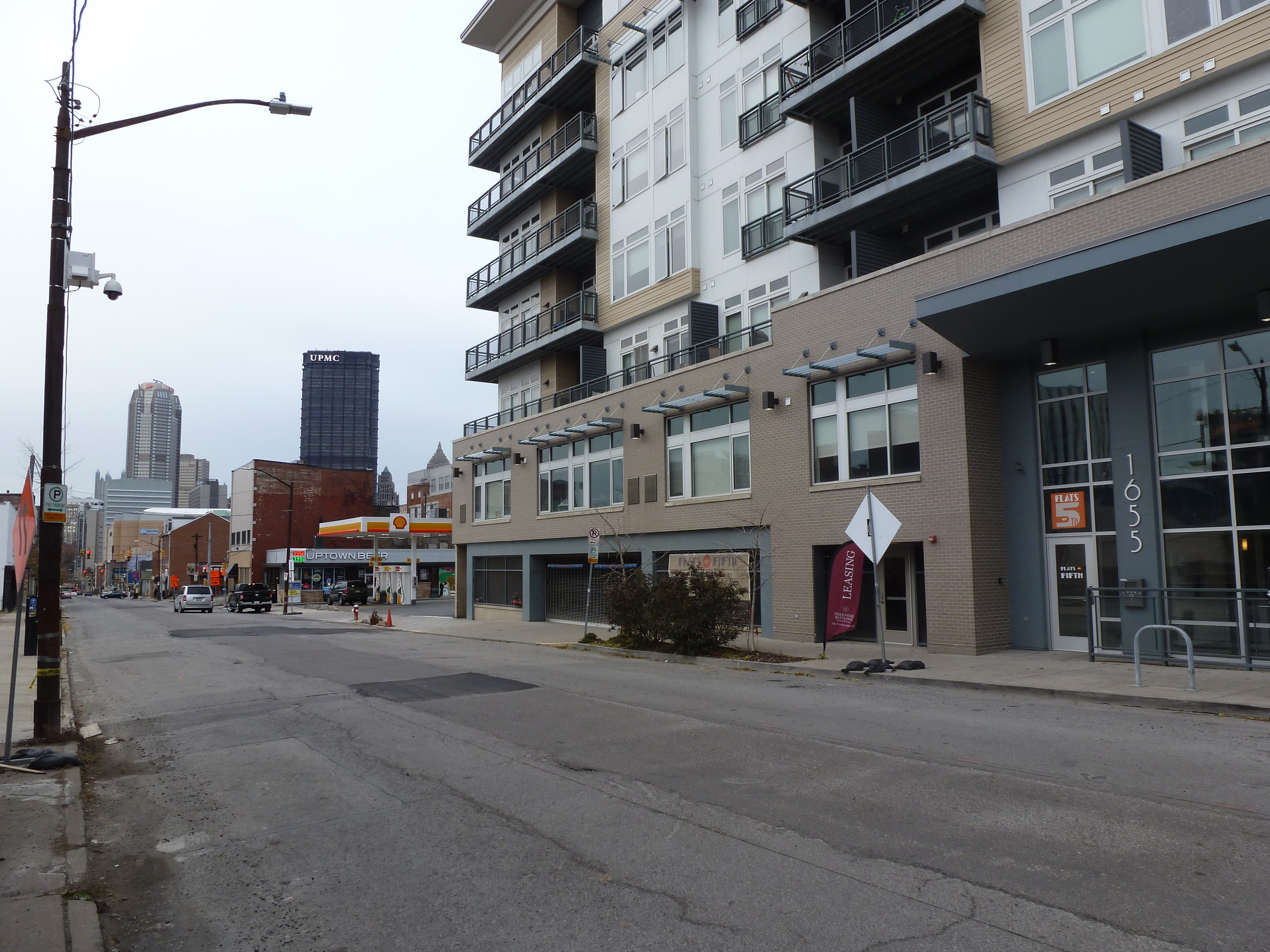
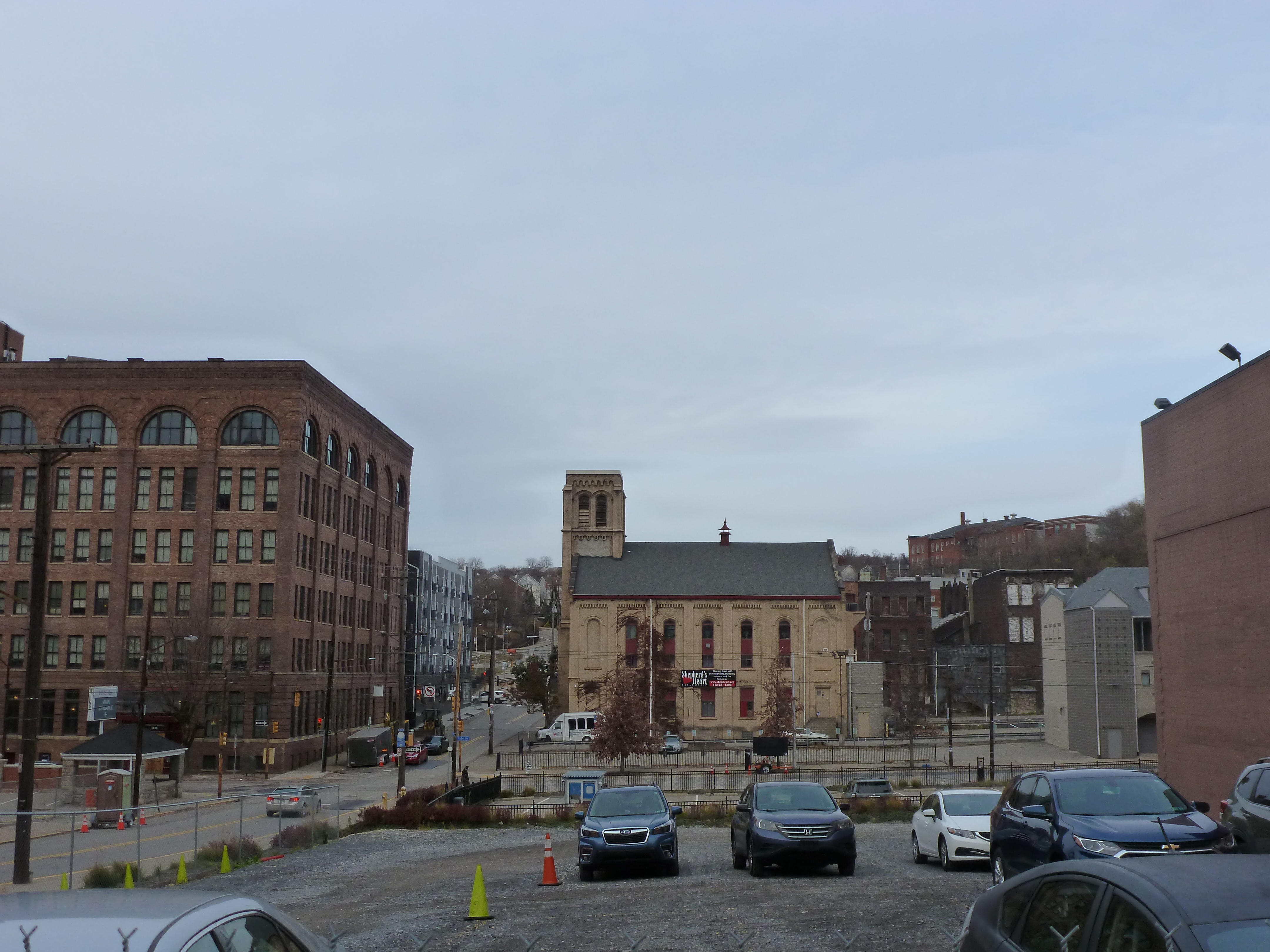
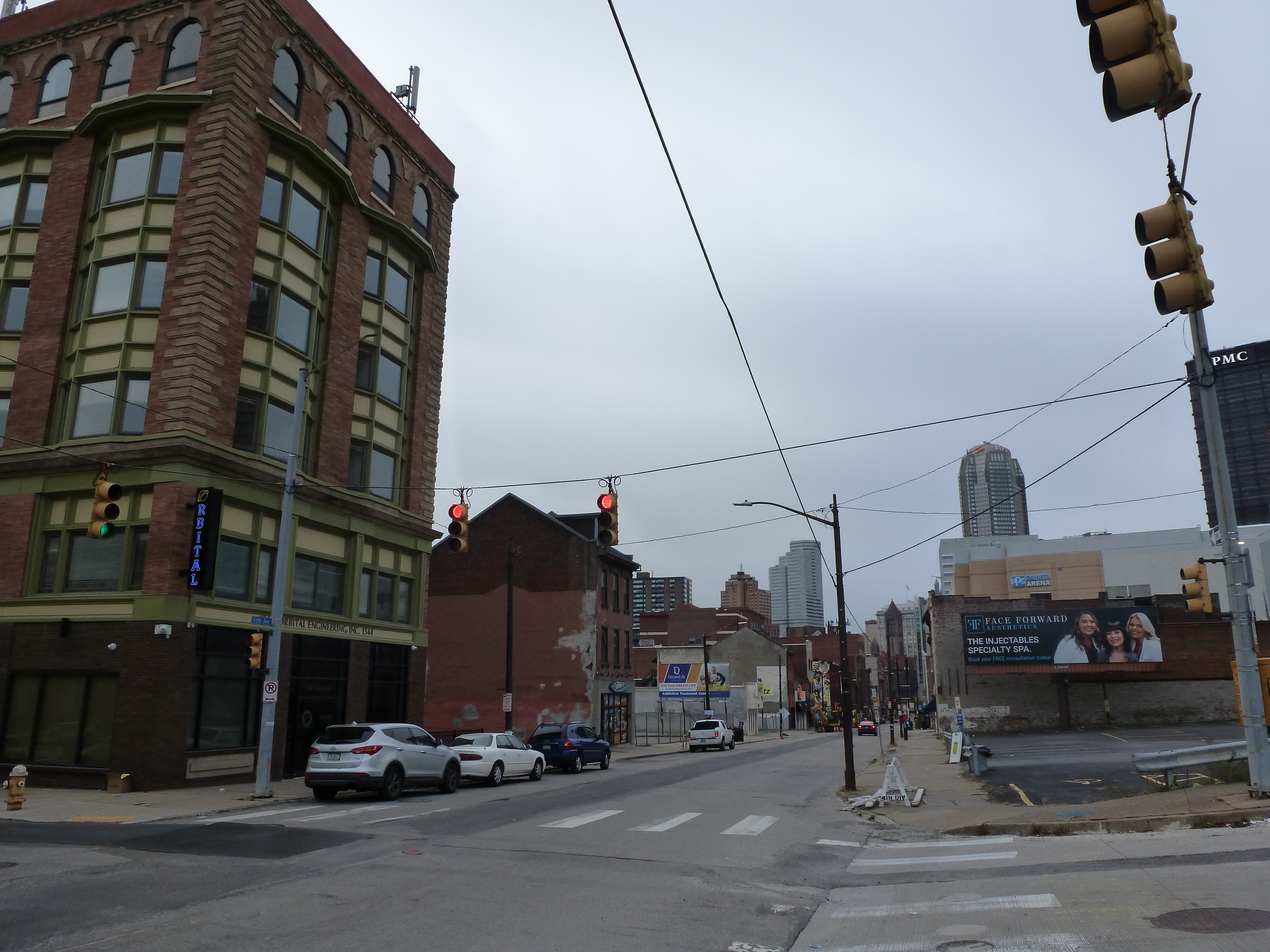
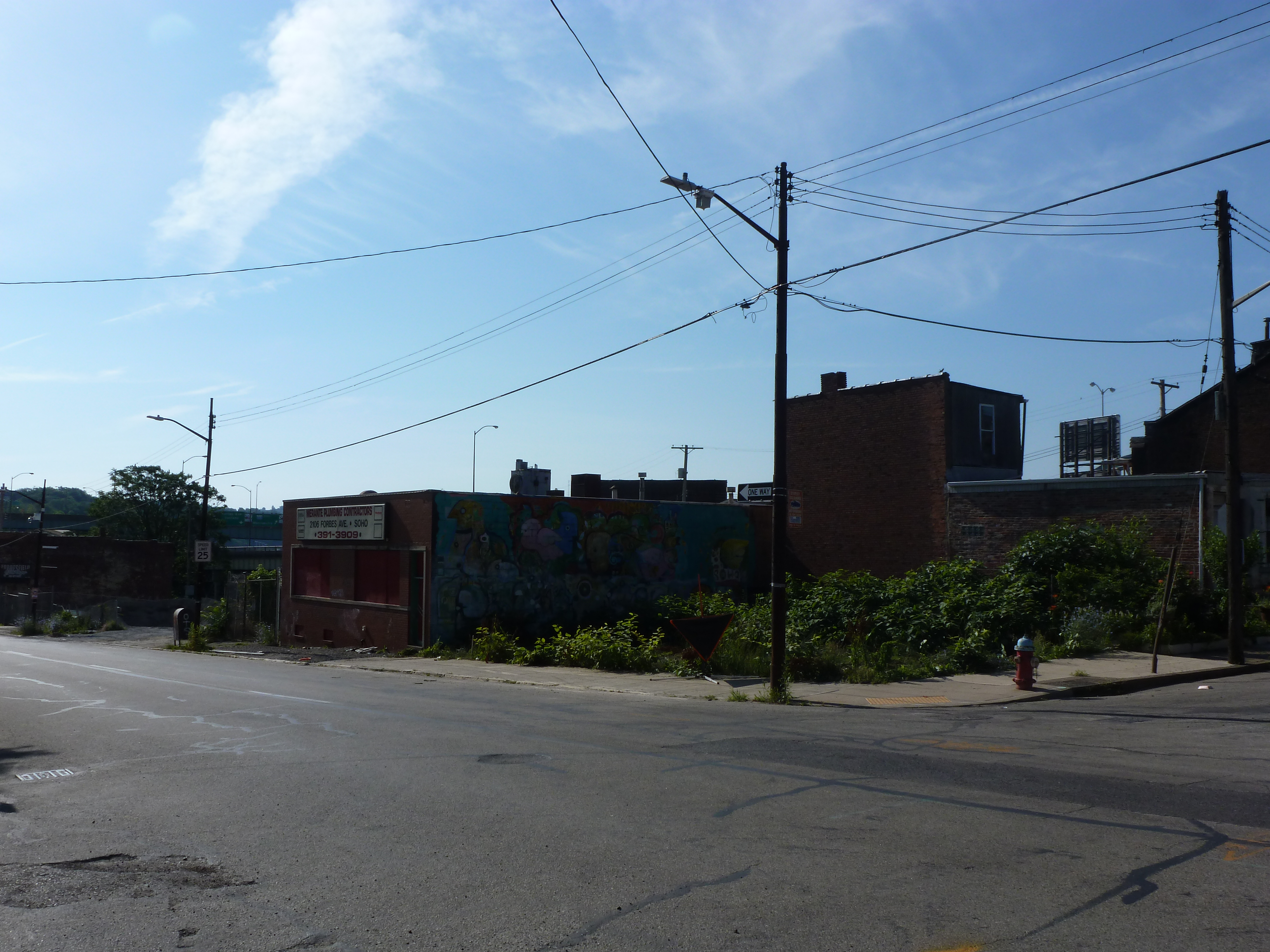
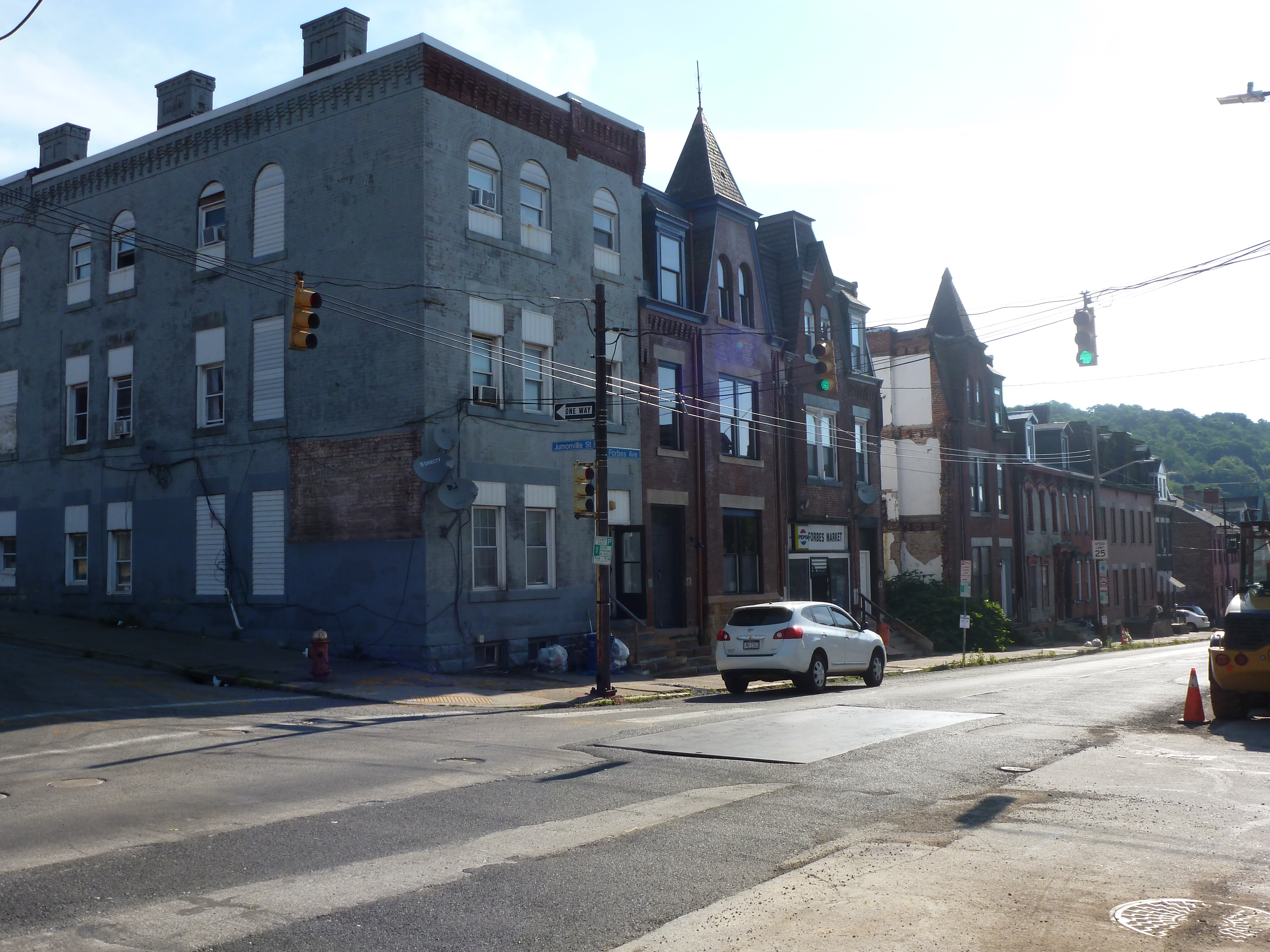
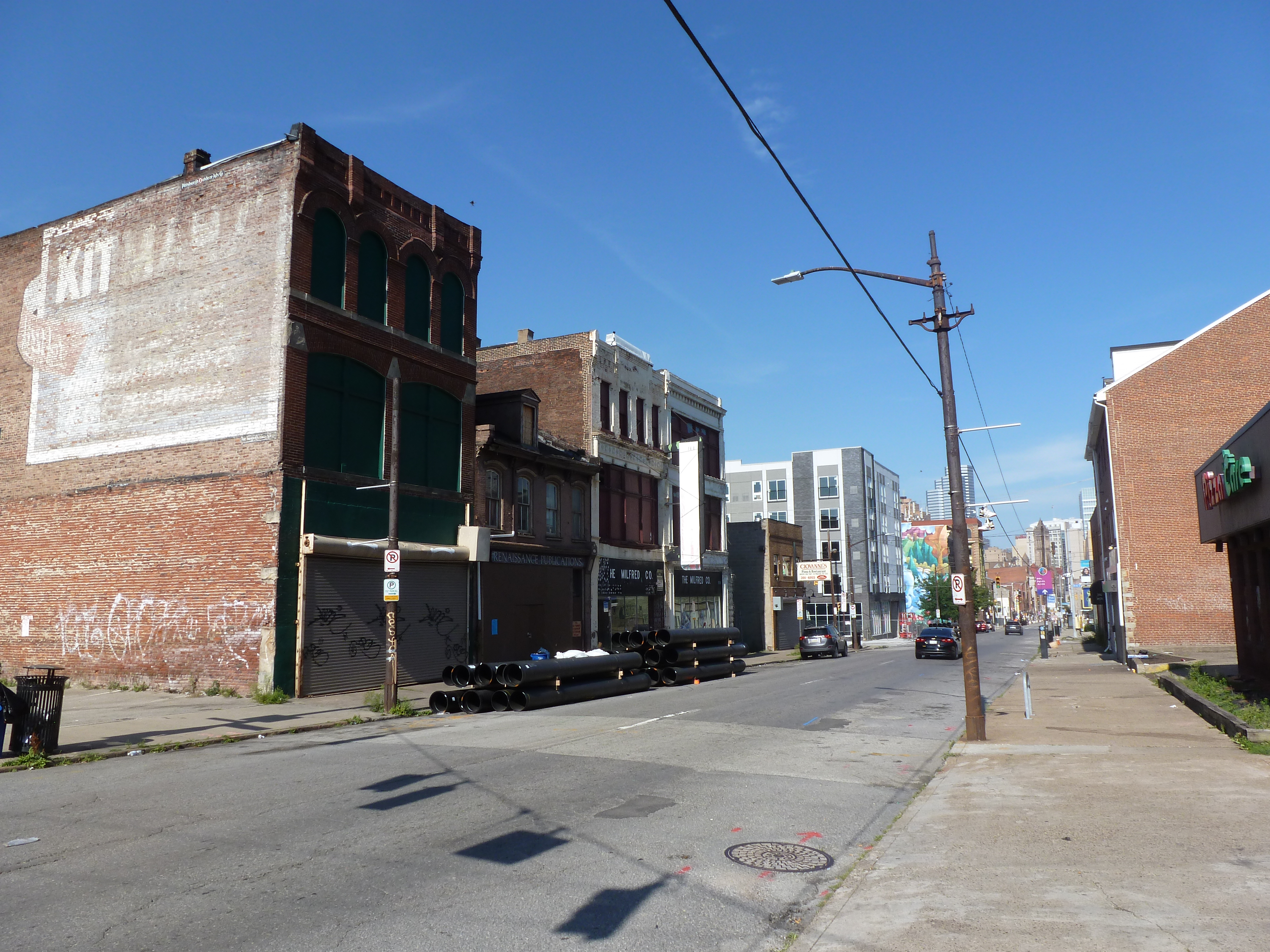
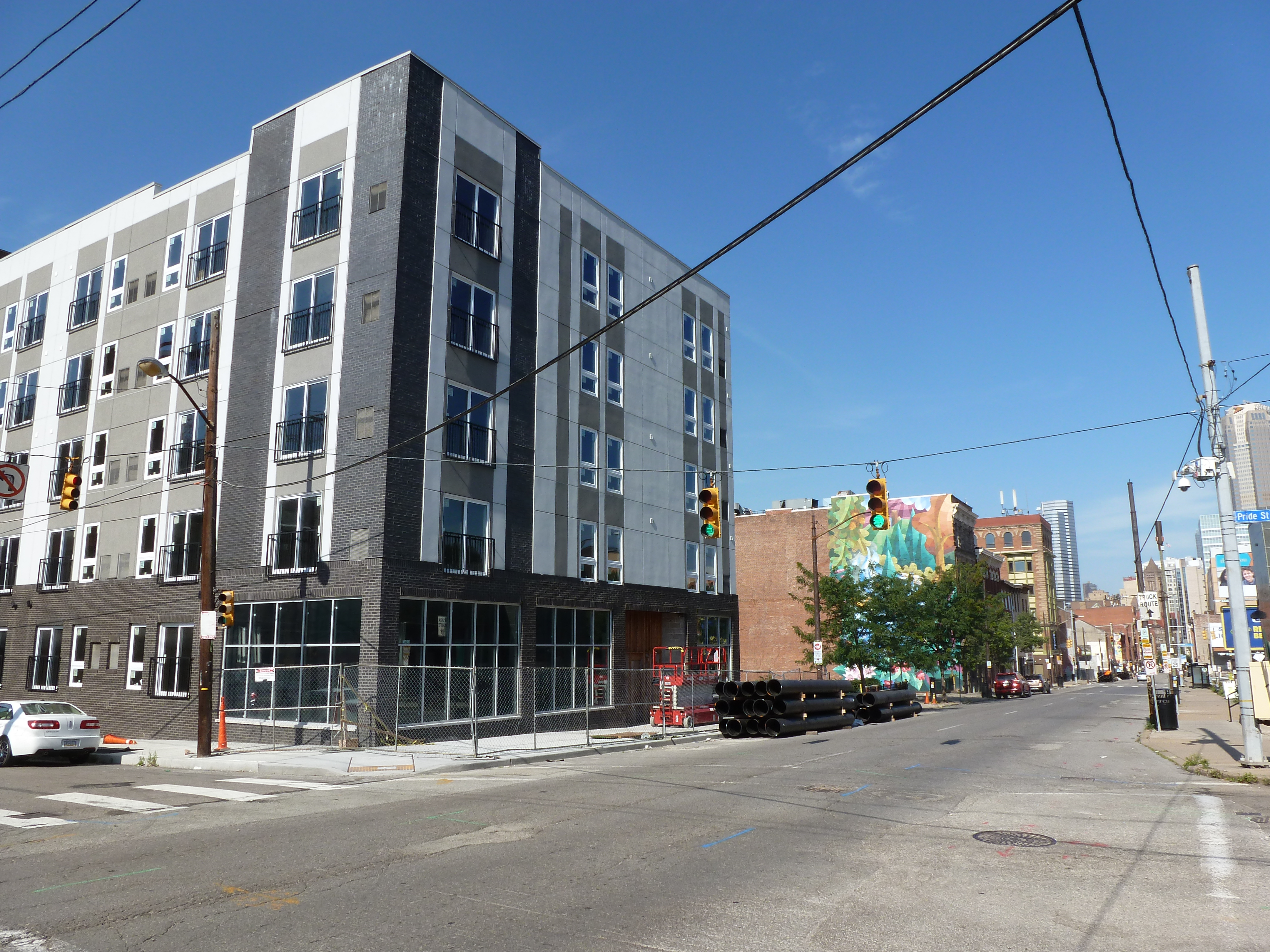
Development activity is picking up in Uptown. Walking around the neighborhood for this update required skirting closed sidewalks, uneven pavement, and construction staging of materials and equipment. The new activity includes:
PWSA’s (Pittsburgh Water and Sewer Authority) replacement of the watermain and lead service lines along Forbes Avenue
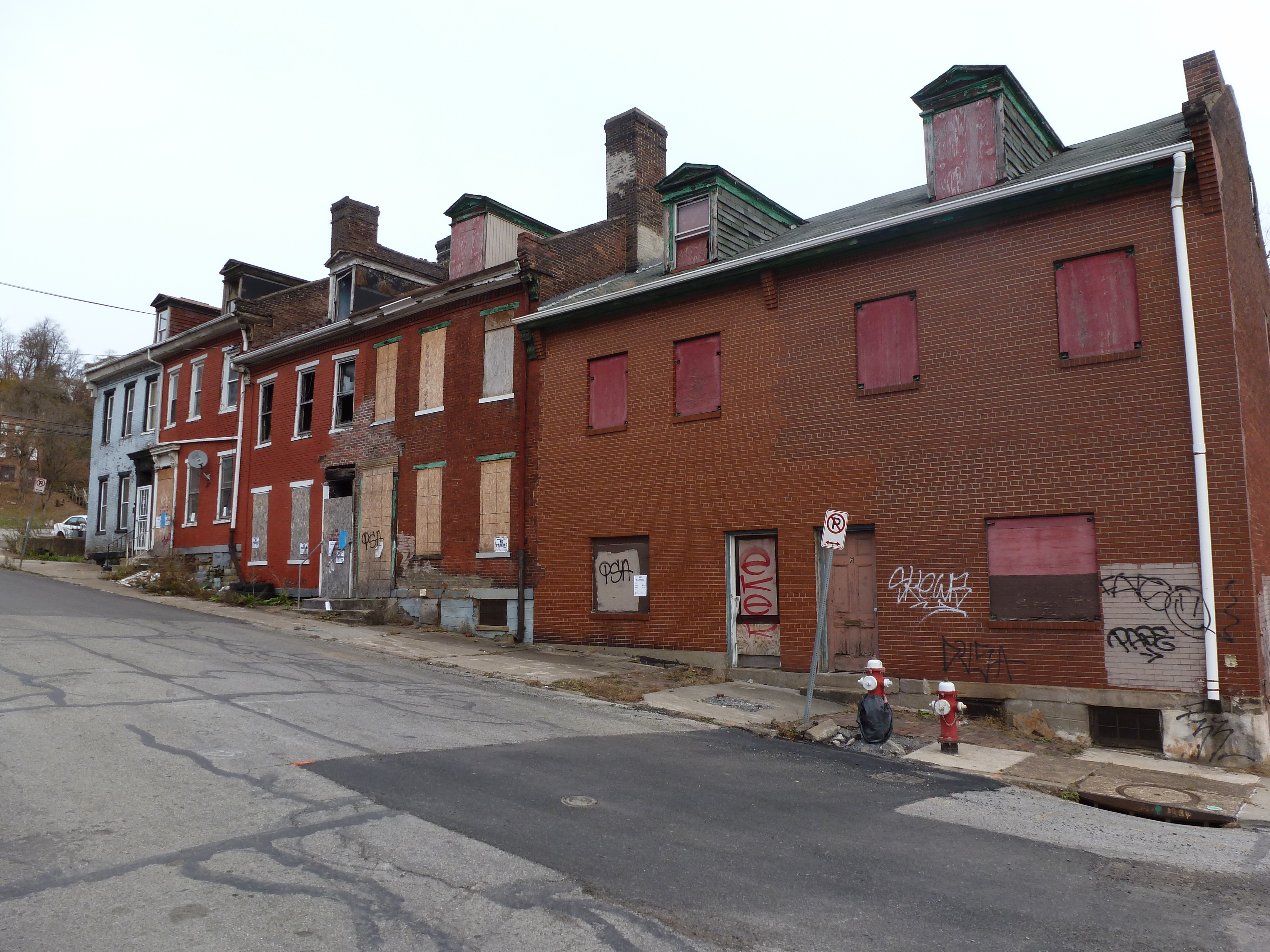
Evidence of demolition work on the long boarded-up Seneca Street rowhouses (image 3)
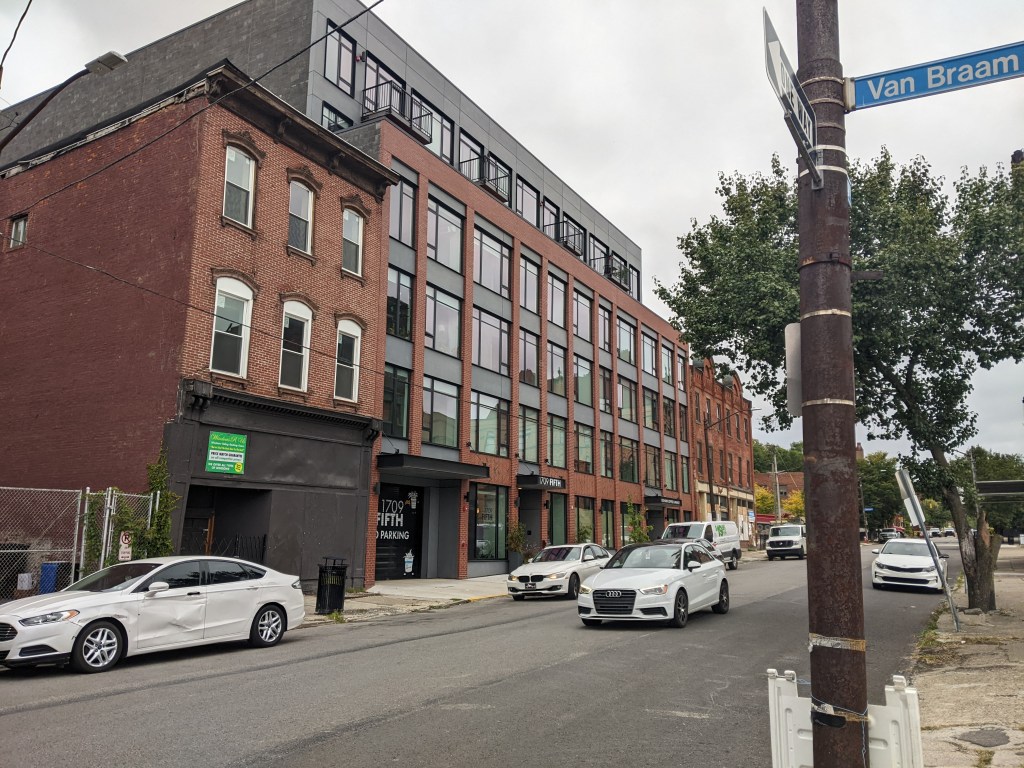
A new project for apartments and retail going up on 5th Avenue while the buildings around it appear to be preparing for renovation or demolition (image 8a)
Duquesne University’s next project to demolish and build on the site across the street from its newly rebuilt fieldhouse (images 21a & 22a)
Uptown Partners began to install free community wi-fi in the neighborhood (Pittsburgh Business Times, November 10, 2020).
And more federal funds have been directed toward the ongoing development of the Bus Rapid Transit system through Uptown to connect downtown and Oakland (Pittsburgh Business Times, June 11, 2021).



















































 urbantraipsing