Wheeling Suspension Bridge

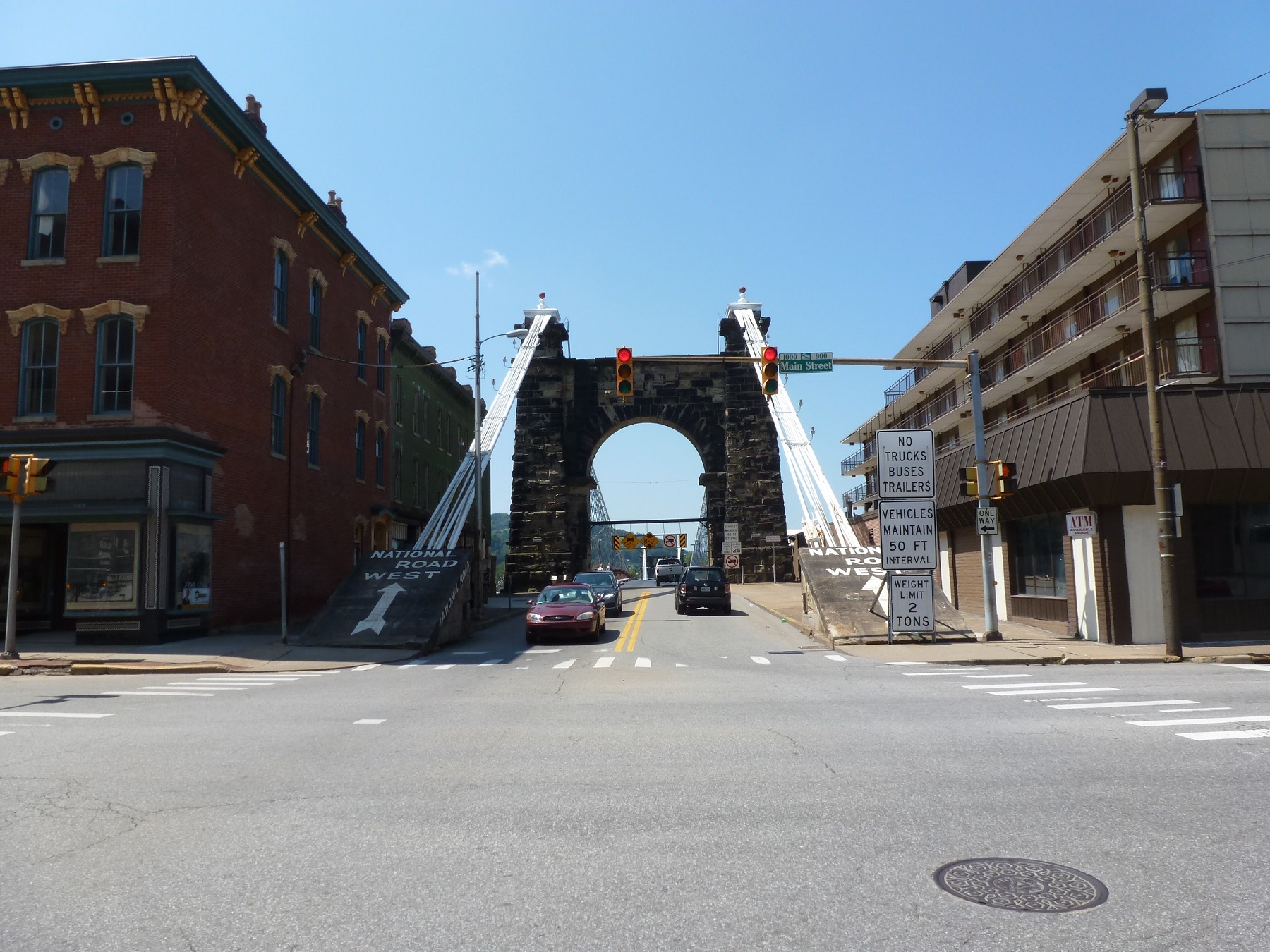
Wheeling Bridge - straight on

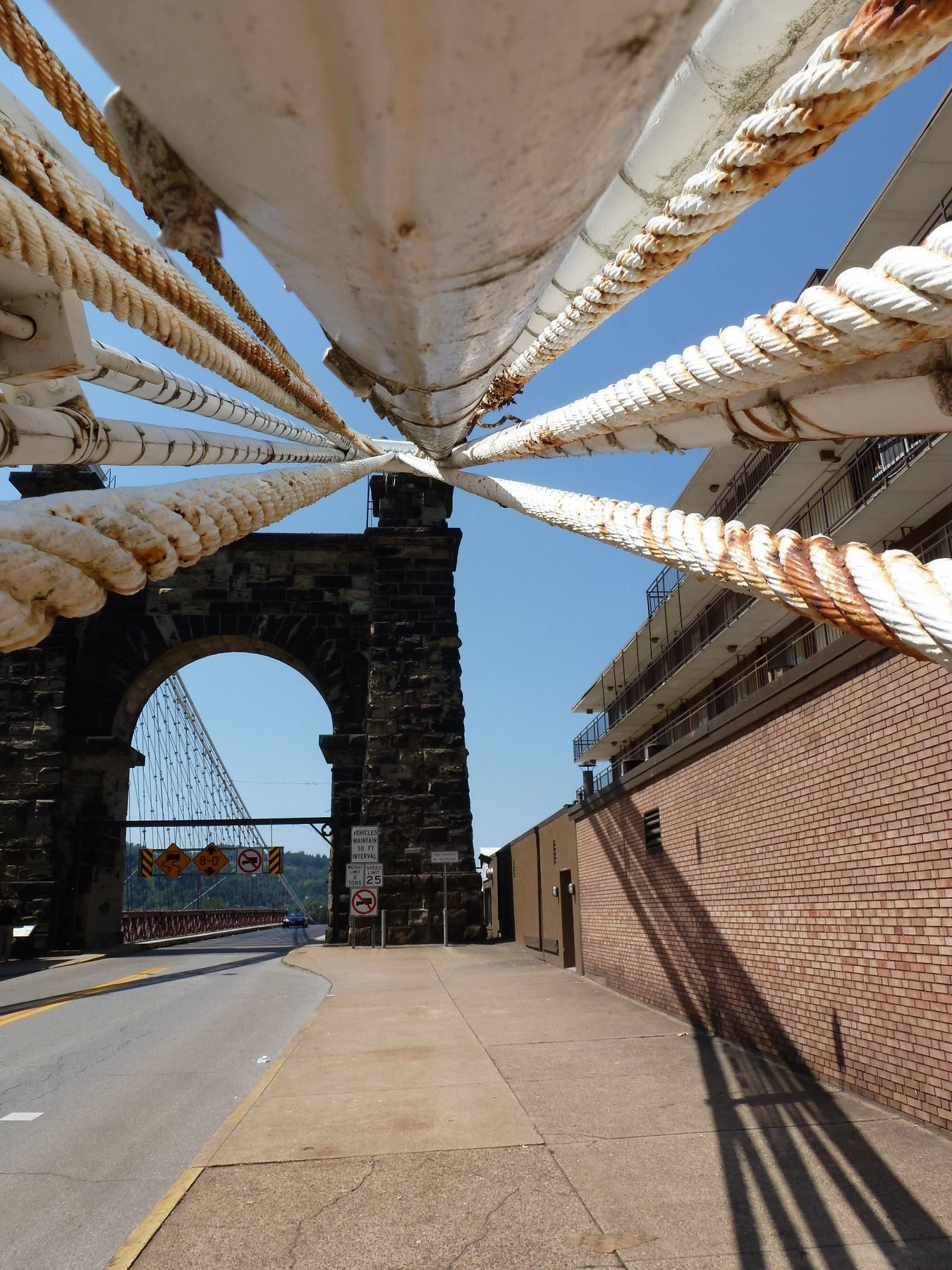
I had a blast with the Wheeling Suspension Bridge.  First, I was fascinated by how it was squeezed between the buildings on the mainland side.  Second, as an early suspension bridge, it has many parts to ensure that it would stay up, which provided more than the average opportunity to attempt to be artistic in photographing it.

Artsy shot 1
Artsy shot 2
Artsy shot 3

The Wheeling Suspension Bridge was the largest suspension bridge in the world when it was built.  Charles Ellet won the competition to design the bridge over John Roebling.  There are some similarities in style between this bridge and Roebling’s Brooklyn Bridge with the stone piers and suspension ropes.  Before we walked across this one and read the plaque, we were under the impression that it was a Roebling bridge.

Wheeling Bridge.jpg

Wheeling has two different trends of riverfront uses than those found in Stuebenville.  On one side of the river (island side), is riverfront housing of surprisingly old construction.  On the other side (city side), is a modern riverfront park with bike trail.
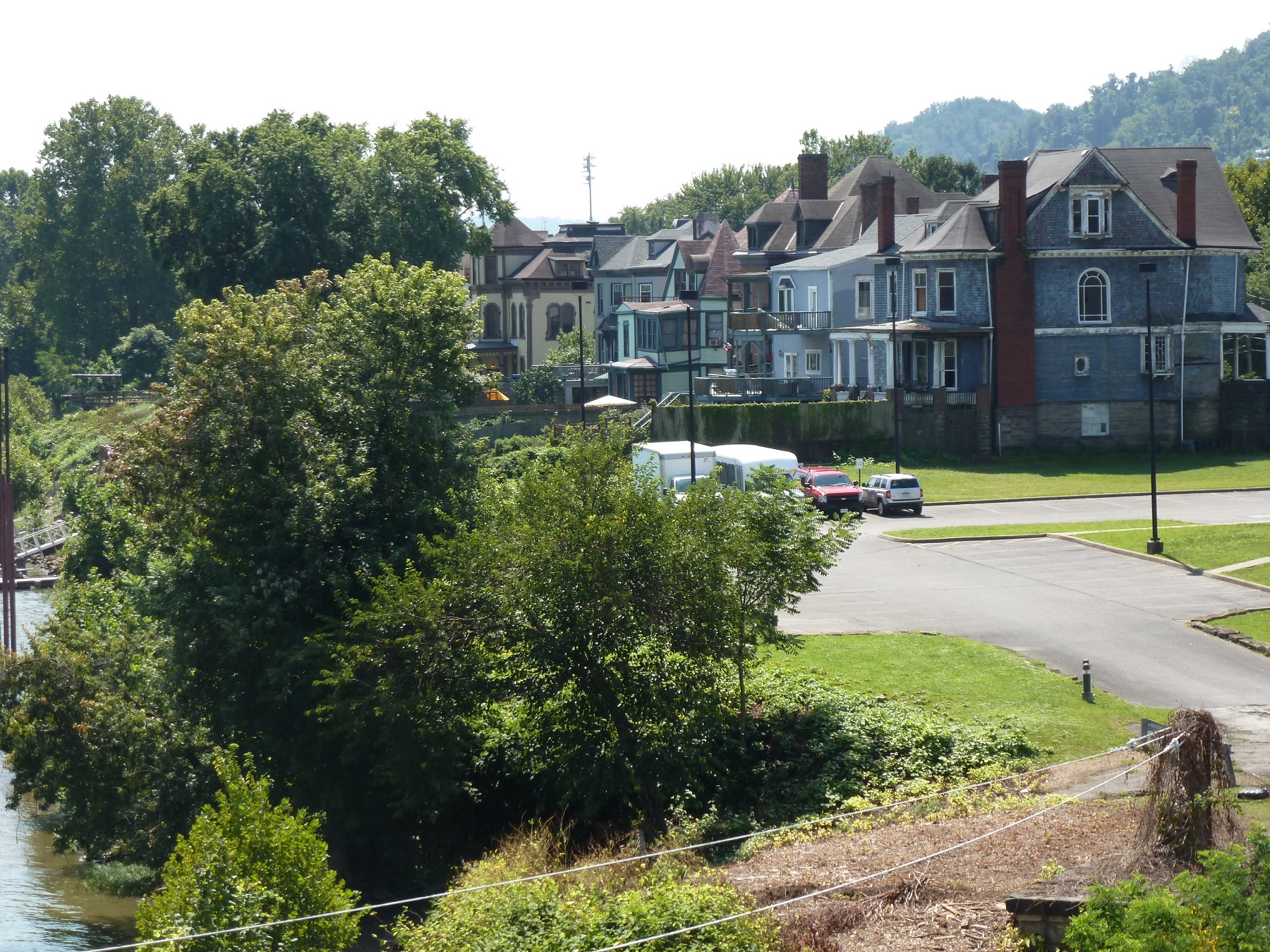
Riverfront homes
Riverfront park

Big Dam Bridge

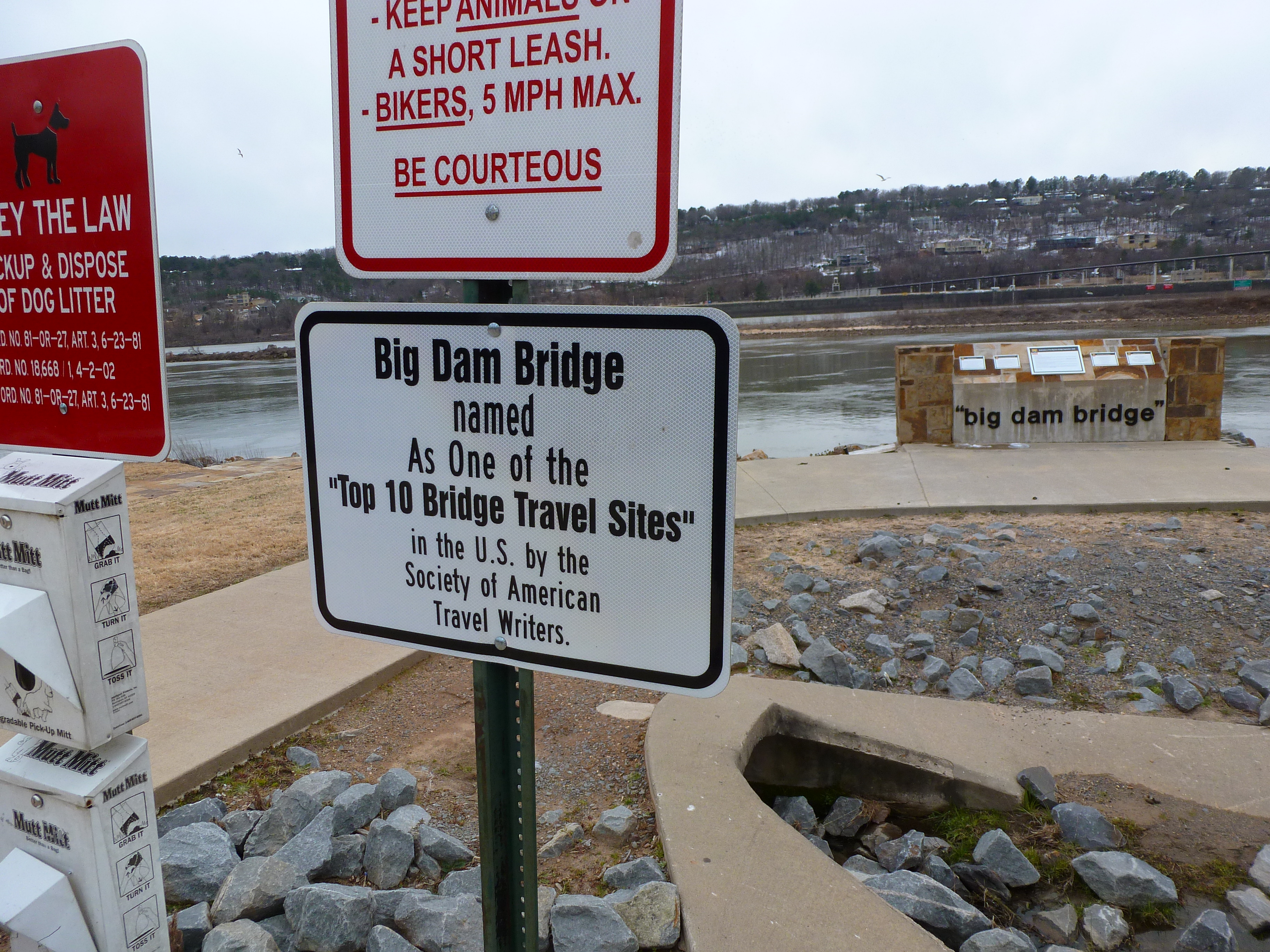
Big Dam Bridge signThe name says it all. This bridge was built as the longest pedestrian- and bicycle-built bridge in the country spanning 4,226 feet across the Arkansas River, connecting Little Rock and North Little Rock. It is part of the Arkansas River Trail.
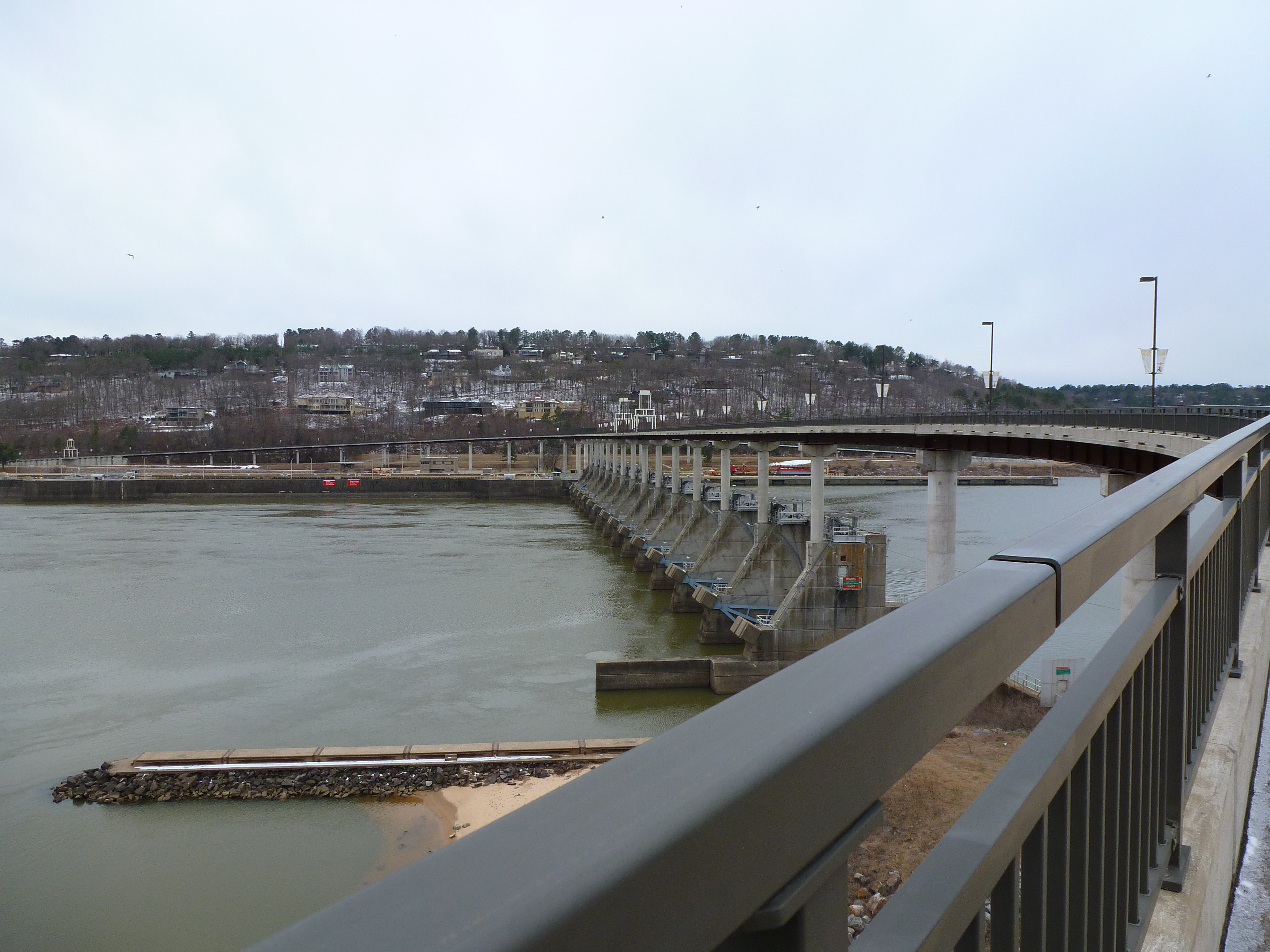
Big Dam Bridge

On a trip to Arkansas this winter, I discovered this bridge and naturally had to add it to my list of bridges I’ve walked across. The intention of my trip to Arkansas was to visit friends but also to get a break from the cold northern winter by heading south. When I bought my tickets in January, the Little Rock region was having 60 degree weather. A month later when I arrived, the high was 26.
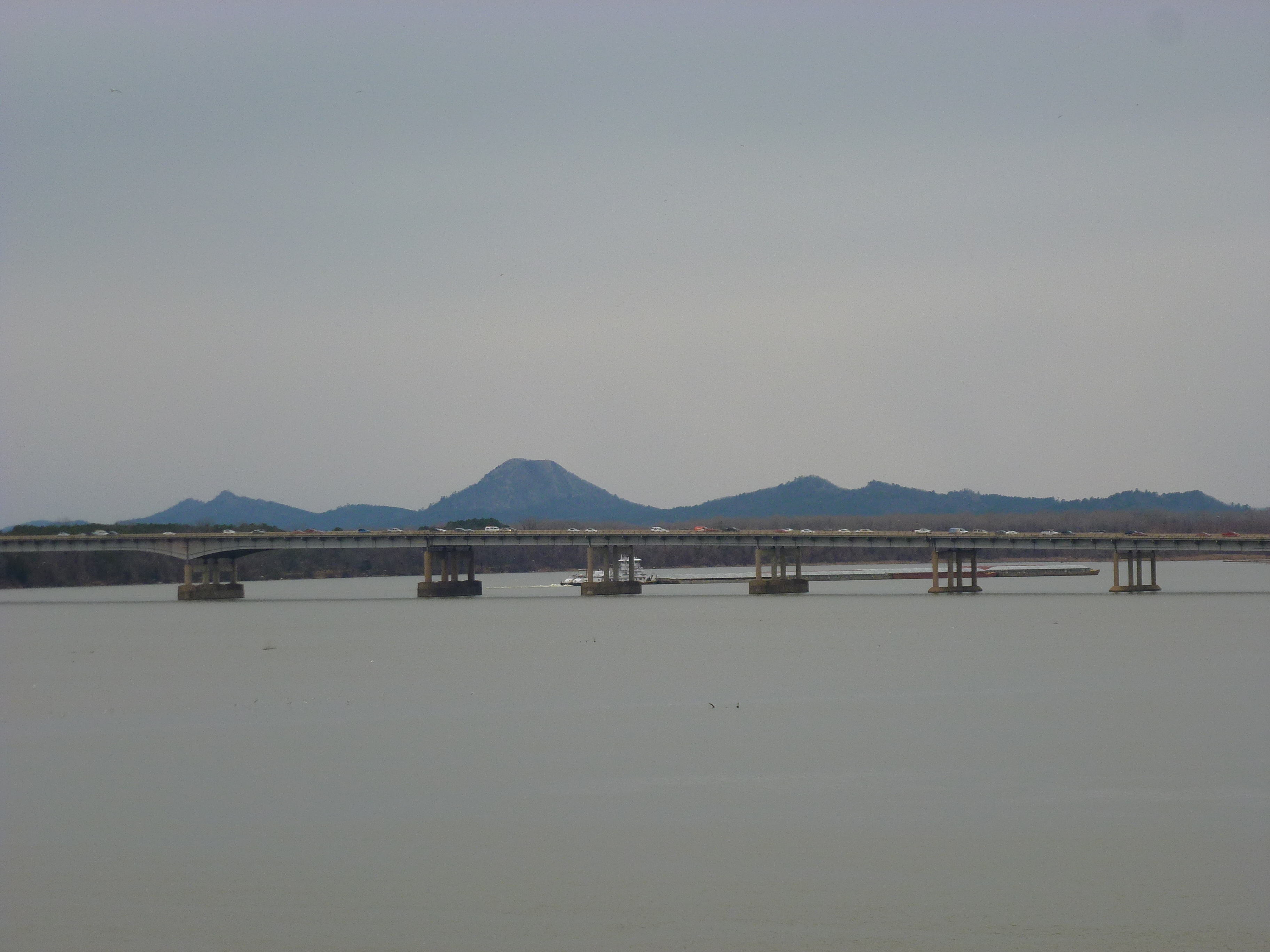
View of Pinnacle Mountain from the Big Dam Bridge

View of Pinnacle Mountain from the Big Dam Bridge

View toward downtown Little Rock showing Rebsaman Park

View toward downtown Little Rock showing Rebsaman Park

By the time we reached the half-way point of the bridge, we were frozen stiff. The farther we got on the bridge the stronger the wind got, probably creating a wind chill factor closer to 20 degrees or less. After admiring the views from the midpoint for a minute, the cold and wind forced us to turn back toward the car.On the Big Dam Bridge

Top 10 Bridge Travel SitesWhile I didn’t make it all the way across, I can still say I’ve been on one of the Top 10 Bridge Travel Sites in the US. Now I just have to find the other 9 sites.

Heth’s Run Bridge: Redux

Heth’s Run Bridge, the first bridge I posted about in my Pittsburgh bridges project, is scheduled to be replaced by the end of next year.  The notice to proceed was expected to be issued last week with construction beginning on Sept. 24 with the installation of a temporary road around the bridge, through the zoo’s parking lot.  According to the schedule that was passed out at a community meeting at the end of August, the bridge is expected to close with all car traffic being diverted to the temporary road on Nov. 1st.  Due to the turning radius constraints with the temporary road, trucks will not be permitted and will instead be by way of the Highland Park Bridge, Route 28 and the 62nd Street Bridge.  If all goes according to schedule the bridge should reopen to all traffic on October 1, 2014.  Additional road work will continue through October.  After final inspections, the project is expected to be officially completed by December 8, 2014.

Heth's Run Bridge's hazardous sidewalk

This is a PennDOT project expected to cost over $18.5 million and is definitely needed.  As I discuss in my Heth’s Run Bridge Part II and Highland Park Bridge posts, the sidewalks here are in desperate need of repair and the proportion of sidewalk to road across the bridge is at least 50 years out of date.  All this is going to be addressed in the reconstruction.  The new bridge is going to have two lanes in each direction to match the roadway on either end.  Additional features of the new bridge will be decorative railing, period lighting, entrance pylons, and “architectural features on the abutments with form liners” (which I believe refers to new urns).  At the community meeting, it was mentioned that the current urns will be saved and kept in a warehouse until a new home is found for them.

In addition to the bridge, about 870 feet of Butler Street are going to be reconstructed including sidewalks.  My understanding is that this is the part of Butler from the Heth’s Run Bridge to the ramps of the Highland Park Bridge, which should take care of my complaints about the condition of the sidewalk for those of us trying to cross the Highland Park Bridge without a car.  This should also clear up the confusion for the outbound traffic of whether this part of the road is one lane or two as the plans include removing the “kink” from the existing alignment.

New signals and ADA ramps will be installed at the intersections of Butler with One Wild Place and with Baker Streets.

Another major part of the project is the excavation under the bridge to an elevation of 762.  According to GoogleEarth, the bridge is at an elevation of 800 ft. I’m not sure if this will restore the bridge to its exact historic height, but it will be close (see the photo of the previous bridge from 1912).  This will also pave the way for connecting this area to the proposed Allegheny Riverfront Green Boulevard project.

This project will no doubt cause some inconveniences during the construction process, but the construction of the temporary road will significantly cut down on this even though it adds over a month to the process.  Imagine instead, everyone having to go on the truck detour or all the Zoo traffic coming down Morningside Ave and Baker Street instead of One Wild Place and Butler Street.  That would be a true nightmare.  Thank you, PennDOT and the Pittsburgh Zoo & PPG Aquarium for the temporary road.  Thank you, PennDOT and any other funders, Sen. Jim Ferlo, Rep. Dom Costa, and anyone else who had a hand in helping bring about this long overdue project.

I can’t wait to walk over the new bridge when it’s finished!

More information about the project including the design of the temporary road can be found here: http://morningside-pa.org/wp-content/uploads/2013/08/hethsrunbridge.pdf

Safety while Traipsing

The Bloomfield-Garfield Corporation, a non-profit community development organization in Pittsburgh, is raising funds to buy back guns.  The goal is to get unwanted guns out of the community where they may be stolen and used in a crime or found by a child and played with, causing injury and death.

In the process of raising funds and talking with different people, it’s become clear that not all guns are bad.  Some guns are very useful such as soldering guns, caulking guns, staple guns, salad shooters, glue guns, nail guns, heat guns, cookie guns, water guns, and cameras (which shoot).  Check out the links for each of these guns to see how they can improve communities (more links will be added over the next few weeks).

As an urban traisper, it is important to feel safe as I walk around exploring the city.  I have chosen not to walk the bridges in certain neighborhoods of Pittsburgh, because of safety concerns.  I was excited when I joined the staff of the BGC to hear that they were working on planning a gun buyback to reduce the chances of gun violence in their neighborhoods.  Maybe our work will make a small difference and help lead to broader changes that will improve the safety of the currently troubled areas or those perceived as troubled.

For more about the Gun Buyback Initiative, check out our Razoo page.  While you’re there, please consider giving a donation.  We hope to reach at least $15,000 by August 31.  Thank you!

The Point…of Gathering

A renewed downtown Pittsburgh attraction is a great place on a hot day.  With last weekend’s temperatures reaching near 90, the revitalized Fountain on the point of Point State Park was a popular place to be.

The Fountain

The new “wading” portion of the fountain was enjoyed by families, friends, couples, and pets.

Bathers

Families and Pets

Pittsburghers and Icons

The fountain was also a gathering point for bikers enjoying the Three Rivers Heritage Trail System and Pittsburgh’s bike rental program and kayakers taking advantage of Venture Outdoors’ Kayak Pittsburgh rentals.

Kayakers and Bikers enjoy the Point

The Point is one of the key geographical features that influenced the creation and history of Pittsburgh.  With the rebirth of the fountain, it will continue to be an important attraction in the city.

The Point of...


Pedestrian Bridges: Chicago

BP Bridge

There are two pedestrian bridges connecting to Millennium Park in Chicago.  The first I encountered was the BP Bridge.  I admired the undulating silver sculpture above as I walked past and was thrilled to discover it was a pedestrian bridge.  My excited was quickly crushed as the bridge was closed to traffic due to construction at the other end.  I realized that I have become quite addicted to bridge-walking.  I was on my way to see The Bean before renting a bike to ride along the lake, when seeing this bridge completely sidetracked me.  I had a desperate urge to walk a bridge.  Fortunately, there was another pedestrian bridge nearby and while it was not nearly as enticing, it had some interesting parts.

BP Bridge The Nichols Bridgeway

The Nichols Bridgeway connects Millennium Park with the Art Institute of Chicago.  Both ends had space-age-like toughs, which I assumed were supposed to be a fancy drainage system.  If their purpose is a drainage system, the upper end by the Institute has failed and been turned into a wishing well.

Lower Trough Upper Trough/Wishing Well

The part I liked best about this bridge was that while it looked like the surface was level, there were ridges or “speed-bumps” every few feet.  I wondered if these were merely artistic or if they had a functional value like reducing the slipperiness of the bridge during icy conditions.

Bumpy Walkway The Nichols Bridgeway

What is a Bridge? Chicago Edition I

Stetson Ave, Chicago, from the Hyatt

In July 2012, a few months into the height of my Pittsburgh bridge-walking, I pondered the definition of a bridge in What is a Bridge? Pittsburgh Edition I and What is a Bridge? Pittsburgh Edition II.  Asking what a bridge is may seem a little odd.  After all, it’s one of those things that you know it when you see it, right?  Yet, in walking bridges, I’ve discovered it really isn’t that simple.  In everyday life, the actual semantics of what a bridge is, is not important–you either cross it or you don’t and move on with your life.  But if you’re trying to walk as many Pittsburgh bridges as you can (as I am) or to count the number of bridges a city has to see which has the most of any city in the world (as others have), spelling out a clear definition of a bridge becomes important.  By the end of my previous posts on the definition of a bridge, it seemed like I had covered almost all the difficulties: is a bridge still a bridge if it no longer bridges anything? what’s the difference between a bridge and a ramp? how many is one bridge?….but then I went to Chicago and faced a new facet to this problem.

The issue Chicago brings up is best illustrated by the image above.  Is there a bridge in that picture?….No, right?….Try again.  If you walk past the buildings on the right, you get a new perspective on the seemingly solid ground you stand on (pictured below).

Discovering Ground Level on Stetson Ave
Looking Back Toward Hyatt on Stetson

Walking around on this street and the blocks around it, you may notice metal joints like those normally found only in bridges running across the roads and sidewalks.  You may also feel the ground bounce like a bridge as a large truck drives by.

Metal Joints across road and sidewalk on Michigan Ave
Metal joint across road on Columbus Drive

Are these roads, then, really bridges?  If no, what are they?  If yes, where does one bridge end and the other begin?  For example, is the Michigan Avenue Bridge across the Chicago River, visible in the back left of the image above-left, just a continuation of the Michigan Avenue road-bridge or is it a separate bridge?


Additional Posts in Series:

Manhattan Bridge: A Multimodal Link

The Manhattan Bridge

When I was planning my walk across the Brooklyn Bridge while in New York City last December, I noticed there was a bridge nearby called the Manhattan Bridge.  I decided to cross to Brooklyn by the Manhattan Bridge and return to Manhattan by the Brooklyn Bridge.  The Manhattan Bridge ended up being the more interesting of the two bridges.

Gateway to the Manhattan Bridge

I found my way from the subway stop to the Manhattan Bridge by following the way-finding signs for the bike lanes in the Lower East End.   This brought me to the left side of the bridge, where I was temporarily upset to see that pedestrians were not permitted to use the sidewalk on that side of the bridge–it was dedicated to two-way bicycle traffic.  I was concerned that I was not going to be able to walk across this bridge and instead would have to cross the Brooklyn Bridge twice (I try to avoid walking across a bridge just to walk back across it; doing so gives me a sense of pointlessness).  Luckily, there are sidewalks on both sides of this bridge (from walking Pittsburgh bridges I know not to assume that bridges have sidewalks on two sides) and the sidewalk on the right side is dedicated to pedestrians.

I suggest that NYC puts up a sign on the bicycle side to direct pedestrians to the other side, which might help encourage pedestrians to follow the traffic directions set up on this bridge–I watched a pedestrian ignore the bicycle-only signs to cross the bridge on the bike lanes.

The Pedestrian Side

This bridge is the most multimodal bridge I have walked with the bike lanes on one side, pedestrian way on the other, and the subway and roadway in between.  While I approve of this welcoming of alternative transportation methods, I am not sure about placing the pedestrians next to the subway tracks.  This does give a barrier between the pedestrians and the noise of the cars, but instead, the pedestrians have to deal with the noise of the subway, which while it is less constant than the cars, it is a little more startling/disturbing.

The Manhattan Side The Brooklyn Bridge

The neighborhoods the Manhattan Bridge links had some similar physical elements, but are clearly used by different populations.  The populations on both the Manhattan and Brooklyn sides use their rooftops, but for different purposes.  On the Manhattan side, the rooftops were covered in graffiti, while the Brooklyn rooftops had new additions and places to sit.  There were also parks on both sides of the East River.  However, the Manhattan side only had a baseball diamond while the Brooklyn side had a carousel and a pirate-ship playground.

Manhattan side park

Carosel Pirate Ship Playground

What intrigues me most about the Manhattan Bridge is that I had never seen or heard of it before and yet it is the bridge shown in the background (multiple times) in the Doctor Who episode “The Angels Take Manhattan.”  Based on my walk on the Brooklyn and Manhattan Bridges, it looks like these shots were taken on the Brooklyn side of the river, in which case it seems like it possible to get the Brooklyn Bridge in the background instead as these two are close together on that side.  To me the images of the Brooklyn Bridge say New York, while (at least before I walked it) images of the Manhattan Bridge just say a place with a bridge and hence water.  I wonder if the Manhattan Bridge is better known in the UK than in my circle?

View like that used in Doctor Who

Science Dino – Pittsburgh DinoMite Parade 1

While walking the Three Rivers Trail System on my way to the West End Bridge (post to come), I found a dinosaur that I had not seen before.  As I mentioned in my Cleveland Guitar post, Pittsburgh has dinosaurs like this spread out across the city.  It has been another idea of mine to try and find them all, but for now I’m just stumbling upon them on my other explorations of the city.  Like most of the dinosaurs I’ve come across, this one is appropriately located.  The science theme of the dinosaur’s design fits with its location next to the Carnegie Science Center.

10th Street Bridge

The 10th Street Bridge (which a reader pointed out is nicknamed the Phillip Murray Bridge after the first president of the United Steelworkers of America) was the last of the bridges over the Monongahela River for me to walk.  Or so I thought.  It turns out that the Liberty Bridge also has a sidewalk despite the fact that it is a freeway bridge like the Veteran’s Bridge (see post).  So I’ll have to come back to the Liberty Bridge at some point.

I delayed my walk of the 10th Street Bridge in part because it seemed like an awkward one to get to and from.  One end is in the middle of the South Side, but the other connects to the Armstrong Tunnel, which would obviously not be pedestrian friendly.  Last week, I finally went out and walked it and as I hoped, it turns out there is a pedestrian access over the hill to the high-bus-traffic corridor of Fifth and Forbes avenues in the form of a giant staircase that I will address in another post.  This end of the 10th Street Bridge was more well-connected than I had anticipated.  Not only do the stairs provide access to the top of the hill when Duquesne University sits, but there is also access to a parking lot down by the river which also connects to the Three Rivers Trail System.  The best proof of this bridge’s connectivity is the number of other pedestrians I saw walking the bridge.  While I did not keep a count, I noticed that there was a comparatively high level of pedestrian traffic.  It certainly wasn’t as much as the Smithfield Street Bridge (see post), but it was comparable to or higher than that on the other downtown bridges.

My favorite part about this bridge was the dinosaurs painted at the top of the southern tower.  I couldn’t tell if they were official or freelance graffiti, but it seemed appropriate given that Pittsburgh is famous for dinosaurs.  Andrew Carnegie brought the first dinosaur skeletons on display anywhere in the world to his natural history museum.  I found someone else wrote a post about the dinosaurs on the bridge, which the artist apparently calls geese, which suggests that the painting may not have been officially sanctioned.

The post mentioned above about the dinosaurs also comments on the “rusty” condition of the bridge.  While I didn’t notice the rust much (it wasn’t nearly as bad as the 28th Street Bridge), I did notice the condition of the sidewalk.  I thought my theory that the top of the sidewalk had worn away to expose the metal framework supporting the structure rather farfetched, as how could the entire sidewalk (on both sides as far as I could tell) wear out so evenly.  Yet, I cannot think of any other sidewalk I’ve walked that looks like this and given the other bloggers comments on the poor physical condition of the bridge, perhaps my idea isn’t totally crazy?