
Tag Archives: Public Art
Layers of the City: Chicago Edition
The first place to show me how a city can be stacked like a layer cake, Chicago provided ample opportunities to explore all levels of the city. The experience of noticing the expansion joints in roads that I assumed were on solid ground opened my eyes to the possibilities of stacking uses.
Underground Life
A vacant lot two stories below street level solved the mystery of the expansion joints, by exposing the inner guts. Two more roads sit below street level to segregate trash pick-up and deliveries from the flow of traffic. These lover levels also provide some opportunities for parking without monopolizing valuable real estate above. Retail shops connected by pedestrian passageways are also interspersed in these layers.
River Life
At the same elevation as the “underground life,” the Chicago River flows through the heart of the city. On and along the river are a variety of activities. Pedestrian paths, cafes, housing, parks, industrial uses, and homeless encampments line the shores. Meanwhile, the river abounds with ducks, boat tours, water taxis, construction staging, and marinas.
Street Level
Back up on the street level, life buzzes. Vehicular and pedestrian traffic rush passed, occasionally pealing off to visit the numerous shops, offices, museums, restaurants, cafes, parks, and trails.
Pie in the Sky
Yet, more life looms above. Several of the skyscrapers have penthouse, or nearly penthouse, restaurants. Others have rooftop observation platforms. Between these and the street are many other opportunities for enjoying life including a religious sanctuary, the “L”, gardens, art, pedestrian bridges, and of course, offices, apartments, hotel rooms, and shops.
Unlike Pittsburgh, in Chicago, the public is welcome in some form on every level to gain a full experience of the city.
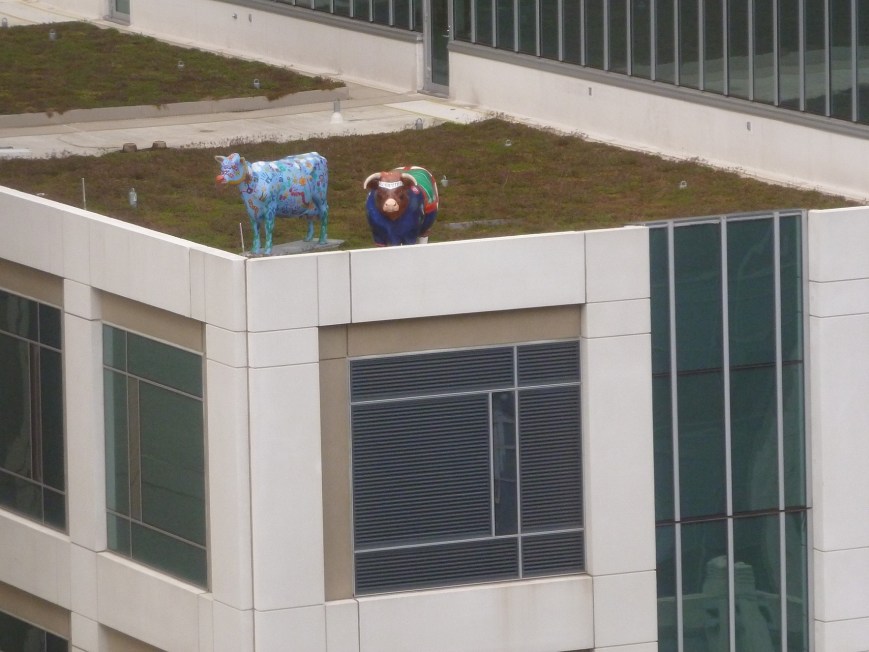
Harrisburg Cow Parade 2
Seven Generations
One sculpture in Harrisburg’s riverfront park grabbed my mind like no other. Seven silhouettes each cut out of the other lined up in a row. Looking at it head on, it appeared to be one silhouette. The effect of their joining together and breaking apart as I passed mesmerized me.
I didn’t want to spoil the effect by learning hard facts about it from any plaque that may have been with it, so I continued on my way. Yet, the sculpture stayed with me, begging questions I barely knew how to form. I began to wonder what the artist intended. My curiosity was unexpected rewarded while I waited for my train home. The walls of the station had some posters which I read to pass the time. Turns out they were a guide to the sculptures in the park. The piece that had engaged me was a reference to the Iroquois stewardship policy to consider the effect any decision would have on the next seven generations before making a choice.
Seven generations.
That would be my great, great, great, great, great grandchildren.
None of the trees my great, great, great, great grandfather and his father-in-law encountered while establishing their homesteads in Western Pennsylvania still stand. Though it has been sold outside the family, the house my Cross ancestor built is still occupied. How many of the new buildings I have approved for Zoning in the last four years will still stand seven generations from now? Will they even survive for two generations?
How many of the next seven generations will be outlived by the plastic bag I brought home from the grocery store because I forgot my reusable bags?
What will happen to the latest gadget that will become obsolete in a year or so? What will happen to all the energy and waste that went into creating it and then destroying it?
I’ve sometimes heard people question what kind of world they are leaving their children and grandchildren, perhaps even their great grandchildren, but no further than that. What would happen if we set our sights a little bit further–a few more generations out?
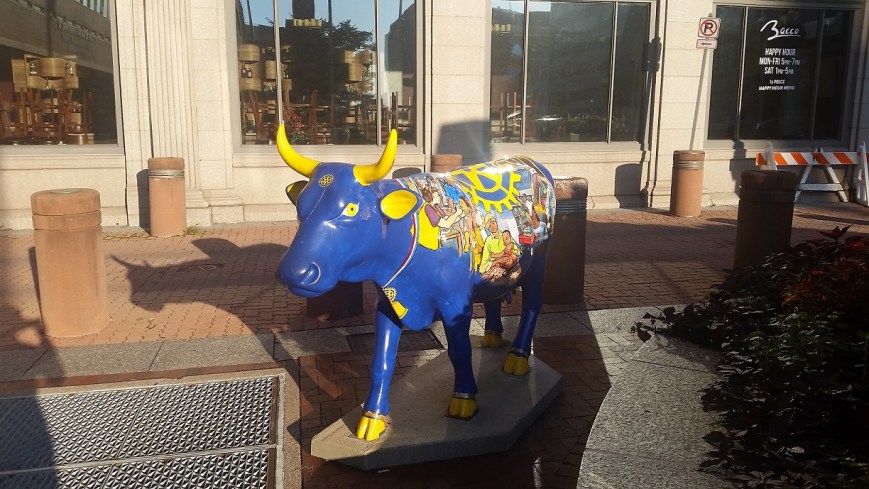
Harrisburg Cow Parade 1

Harrisburg: Coal or Gem
I didn’t understand the pitying looks I received when I announced my fall vacation to Harrisburg. Now that it is over, I still don’t understand.
As a capital city, the downtown is quiet on the weekends, but the neighborhoods are still full of people. Even on a chilly, sleepy Sunday morning, joggers, bikers, and walkers enjoy the fresh air along the riverfront park that is part of the 20-mile Harrisburg Capital Area Greenbelt Trail. Sculptures dot the public spaces and art coats the fire hydrants and signal control boxes. Beautiful and intriguing architecture abounds. A former theater houses the largest used bookstore I’ve ever visited. Across the street, the Broad Street Market is filled with vendors of such mouthwatering temptations as Amish baked goods, hot Indian food, exotically flavored ice cream, fresh baked pretzels, and more.
A relatively compact and walkable city, I find surprising gems each time I visit Harrisburg.

