Border Crossing

With summer full upon us, I have pulled out all my summer straw hats. One I picked up as an emergency hat. I’ve squished it into a suitcase, sat on it, and abused it in other fashions for years, but it’s still a great plain soft straw hat. Another one is a broad brim straw hat with a plain black band I acquired in Old Town Sacramento to complete my 1860s costume. It’s a great hat, but without the hat pin, it blows off at the slightest provocation. The cream of the crop is a fine two-toned, straw hat with green and grey cords, peach-colored flowers, and an extra wide brim. This one came from Tijuana, Mexico.

I was fifteen or sixteen when my parents took me across the border for a day trip in Tijuana. My memory of this trip is fuzzy, but punctuated with sharp images of intense emotion. I vaguely remember booths and lots of lanes of cars, even by California standards, for crossing south, but lots of lines of people for crossing north. While we drove down, we had to leave our car somewhere along the border. All the tourists were funneled on foot onto the main drag, which was glitzy enough to rival Las Vegas. Shop owners stood on the sidewalk outside their stores to entice the US currency from our pocket to theirs.

I squinted at the glare and cringed at the solicitous fawning. After we visited several shops, my Dad asked a proprietor where he could find a CD of a particular kind of music. The proprietor gave us directions to a shop several blocks away from the main road. As soon as we stepped into the first side street, all the glitz and glamour vanished. Instead, we found blocks of small, plain adobe or stucco houses. The contrast turned my stomach.

The honest plainness of these blocks soothed my eyes, while throwing into sharp relief the fashionable begging of the tourist trap we temporarily left. I was surprised we were given directions that went outside the trap. I wondered how many tourists crossed that invisible line.

Though most of these buildings looked the same, we were able to locate the music shop without incident. My Dad found what he wanted and we went back the way we came. Not long after we returned to the border to cross back to the US.

We had to stay in a waiting area either for our car or for our turn to go through the border crossing. While there, my Mom had me try on hats for sale at a small kiosk. I suspect this was in part to distract me from the physical reaction I was having to the contrasts we saw and in part to encourage me to get a souvenir from this excursion. Having a weakness for hats, I ended up with a beautifully-crafted straw hat that I still wear for special summer occasions.

Layers of the City: Chicago Edition

The first place to show me how a city can be stacked like a layer cake, Chicago provided ample opportunities to explore all levels of the city. The experience of noticing the expansion joints in roads that I assumed were on solid ground opened my eyes to the possibilities of stacking uses.

Underground Life

A vacant lot two stories below street level solved the mystery of the expansion joints, by exposing the inner guts.  Two more roads sit below street level to segregate trash pick-up and deliveries from the flow of traffic.  These lover levels also provide some opportunities for parking without monopolizing valuable real estate above.  Retail shops connected by pedestrian passageways are also interspersed in these layers.

River Life

At the same elevation as the “underground life,” the Chicago River flows through the heart of the city.  On and along the river are a variety of activities.  Pedestrian paths, cafes, housing, parks, industrial uses, and homeless encampments line the shores.  Meanwhile, the river abounds with ducks, boat tours, water taxis, construction staging, and marinas.

Street Level

Back up on the street level, life buzzes.  Vehicular and pedestrian traffic rush passed, occasionally pealing off to visit the numerous shops, offices, museums, restaurants, cafes, parks, and trails.

Pie in the Sky

Yet, more life looms above.  Several of the skyscrapers have penthouse, or nearly penthouse, restaurants.  Others have rooftop observation platforms.  Between these and the street are many other opportunities for enjoying life including a religious sanctuary, the “L”, gardens, art, pedestrian bridges, and of course, offices, apartments, hotel rooms, and shops.

Unlike Pittsburgh, in Chicago, the public is welcome in some form on every level to gain a full experience of the city.

Layers of the City: Pittsburgh Edition

I clench my teeth every time the “T”, Pittsburgh’s light rail system, slowly makes the first 90 degree bend leaving Gateway Station, squeaking like fingernails on a chalkboard.  After traveling a few hundred yards, it turns back 90 degrees–squeak, scratch, squeak–before pulling into the Wood Street Station.  As everyone knows that the shortest distance between two points is a straight line, I struggled to understand why the T was built with turns so sharp it is impossible for the trains not to screech, until my friend pointed out that there might be building foundations or basements that the underground tracks need to maneuver around.

Like many metropolises, the density of downtown Pittsburgh creates various physical layers of activity.  Yet compared to other some other cities (see Layers of the City: Chicago Edition), Pittsburgh’s layers can be hard to notice.  The T is perhaps the most obvious example.  For most of it’s length through the southern neighborhoods and suburbs, the T travels at grade.  Once it crosses the Monongahela River into Downtown, it becomes an elevated train for a few blocks before submerging underground until it passes under the Allegheny River to the North Shore, where it reemerges to end as an elevated train.

Underground Life

If you get off the T at Gateway Station and walk down a block to the start of 5th Ave, which actually feels like an alley, you might notice that the Highmark Building is built over an underground garage.  I assume that this garage has multiple levels below grade and is at least part of the reason for the T’s sharp turns.

The new PNC Tower also has a garage below grade.  Yet the most recent new construction project downtown, on the former site of Sax Fifth Avenue, places the garage between the first floor retail and proposed upper level residences.

The building I work in, the former Jones & Laughlin Steel Mill Headquarters, has at least 3 1/2 levels of basement.  The building is long past its days of glory with peeling paint, cracked foundation, and elevators that you may never make it out of again.  The mezzanine level of the basement is a maze of building supplies, file cabinets, discarded furniture and boxes upon boxes of documents.  It is damp and dusty.  Five minutes down there could lead to a severe allergy attack.  Yet the stairs keep going down and down, plunging further into the dark depths.  I’ve heard rumors of more documents being stored in the lower levels.

Street Level

Coming back above ground, most activity in downtown Pittsburgh takes place at street level.  Pedestrians, bicyclists, buses, cars, delivery trucks, dumpsters, and more compete for space on the narrow streets and sidewalks.  Most shopping and restaurants are located at street level.  The Highmark Building and the Oxford Building still have some retail above the first floor.

Pie in the Sky

As you walk around downtown, if you look up, you might catch a rare sight of pedestrian sky bridges.  The most famous of which is the Bridge of Sighs connecting the Allegheny County Courthouse with the former Jail.  The second most famous (speaking with pure bias) is the bridge connecting the parking garage with what used to be the shoe section of the former Kaufmann’s Department Store (always a necessary stop when shopping for back to school).  A handful of others are sprinkled throughout downtown.  Indianapolis has got us beat though.  That city has a network of pedestrian connections that enables you to walk for miles between the stadiums, office buildings, and other structures downtown without ever getting a taste of fresh air.

Higher up, there is a sprinkling of rooftop or penthouse restaurants.  This is one of our complaints at work: while many new, good restaurants have opened downtown in recent years, there is still a dearth of restaurants and bars with views.  Sienna Mercado’s Il Tetto, Harris Grill, and the Biergarten at Hotel Monaco all have rooftop decks, but they are surrounded by taller buildings limiting views.  Ollie’s Gastropub on the top floor of the Oliver Building has some good views, but no fresh air.

There isn’t much connection or relationship between the different parts of these layers in Pittsburgh.  It is like they are experiments, like the city is only dabbling.  As if to say, it can’t make up its mind whether or not to let the public leave street level and participate in or explore all levels of the city.

Pittsburgh’s Bragging Rights

I mentioned previously that I totally geek out over maps.  I recently came across a fascinating “new” map called The “Z” Atlas & Map of Pittsburgh, PA, and Mount Oliver, PA.  I am adding it to the Sanborn Maps and GM Hopkins Maps as a go-to for studying the changes Pittsburgh went through in the 20th Century.  The “Z” Atlas was published in 1952.  There are two things about this map that caught my eye as setting it apart from others during my initial perusal.

First, in the street index, it identifies which streets have unusual addressing.  Pittsburgh is known for some unique addressing situations.  For example, there is a block where houses built before WWII have 1300 numbers and the ones built after WWII have 1400 numbers, even though they are intermixed.  This atlas shows that the post WWII houses were built after 1952 because the address numbers on that street weren’t wonky yet.

Second, this map claims that “Pittsburgh has more streets than any City in the World. You will find EVERY ONE of them in this ‘Z’ Atlas and Map!”

“Preposterous,” I said, when I first read that claim.  Pittsburgh’s land area is small compared to other large metropoles.  It does not make Wikipedia’s current list of the 150 largest US cities by land area.  Without digging into census data, I assume that many of the old cities (ex. New York City, Chicago, Cleveland), if not most of the 150 listed, likely were of a similar size in the 1950s as today.  How could it be possible for Pittsburgh to have more streets than these cities that are significantly larger?

Then it hit me.  It is possible by the same token that makes it possible for Pittsburgh to have more bridges than any other city in the world, more steps than any other city, and the steepest paved street in the world: topography.

Pittsburgh’s many hills, ravines, cliffs, and rivers mean there are few long streets and many short streets.  Maybe after all, Pittsburgh did have more streets than any other City in the World in 1952.  Reading more of the “Z” Atlas, it elsewhere explains that Pittsburgh had over 6,000 streets at the time of the map’s publication.  That number does include the numerous “paper” streets that were surveyed and mapped, “but never built or even marked in the dirt.”

Many of these paper streets still exist today causing headaches for the City and its citizens, but some have been vacated and turned over to private ownership.  Between that and the rise of mega-cities since the 1950s, I won’t say that Pittsburgh can still claim more streets than any other city.  A quick Google search showed that the question of what city has the most number of streets is not as well discussed as what city has the most bridges.  Perhaps a more ambitious person than myself could run an analysis to see whether Pittsburgh still has more streets than any other City in the World.  (Don’t forget to count the step streets!)

Utility Siloes Part 2


20180624_080041 (2)

Dismantling in progress (6/24/2018)


After continued observations, I need to modify some of my assumptions in the post Utility Siloes.  It turns out that the existence of the other utility wires attached to the poles does not prevent the old poles from being removed.  Instead, weeks after a new utility pole is installed, the remainder of the deteriorated pole is removed except for the chunk where the other wires are attached.


20180624_080058 (2)

Close-up of the dismantling (6/24/2018)

Perhaps the crew that removes poles is different than the crew that installs them.  Although, the installation team is able to lob off the top of the old pole after they transfer the wires to the new one.  Why then can’t they dismantle the rest of the pole at the same time?  And in the case of constricted locations, such as the feature of these posts, why can’t they located the new pole in the same location as the old one?


20180630_093623 (2)

Dismantling Complete (6/30/2018)


20180630_095652 (2)

View of another dismantled pole, the remaining chunk is secured to the new pole by a rope.


Out of Sight…

20180614_155542 (2)

Trash Train Passing through Pittsburgh

Once a week, I put a bag of trash out at the curb before going to bed.  When I leave for work in the morning, it’s gone.  Poof!

Yesterday, while enjoying the beautiful summer day, the stench of garbage made me look up.  Crossing the railroad bridge, chugged a train full of trash.  I couldn’t see either engine or caboose, only car upon car upon car full of trash.  As I passed under it, smelling the breadth of the aura of stink surrounding the train, my mind imagined all the homes, parks, farms, mountains, forests, and prairies that would be polluted by this rotting mass before it reached its final destination.  A destination that is forever polluted.

I don’t litter.  I recycle when possible (or easy).  I don’t have a newspaper delivered as most of it ends up going straight to my recycle bin, wasting energy and resources.  I try to buy yogurt by the quart instead of single serve to reduce the amount of plastic used.  I plan to compost, one day.  Yet, I had no qualms setting out a bag of garbage every week.

In a corner of my mind, I knew that a truck comes and takes the garbage away to something called a landfill.  And that the garbage will sit there…forever.

OLYMPUS DIGITAL CAMERA

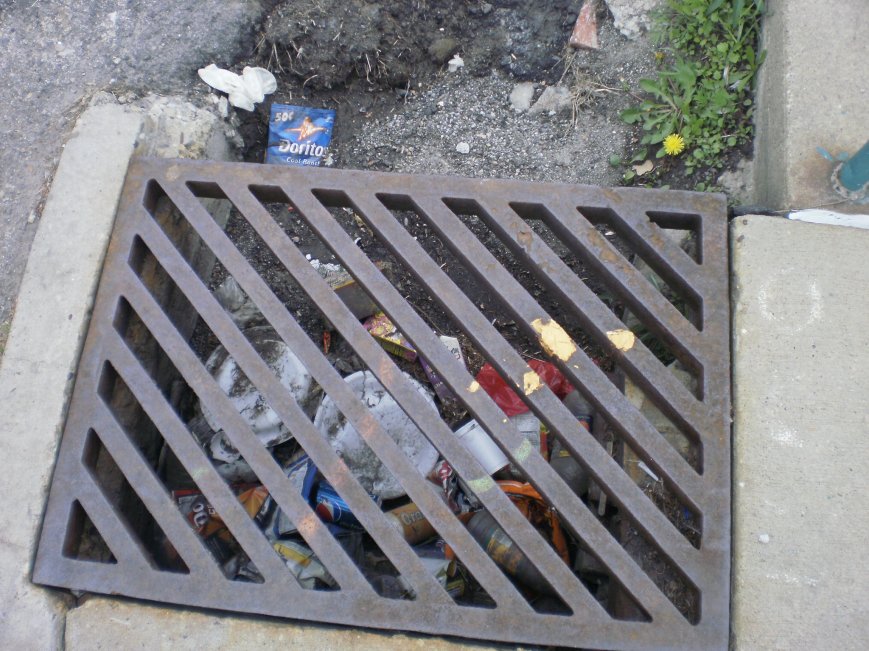
A Storm Drain Treated as a Trash Can

Today, that image of the trash train is causing me to question my behavior.  Is my habit of collecting all my “garbage” in a plastic bag and setting it at my curb for it to find its way to this train and then to a landfill really any better than the person whose habit is to drop their trash on the ground or down a storm drain?  Is a landfill really any better than the Great Pacific Garbage Patch?

Social media is filled with indignation over the trash vortex floating in our ocean, but maybe there should be more discussion and awareness about the rest of our trash: where it goes and what alternatives we have.

Utility Silos

20180421_133652 - Copy

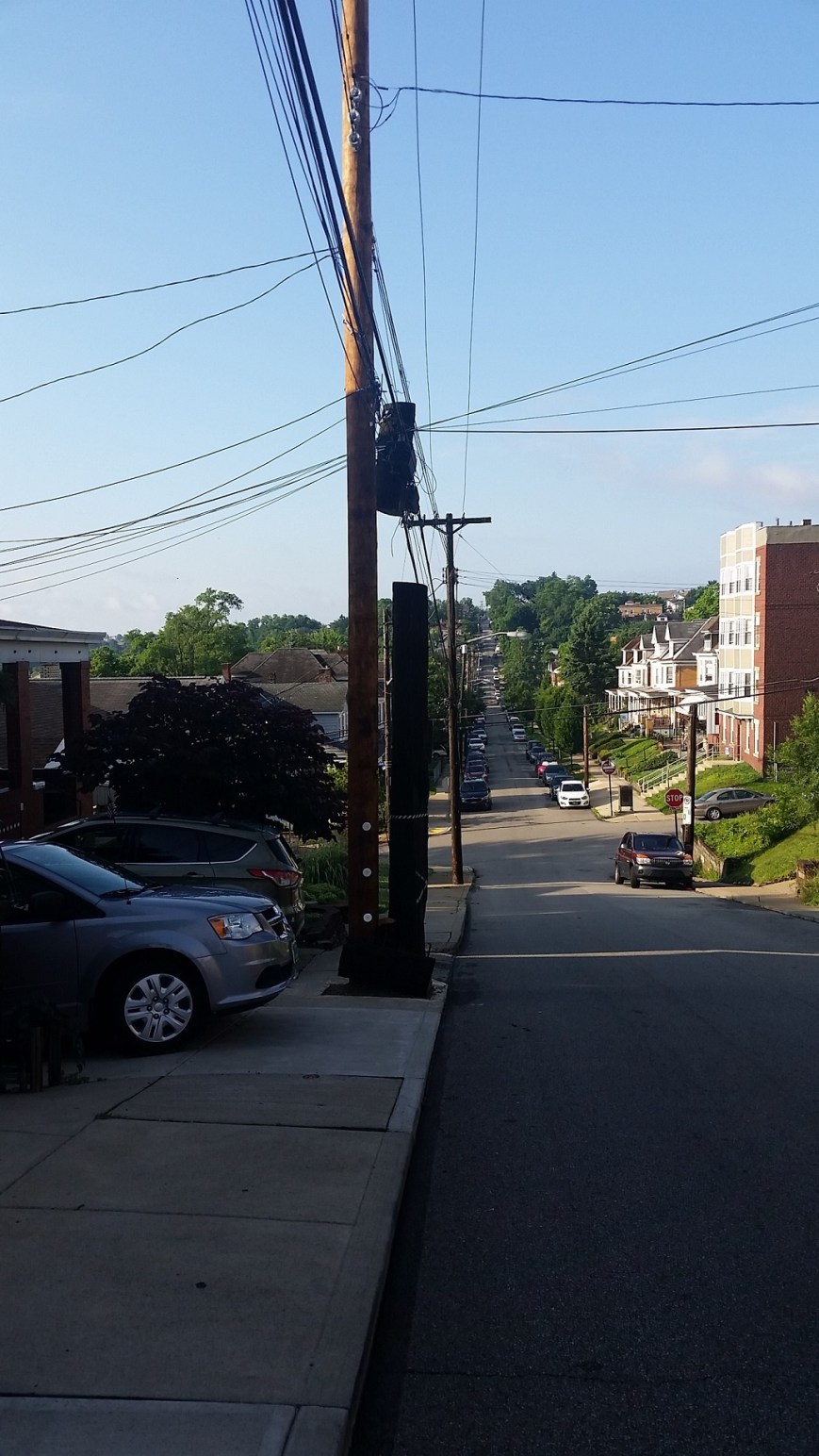
The obstruction from utility silos

This spring, the electric company went around my neighborhood installing replacement utility poles where the existing ones were on their last leg.  Watching them do this for a pole just down the street from me, I drew some conclusions about the interaction between the various companies that supply the different technologies available at our fingertips.  The electrical company owns the poles and the electric wire, but other companies own the other fiber optics and cables that use the poles.  The electric company installs new poles when the existing ones are deteriorated.  Once installed, they transfer the electric lines to the new pole.  The old pole is left with all the other lines in place, until the companies that own the rest of the lines transfer them to the new pole.

This arrangement seemed relatively harmless as I watched it in action near my house, but then I found the example above.  In this case, the rigidity of the silos and jurisdictions of the various companies created a physical barrier in the neighborhood that will likely be in place for the next 35 years or so, until the pole is ready to be replaced.  This is in direct contradiction to the City’s initiatives for greater accessibility illustrated by the sidewalk curb ramps installed within the last year at the intersections on either side of this pole.

20180421_133736 - Copy

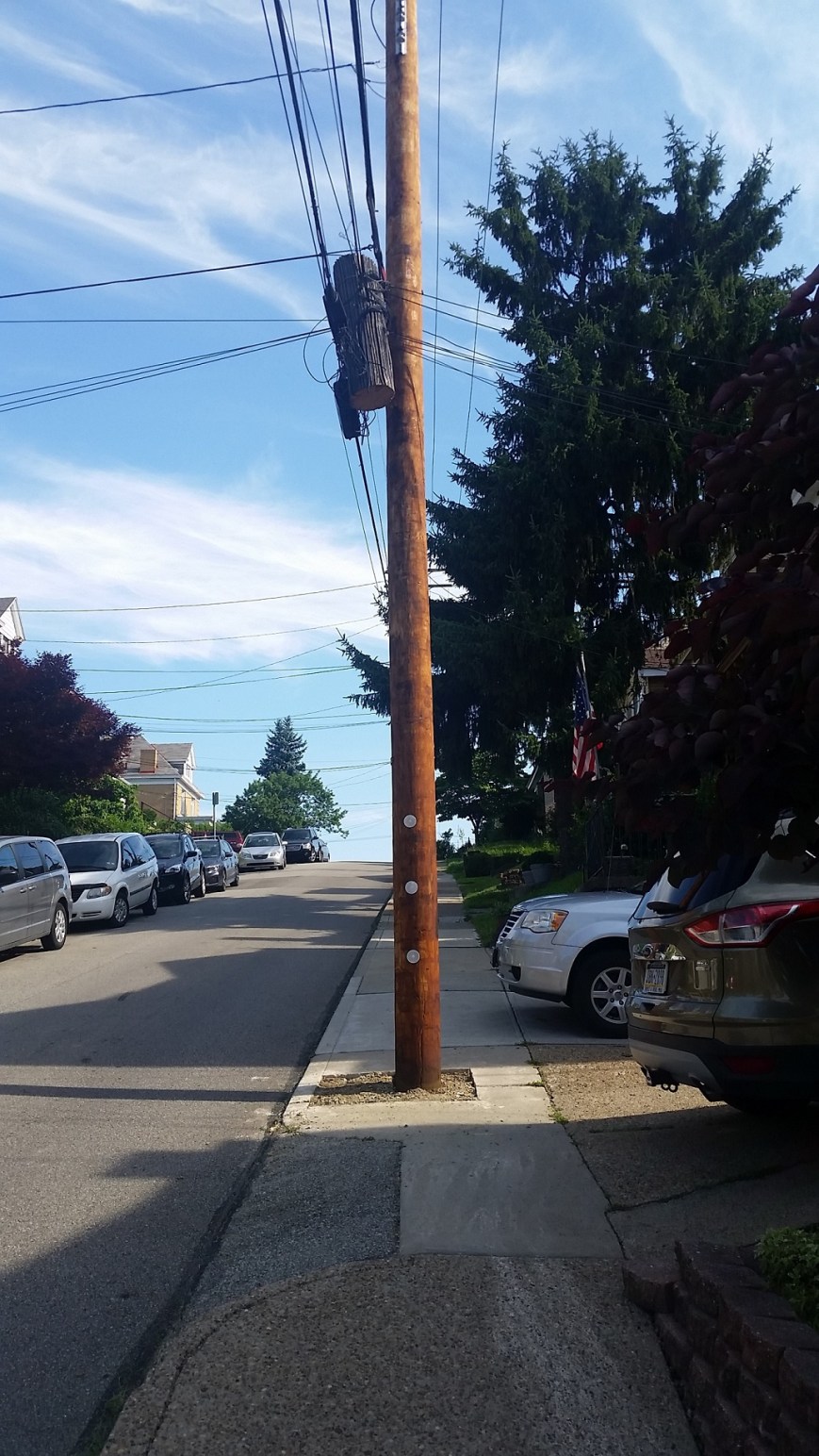
Close-up showing the curb, the old pole, the new pole, the foot of sidewalk left, and the combined driveways

The choices were limited for siting this new utility pole.  There are driveway curb cuts immediately adjacent on either side.  Therefore, to place the new pole in line with the existing poles would have partially blocked someone’s driveway.  Apparently, the silos are so entrenched that even under unusual circumstances such as these the various companies cannot work together so that a new pole can be placed in the exact same spot as the old pole.  The sidewalk that was already narrow and could not accommodate the recommended 5-foot clearance around obstructions is now nearly impassible and requires pedestrians to cross partially on the driveways.

I do not know if anyone paused before installing this new utility pole to ask if there was a different or better way to approach the situation.  From my experiences at my office in trying to work with others to design an approach that looks at the organization as a whole while still respecting and acknowledging each area of expertise and specialization, it is difficult to get all parties at the table to apply creative thinking and openness to how we can approach our work.  No doubt, even if someone was able to get all relevant parties involved in this utility pole to the table, they would have encountered similar challenges.

20180421_133844 - Copy

Evidence that the old poles eventually get removed and an example of where a new pole was placed next to the old along side the curb