Bloomfield Bridge

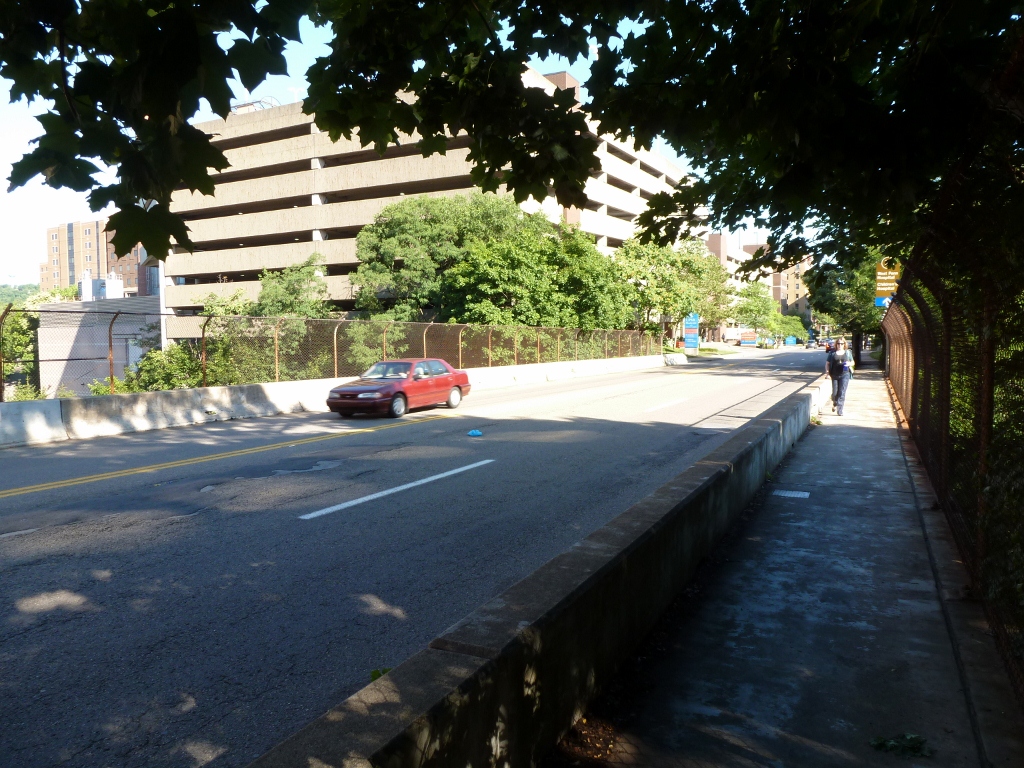
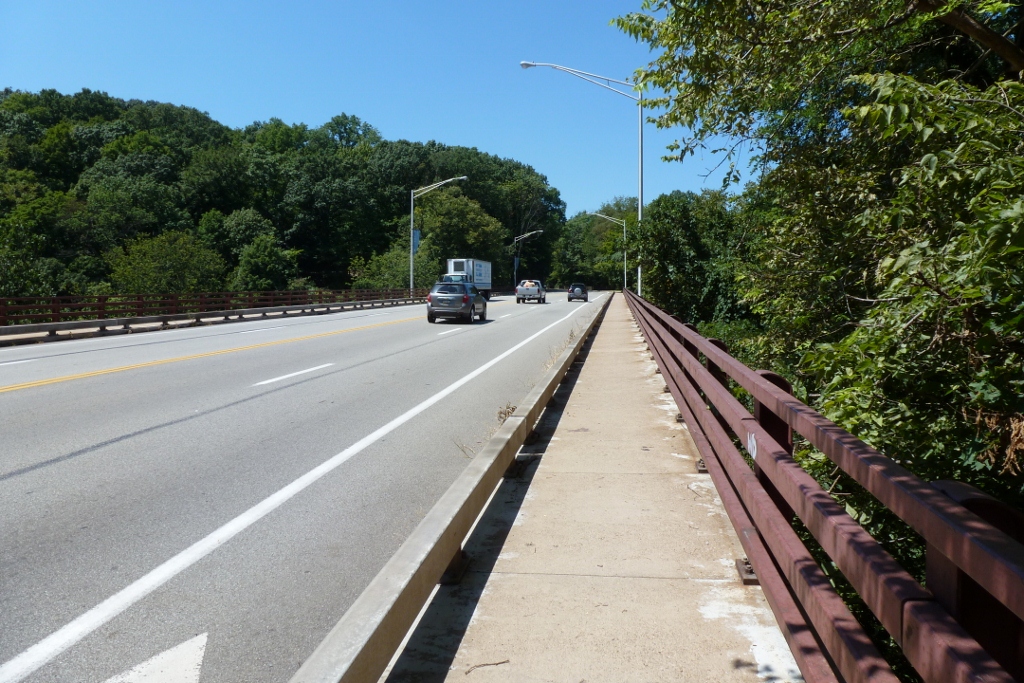
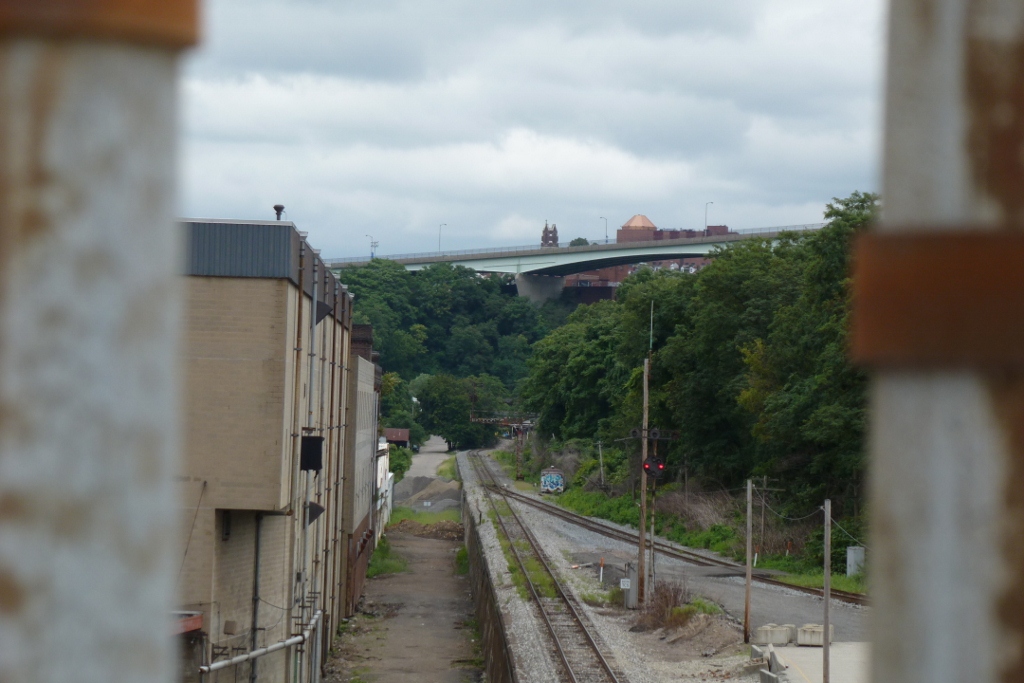
The Bloomfield Bridge towers over much of the surrounding areas thanks to the unique geography of Pittsburgh.  As I discussed in Pedestrian Bridges: Bigelow Boulevard, the Bloomfield Bridge is an a location that could lend itself to higher pedestrian traffic than some of the bridges I’ve walked because of its close proximity to a grocery store and a drug store on one side and residences on the other.  However, the accessibility for the residents is limited and not inviting.  Car traffic on the bridge and on Bigelow Blvd tend to have higher speeds, particularly as Bigelow Blvd is used like an expressway to get from one part of town to another.

Despite the issues of limited accessibility and the non-pedestrian friendliness of the bridge, it was worth the walk across for the various views of the city available from this bridge.  As I mention in my introductory post about my plan to walk Pittsburgh’s bridges, what I was already enjoying about the project was the various views of the city from the beautiful to the industrial and developing a greater awareness and appreciation for the varied geography of the city.  The Bloomfield Bridge covers both of these ideas.
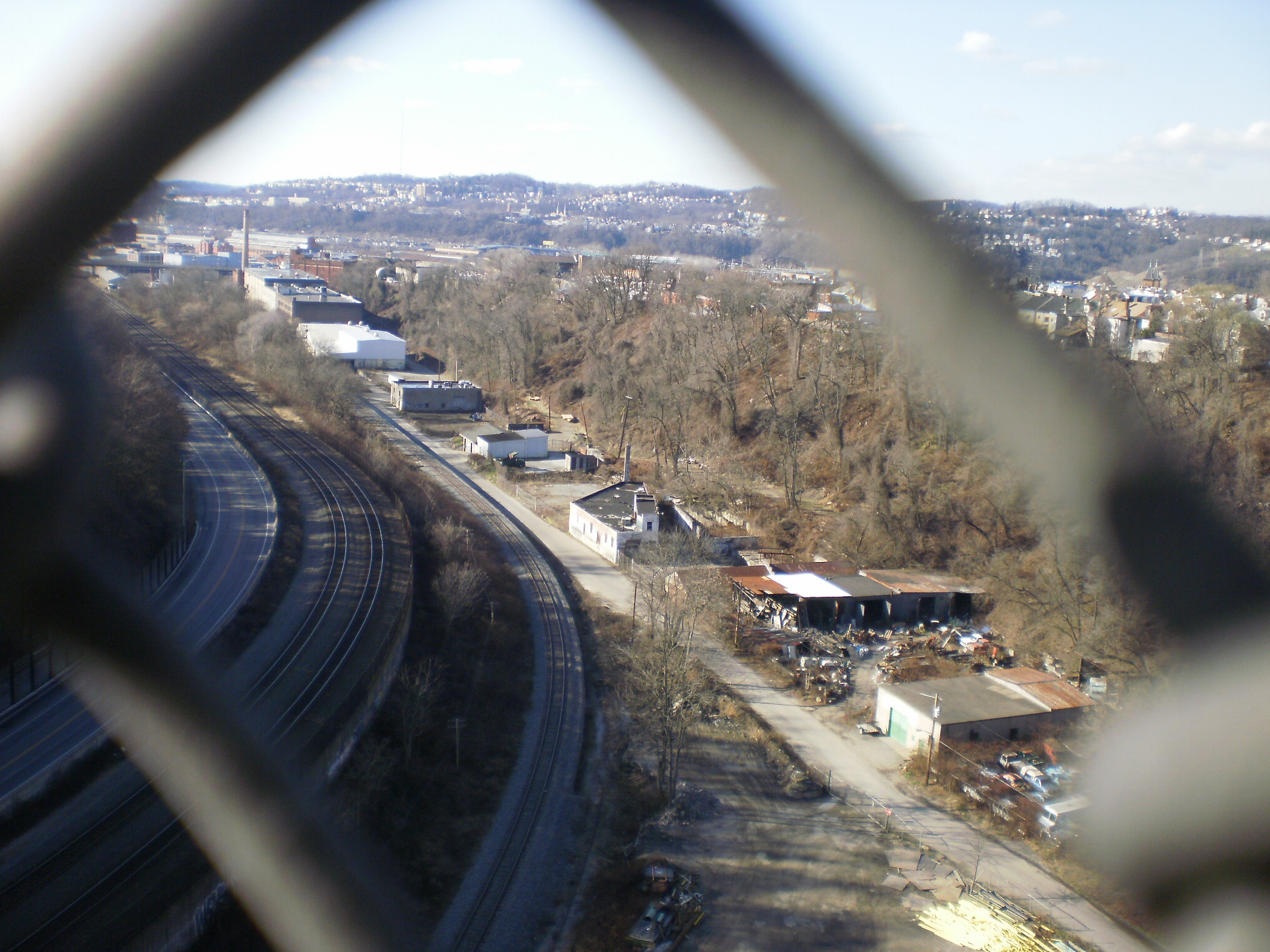
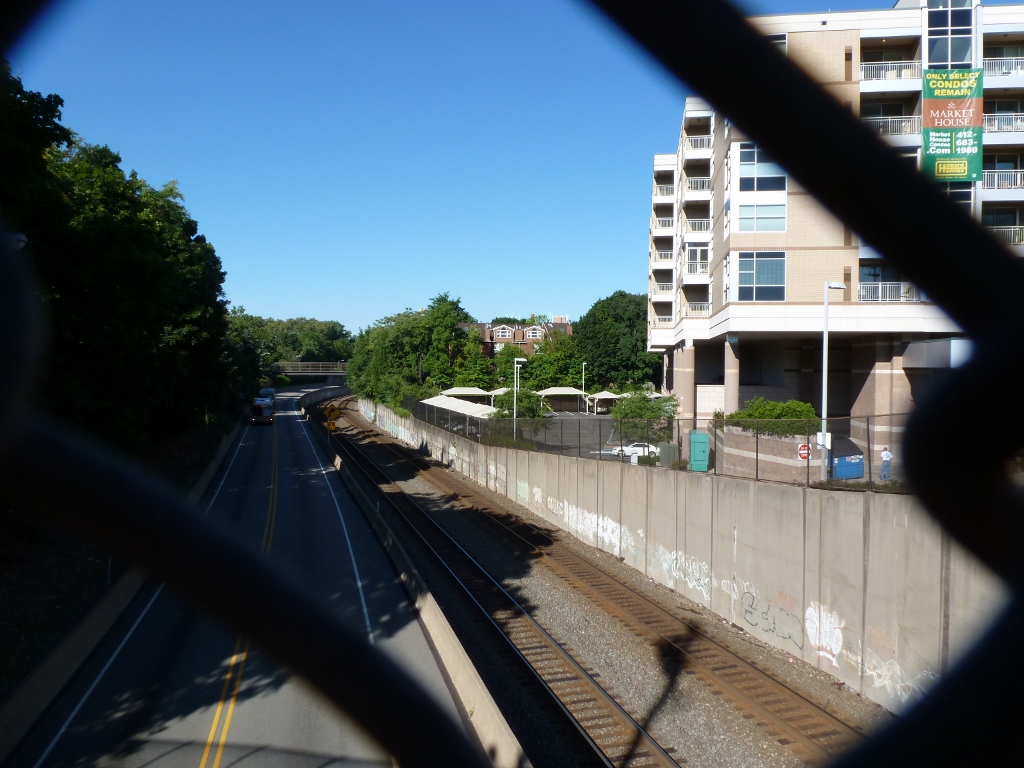
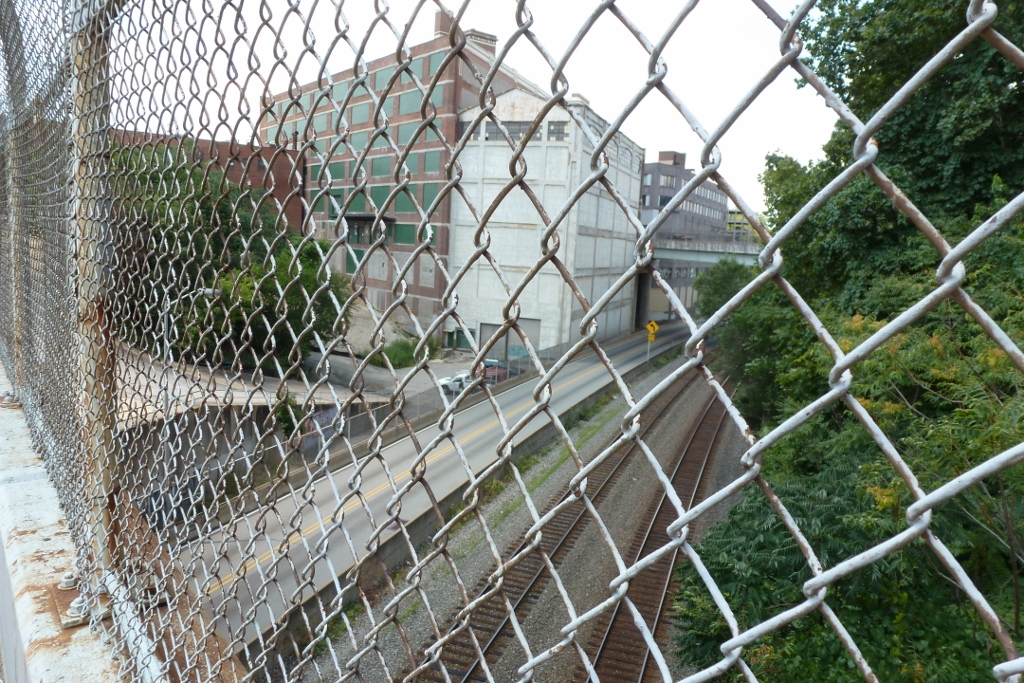
I refer to the Bloomfield Bridge in the introductory post linked above because of the “underbelly”-like view it still provides of Pittsburgh.  While much of the city is being shined and cleaned up–such as downtown and East Liberty–there are still places of what I like to call the nitty-gritty of Pittsburgh.  The Bloomfield Bridge shows one of these areas along the busway.  I’m not sure how all the buildings lined up in the picture above are used, but I believe at least some are junk yards for cars.  I believe the smoke stack in the distance at the end of the line buildings is for the former Iron City Brewery site, which I will talk about more in the post on the Polish Hill bridges.
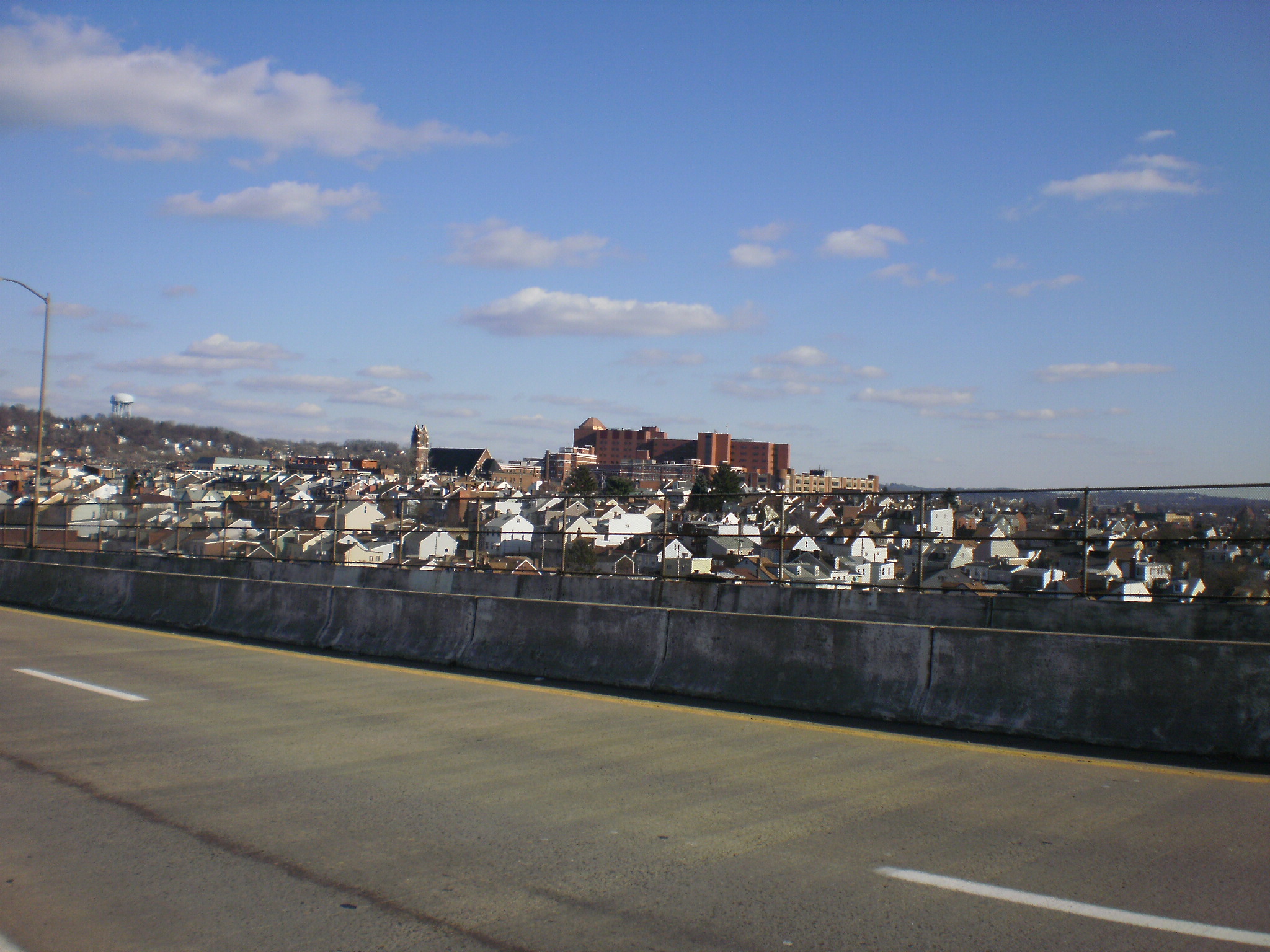
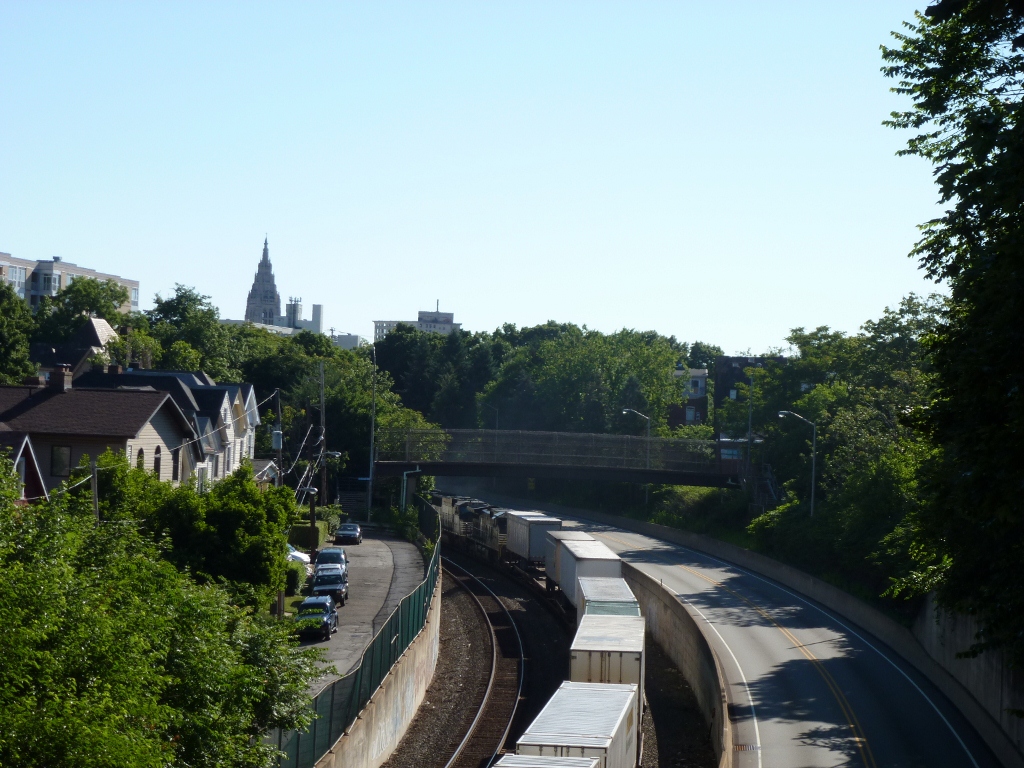
This view off of the other side of the bridge helps illustrate the extreme changes in geography around the Bloomfield Bridge from the rise on which West Penn Hospital sits (this photo) to the gully where the busway runs (photo above).  I think that the Bloomfield Bridge may offer one of the most open views in the city.  Like the view from the pedestrian bridge across Bigelow, the view east from the Bloomfield Bridge stretches past Bloomfield to East Liberty, Shadyside and beyond.
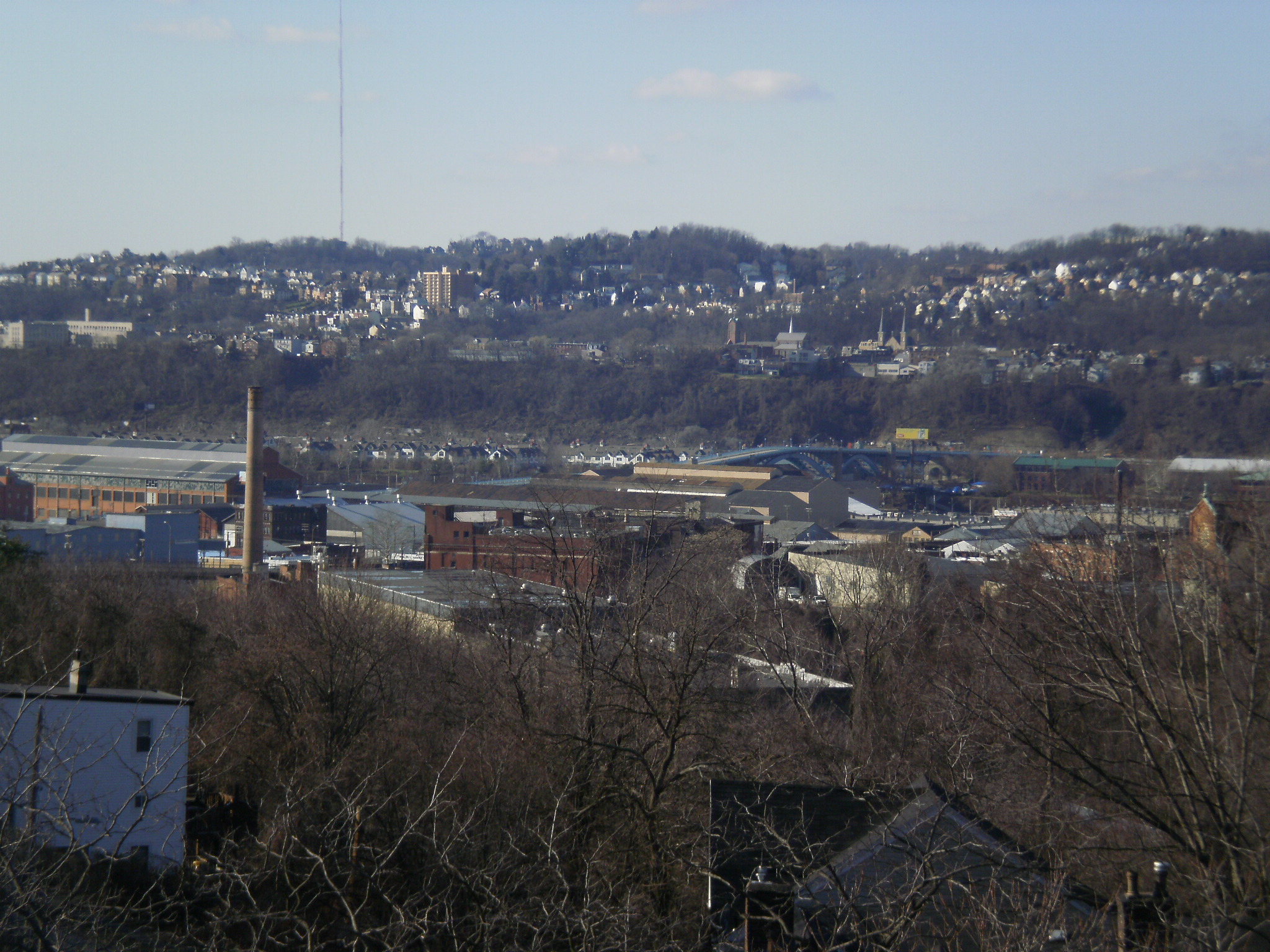
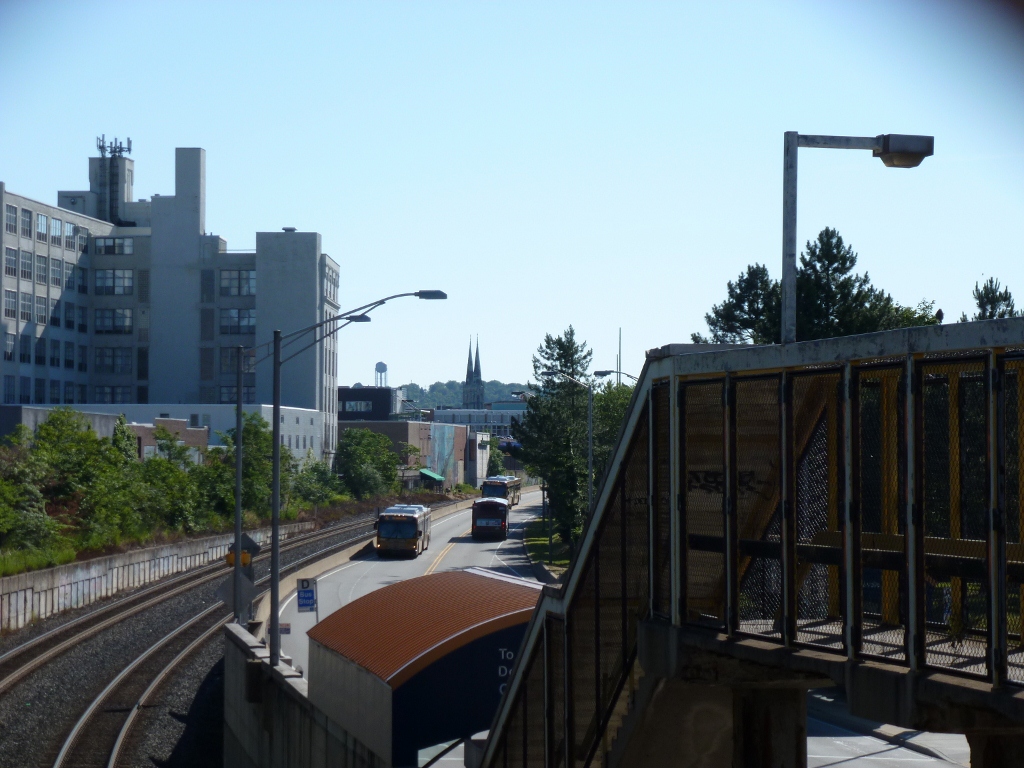
The view west of the bridge also reaches far: beyond the busway out over the rooftops of the warehouses and factories of The Strip District to the 31st Street Bridge (see post), the Herr’s Island development (see post) and the hills beyond.  There are not many places in Pittsburgh where the view stretches so far in multiple directions.
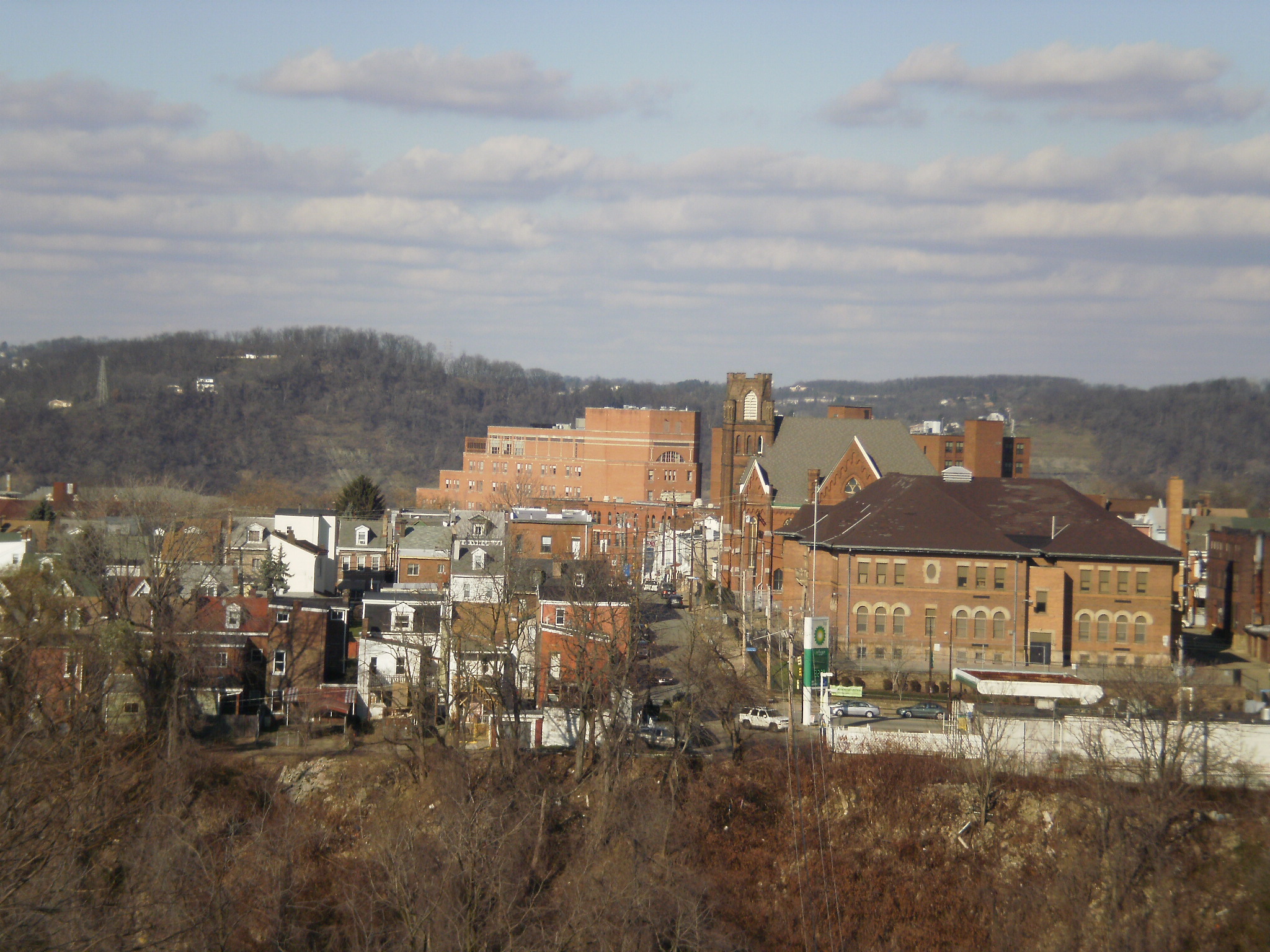
Part of the neighborhood of Bloomfield continues west of the Bloomfield Bridge.  Just a few blocks from the bridge is Woolslair Elementary School behind which is the Choir Loft Condominiums (formerly a German Evangelical Church).  I pointed out this church in my 31st Street Bridge post.  I explained in my first post about this blog that my current themes in walking are bridges and the adaptive reuse of churches.  This summer I focused mostly on the bridges as I set myself the goal of walking as many of Pittsburgh bridges as I could.  This fall I plan to shift the focus more toward the adaptive reuse of churches, though I will still continue to walk bridges as well.  Once I shift my emphasis, the Choir Loft Condominiums will be among the first adapted churches in Pittsburgh I will discuss.
Pedestrian Bridges: Bigelow Blvd

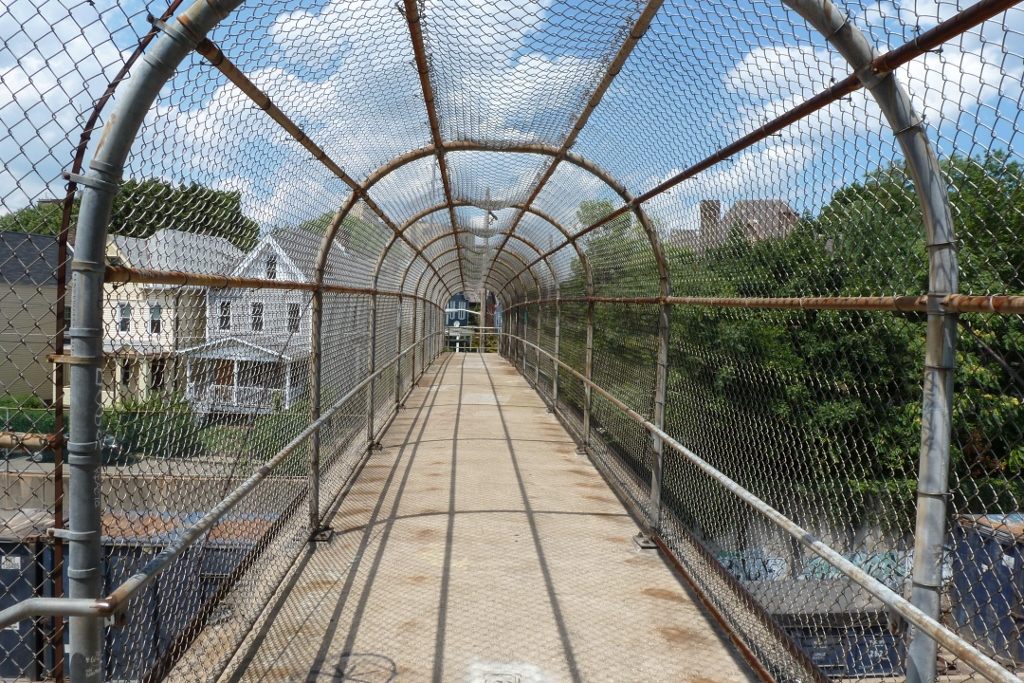
There is a pedestrian bridge across Bigelow Boulevard at the Bloomfield Bridge.  I walked this bridge before I started this blog and didn’t think to take a picture of the bridge itself.  Its appearance is similar to the Graham Street Pedestrian Bridge (see post) except that the fencing doesn’t connect overhead and does continue along the stairs.

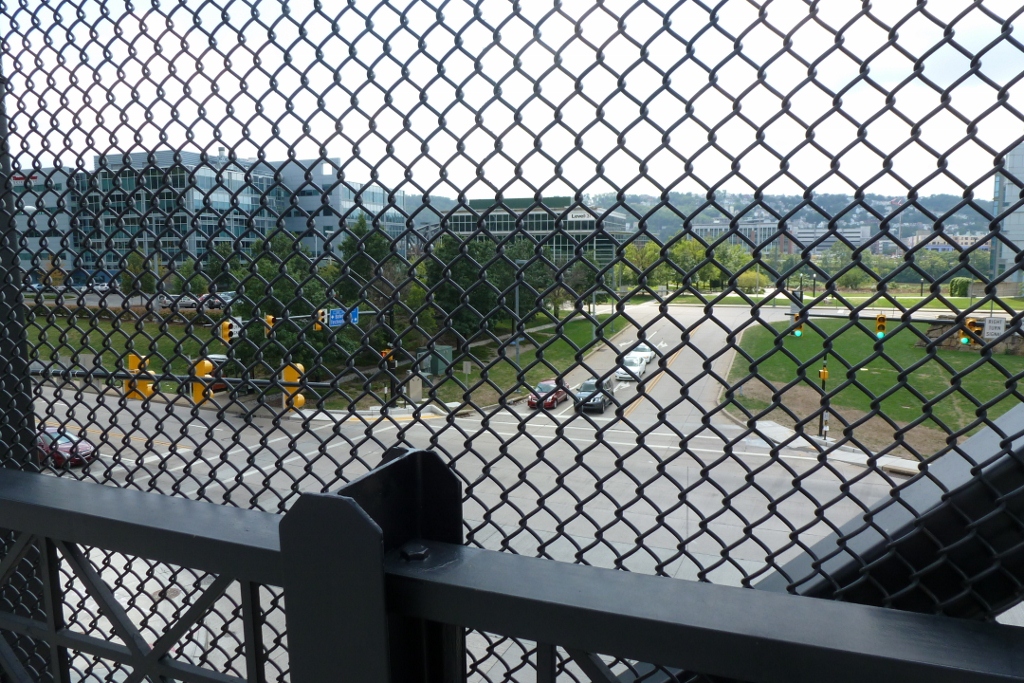
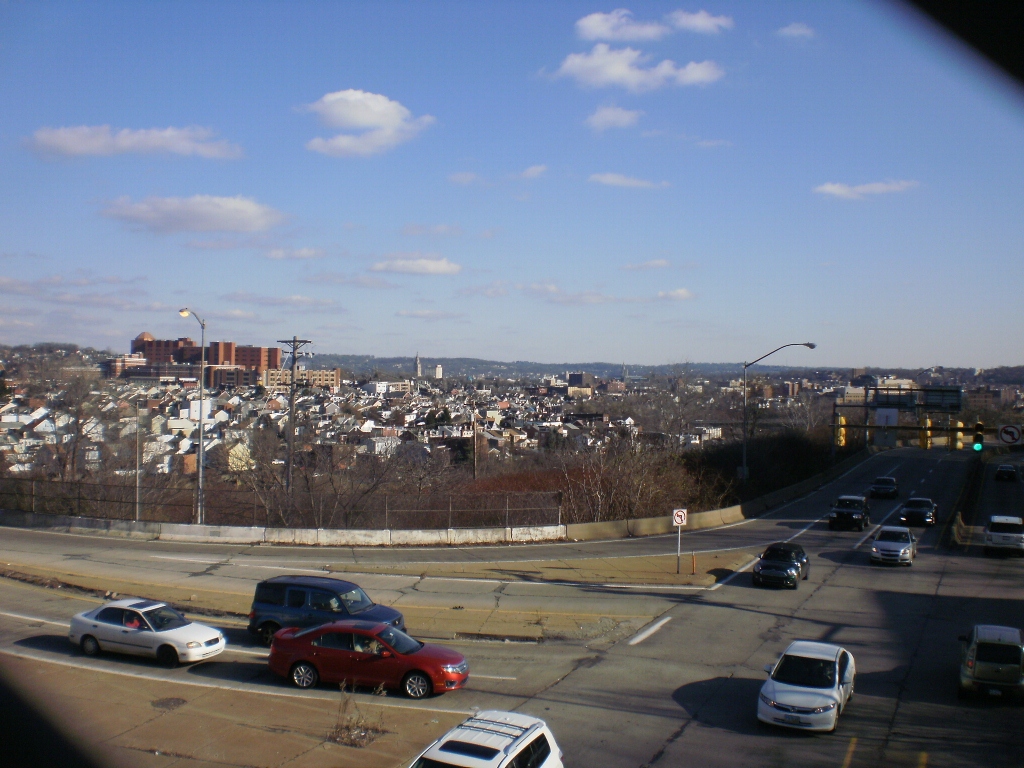
The picture above is from the Bigelow pedestrian bridge looking out over Pittsburgh’s East End.  The large brownish building on the left is West Penn Hospital in Bloomfield.  In the middle of the frame are two white points standing above the other buildings.  These are the steeple of East Liberty Presbyterian Church on the left and the Highland Building, also in East Liberty and designed by Daniel Burnham, on the right.

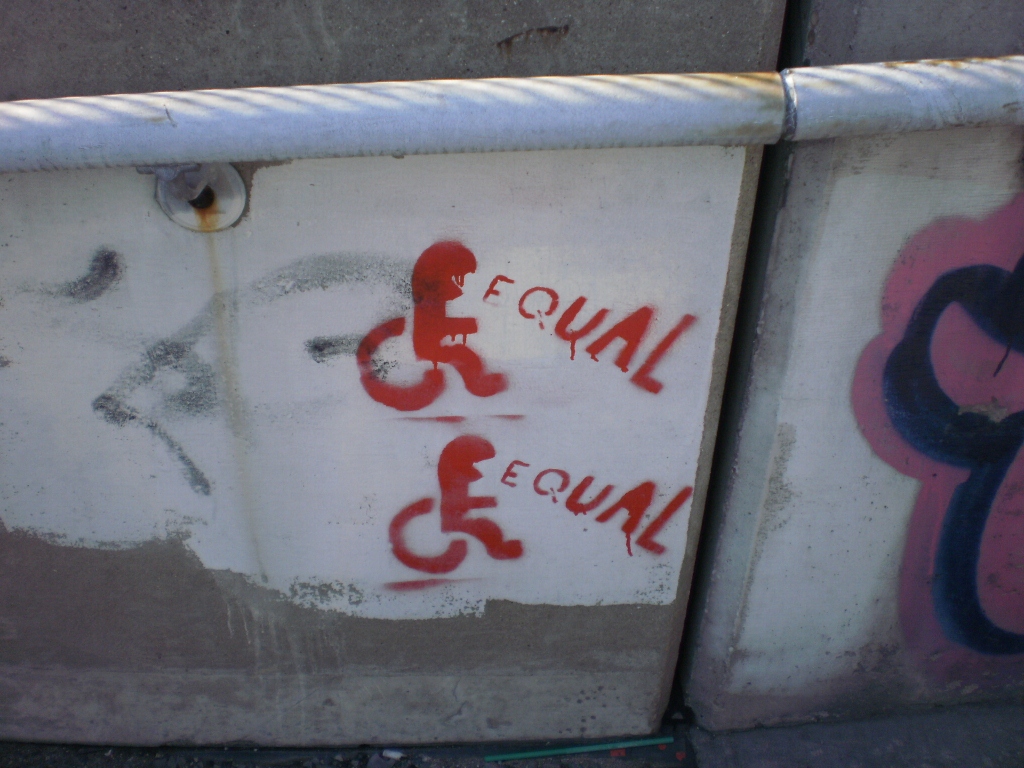
When I saw this symbol on the pedestrian bridge, I stopped to consider it.  This was the first time I had ever seen this symbol.  I thought whoever put it on this bridge had a very good point.  The only way to access the Bloomfield Bridge from Oakland and the uphill side of Bigelow Boulevard is by the pedestrian bridge, which is only accessible by a set of stairs on either side.  As such anyone with a mobility disability is barred from using the Bloomfield Bridge as a pedestrian.  The way the intersection of the bridge and the boulevard is set up now, it would not be safe for any pedestrian to attempt to cross the streets, let alone one with a disability.  This is a unequal and limiting situation.  There is a grocery store across from the other end of the bridge and a drug store and restaurants within another block.  Up the hill from this side of the bridge is a residential area.  The other end of the Bloomfield Bridge is the residents closest area for essentials found at grocery and drug stores as well as entertainment found at restaurants and bars.  It would be highly convenient for the residents on the hill to be able to walk to this area; however the current situation limits who is able to use this resource.  (Not to mention the ugliness of the bridge and the intersection which probably discourages many people from even considering the short walk across the Bloomfield Bridge.)

The second time I saw this graffiti symbol was on the 16th Street Bridge (see post).  I could not figure out what statement, if any, the 16th Street Bridge one was trying to communicate.  As far as I could tell, that bridge is accessible to any pedestrian with or without mobility issues.  At least there are no stairs to contend with at either end.

Busway Bridges: Shadyside

The Negley Avenue and Aiken Avenue bridges connect the sections of Pittsburgh’s Shadyside neighborhood divided by the busway.  Both were originally built in the 1920s and renovated in the 1970s.  There were at least two previous bridges at Aiken (see 1909 and 1924 photos).  I did not find any images of an earlier bridge on Negley, but there are images of the bridge from 1924 (the year it was built) and from 1965.

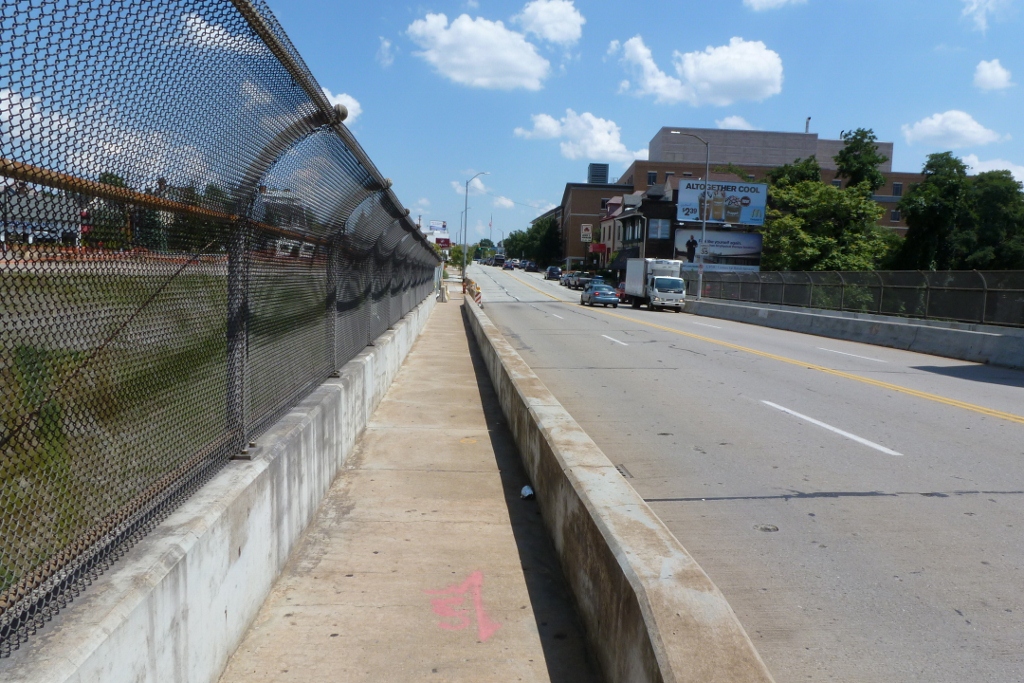
Today, these bridges share the feature of the mesh fence protecting the pedestrians from the edge.  The width of the sidewalk on the Aiken Bridge is wide enough to reduce any feelings of being caged in, but on the Negley bridge, the metal girder on one side and the fence on the other enhance the caged feeling for pedestrians.

These bridges are two blocks apart, but because the busway curves they are not visible to each other.  Both do see the Graham Street pedestrian bridge (see post).

This space between the Negley and Aiken bridges is mostly residential.  Next to the Negley Bridge is a condo complex while single family homes line the busway near Aiken Avenue.  On the other sides of the bridges, the area turns more industrial.  The industrial area east of Negley is denser than that west of Aiken.

Pedestrian Bridges: Bates Street

The trail bridge over Bates Street, which opened in 2011, is the second newest bridge in Pittsburgh.  The newest is the pedestrian bridge in East Liberty (see Taking the Long Way Round post).  The East Liberty bridge was a completely new bridge, whereas there was a trail bridge over Bates Street before.  This bridge carries the Eliza Furnace Trail.  This trail is part of the larger Three Rivers Heritage Trail.  I believe that this is the only bridge over a road along the Three Rivers Trail system.  There is a converted railroad bridge that carries the trial over part of the Allegheny River (see July 15 post).  The Hot Metal (Aug 9 post), Smithfield Street and Fort Duquesne (June 19 post) bridges are also considered part of the trail system according to the trail map.

As I mentioned in the Birmingham Bridge post, the part of the Three Rivers Trail system that travels on the northern side of the Monongahela is not a very pleasant stretch.  This area around the Bates Street Bridge is one of the worst sections.  The trail is caught between a freeway and the high traffic, through way of Second Avenue.  There is no vegetation or anything else to act as barriers to the noise of the traffic on these two roads and to the sun on a hot day.

Further away from town (in the direction the picture above looks), the trail improves some as it comes to an elevation between that of the freeway and Second Avenue and there is more space between the trail and the roads.  I’ve traveled on this trail toward town only once or twice, so I don’t remember specifics about it.  I do remember that it does continue to lean toward being unpleasant.  The times I traveled on it, I was biking.  From that experience I know I would never choose to walk it.  On a bike, you go fast enough to ignore much of the harshness of the trail, but walking you would be forced to take it all in.

Perhaps the biggest problem with this part of the trail system is that it doesn’t approach anywhere near the river.  This is a significant flaw for a trail considered part of a river trail system.  At the Bates Street Bridge, the trail is separated from the Monongahela River by Second Avenue and the office/technology park I reference in the Birmingham Bridge post.

One of my original fascinations with my walking bridge project was the different views of the city captured from the various bridges.  The Bates Street Bridge adds to the views of downtown I’ve collected so far:

Busway Bridges: Millvale Avenue

When I crossed the Millvale Avenue Bridge over the busway, I was thinking a lot about the “caged” aspect of many of Pittsburgh’s bridges.  I wrote about this idea in my Highland Park Bridge, Taking the Long Way Round, and Busway Bridges: East Liberty posts.  While a lot of bridges in Pittsburgh have the mesh fencing, which often makes me as a pedestrian feel caged in, there are several that do not.  As I prepared to cross this bridge I wondered why that is.

I wondered if perhaps it was to prevent people from jumping off the bridges.  This theory did not make sense though.  First, if that is the case shouldn’t all the bridges have the fences?  One of the times I crossed the Birmingham Bridge, I witnessed a scene that I believe was a group of people working to dissuade a jumper.  The Birmingham Bridge is one of the bridges without a fence.  The second reason this theory doesn’t fit is that on the Millvale Bridge, the fencing is only along part of it.  There is a significant stretch not fenced with a big drop.  The part that is fenced is the stretch over the railroad tracks and the busway.

My next ideas were that perhaps the fences are meant to stop litter from blowing off the bridge and onto the tracks/road/river below or to stop people from throwing things over the bridge.  Again, these don’t make sense.  Litter can blow in from any direction and could blow over the fence.  There is also a parking lot under the Millvale Bridge, so if the concern is about people tossing things over the bridge, why isn’t the fence extended to protect the cars in the lot?

I mention in Busway Bridges: Baum-Centre Corridor that most of the bridges across the busway between Penn Avenue and the Bloomfield Bridge are ugly and unpleasant.  Millvale Avenue Bridge is mostly exempted from this.  The design of the bridge is more aesthetically pleasing than the concrete of the Baum and Centre bridges and the rusty metal of the Highland and Negley bridges.  The area surrounding this bridge is also more residential and less used than the commercial arteries of Baum and Centre.

I thought the aesthetic difference might be explained by the years in which the bridges were built, but that is not the case.  The Highland, Negley, Aiken, Baum, and Millvale bridges across the busway were built in the 1910s or 1920s.  They were all reconstructed while the Penn, Centre, and Bloomfield bridges were all built in the 1960s, ’70s, or ’80s.  The Negley and Aiken bridges also connect with residential areas, so the land use around the bridge cannot explain the slightly different and better design of the Millvale Bridge.

Busway Bridges: Baum-Centre Corridor

Baum Boulevard and Centre Ave run parallel along the border of Pittsburgh’s Shadyside and Bloomfield neighborhoods and are arteries that help people move from downtown and Oakland to East Liberty and other East End neighborhoods.  The Baum-Centre corridor is currently receiving a lot of attention from the perspective of the development of the city.  There is even a community group called the Baum-Centre Initiative made up of representatives from other groups along the corridor.  Their goal is to work together to promote development along the corridor that is beneficial and satisfactory to their respective groups and communities.

This area is attracting interest in part because of its arterial activity, but also because Baum used to be the car dealership district.  Most of the dealerships have closed their locations leaving behind many empty buildings.  Contrary to this disinvestment, Centre Ave hosts one of the UPMC hospitals and an urgent care center was recently added.  From what I’ve picked up, UPMC is working to expand in this area.

The large building between Centre and Baum last housed a party/costume supply store, but I image most of the building was sitting empty.  For about the last year, it has been under redevelopment.  The rumor I have heard is that something related to UPMC is going into the space.

I also heard that UPMC wants to build a parking lot for its employees in this area.  I couldn’t picture exactly where it was to be placed from the description I heard, but I wonder if it is this empty lot off of Baum Boulevard.

Outside of the developments going on near them, my impression of these two bridges is that they are quite ugly.  I am glad that except for when I walked them for my project, I’m in a bus when crossing Centre Avenue’s bridge and in a car when crossing Baum Boulevard’s bridge.  Now that I mention it, that’s how I felt about most of the bridges across the busway I’ve walked (except for the new pedestrian bridge, see July 26 post).  Though I haven’t written the posts for all of them yet, at this point I have walked all the bridges over the busway between Penn Avenue and the Bloomfield Bridge.

My favorite part about walking these two bridges was the view of Bloomfield/Lawrenceville from the Baum Boulevard Bridge.  This view captures two of Bloomfield’s churches (both currently active) with Lawrenceville’s Childrens Hospital sandwiched between them.

Frick Park Bridges

Some of my favorite Pittsburgh amenities are the city parks, which I don’t use nearly as much as I would like.  Each park has a slightly different flavor.  Highland Park has a reservoir that is popular among locals for walking and jogging exercising.  When I was a kid, I loved Highland Park because it had the best playground in the city–the wooden playground, perfect for all kinds of imaginary games including those set in pirate ships and castles.  Schenley Park is good for disc golf, ice skating and other sports.  Frick Park is best for hiking and provides a good escape from the noise and traffic of the city.

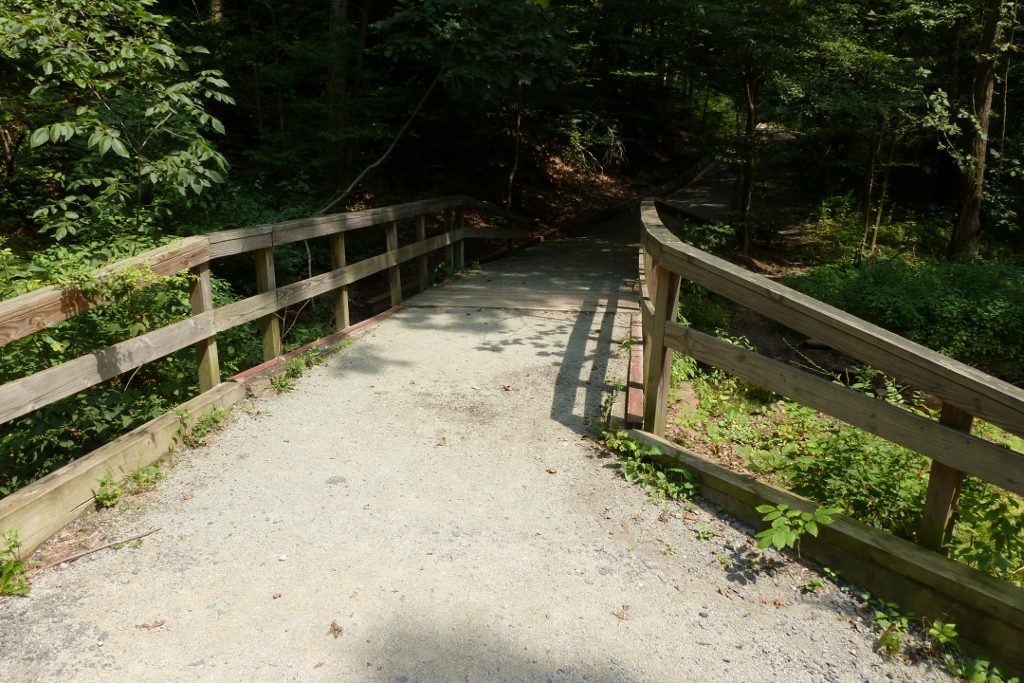
I walked 7 “bridges” in Frick Park.  Only one of these bridges can be counted toward the 446 non-railroad bridges of Pittsburgh.  Three of them I consider bridges, but the actual bridging portion was significantly less than eight feet.  While the other three are also called bridges on the map of Frick Park, they are really just glorified drain pipes.  I do not have a lot to say about any of these bridges, so the rest of the post will be short on words and long on pictures.

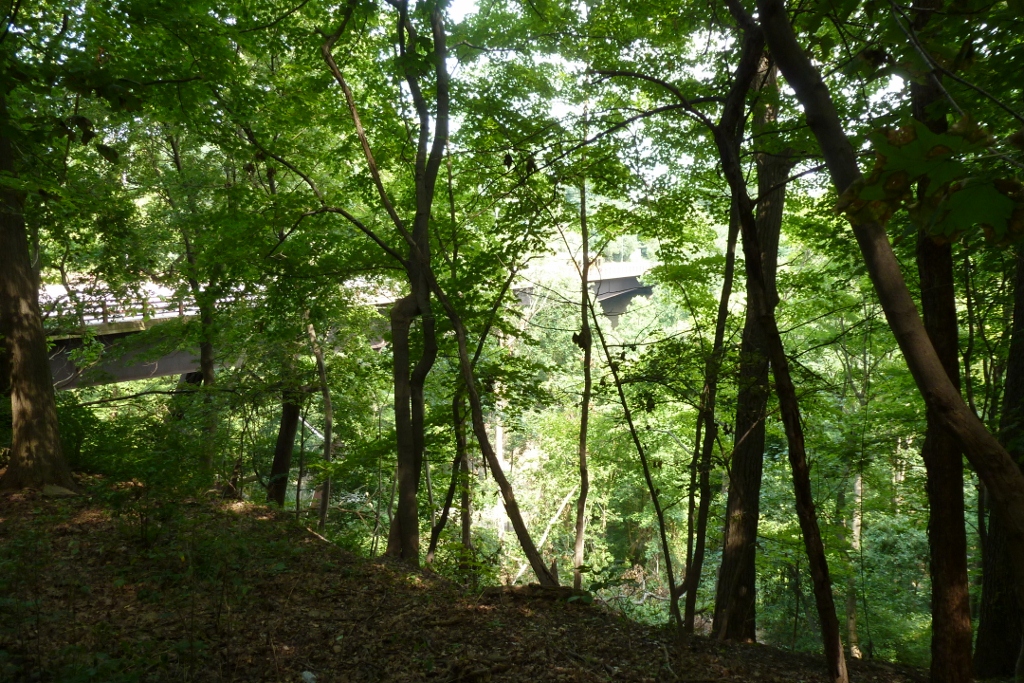
The one bridge that counts toward my goal of walking as many of the 446 bridges I can carries Forbes Avenue over the park.  It’s hard to see from the bridge because of all the trees, but one of the park’s main trails passes underneath the bridge.

The three structures I considered bridges crossed over a little stream that runs as parallel to the path mentioned above as nature allows.

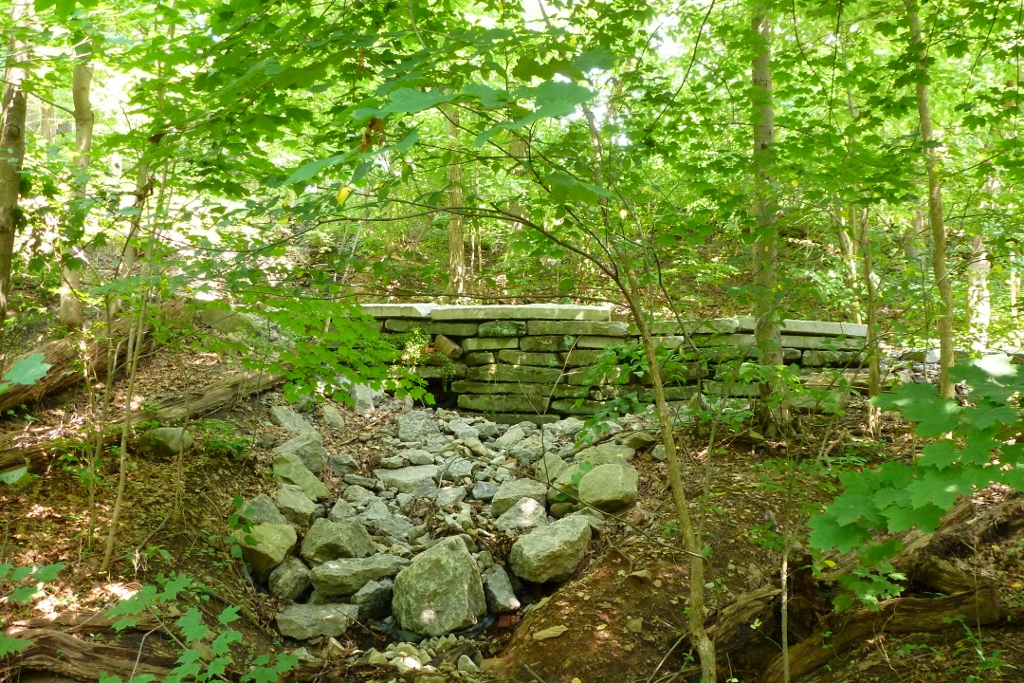
The glorified drains are along the hillside where little stream-lets run down to the stream below.

Hot Metal Bridge

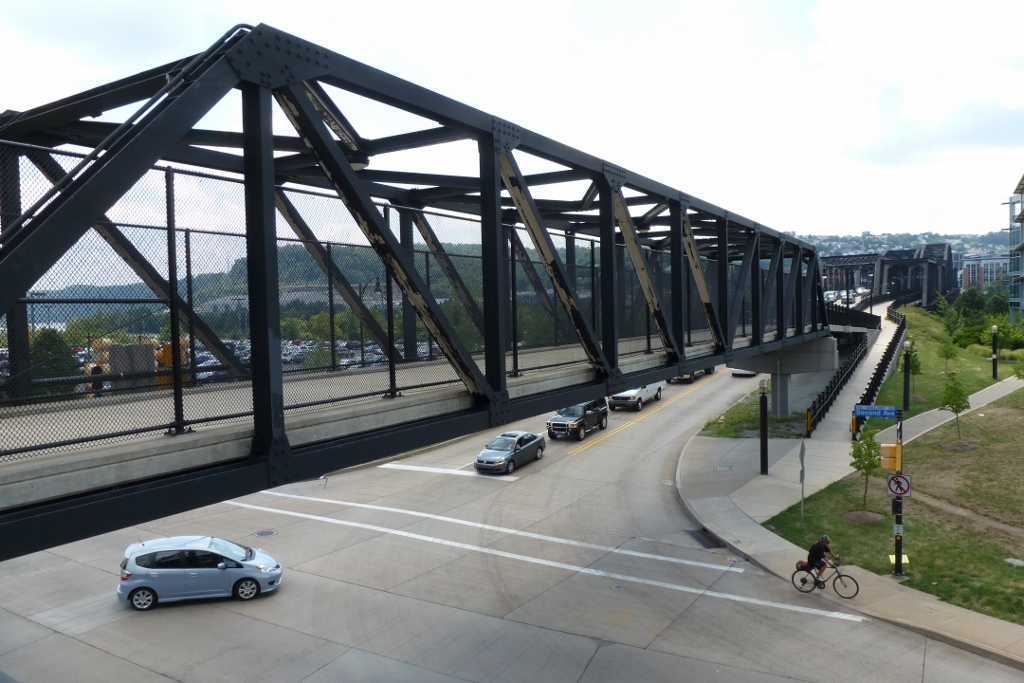
After walking the Hot Metal Bridge, I realized that it is really three separate bridges.  One of the bridges is the bike/pedestrian bridge pictured above that crosses over Second Avenue.  The other two are in the background of the image above–one carries all vehicular traffic while the other carries all pedestrians and bicycles.  The bridge pictured above is not structurally connected with either of the other bridges.  The two bridges that span the Monongahela River were built at different times.  While at this end (north) the bridges are at the same level, they are at two different elevations on the other side of the river.

The Hot Metal Bridge is one of the more locally famous and popular bridges in the city.  In my experience of participating in and overhearing people’s conversations locally about Pittsburgh bridges, the Hot Metal and Smithfield Street bridges are the two that come up the most as fun to use and interesting.  In the case of the Hot Metal Bridge, this is perhaps because it used to be a set of railroad bridges which have now been converted.  They were built and used by the Jones & Laughlin Company to connect its sites on opposites of the river.  The name of the bridge (Hot Metal) came from the fact that the trains were carrying molten metal from one factory to another.  There are, or at least there were, placards along Water Street along the South Side Works that describe the history of the J&L steel company on this site and on the bridge.  I don’t know if they are still up as there is currently construction going on in this area.

According to the description attached to the oldest image of the bridge on Historic Pittsburgh, the bridge was built in 1887.  This image, as well as PGHbridges.com’s page for the bridge, identifies the names of the two structures as the Monongahela Connecting Railroad Bridge (now the vehicular bridge) and the Hot Metal Bridge (now the pedestrian bridge).  The G.M. Hopkins maps tell a slightly different story.  As early as 1882, the maps show a bridge at this location.  That map and the 1889 map identify the bridge as the East End Bridge.  All the maps from 1890 through 1923 of this site call it the Jones & Laughlins Bridge.  Up until 1904, the bridge is depicted as carrying a single track, which I assume would be the bridge that is now the pedestrian bridge.  Starting in 1910, the bridge is depicted with three railroad tracks, meaning the current vehicular bridge was added in that time.

It is amazing to me that as late as 1998 this part of the city was still dominated by steel mill buildings as illustrated by this photo.  I suppose this means that I did not come to this part of the city then.  As the South Side Works mall did not exist yet, I guess there was no reason for me to come over here.  According to PGHbridges.com, the conversion of the bridges began in 1998, but the larger of the two bridges didn’t open until 2000 while the pedestrian bridge opened in 2007.

My final comment on this bridge is that there is a nice view of downtown from here, although the buildings don’t form any interesting patterns and clusters like they did in the views from the Allegheny River bridges (see 16th Street Bridge post for an example of this).

Pedestrian Bridges: Shadyside

When the pedestrian bridge I discuss in “Taking the Long Way Round” was in the process of being built, I was thinking it was the first pedestrian bridge in Pittsburgh.  When I started my project of walking the bridges in Pittsburgh, I realized what a ridiculous thought that was.  Pittsburgh has many pedestrian bridges, but until the new one was built, I never heard anyone talk about any pedestrian bridge in the city.  Many of these pedestrian bridges are not particularly attractive and are not in high traffic areas.

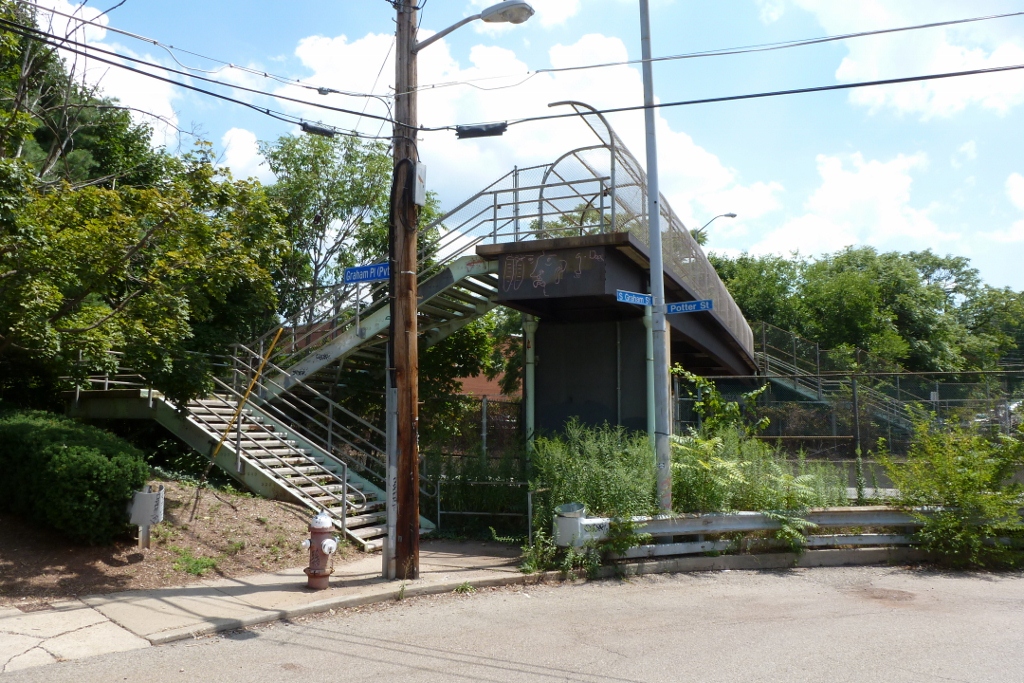
Shadyside has one of these hidden pedestrian bridges.  The bridge connects Graham Street across the busway and railroad tracks.  The only reason I know about this bridge is from riding buses on the busway.  Walking down Graham from Centre Ave (a busy corridor lined with businesses, churches and a hospital and used by several major bus routes and lots of cars), I was impressed how quiet and peaceful the residential area between Centre and the busway was.  That is until a train comes by.

As I walked across this bridge, I wondered why it was there.  There is a vehicular bridge with sidewalks on both sides across the busway a block in either direction.  There are eight other roads between this bridge and the Penn Ave Bridge that end at the busway and have neither a vehicular or pedestrian bridge connecting them to the other side of the busway.  In my walk, I speculated that perhaps it was put in to connect the residents on the north side of the busway to places of work on the southern.  This was based on the fact that there was a large building on the southern side that now houses the Shadyside Boys and Girls Club (photo below).

When I got home I went to PGHbridges.com, which I have used whenever I’ve had questions like this about the origin or design of Pittsburgh bridges.  However, for some reason this website ignores many of the bridges over the busway.  In looking up some of the bridges that PGHbridges.com misses, I found several other bridge websites that list and identify many of the bridges in the city, but none of them include the Graham Street Bridge, not even the National Bridge Inventory Database.

So I turned back to my favorite resource–the G.M. Hopkins maps.  I also went to the image collection on Historic Pittsburgh, the parent site for the Hopkins maps.  In the image collection I found one photo from 1908 of the bridge under construction.  The 1904 and 1911 maps show the area immediately adjacent to the bridge as all residential.  The building that is now the Boys and Girls Club does not exist.  All I’m left with is speculation at this point.  However, there is a school a few blocks from the southern end of the bridge and in between 1904 and 1911 another church was built a couple blocks north of the bridge.  There already was a large church a block from the site of the newer, smaller one.  Perhaps, the bridge was built to facilitate school students and church goers to get to their respective destinations.

Based on the way the bridge is depicted on the 1911 map and the 1939 map, I suspect the bridge may have been rebuilt since 1908.  At the very least the stairs were replaced.  The southern steps are drawn as coming straight out from the bridge to the road, but today the stairs are perpendicular to the line of the bridge and Graham Street.  The northern steps are drawn perpendicular to the bridge and facing the same direction the southern steps face today.  However, the steps I walked are switchback style, with the upper portion facing the opposite direction depicted on the 1939 map.

Birmingham Bridge

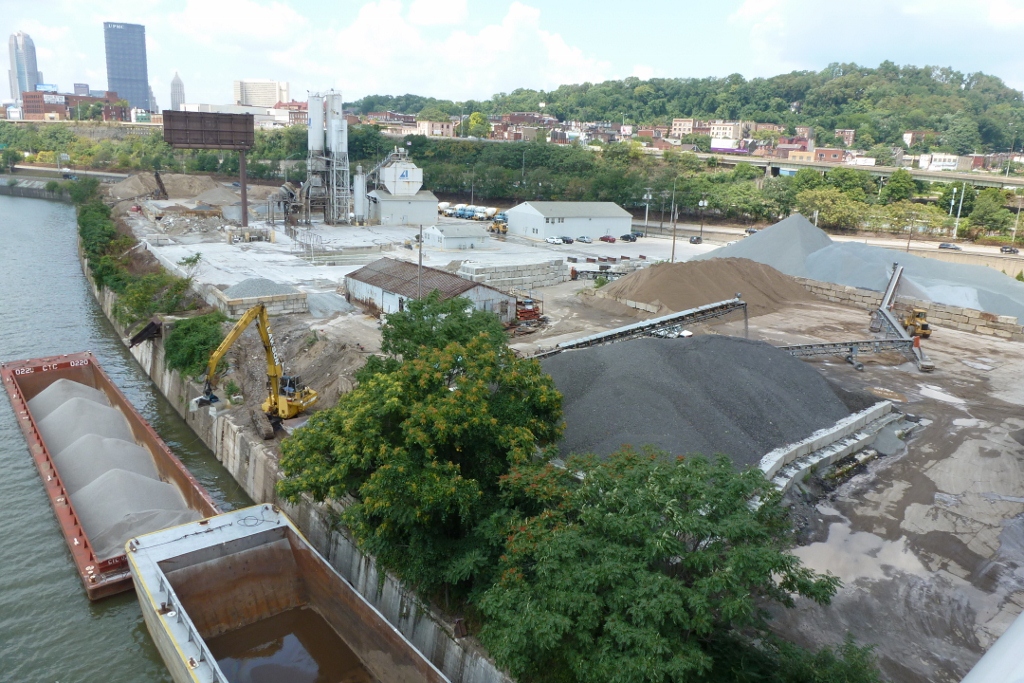
Outside of the safety issues of the Birmingham Bridge (see July 30 post), the surroundings and view from the bridge were interesting.  I was particularly interested in the uses along the waterfront around the bridge as there were three distinct types of use.

On the northern shore of the river and western side of the bridge is this gravel/cement? factory. I classify it as an industrial use, but I don’t really know what its purpose is.  I watch for a little while as the excavator scooped gravel from the barge and dumped it on the conveyor belt which passed it along and piled with the rest.  I think it is easy to forget at times that our rivers are still working rivers–some coal and other materials are still shipped by the rivers.  The image above is a reminder of this as the gravel was obviously delivered by river.

On the same shore, but the other side of the bridge, is one of Pittsburgh’s redeveloped brownfields.  This area used to be part of the Jones and Laughlin Steel Company, dominated by the Soho Iron Works (see 1923 map).  Today it is home to several office buildings along Technology Drive, including Carnegie Mellon University’s Entertainment Technology Center.  I believe the University of Pittsburgh may also have property on this site.  This site is an illustration of Pittsburgh’s Second Renaissance, the “Eds and Meds,” which was implemented in the 1980s to counteract the job loss and deterioration caused by the decline of the steel industry.  Here the former steel plant was replaced by buildings housing at least the education part of “Eds and Meds.”

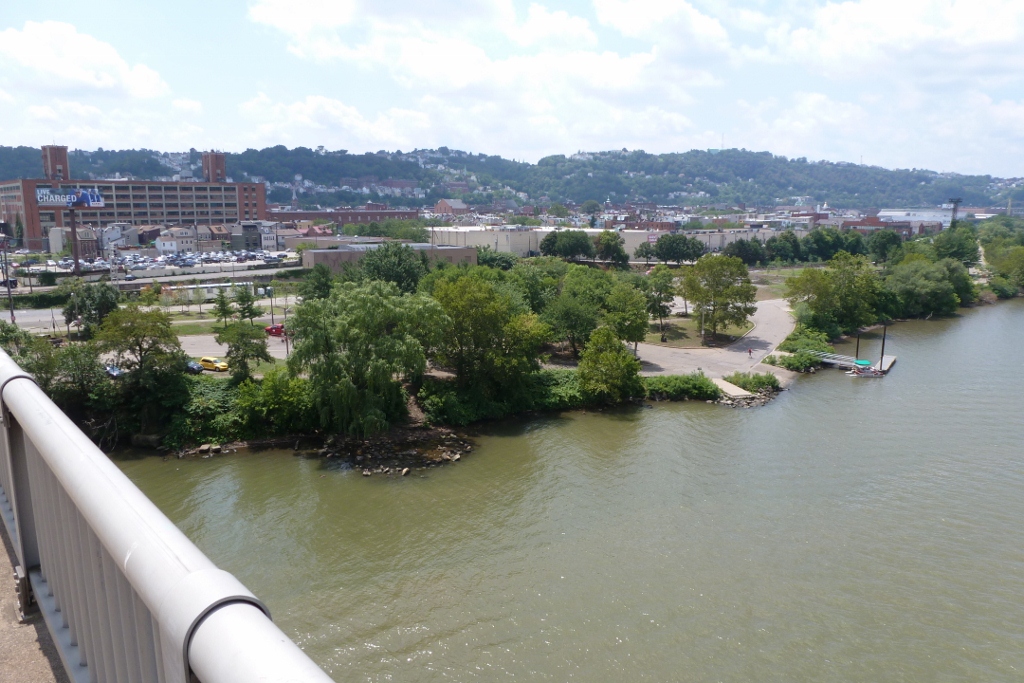
The third use of the waterfront at the Birmingham Bridge is recreation (and green space) on the southern shore.  The Three Rivers Heritage Trail travels near the river among the trees and grass.  The trail also passes under the Birmingham Bridge on the north shore, but the technology park and gravel site separate the trail from the river and it passes near the freeway, making it not a very pleasant place for recreation.  The southern branch of the trail on the other hand is pleasant as it passes among greenery and near the river.  The western side of the bridge provides additional opportunities for recreation on the southern shore as there is a boat launch and a parking lot that provides access to the boat launch and some picnic areas nearby.

The area around the Birmingham Bridge captures the various uses which riverfront property has been put in Pittsburgh.  First it was an ideal spot for industry and mills.  This has been replaced in some areas with new developments such as the offices at the technology center.  Now there seems to be an increasing interest in making the river fronts accessible and available for recreational use.