Pittsburgh Steps

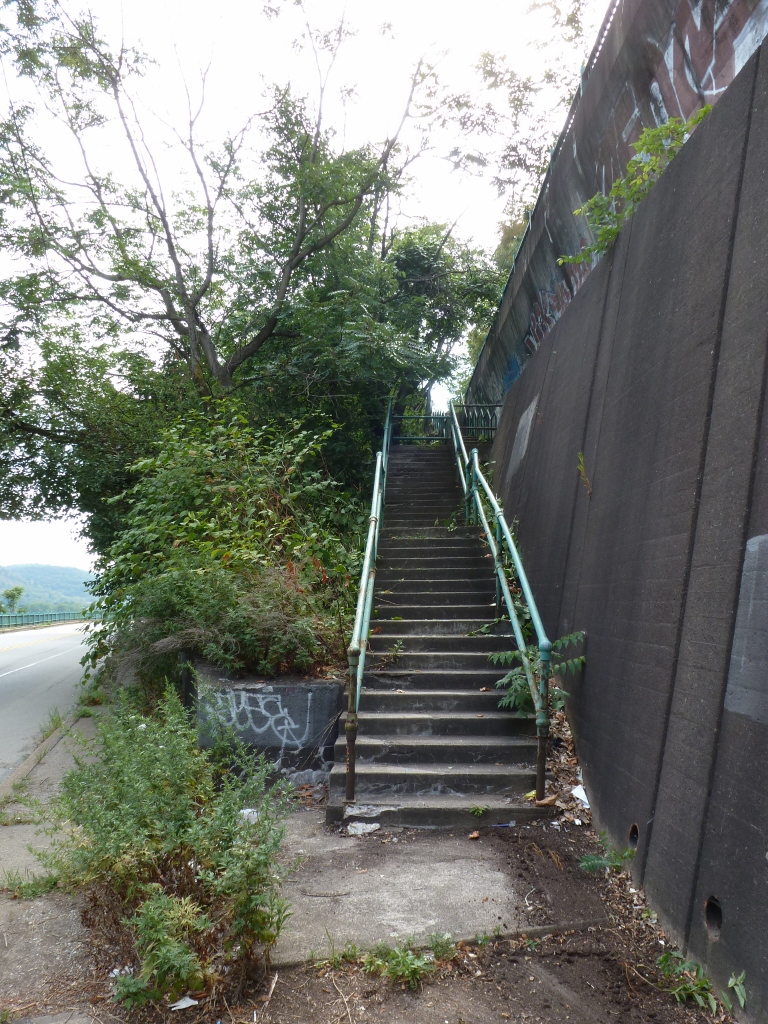
According to an article in today’s Post-Gazette, not only does Pittsburgh have more bridges than any other city, but it also has more steps (at least compared to US cities).  Pittsburgh has 712 flights of steps, while San Francisco only has 168.  After I walk all 446 of Pittsburgh’s bridges (at least all of them that are pedestrian accessible), perhaps my next goal should be to walk all of the steps.  I have considered doing this in the past, but have hesitated because of the condition of some of the steps.  The one pictured above is in good condition, but more often than not the steps are over grown, cracked, perhaps missing a step or two, and the railings are rusted and look like they’ll crumble to the touch.  The steps were frequently used in the past by mill workers who lived up or over the hill from the mill, but since cars became more common and the mills closed, they mostly sit vacant.  As there isn’t much demand for them, it is understandable that the city doesn’t spend the few dollars it has on their maintenance.  All the same it is a shame to see them deteriorate.

However, that may all be about to change!  Today’s article is about a group of young people who created an organization, Community Steps Cooperative to clean the steps and make them safe.  An eventual goal is to make them attractive destinations a side-effect of which may be that they rival San Francisco’s steps.  I am very excited to see a group take initiative on this and I hope to be able to participate in some of the volunteer events to help clean the steps!

Converted Railroad Bridge

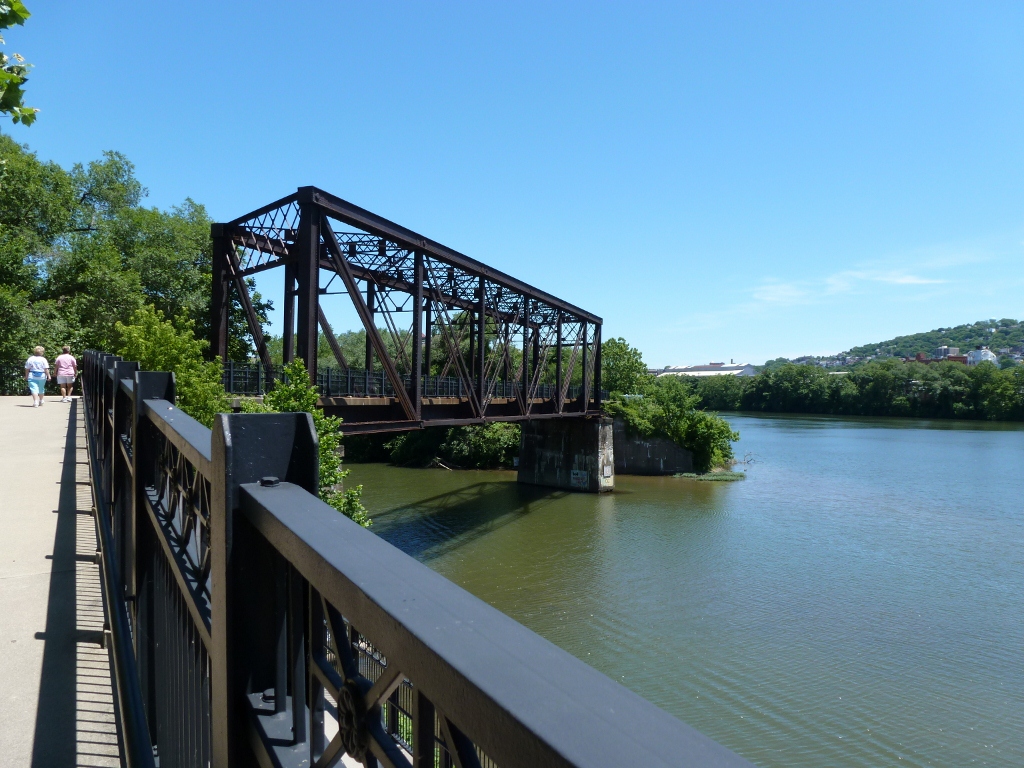
This is the bridge that I missed when identifying the river bridges to cross on GoogleEarth.  I missed it because it doesn’t cross the entire width of the Allegheny River.  About 2.5 miles upriver from Downtown Pittsburgh is Herr’s Island, also known as Washington’s Landing.  The name Washington’s Landing refers to the story that this was where George Washington spent the night after a crossing of the Allegheny River during which he fell into the river.  (The folk song “The Forks of the Ohio” describes the incident.)  Herr’s Island refers to one of the original landowners of the island, Benjamin Herr.

One of the names of this bridge is Herr’s Island Railroad Bridge.  While PGHbridges.com lists multiple names for the bridge, none of them refer to the new use of the bridge as a pedestrian bridge.  The bridge connects the northern shore of the Allegheny with Herr’s Island and I image was very well used while the island was covered with industry.  Now is it a very pleasant pedestrian bridge connecting the northern branch of the Three Rivers Heritage Trail with Herr’s Island, which now features a swanky residential area.


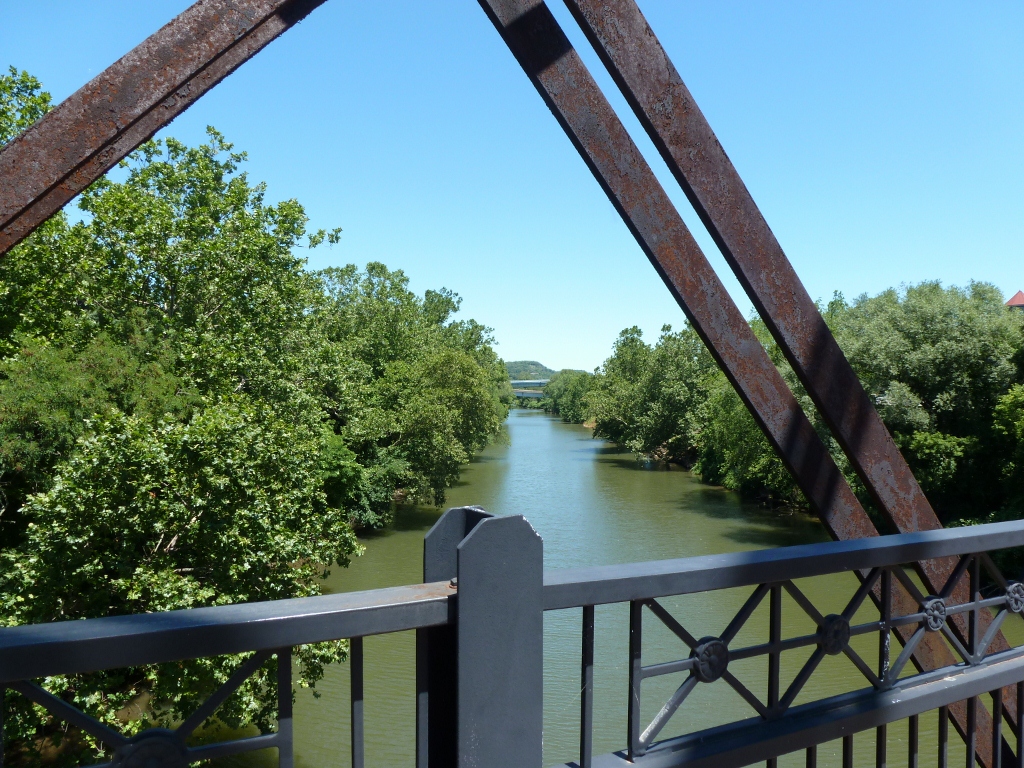
The view upstream shows the little stretch of the Allegheny that separates the northern shore from Herr’s Island, while the downstream view captures downtown.

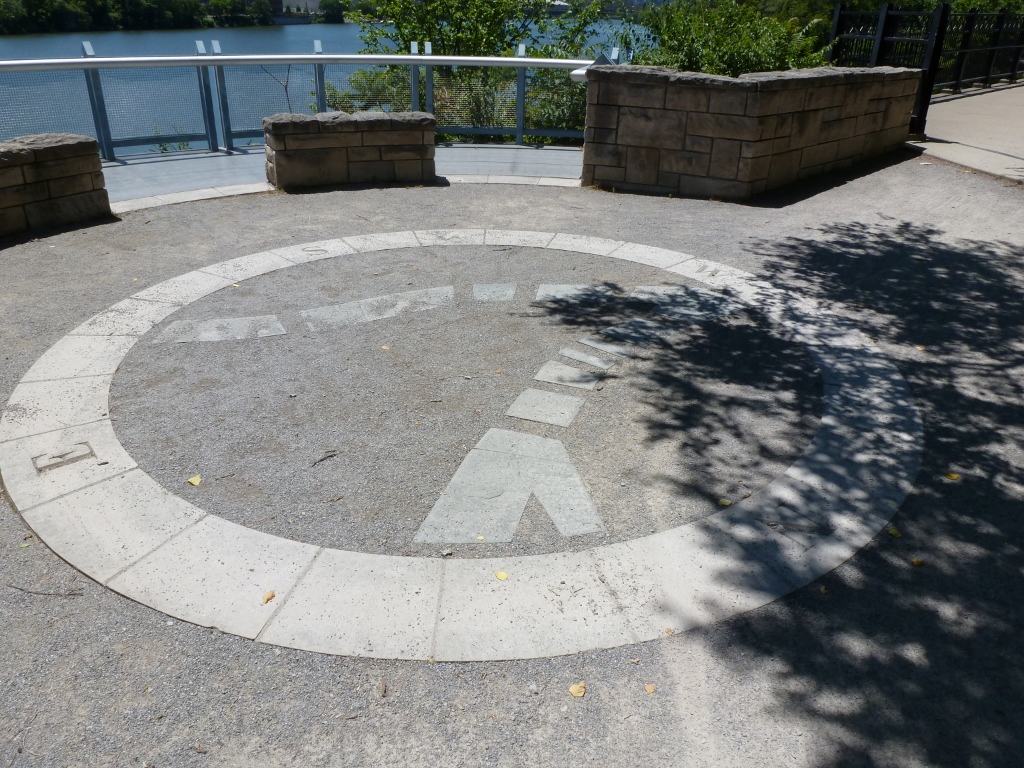
At the Herr’s Island end of the bridge is a nice look-out space featuring this compass with the three rivers.  While this part is nice and seems to welcome the public, I always feel very awkward as I continue on the trail along Herr’s Island.  The way the island was developed, it feel like it’s a private, gated community and people like me who use the trail but don’t live there are interlopers and trespassers.

16th Street Bridge-Developments


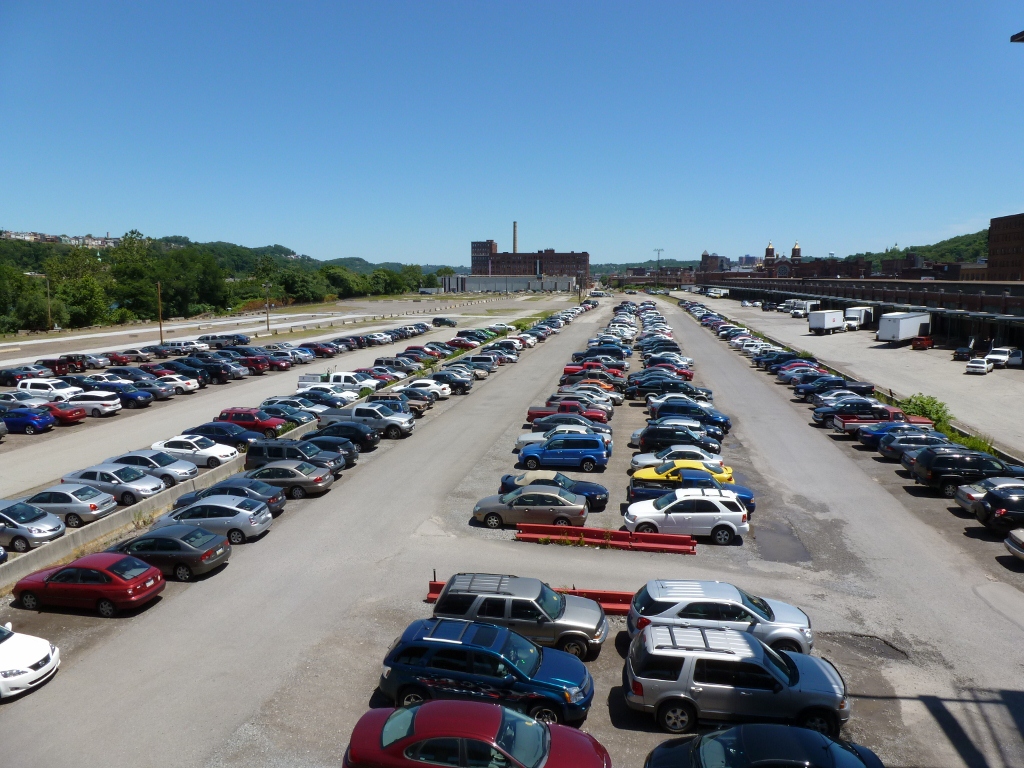
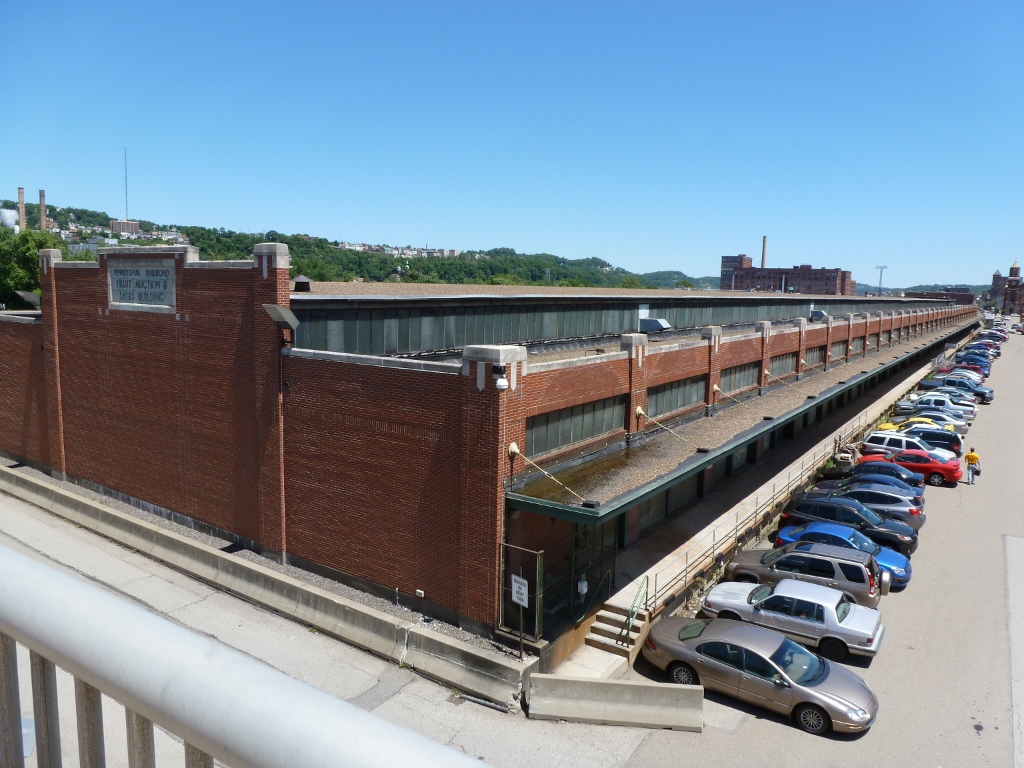
The southern end of the 16th Street Bridge soars over an area that is currently provoking controversy in the city.  It is a site where there are what feels like be miles of barren (although used) parking lots right up against the river on either side of the bridge.  It is a very un-pedestrian-friendly area and a very unattractive place.  Alongside these parking lots on one side of the bridge is the historically significant produce terminal building.  While a developer has put forward a plan to redevelop the area, connecting the existing Strip District to the Allegheny River and adding new mixed development in place of the parking lots, part of the plan requires a partial demolition of the produce terminal.  (A description of this intended development can be read in the article linked here.)

In the beginning of June, City Councilman Dowd began holding up funding for the project, saying he wanted more information about how the funding was to be used (see article).  Then about a week ago, two more councilmen voiced their wish for more information about the use of the funding as well as other aspects of the project such as how the community has been engaged (see article).  Another newspaper article from a few days ago, describes a lawsuit being filed about the property and the development.  This article explains, “The lawsuit alleges that the city is not following its own stormwater management program nor that of the federal Environmental Protection Agency in allowing the project.”

Based on what I’m learning in my internship this summer, this seems like the opposition against, or at least concerns, about the project are piling high enough to prevent the development from happening.  As I am not a fan of harsh, stark parking lots currently in place, it would be a shame for the project to fall through.  However, if the claims of the opposition are true, then it seems we need to find someone else to develop the site.  As awful as the parking lots are, their removal is not worth the price of poorly spent funds, no community engagement, and poor storm water management.  The last concern is the most significant given the fact that the city’s storm water management already causes problems.  (For more related to this issue seen my Heth’s Run Bridge post.)

One River Down!!

This week I officially crossed all the pedestrian accessible bridges in Pittsburgh across the Allegheny River.  I still have a few more to post about, but I’m so excited about having reached this milestone, I had to share it with my readers.  I finished the legwork and now just need to complete the fingerwork to be geographically one-third of the way to reach my goal for the summer.

Of the 20 bridges I initially identified as pedestrian accessible over the three rivers in Pittsburgh (see May 30th post), 10 cross the Allegheny River.  It turns out one of these that I identified wasn’t actually pedestrian accessible, though I posted about it anyway (see June 24th post).  However, it turns out that I missed a bridge on the Allegheny when picking them out on the map.  So I still crossed 10 out of 20 bridges.

I have been using the term pedestrian accessible because not all of the bridges I crossed were necessarily pedestrian friendly.  From the Point downtown up to the 31st Street Bridge (see July 19 post) the bridges were mostly pedestrian friendly.  The 31st Street Bridge begins to get a little dubious.  Farther upriver, while the bridges remain accessible, they are not particularly pedestrian friendly.  See Highland Park Bridge, Washington’s Crossing Bridge and The Last Allegheny River Bridge posts.

16th Street Bridge

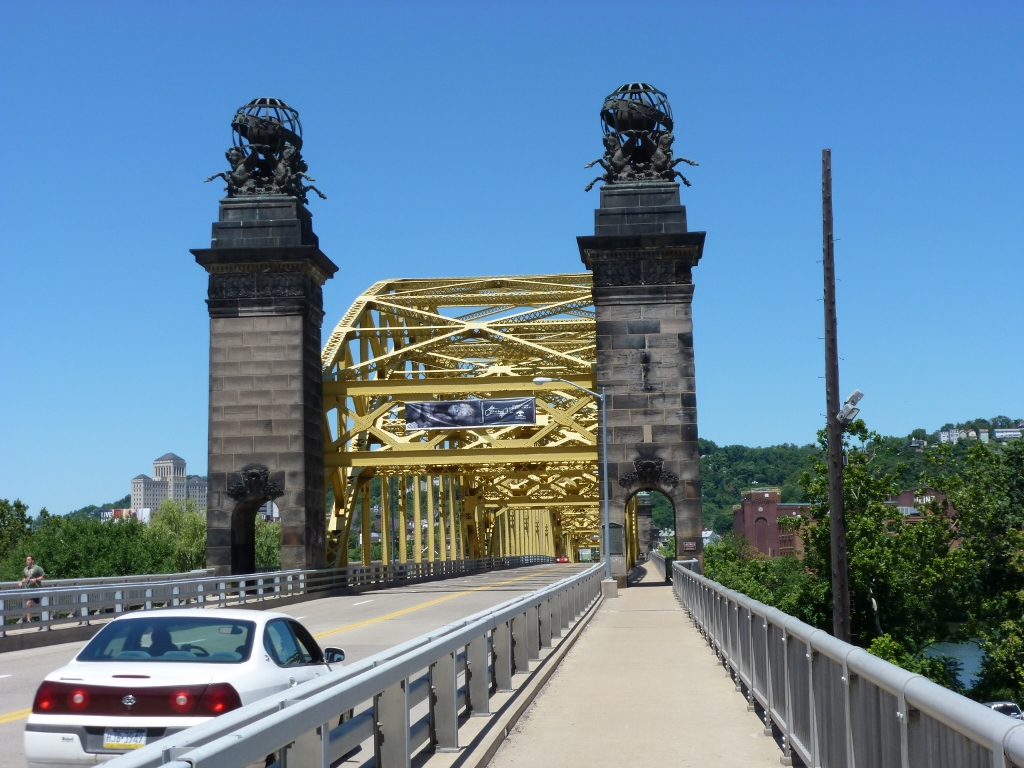
Pittsburgh’s 16th Street Bridge was quite interesting.  I was surprised by how many people were crossing it.  As there is only one pedestrian in my picture above, there obviously weren’t crowds of people, but compared to the other bridges upriver that I’ve crossed there were a lot.  I thought this bridge was far enough out from downtown that the sidewalks wouldn’t be used much.  Also there didn’t seem to me to be much development on either side of the river that would promote walking across the river.  For all the bridges downriver from this point, one side is connected to downtown and the other is connected to a sports stadium and/or large office buildings.  While at the 16th Street Bridge there are some offices near the southern end and some apartments near the northern end, there didn’t seem to be enough for people to be using the bridge so much.  One explanation I came upon was that it was lunch time and both ends of the bridge connect or almost connect with the Three Rivers Heritage Trail.  It seemed like it would be a nice loop for downtown workers to walk the trail on one side of the river, cross the 16th Street Bridge, and return to work on the other side over lunch break.


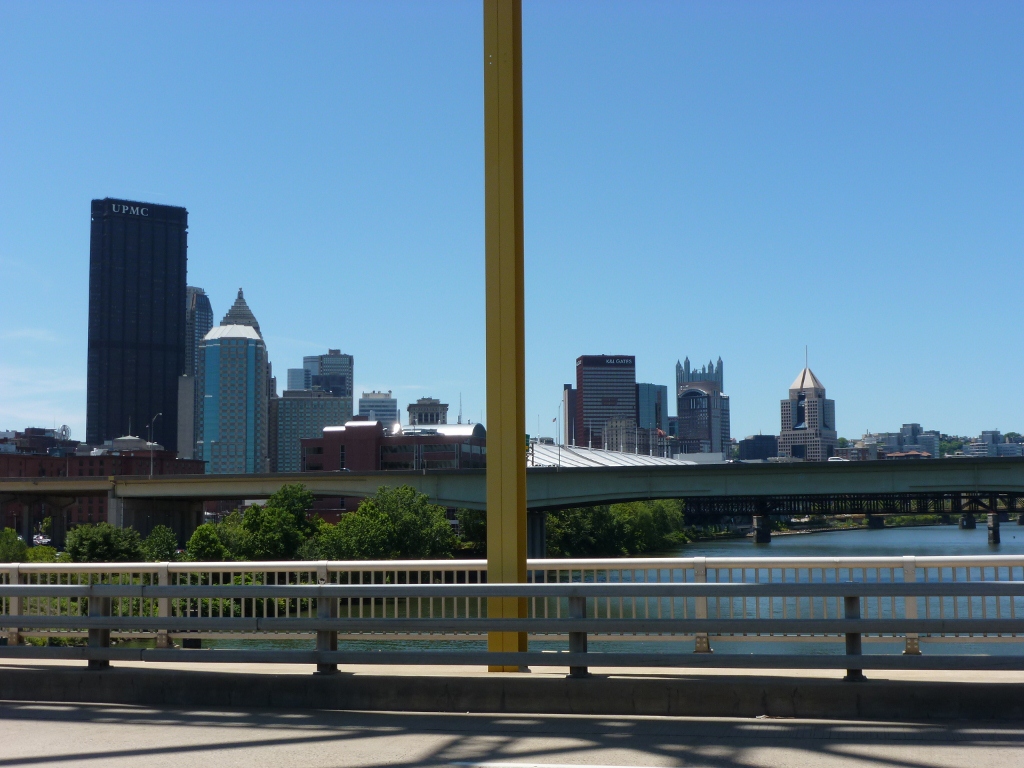
The view on the left of downtown fascinated me.  It looks like there are two clumps of tall buildings (the yellow post doesn’t block any tall buildings).  However, the view on the right supports something I heard in one of my classes which I sort of scoffed at at the time.  I don’t remember exactly how it went, but it was something like the US Steel building (now labeled UPMC) was the center point of a triangle of downtown buildings and as such had to be the tallest.  I think part of the reason I had an issue with it was because the building is located in the middle of a side of the triangle and so the term “apex” or “center point” or whatever the teacher used didn’t fit my sense of geometry.  Actually, regardless of the term used, having the center of the base of a triangle as the focal point doesn’t match my sense of geometry.  However, in the view from the 16th Street Bridge, I can accept the US Steel building as the tallest and therefore a focal point because from this view, the buildings gradually increase in height until reaching it.

This graffiti symbol was painted on the sidewalk of the 16th Street Bridge.  I will not go into a discussion about it here, as I have come across it somewhere else that provokes a much more interesting conversation about it.  I was very surprised and intrigued to see it on this bridge as well, as I have only noticed it in one other place in the city, which isn’t exactly next door.  Although now that I’ve spotted it twice, I will be keeping my eyes open for it.

Westminster Bridge

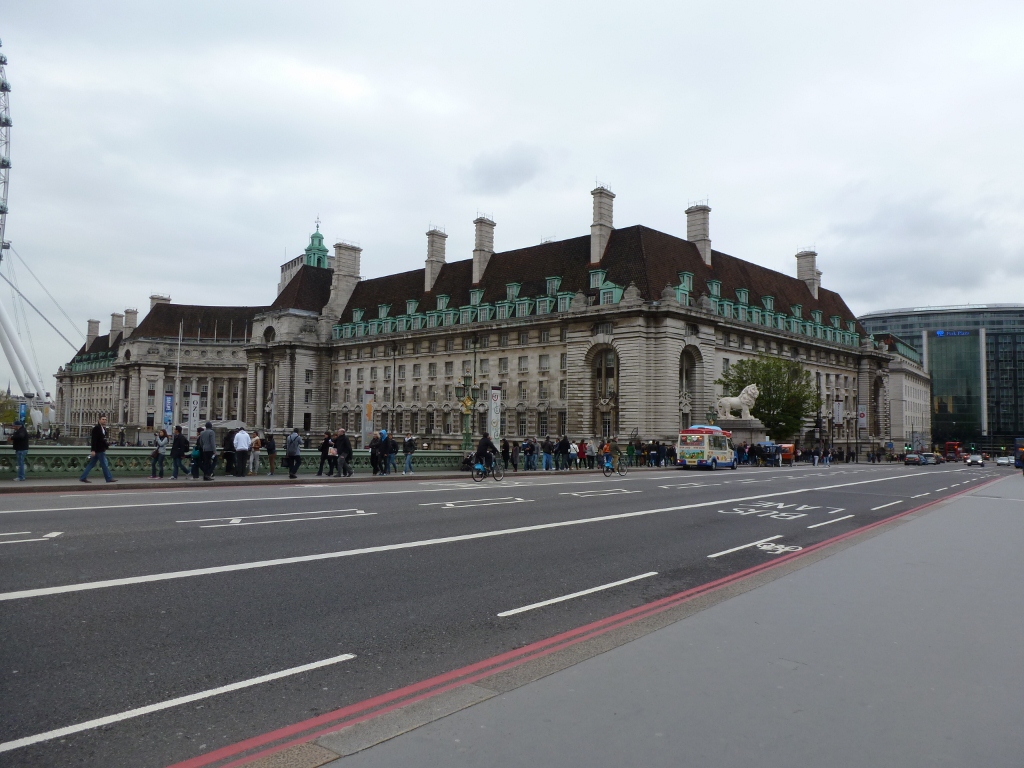
I mentioned in my post on Battersea Bridge that the traffic on the bridge was low, but that this was probably in part due to the fact that I crossed it on Sunday afternoon.  I was so excited about walking all the bridges in London that I walked half of them first thing that Sunday afternoon when I arrived.  The traffic condition on most of the bridges was similar to the Battersea Bridge–not much.  I did pass several other pedestrians as I walked along the Thames River Path to get between the bridges, but the volume of the pedestrian traffic changed significantly when I reached Westminster Bridge.  Crowds of people were crossing the Westminster Bridge, enough that an ice cream truck parked at one end to attract customers from the passersby.


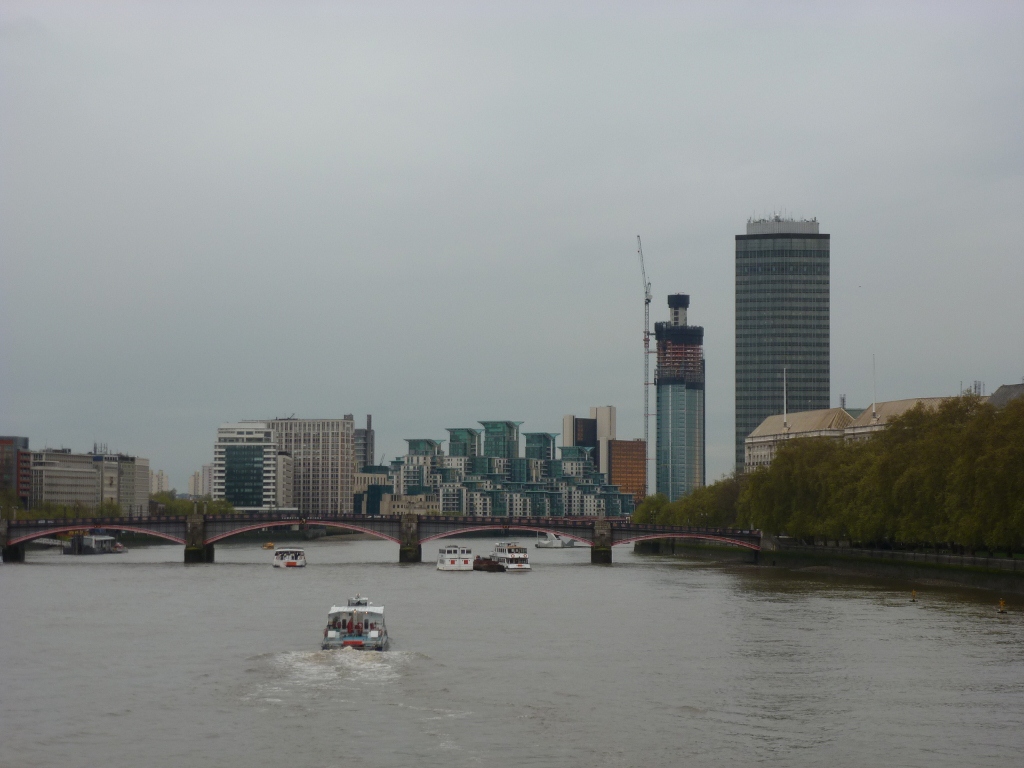
Going back to the mysterious tower under construction next to the St Georges Wharf Apartments (see Lambeth Bridge post and Battersea Bridge post), my favorite view of these buildings was from the Westminster Bridge.  The way they appear in a cluster with other buildings along the river soothes my sense of harmony, as the tower doesn’t stick out so abruptly in this view.  This is one of my favorite things about walking bridges–seeing how the appearance of a particular location can change drastically when viewed from different locations.  The Thames River is particularly good for this as it twists and turns quite a bit as it passes through London.  This causes the incomplete tower to look like it is right next to the other tall building, when in reality they are separated by a fair distance and are on opposite sides of the river (again refer to the Lambeth Bridge post for a different view of these buildings).

Istanbul Bridges

I decided it was time to add some variety to my bridges post.  Last year I spent two weeks in Istanbul.  While I was not as absorbed in my bridges quest at that time, I found that thinking about the bridges in Pittsburgh and London caused me to reflect on the bridges in Istanbul.  Considering how much water there is in Istanbul, there are very few bridges.  I can only recall seeing three: the Galata Bridge, Ataturk Bridge, and the Bosphorus Bridge.  (Apparently my memory is a little rusty as I just looked up a map of Istanbul which shows there were four bridges that I would have seen, this obviously reflects the fact that I was not in my bridges phase at that time.)  Of these four bridges, I only crossed the Galata Bridge, but I walked under the Bosphorus Bridge and took some pictures of it.

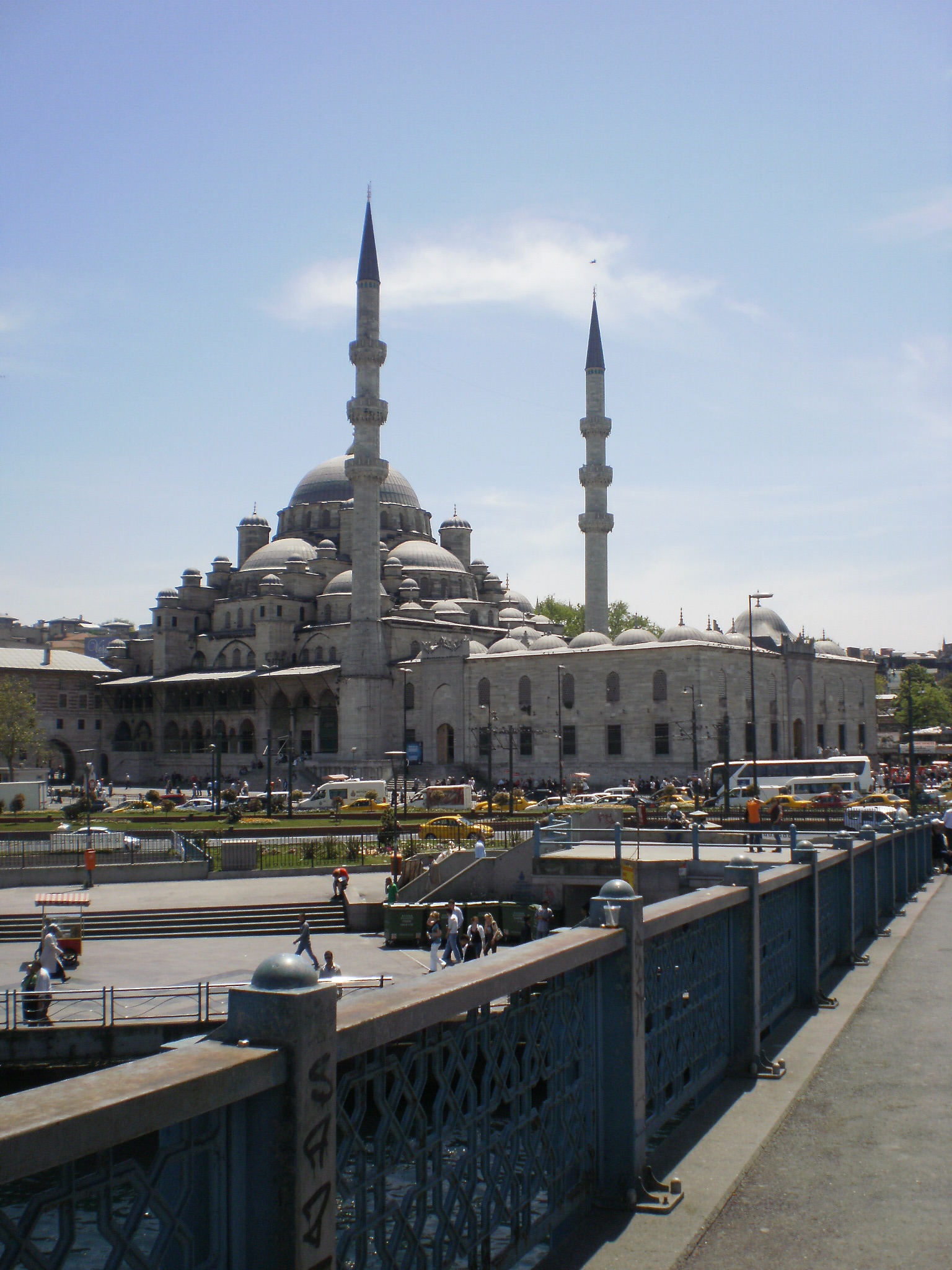
The Galata and Bosphorus bridges are very different in age and use.  There has been a Galata Bridge since the middle of the 19th century and a bridge over the Golden Horn (the body of water the Galata Bridge spans) since at least the 6th century.  The Galata Bridge has many uses.  There are wide sidewalks that accommodate pedestrians, three lanes in each direction for cars, and tracks down the middle of the bridge for the trams.  While I worked very hard not to get any of them in the picture above, the bridge is usually lined with fisherman and street vendors sell freshly caught and cooked fish.  Below the street deck are numerous restaurants.  One day, we had fish sandwiches for lunch at one of these, which were surprisingly good (I’m not much of a fish fan).  The line of one of the fisherman on the street deck above can be seen in my picture from the restaurant.  The Galata Bridge not only provides access between two points, but also provides people access to their livelihoods and to decent meals.  This shows that bridges do not have to be just about funneling traffic from one place to another; they can be a lively and interactive space in the city.


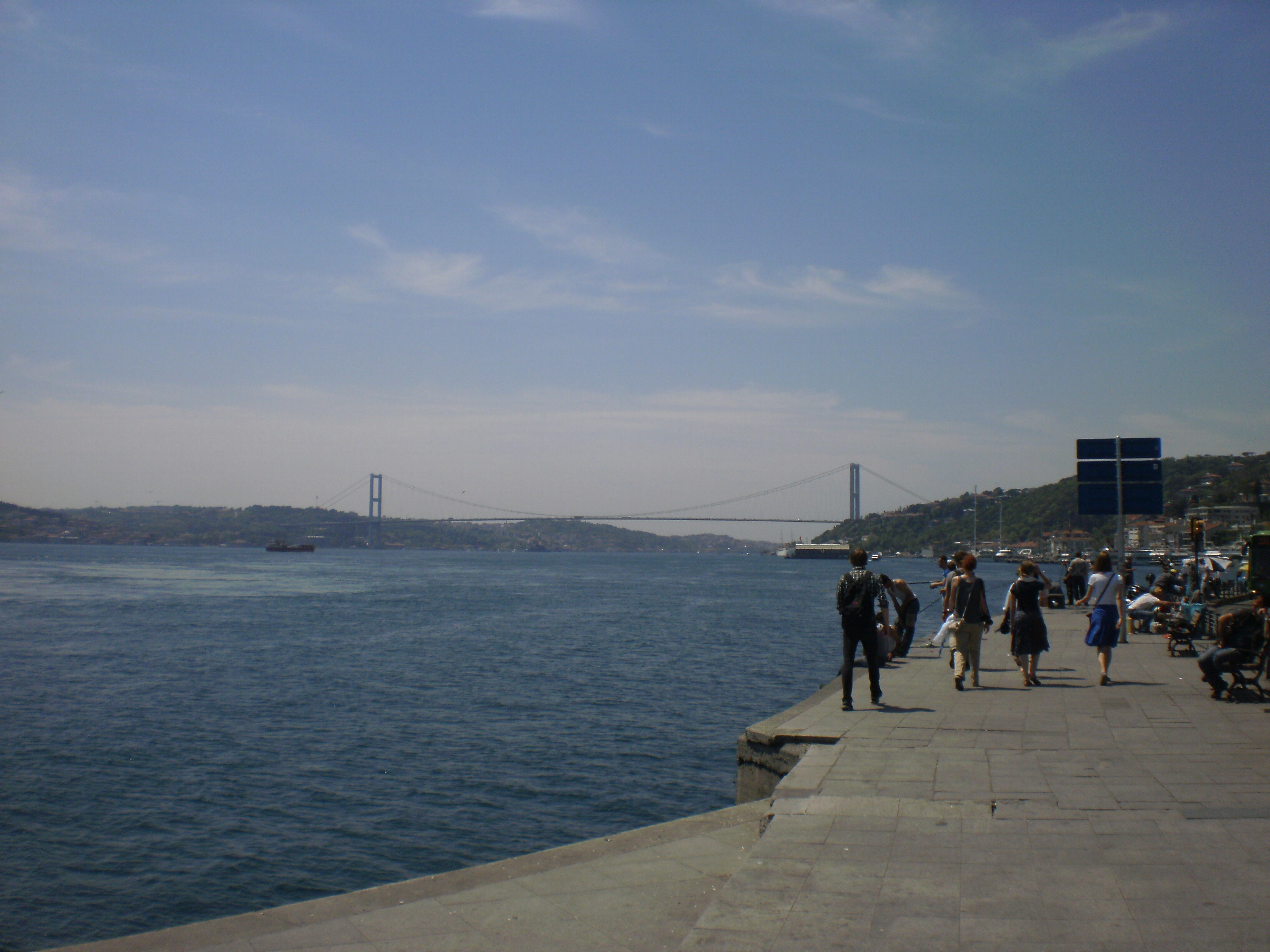
On the other hand, the Bosphorus Bridge, built in the 1970s as the first bridge to span the Bosphorus strait, is purely a funnel (as far as I observed).  It looks like it could be in New York or almost any other US city.  The purpose of the Bosphorus Bridge is like that of most of Pittsburgh’s river bridges–to provide vehicular access across a body of water.


Veterans Bridge

The Veterans Bridge is one of the bridges I will not be walking in Pittsburgh because it doesn’t have pedestrian access.  It carries another one of the freeways over the Allegheny River.  As discussed in the Fort Duquesne Bridge post, freeways and pedestrians usually don’t mix.

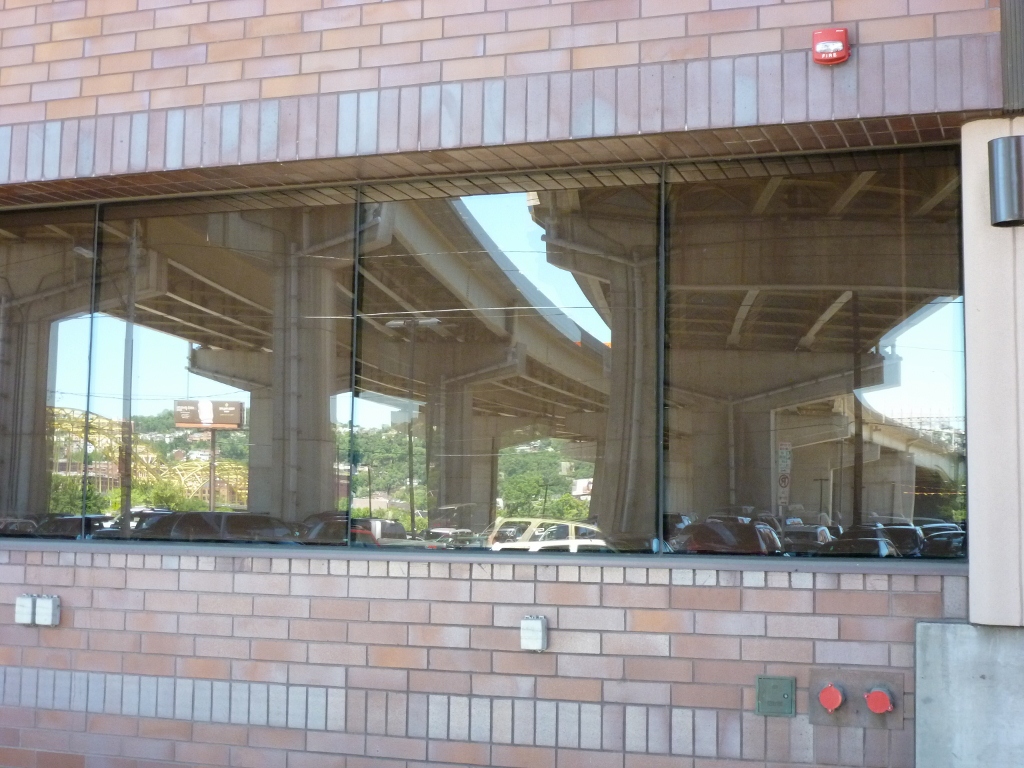
The reason that I am including a post on this bridge, as my focus is on the bridges that I walk, is that it adds to the discussion of how many bridges are there in Pittsburgh.  As the Veterans Bridge, I consider it a single bridge entity.  However, the image above shows that there are three separate entities that make up the bridge, at least as it crosses over the parking lots in The Strip (I believe at least two of these merge before the bridge crosses the river).  So the question is, do these three elevated roadways get counted as three separate bridges in addition to the bridge over the river?  If that is the case, then it is easy to see how Pittsburgh can outrank Venice in the number of bridges each city has.  Though I have yet to go to Venice, I image its bridges are more like London’s bridges where there is only one roadway and few or no elevated ramps/roadways to approach the bridge.

A Sidewalk to Nowhere

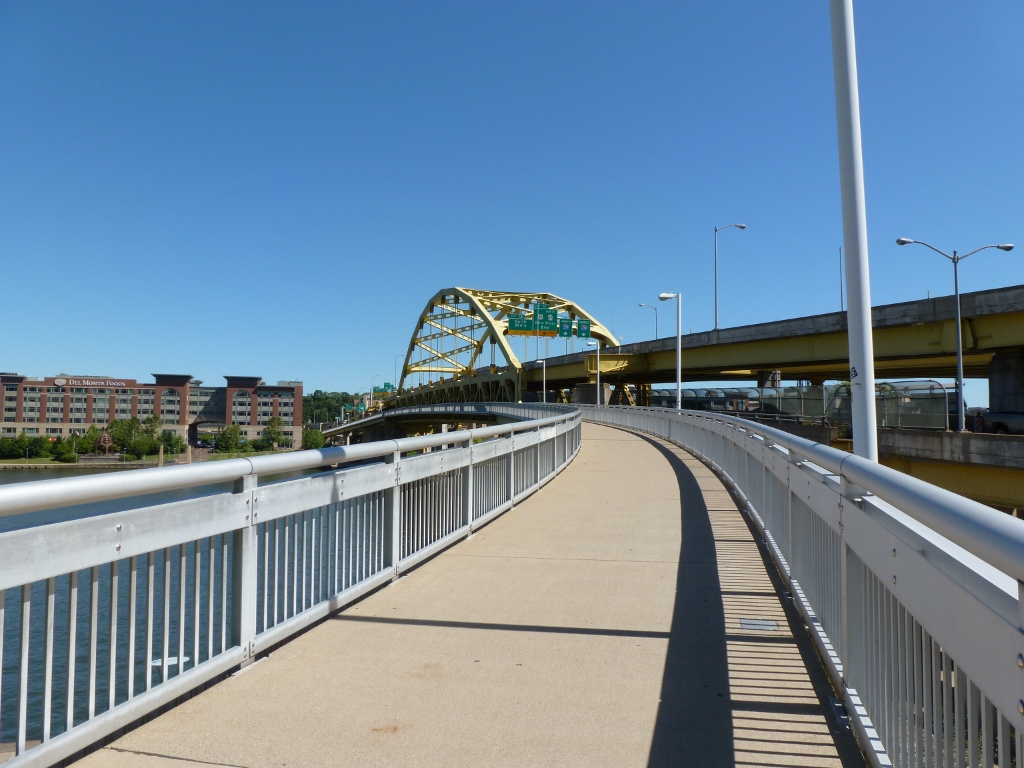
For those who may not want to walk the 6th Street Bridge (click to view June 14th’s post) to get from downtown Pittsburgh to a Steelers or Pitt football game, the Fort Duquesne Bridge provides a pleasant alternative.  As the picture above indicates, the sidewalk is not directly connected to the bridge for most of the way.  The walkway starts from a pleasant path through Point State Park (which means crossing the Bridge Under a Bridge, June 15th’s post) and ends on the North Side about halfway between PNC Park and Heinz Field.

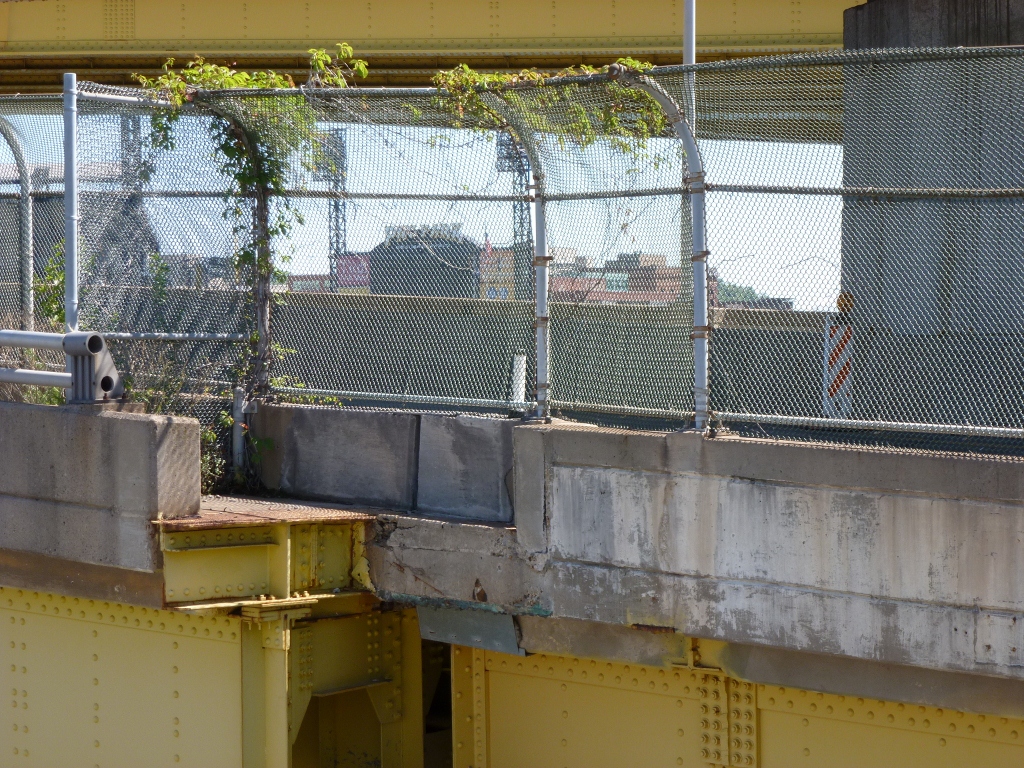
I was surprised by how new and clean this bridge appeared.  Before crossing, I had my doubts as to whether there was a pedestrian path across the Allegheny at this point as Fort Duquesne Bridge carries one of the interstates and pedestrians and interstates do not usually go together.  At first I thought the newness of this pedestrian bridge accounted for the presence of the pedestrian access, but then I saw the sidewalk to nowhere on the Fort Duquesne Bridge itself.

This suggested that at the time the bridge was built in the late 1950s and early 1960s, people were not quite as adverse to having pedestrians and interstates share infrastructure.  However, this is evidence of the violence of the feelings against such an arrangement today.  PGHbridges.com has a picture of this severely truncated sidewalk that includes a remnant of the staircase that used to lead to it.  I do not believe that the staircase remnant exists any longer.  When I saw the sidewalk to nowhere I looked around for some sign of where it used to go and did not find any, but I cannot remember if I looked down.  I have walked around the part of Point State Park near where the staircase would have been several times and never noticed any steps.  I will look carefully the next time I am there to make sure they have been completely removed.

While I have been referring to the Fort Duquesne Pedestrian Bridge as new, it is actually over 10 years old.  Though I have not been able to find an exact date for its construction and/or opening, it was in use before the demolition of Three Rivers Stadium in 2001.  (Here are two YouTube videos of the demolition: one and two.  I find it fascinating that the demolition was celebrated with fireworks.)  A website with directions between North Side, Point State Park, and the Duquesne Incline refers to the “new pedestrian bridge” that provides access to Three Rivers Stadium accompanied by a photo of the stadium taken before the start of the construction of Heinz Field in 1999.  This website has no dates, but based on this information the pedestrian bridge must be over 13 years old, which I suppose is still fairly new for a bridge, but it is older than I had imagined.

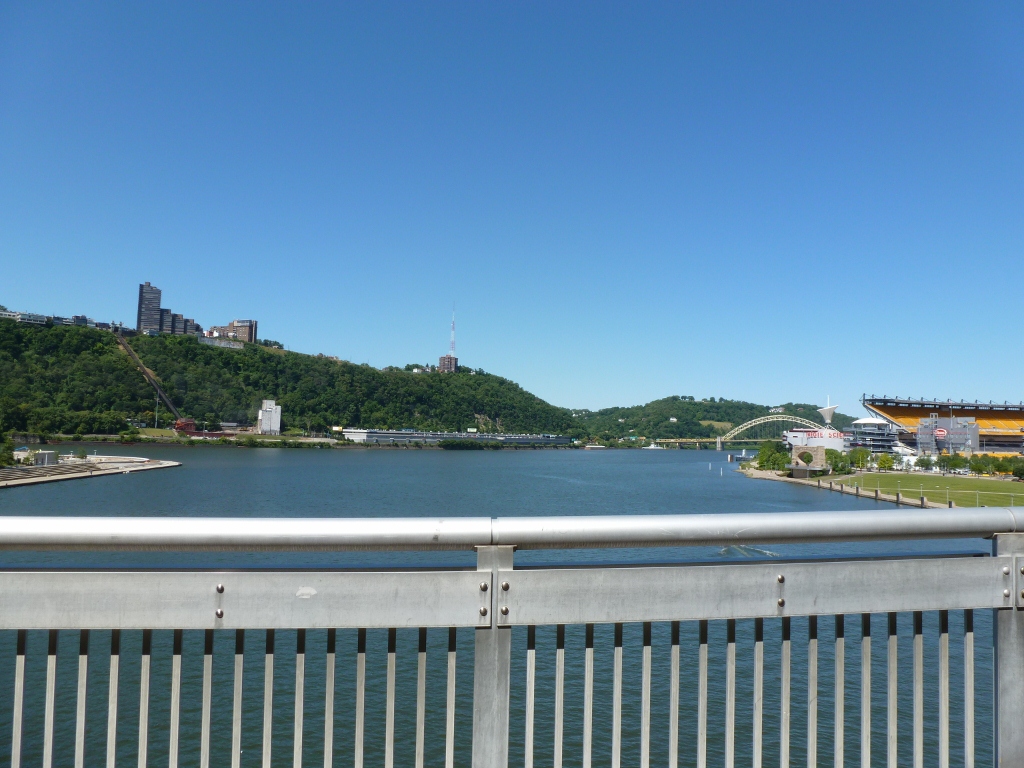
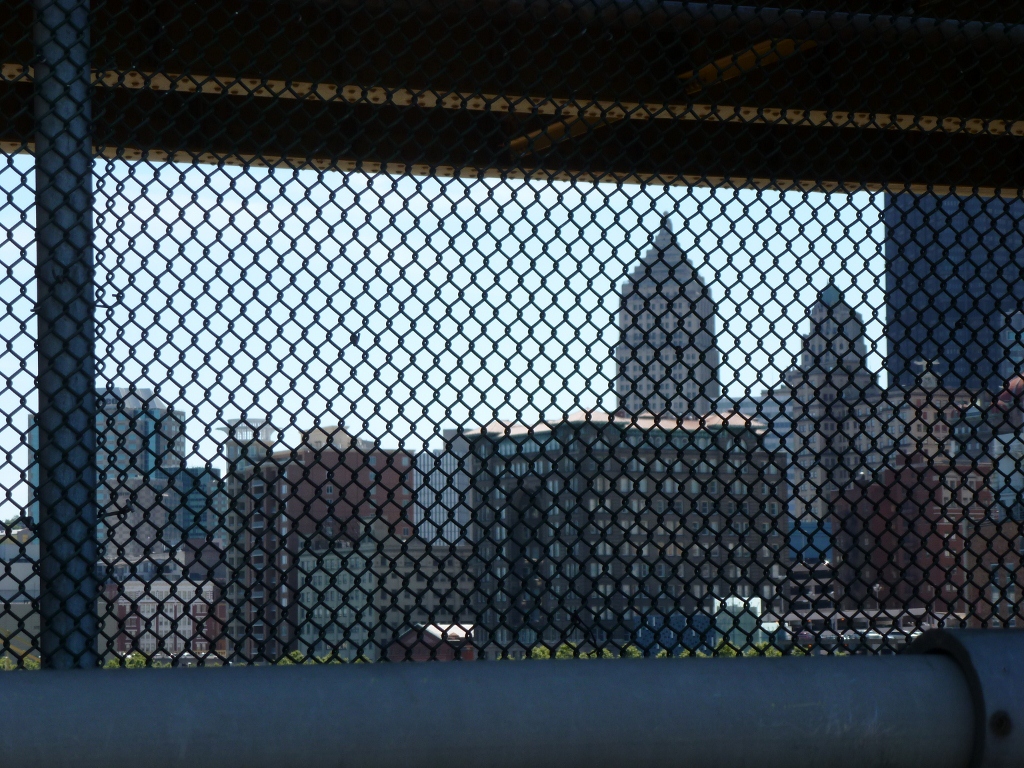
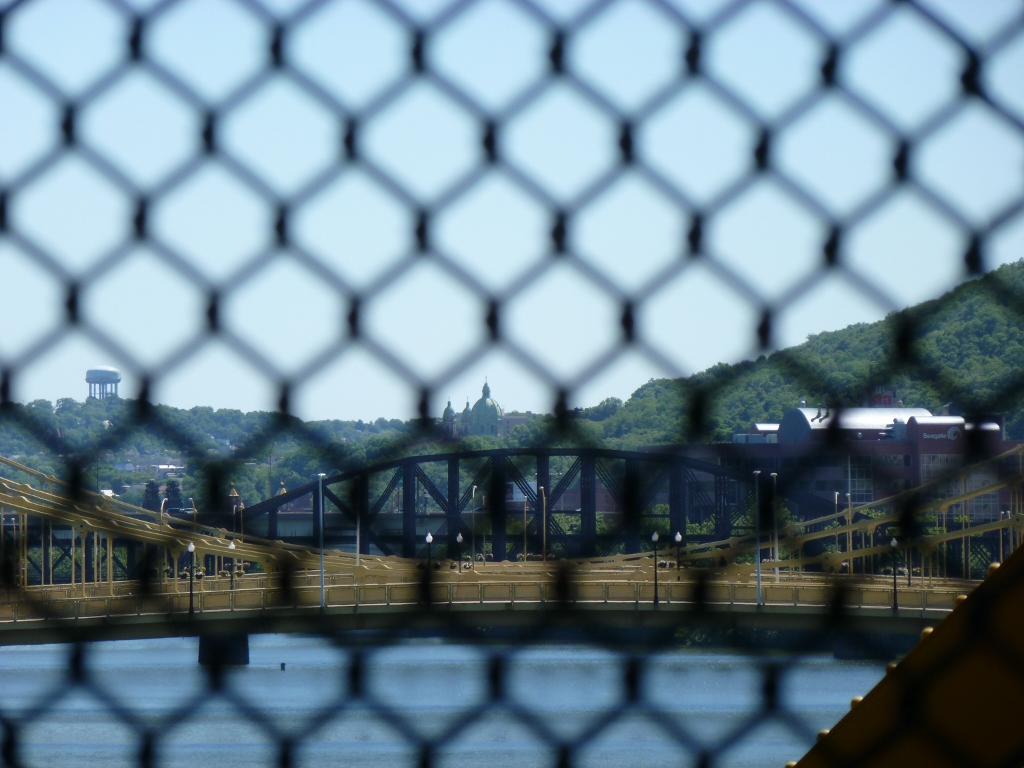
There is a nice view downriver from this bridge.  Several famous Pittsburgh sites are included in the view: the Point, the Duquesne Incline, and Heinz Field.  Other sites of interest in this view are the Carnegie Science Center, the West End Bridge, and the remnant of a former bridge across the Allegheny.  The view upriver is partially obstructed by the wire mesh fence along the interstate bridge.  I did get a couple of shots that you can mostly make out what is there.  One shows downtown Pittsburgh and the other shows the bridges upriver including the Three Sisters (see June 14th, June 21, and June 22 post) and a railroad bridge.  There is an item of interest I want to point out in this second view: just about in the middle of the frame, the domes of the Immaculate Heart of Mary Catholic Church on Polish Hill.  This is one of my favorite buildings in Pittsburgh, because of its unique green domes that are a significant landmark visible for miles up and down the Allegheny River.

               

I have to add that I chose the name for this post (A Sidewalk to Nowhere) before I was aware that the Fort Duquesne Bridge’s nickname is “The Bridge to Nowhere.”  While the pedestrian bridge attachment connects two points, the Bridge itself does not directly connect any points of interest.  Instead it ferries cars from one interstate to another.  The north end of the bridge continues onto elevated ramps in between various highways and freeways.  The south end connects seamlessly to the Fort Pitt Bridge and Tunnels by way of the Portal Bridge (mentioned in June 15th’s post) and though there is also some access to downtown it is directed to the roadways along the rivers that permit cars to bypass downtown.

A Bridge under a Bridge

This pedestrian bridge is located in downtown Pittsburgh.  As best as I can tell, this bridge was built in the early 1960s.  The upper bridge is called the Portal Bridge, carries one of the interstates over the Point, and does not have pedestrian access so I will not be walking it or posting about it.  The pedestrian bridge does not have its own name and is not included in PGHbridges.com’s list of bridges in Pittsburgh.  It crosses over a reflecting pool to connect the two parts of Point State Park which are divided by the highway.  It is the only access point from downtown to the park.

The Point hosted both British (Fort Pitt) and French (Fort Duquesne) forts early in its European history.  (The outlines of these forts are laid out on the grounds of the park.)  This area became a railroad and warehouse district before the first (we are apparently now on our third) “Pittsburgh Renaissance” in the 1930s/40s/50s at which time it was turned into a park with the interstate transecting it.

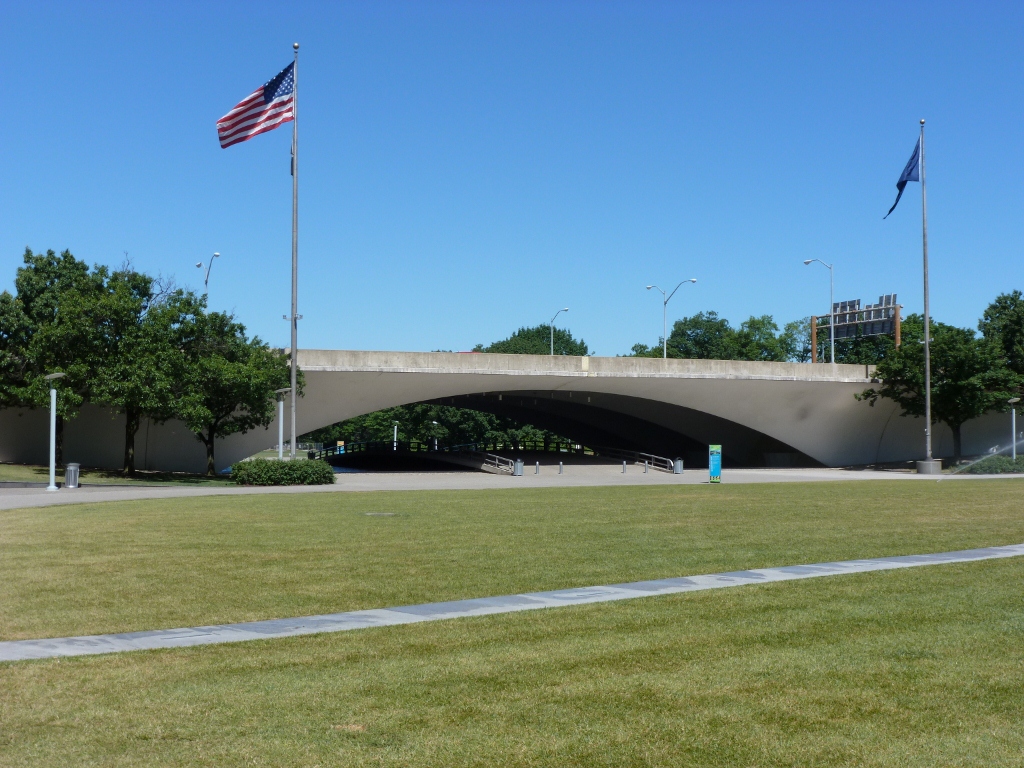
The view above is looking toward the pedestrian bridge and the park away from downtown.  This side of the bridge is a large, unexciting field.  During festivals and events there will often be tents and kiosks here.  On the other side of the bridge are the interesting parts of the park.  My favorite feature is the fountain, which unfortunately has been turned off and under reconstruction for the last three years.  According to a press release, the fountain will be back in working order next summer and better than ever.  Also found on the other side of the pedestrian bridge is the Fort Pitt Museum (which I believe I went to once and keep saying I should visit again), the steps along the Allegheny River used for watching boat races and the Three Rivers Regatta which will be held June 30-July 4 this year, and some tree-lined walks.