Pedestrian Bridges: Chicago

BP Bridge

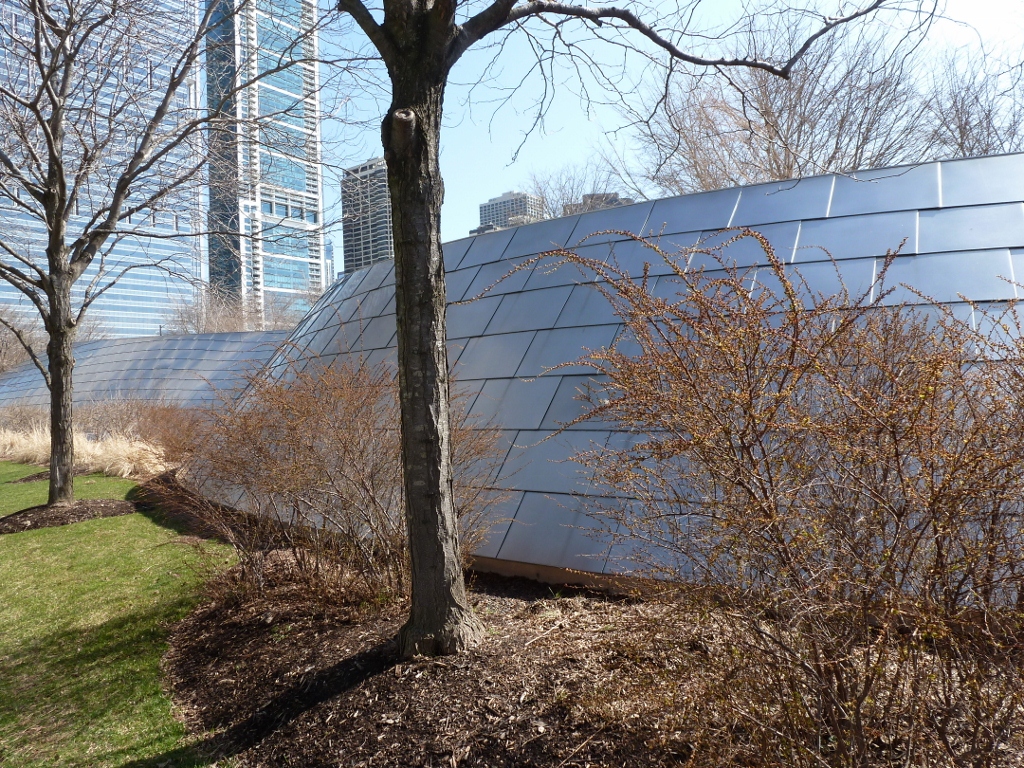
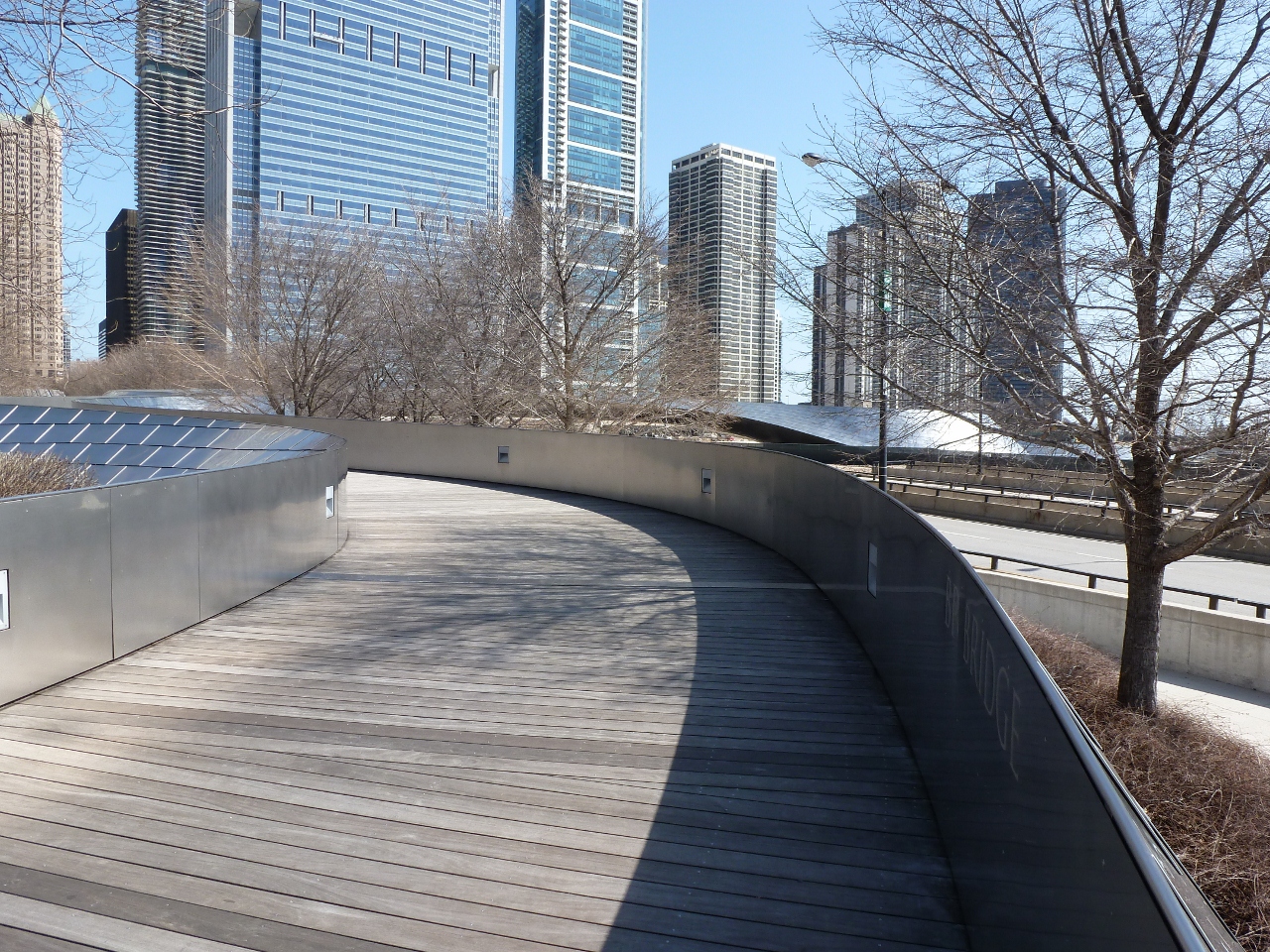
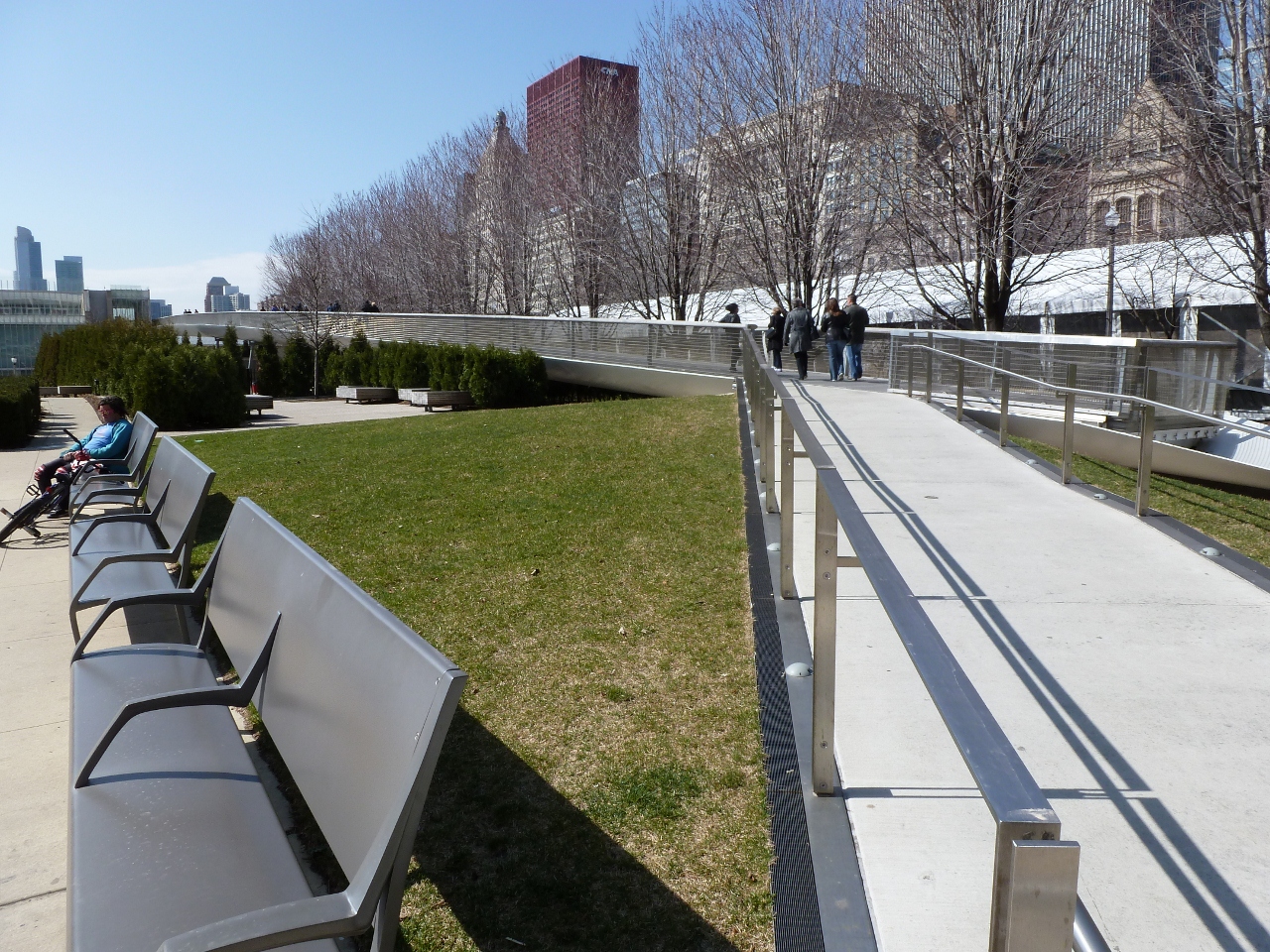
There are two pedestrian bridges connecting to Millennium Park in Chicago.  The first I encountered was the BP Bridge.  I admired the undulating silver sculpture above as I walked past and was thrilled to discover it was a pedestrian bridge.  My excited was quickly crushed as the bridge was closed to traffic due to construction at the other end.  I realized that I have become quite addicted to bridge-walking.  I was on my way to see The Bean before renting a bike to ride along the lake, when seeing this bridge completely sidetracked me.  I had a desperate urge to walk a bridge.  Fortunately, there was another pedestrian bridge nearby and while it was not nearly as enticing, it had some interesting parts.

BP Bridge The Nichols Bridgeway

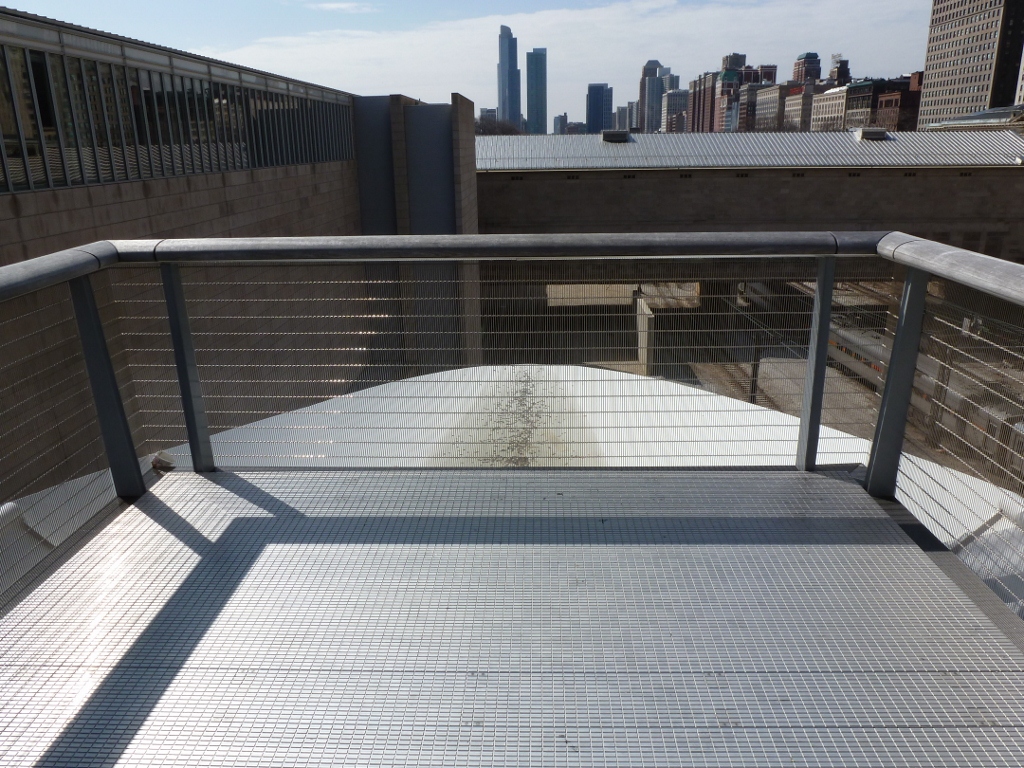
The Nichols Bridgeway connects Millennium Park with the Art Institute of Chicago.  Both ends had space-age-like toughs, which I assumed were supposed to be a fancy drainage system.  If their purpose is a drainage system, the upper end by the Institute has failed and been turned into a wishing well.

Lower Trough Upper Trough/Wishing Well

The part I liked best about this bridge was that while it looked like the surface was level, there were ridges or “speed-bumps” every few feet.  I wondered if these were merely artistic or if they had a functional value like reducing the slipperiness of the bridge during icy conditions.

Bumpy Walkway The Nichols Bridgeway

Manhattan Bridge: A Multimodal Link

The Manhattan Bridge

When I was planning my walk across the Brooklyn Bridge while in New York City last December, I noticed there was a bridge nearby called the Manhattan Bridge.  I decided to cross to Brooklyn by the Manhattan Bridge and return to Manhattan by the Brooklyn Bridge.  The Manhattan Bridge ended up being the more interesting of the two bridges.

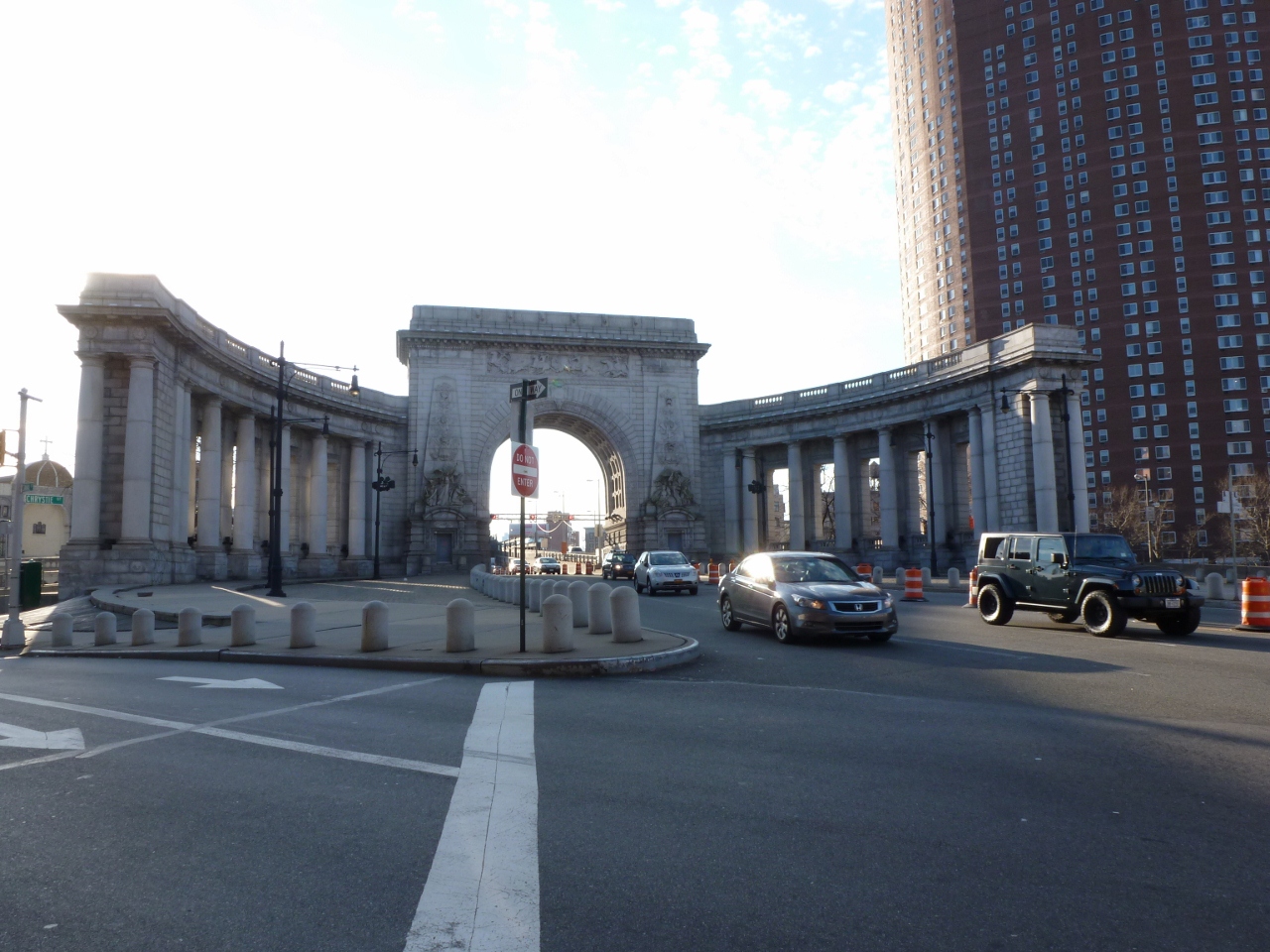
Gateway to the Manhattan Bridge

I found my way from the subway stop to the Manhattan Bridge by following the way-finding signs for the bike lanes in the Lower East End.   This brought me to the left side of the bridge, where I was temporarily upset to see that pedestrians were not permitted to use the sidewalk on that side of the bridge–it was dedicated to two-way bicycle traffic.  I was concerned that I was not going to be able to walk across this bridge and instead would have to cross the Brooklyn Bridge twice (I try to avoid walking across a bridge just to walk back across it; doing so gives me a sense of pointlessness).  Luckily, there are sidewalks on both sides of this bridge (from walking Pittsburgh bridges I know not to assume that bridges have sidewalks on two sides) and the sidewalk on the right side is dedicated to pedestrians.

I suggest that NYC puts up a sign on the bicycle side to direct pedestrians to the other side, which might help encourage pedestrians to follow the traffic directions set up on this bridge–I watched a pedestrian ignore the bicycle-only signs to cross the bridge on the bike lanes.

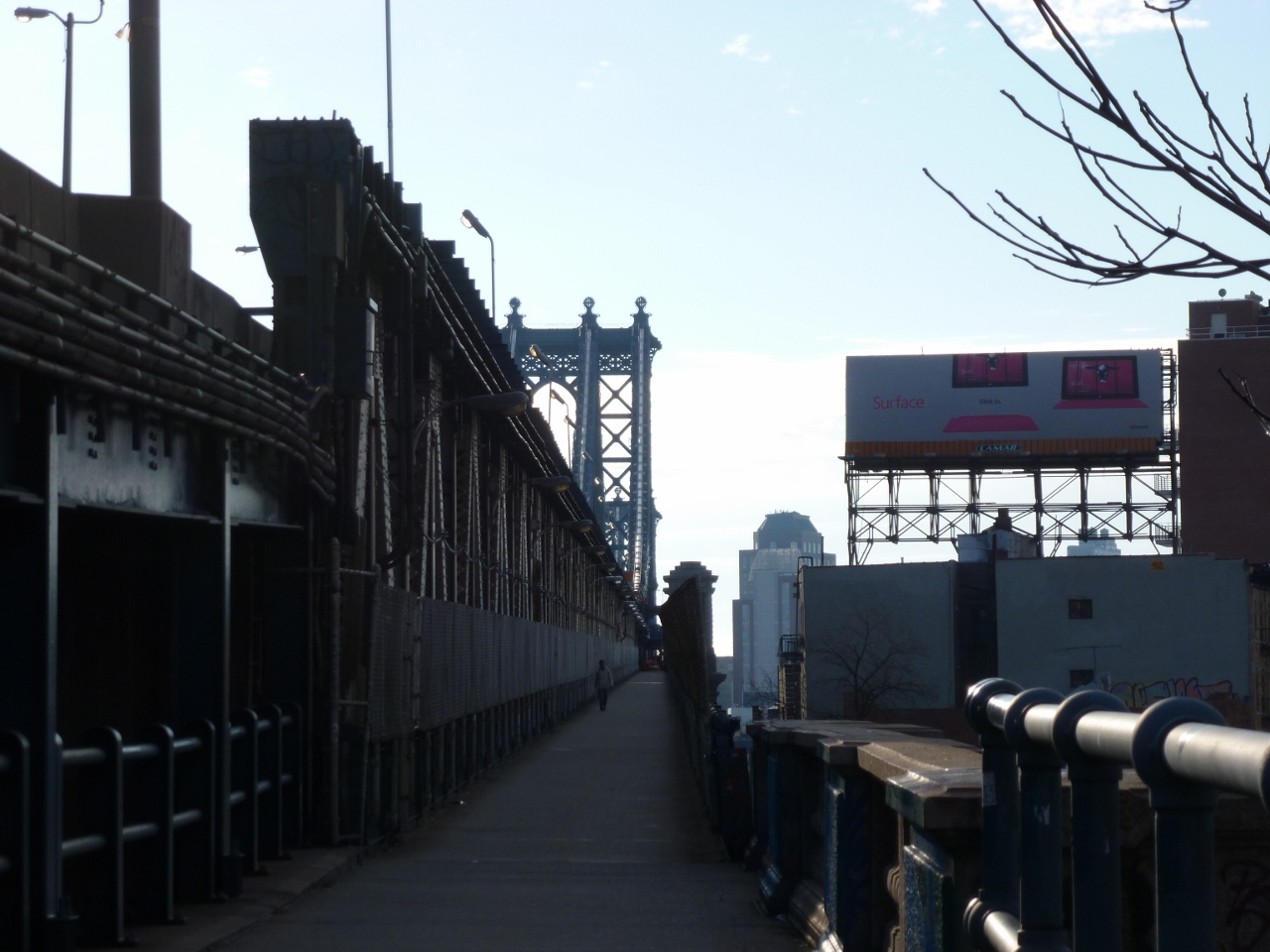
The Pedestrian Side

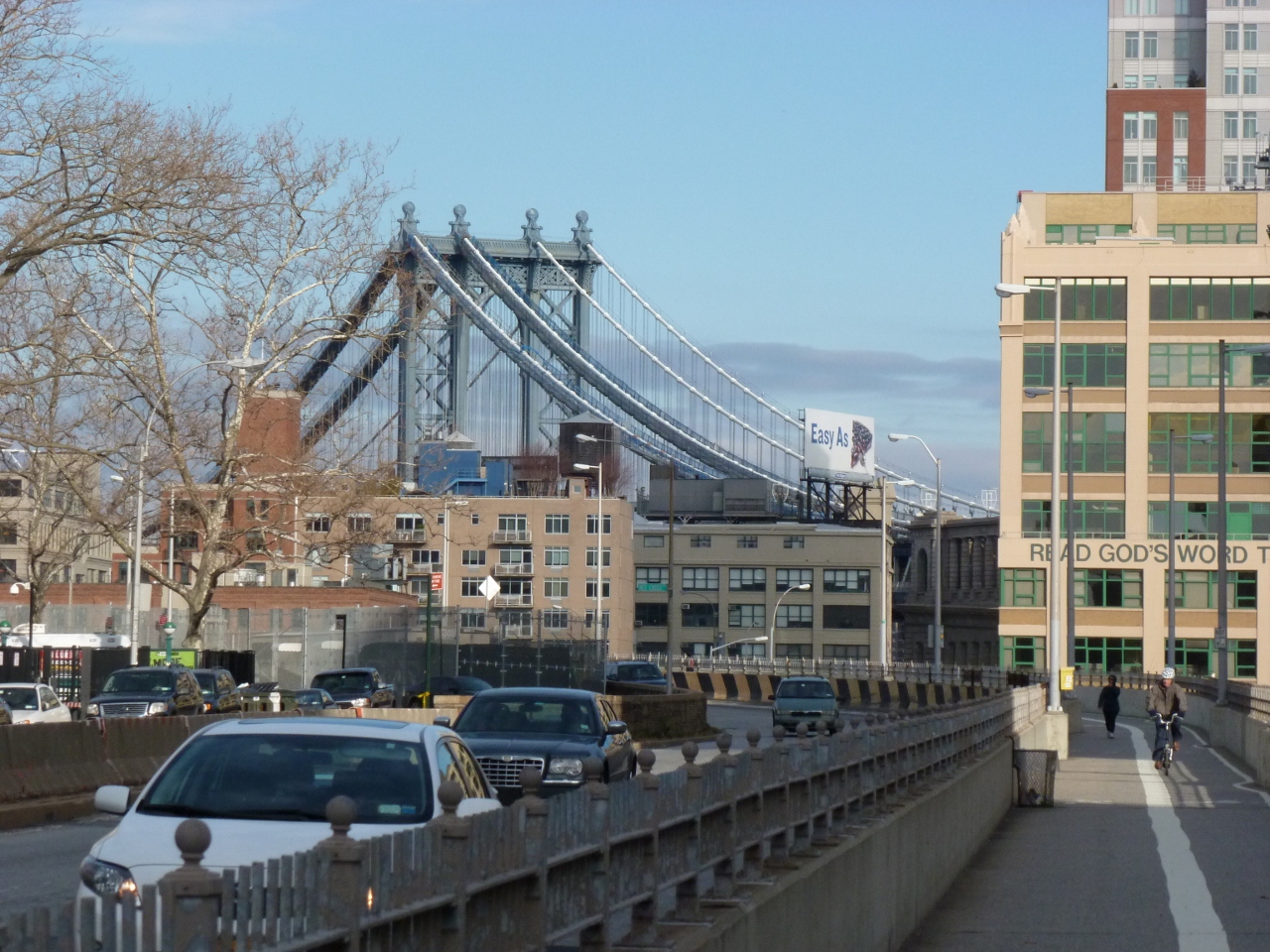
This bridge is the most multimodal bridge I have walked with the bike lanes on one side, pedestrian way on the other, and the subway and roadway in between.  While I approve of this welcoming of alternative transportation methods, I am not sure about placing the pedestrians next to the subway tracks.  This does give a barrier between the pedestrians and the noise of the cars, but instead, the pedestrians have to deal with the noise of the subway, which while it is less constant than the cars, it is a little more startling/disturbing.

The Manhattan Side The Brooklyn Bridge

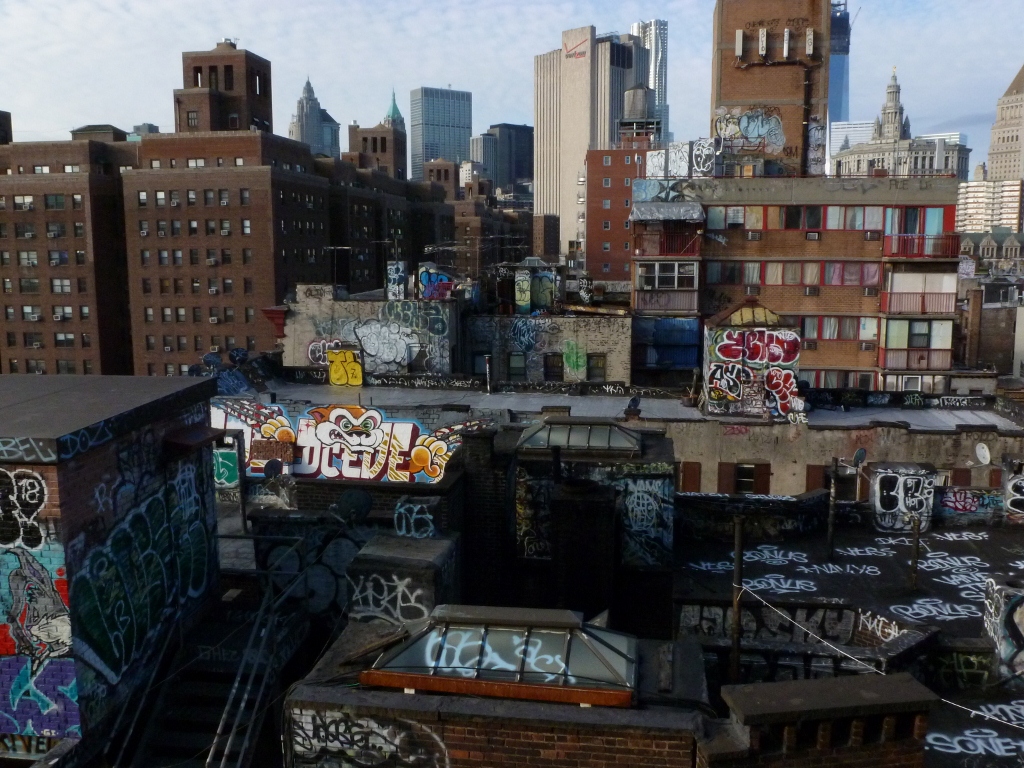
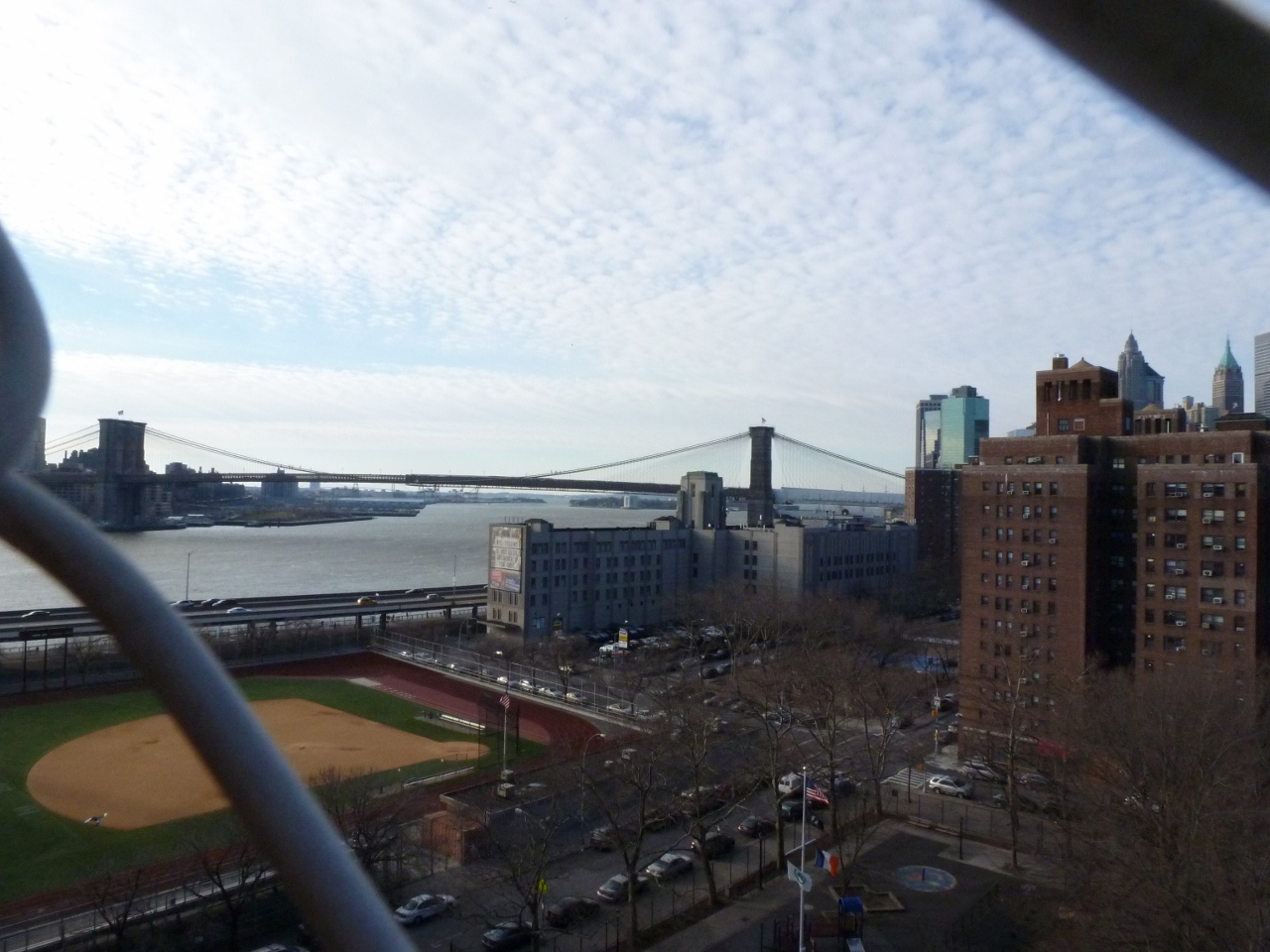
The neighborhoods the Manhattan Bridge links had some similar physical elements, but are clearly used by different populations.  The populations on both the Manhattan and Brooklyn sides use their rooftops, but for different purposes.  On the Manhattan side, the rooftops were covered in graffiti, while the Brooklyn rooftops had new additions and places to sit.  There were also parks on both sides of the East River.  However, the Manhattan side only had a baseball diamond while the Brooklyn side had a carousel and a pirate-ship playground.

Manhattan side park

Carosel Pirate Ship Playground

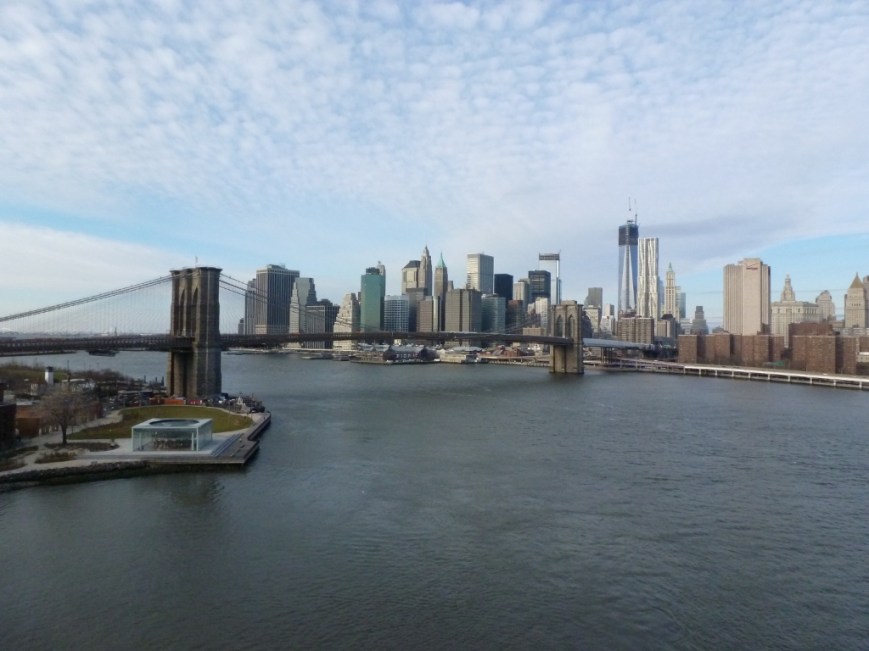
What intrigues me most about the Manhattan Bridge is that I had never seen or heard of it before and yet it is the bridge shown in the background (multiple times) in the Doctor Who episode “The Angels Take Manhattan.”  Based on my walk on the Brooklyn and Manhattan Bridges, it looks like these shots were taken on the Brooklyn side of the river, in which case it seems like it possible to get the Brooklyn Bridge in the background instead as these two are close together on that side.  To me the images of the Brooklyn Bridge say New York, while (at least before I walked it) images of the Manhattan Bridge just say a place with a bridge and hence water.  I wonder if the Manhattan Bridge is better known in the UK than in my circle?

View like that used in Doctor Who

Isolated Waterfronts

In October 2012, I spent a few days in Erie, PA, to attend a conference.  Before arriving, I had looked at the map to figure out how to get from the bus station to my accommodations to the convention center.  On the map it looked pretty straight forward and simple.  All the places I had to get were within a mile of each other—piece of cake.  I often walk that far just to get to a bus in Pittsburgh.  Shortly after arriving in Erie, I realized that purely considering distance does not capture the true picture.  The seemingly short mile-long paths that I had to take included significant geographical and man-made barriers.

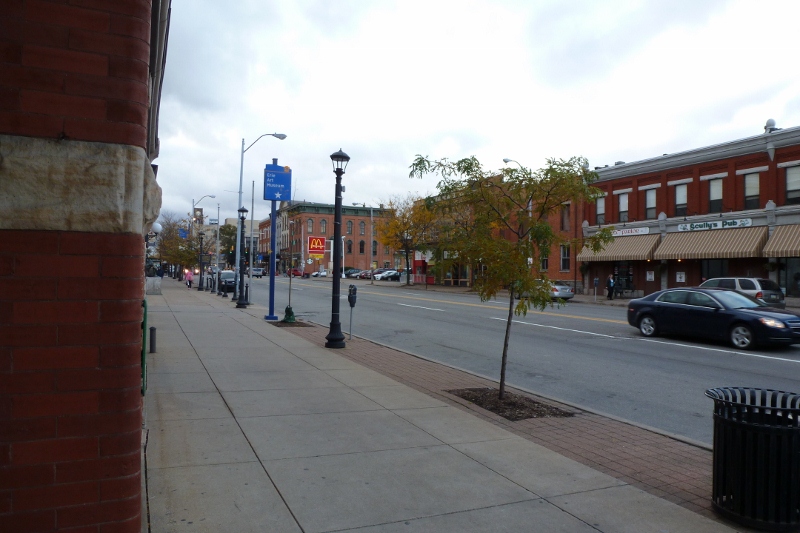
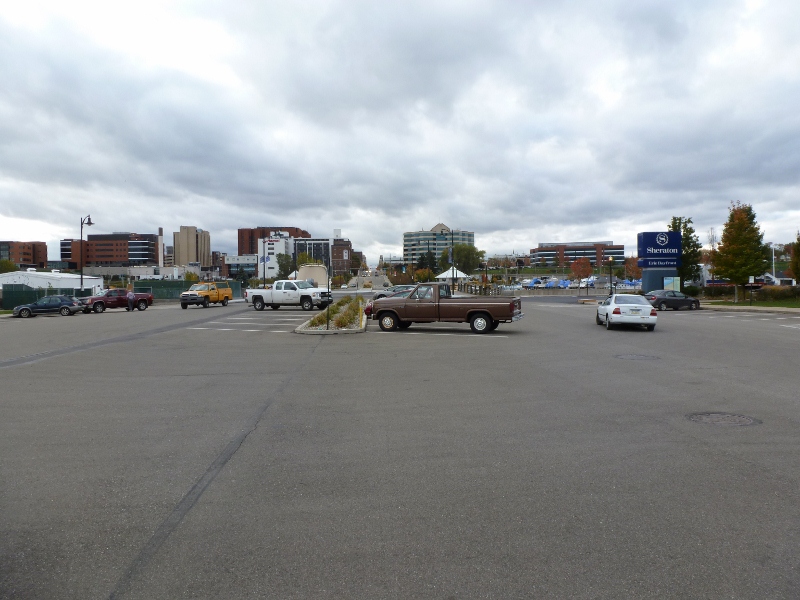
The main drag ran up through the town and straight out to the waterfront ending at the convention center hotel.  From the town square (6th Street), most of the buildings are flush with the sidewalk, except for the parking-lot-centric McDonald’s in the middle of these older buildings.  At 3rd Street, this changes.  The next two blocks are dominated by the campus of a UPMC hospital.  Then the barriers come.

First there is a small hill down toward the waterfront, then a wide parkway, followed by a barren strip of land on one side of the road and a marina on the other.  Finally, there is the convention center hotel.  Of course you have to pass the long parking garage, the lobby and rooms of the hotel, go up an elevator across a pedestrian bridge over the entrance to the marina, and down another elevator before you get to the convention center.

I was staying in a Bed and Breakfast near the town square, so several times a day I walked back and forth along this route to attend the conference events.  Even though the walk was only about a mile long, it seemed to take forever because of the barriers of the hill, road, vacant land, and water.  After going back and forth a few times, I realized that the set up was not much different from what I had seen in Cleveland this summer.  That city also has a major roadway cutting off the town from the shores of Lake Erie.  This road of course was much bigger than the one in Erie as the city is correspondingly bigger.

Despite the fact that there is a major freeway dividing the waterfront from downtown Cleveland, I still felt welcome to cross this barrier to reach the waterfront park or the Rock ‘n’ Roll Hall of Fame.  In Erie, I got a very clear impression that the downtown residents were not welcome to cross the barriers to get to the convention center/hotel or the little public jetty next to it and that the visitors at the hotel/conference center were not encouraged to explore into downtown Erie.  This situation seems to defeat part of the purpose of convention centers to bring economic benefits to the surrounding area, by bringing in more people to use local services.

10th Street Bridge

The 10th Street Bridge (which a reader pointed out is nicknamed the Phillip Murray Bridge after the first president of the United Steelworkers of America) was the last of the bridges over the Monongahela River for me to walk.  Or so I thought.  It turns out that the Liberty Bridge also has a sidewalk despite the fact that it is a freeway bridge like the Veteran’s Bridge (see post).  So I’ll have to come back to the Liberty Bridge at some point.

I delayed my walk of the 10th Street Bridge in part because it seemed like an awkward one to get to and from.  One end is in the middle of the South Side, but the other connects to the Armstrong Tunnel, which would obviously not be pedestrian friendly.  Last week, I finally went out and walked it and as I hoped, it turns out there is a pedestrian access over the hill to the high-bus-traffic corridor of Fifth and Forbes avenues in the form of a giant staircase that I will address in another post.  This end of the 10th Street Bridge was more well-connected than I had anticipated.  Not only do the stairs provide access to the top of the hill when Duquesne University sits, but there is also access to a parking lot down by the river which also connects to the Three Rivers Trail System.  The best proof of this bridge’s connectivity is the number of other pedestrians I saw walking the bridge.  While I did not keep a count, I noticed that there was a comparatively high level of pedestrian traffic.  It certainly wasn’t as much as the Smithfield Street Bridge (see post), but it was comparable to or higher than that on the other downtown bridges.

My favorite part about this bridge was the dinosaurs painted at the top of the southern tower.  I couldn’t tell if they were official or freelance graffiti, but it seemed appropriate given that Pittsburgh is famous for dinosaurs.  Andrew Carnegie brought the first dinosaur skeletons on display anywhere in the world to his natural history museum.  I found someone else wrote a post about the dinosaurs on the bridge, which the artist apparently calls geese, which suggests that the painting may not have been officially sanctioned.

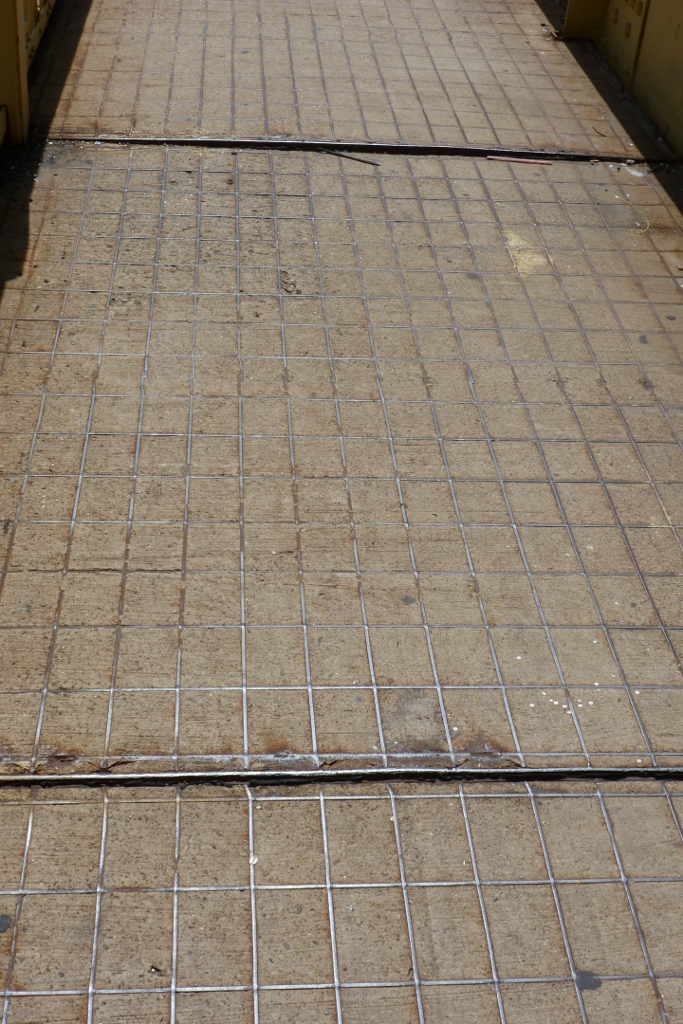
The post mentioned above about the dinosaurs also comments on the “rusty” condition of the bridge.  While I didn’t notice the rust much (it wasn’t nearly as bad as the 28th Street Bridge), I did notice the condition of the sidewalk.  I thought my theory that the top of the sidewalk had worn away to expose the metal framework supporting the structure rather farfetched, as how could the entire sidewalk (on both sides as far as I could tell) wear out so evenly.  Yet, I cannot think of any other sidewalk I’ve walked that looks like this and given the other bloggers comments on the poor physical condition of the bridge, perhaps my idea isn’t totally crazy?

Pedestrian Bridges: Bigelow Blvd

There is a pedestrian bridge across Bigelow Boulevard at the Bloomfield Bridge.  I walked this bridge before I started this blog and didn’t think to take a picture of the bridge itself.  Its appearance is similar to the Graham Street Pedestrian Bridge (see post) except that the fencing doesn’t connect overhead and does continue along the stairs.

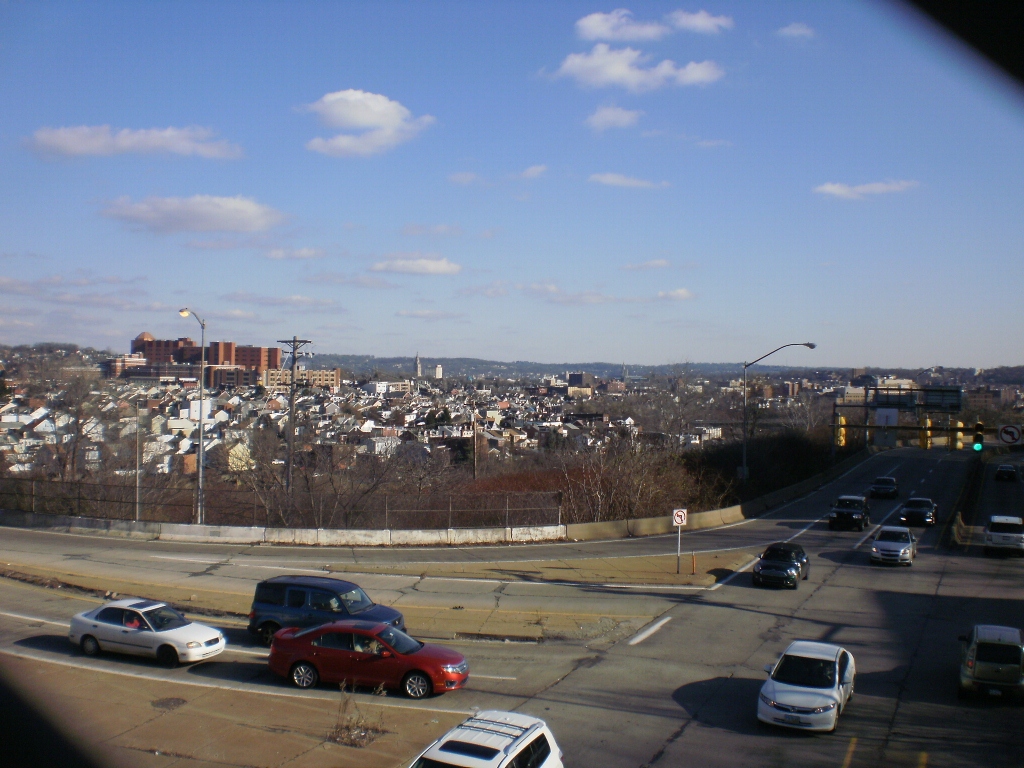
The picture above is from the Bigelow pedestrian bridge looking out over Pittsburgh’s East End.  The large brownish building on the left is West Penn Hospital in Bloomfield.  In the middle of the frame are two white points standing above the other buildings.  These are the steeple of East Liberty Presbyterian Church on the left and the Highland Building, also in East Liberty and designed by Daniel Burnham, on the right.

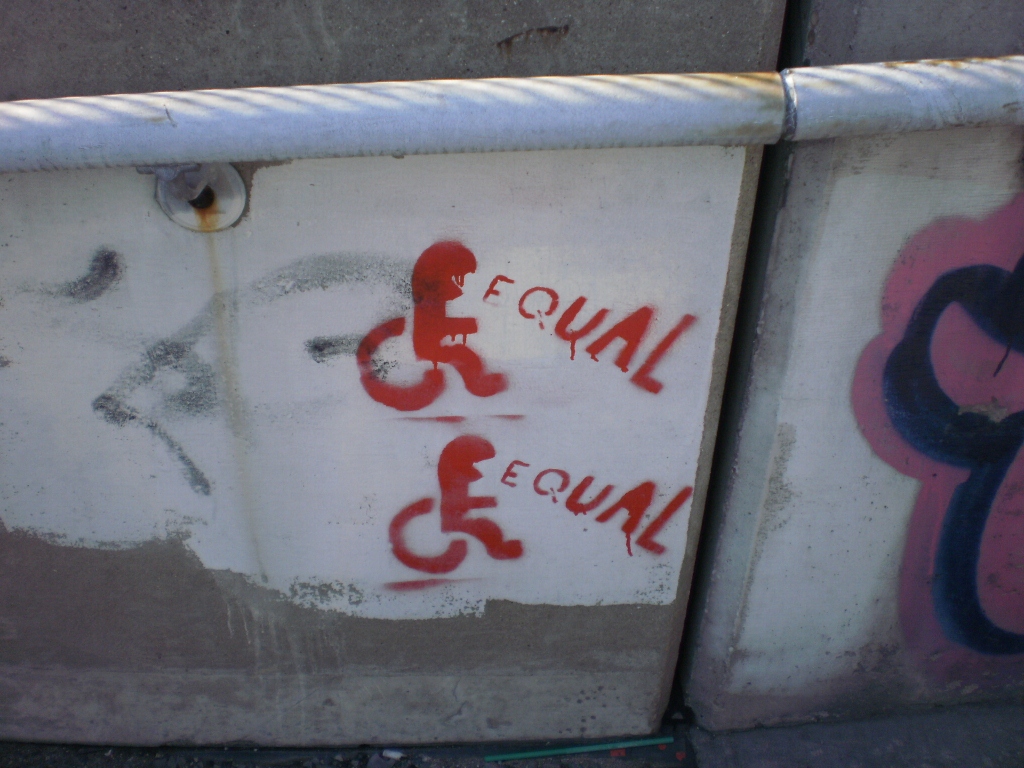
When I saw this symbol on the pedestrian bridge, I stopped to consider it.  This was the first time I had ever seen this symbol.  I thought whoever put it on this bridge had a very good point.  The only way to access the Bloomfield Bridge from Oakland and the uphill side of Bigelow Boulevard is by the pedestrian bridge, which is only accessible by a set of stairs on either side.  As such anyone with a mobility disability is barred from using the Bloomfield Bridge as a pedestrian.  The way the intersection of the bridge and the boulevard is set up now, it would not be safe for any pedestrian to attempt to cross the streets, let alone one with a disability.  This is a unequal and limiting situation.  There is a grocery store across from the other end of the bridge and a drug store and restaurants within another block.  Up the hill from this side of the bridge is a residential area.  The other end of the Bloomfield Bridge is the residents closest area for essentials found at grocery and drug stores as well as entertainment found at restaurants and bars.  It would be highly convenient for the residents on the hill to be able to walk to this area; however the current situation limits who is able to use this resource.  (Not to mention the ugliness of the bridge and the intersection which probably discourages many people from even considering the short walk across the Bloomfield Bridge.)

The second time I saw this graffiti symbol was on the 16th Street Bridge (see post).  I could not figure out what statement, if any, the 16th Street Bridge one was trying to communicate.  As far as I could tell, that bridge is accessible to any pedestrian with or without mobility issues.  At least there are no stairs to contend with at either end.

Pedestrian Bridges: Bates Street

The trail bridge over Bates Street, which opened in 2011, is the second newest bridge in Pittsburgh.  The newest is the pedestrian bridge in East Liberty (see Taking the Long Way Round post).  The East Liberty bridge was a completely new bridge, whereas there was a trail bridge over Bates Street before.  This bridge carries the Eliza Furnace Trail.  This trail is part of the larger Three Rivers Heritage Trail.  I believe that this is the only bridge over a road along the Three Rivers Trail system.  There is a converted railroad bridge that carries the trial over part of the Allegheny River (see July 15 post).  The Hot Metal (Aug 9 post), Smithfield Street and Fort Duquesne (June 19 post) bridges are also considered part of the trail system according to the trail map.

As I mentioned in the Birmingham Bridge post, the part of the Three Rivers Trail system that travels on the northern side of the Monongahela is not a very pleasant stretch.  This area around the Bates Street Bridge is one of the worst sections.  The trail is caught between a freeway and the high traffic, through way of Second Avenue.  There is no vegetation or anything else to act as barriers to the noise of the traffic on these two roads and to the sun on a hot day.

Further away from town (in the direction the picture above looks), the trail improves some as it comes to an elevation between that of the freeway and Second Avenue and there is more space between the trail and the roads.  I’ve traveled on this trail toward town only once or twice, so I don’t remember specifics about it.  I do remember that it does continue to lean toward being unpleasant.  The times I traveled on it, I was biking.  From that experience I know I would never choose to walk it.  On a bike, you go fast enough to ignore much of the harshness of the trail, but walking you would be forced to take it all in.

Perhaps the biggest problem with this part of the trail system is that it doesn’t approach anywhere near the river.  This is a significant flaw for a trail considered part of a river trail system.  At the Bates Street Bridge, the trail is separated from the Monongahela River by Second Avenue and the office/technology park I reference in the Birmingham Bridge post.

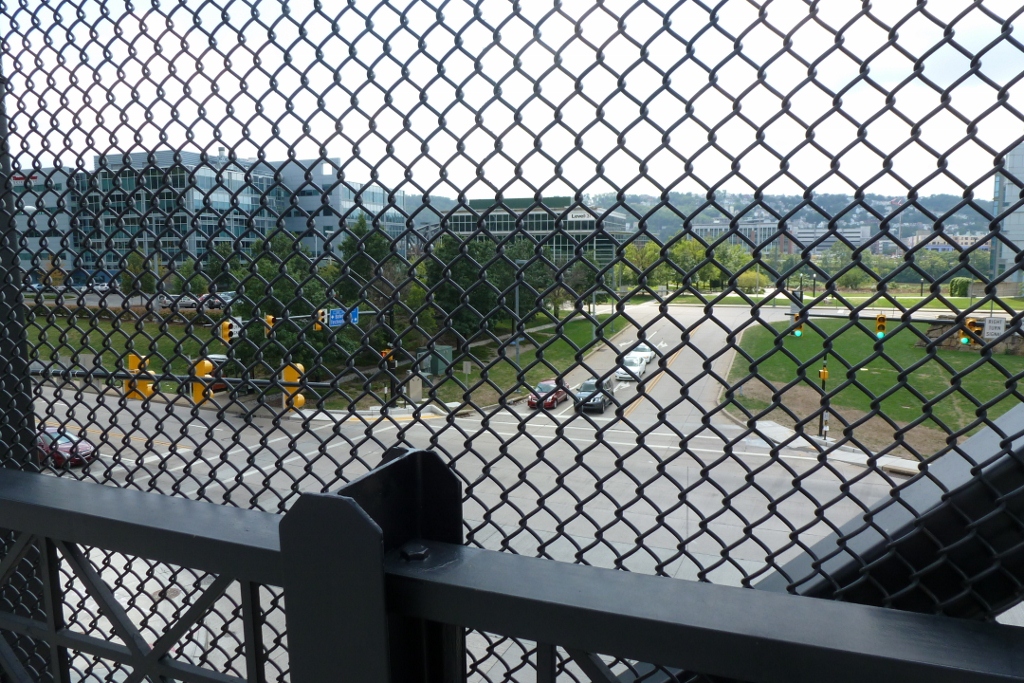
One of my original fascinations with my walking bridge project was the different views of the city captured from the various bridges.  The Bates Street Bridge adds to the views of downtown I’ve collected so far:

Hot Metal Bridge

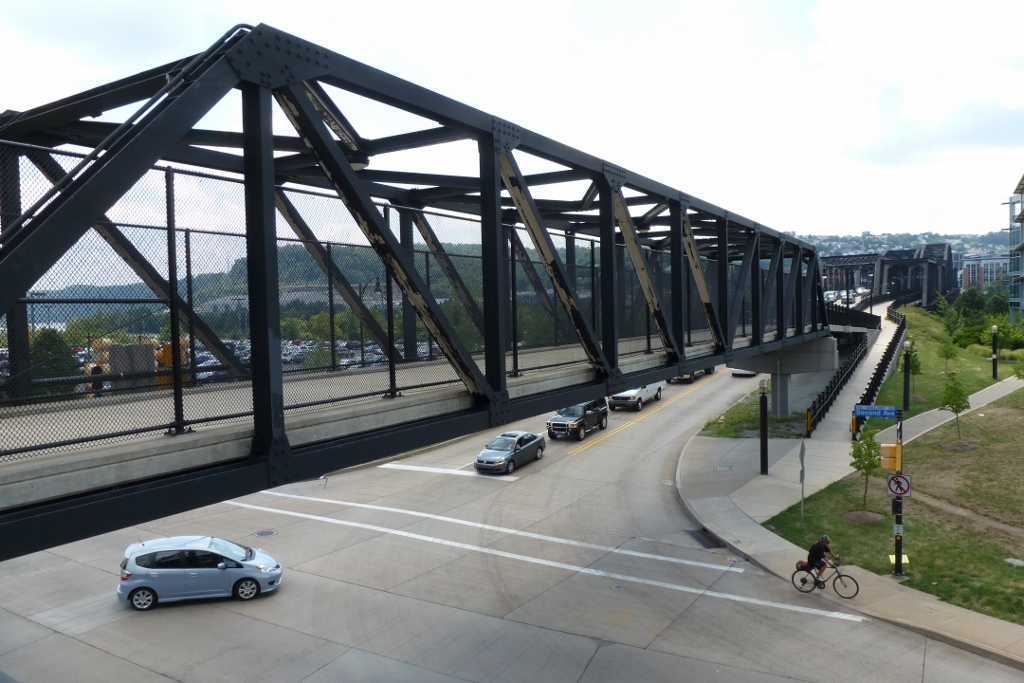
After walking the Hot Metal Bridge, I realized that it is really three separate bridges.  One of the bridges is the bike/pedestrian bridge pictured above that crosses over Second Avenue.  The other two are in the background of the image above–one carries all vehicular traffic while the other carries all pedestrians and bicycles.  The bridge pictured above is not structurally connected with either of the other bridges.  The two bridges that span the Monongahela River were built at different times.  While at this end (north) the bridges are at the same level, they are at two different elevations on the other side of the river.

The Hot Metal Bridge is one of the more locally famous and popular bridges in the city.  In my experience of participating in and overhearing people’s conversations locally about Pittsburgh bridges, the Hot Metal and Smithfield Street bridges are the two that come up the most as fun to use and interesting.  In the case of the Hot Metal Bridge, this is perhaps because it used to be a set of railroad bridges which have now been converted.  They were built and used by the Jones & Laughlin Company to connect its sites on opposites of the river.  The name of the bridge (Hot Metal) came from the fact that the trains were carrying molten metal from one factory to another.  There are, or at least there were, placards along Water Street along the South Side Works that describe the history of the J&L steel company on this site and on the bridge.  I don’t know if they are still up as there is currently construction going on in this area.

According to the description attached to the oldest image of the bridge on Historic Pittsburgh, the bridge was built in 1887.  This image, as well as PGHbridges.com’s page for the bridge, identifies the names of the two structures as the Monongahela Connecting Railroad Bridge (now the vehicular bridge) and the Hot Metal Bridge (now the pedestrian bridge).  The G.M. Hopkins maps tell a slightly different story.  As early as 1882, the maps show a bridge at this location.  That map and the 1889 map identify the bridge as the East End Bridge.  All the maps from 1890 through 1923 of this site call it the Jones & Laughlins Bridge.  Up until 1904, the bridge is depicted as carrying a single track, which I assume would be the bridge that is now the pedestrian bridge.  Starting in 1910, the bridge is depicted with three railroad tracks, meaning the current vehicular bridge was added in that time.

It is amazing to me that as late as 1998 this part of the city was still dominated by steel mill buildings as illustrated by this photo.  I suppose this means that I did not come to this part of the city then.  As the South Side Works mall did not exist yet, I guess there was no reason for me to come over here.  According to PGHbridges.com, the conversion of the bridges began in 1998, but the larger of the two bridges didn’t open until 2000 while the pedestrian bridge opened in 2007.

My final comment on this bridge is that there is a nice view of downtown from here, although the buildings don’t form any interesting patterns and clusters like they did in the views from the Allegheny River bridges (see 16th Street Bridge post for an example of this).

Pedestrian Bridges: Shadyside

When the pedestrian bridge I discuss in “Taking the Long Way Round” was in the process of being built, I was thinking it was the first pedestrian bridge in Pittsburgh.  When I started my project of walking the bridges in Pittsburgh, I realized what a ridiculous thought that was.  Pittsburgh has many pedestrian bridges, but until the new one was built, I never heard anyone talk about any pedestrian bridge in the city.  Many of these pedestrian bridges are not particularly attractive and are not in high traffic areas.

Shadyside has one of these hidden pedestrian bridges.  The bridge connects Graham Street across the busway and railroad tracks.  The only reason I know about this bridge is from riding buses on the busway.  Walking down Graham from Centre Ave (a busy corridor lined with businesses, churches and a hospital and used by several major bus routes and lots of cars), I was impressed how quiet and peaceful the residential area between Centre and the busway was.  That is until a train comes by.

As I walked across this bridge, I wondered why it was there.  There is a vehicular bridge with sidewalks on both sides across the busway a block in either direction.  There are eight other roads between this bridge and the Penn Ave Bridge that end at the busway and have neither a vehicular or pedestrian bridge connecting them to the other side of the busway.  In my walk, I speculated that perhaps it was put in to connect the residents on the north side of the busway to places of work on the southern.  This was based on the fact that there was a large building on the southern side that now houses the Shadyside Boys and Girls Club (photo below).

When I got home I went to PGHbridges.com, which I have used whenever I’ve had questions like this about the origin or design of Pittsburgh bridges.  However, for some reason this website ignores many of the bridges over the busway.  In looking up some of the bridges that PGHbridges.com misses, I found several other bridge websites that list and identify many of the bridges in the city, but none of them include the Graham Street Bridge, not even the National Bridge Inventory Database.

So I turned back to my favorite resource–the G.M. Hopkins maps.  I also went to the image collection on Historic Pittsburgh, the parent site for the Hopkins maps.  In the image collection I found one photo from 1908 of the bridge under construction.  The 1904 and 1911 maps show the area immediately adjacent to the bridge as all residential.  The building that is now the Boys and Girls Club does not exist.  All I’m left with is speculation at this point.  However, there is a school a few blocks from the southern end of the bridge and in between 1904 and 1911 another church was built a couple blocks north of the bridge.  There already was a large church a block from the site of the newer, smaller one.  Perhaps, the bridge was built to facilitate school students and church goers to get to their respective destinations.

Based on the way the bridge is depicted on the 1911 map and the 1939 map, I suspect the bridge may have been rebuilt since 1908.  At the very least the stairs were replaced.  The southern steps are drawn as coming straight out from the bridge to the road, but today the stairs are perpendicular to the line of the bridge and Graham Street.  The northern steps are drawn perpendicular to the bridge and facing the same direction the southern steps face today.  However, the steps I walked are switchback style, with the upper portion facing the opposite direction depicted on the 1939 map.

Tower Bridge

The last bridge in London I walked over was the Tower Bridge.  It is by far the most elaborate bridge across the Thames.  I had assumed it was also the oldest of the bridges I walked in London.  It turns out that this was a false assumption.  The current Tower Bridge was built in the 1890s.  According to the dates I found online, Southwark Bridge (see Aug 5 post)  is the oldest existing bridge I walked having opened in 1819.

The Tower Bridge is the last bridge across the Thames before it empties into the sea.  The view downstream gives some indication of this as there are no bridges in sight and the views from all the other bridges showed either another vehicular bridge, underground bridge, or pedestrian bridge.  That the Tower Bridge is the end of the bridges over the Thames is somewhat surprising to me because as the crow flies the mouth of the river is nearly forty miles away and as the river flows is even farther.  There are some tunnels under the river between the Tower Bridge and the sea, including at least one pedestrian tunnel.  I considered walking the pedestrian tunnel, but the idea of walking through a tunnel under a river seemed long, dark, and scary, and as I had already walked myself off my feet, I chose not to.

Some of the oldest parts of the city are near the Tower Bridge.  The northern shore is where the infamous Tower of London is located.  The Tower itself was built in 1078.  Crossing the bridge and turning right are several very narrow, medieval-like lanes.  Yet right near this old fabric is a very new development, situated almost directly across the Thames from the Tower of London, which from this view seems to include the controversial Shard skyscraper.  The Shard is located near the end of the London Bridge so I believe there must be some separation between the new buildings in the foreground and the skyscraper.  I understand that there is some controversy over the building as many people believed it was too close to the older fabric of the city where they wanted to maintain the historical building heights.  In the midst of the historic neighborhoods I observed this skyscraper looms up as the current tallest building in Europe.  According to an article about the official opening of the building on July4, one of the many features of this building is “double-decker lifts.”  I feel like that is the kind of thing that I’m going to have to see it to believe it.  How would a two-story elevator work?  And why would you want a two-story one?  I think it would only complicate things.

So ends the story of my journey walking across 13 bridges in London.  Hope you’ve enjoyed it!  For those interested in bridges, stay tuned as I continue to walk bridges in Pittsburgh and other cities.  For those interested in London, I plan to post about the adaptively reused churches I found in London in the near future.

Bridge Safety

The first time I walked across the Birmingham Bridge was before I came up with the idea of walking all the bridges in Pittsburgh.  I was going to an event on the South Side and according to the bus schedule, the best method for getting to this event was to take one of the Fifth Avenue buses to the Birmingham Bridge and walk across the bridge and down a few blocks on East Carson Street to the event.  I was quite dismayed when I got off the bus and saw that there was no sidewalk across the bridge–it turns out there is a sidewalk but it only connects to Forbes Avenue which is significantly lower than Fifth Avenue at this point.  Fortunately, there is a bike lane, clearly marked with a buffer zone across the bridge.  I kept as far to the right as I possibly could, hoping that cars recognized and honored the bike lane (I have noticed this is an issue for drivers in Pittsburgh at least in some areas), and headed across.  Nearly a quarter mile from Fifth Avenue, a ramp comes up from Forbes Avenue with a sidewalk.  I climbed over the cement barrier and crossed the core of the bridge on the sidewalk.  However on the southern half of the bridge, the sidewalk goes down a set of steps and comes out between the back of a parking lot and the underside of the bridge.  This seemed like a potentially unsafe place for a lone pedestrian, so I climbed back over the barrier and finished crossing the bridge as I had started, separated from the cars by only the painted lines of the bike lane.

I have walked this bridge a few times since then, employing this same method every time.  I have also observed other pedestrians using a similar method, though some don’t bother climbing over the barrier onto the sidewalk when that becomes an option.  This is truly the case of a bridge that may be pedestrian accessible, but is not at all pedestrian friendly.  In my post “One River Down,” I mention that Highland Park Bridge, Washington’s Crossing Bridge, and the 62nd Street Bridge are less than pedestrian friendly.  The Birmingham Bridge beats these bridges as the least pedestrian friendly bridge I’ve walked in Pittsburgh to the point that it is potentially unsafe for pedestrian use.

While the bridge is designed so that pedestrians can use a buffered sidewalk across the length of the bridge, the access points to this sidewalk are not convenient.  I discuss in “Taking the Long Way Round” that there are times and situations when pedestrians will go out of their way, but the Birmingham Bridge sidewalk does not meet them.  The northern access point is in a hollow surrounded by vacant or industrial-use lots and passes under several ramps/bridges/elevated roads carrying an interstate before reaching the level of the bridge.  Also there is no easy way to get there from Fifth Avenue at the bridge.  A pedestrian has to go down a block to a road that connects Fifth and Forbes avenues and then come back down toward the bridge to reach the sidewalk for it.  There is no incentive for a pedestrian on Fifth Avenue to go so far out of their way when the bridge is right in front of them.  The staircase at the other end of the bridge that I mentioned earlier makes about as much sense as this end’s inaccessible sidewalk access.  Not to mention that the staircase excludes anyone using a wheelchair from access to the sidewalk (it looks like there used to be a ramp on this end as well, but it is now sealed off and cut off).