Caerphilly, Castles and Cheese

Caerphilly Castle

When I arrived in the UK last spring, I realized I had one major flaw in my trip: I hadn’t planned to visit any castles.  Cardiff has a castle in the center of town and my hotel was right across the street from it.  However, I visited this castle on my last trip and remembered much of it: the Roman wall in the basement, the ornate room in the clock tower, the nursery painted with scenes from fairy tales, and the view from the keep.  Looking for a new castle to visit, my guidebook recommended Caerphilly.

Caerphilly is a twenty minute train ride north of the center of Cardiff.  It is a small town and features a castle begun in 1268.  In addition, the guidebook noted that the town is noted for Caerphilly Cheese, a mild relative of cheddar cheese.  As I love cheese, especially cheddar, Caerphilly was an appealing destination to satiate my interest in castles and cheese.

So one morning, I went down to the Central Cardiff station, purchased an open, round-trip ticket to Caerphilly for just a few pounds and enjoyed the short train ride through the Welsh country-side.  Cardiff is very flat, but Caerphilly and the surrounding area are quite hilly.  The castle wasn’t visible from the train station, so I started walking in what seemed the most promising direction: downhill on the main commercial street.  After a short walk, the road made a bend and the shops stopped on one side, leaving a wide view over a green park to the castle and the valley and hills beyond.

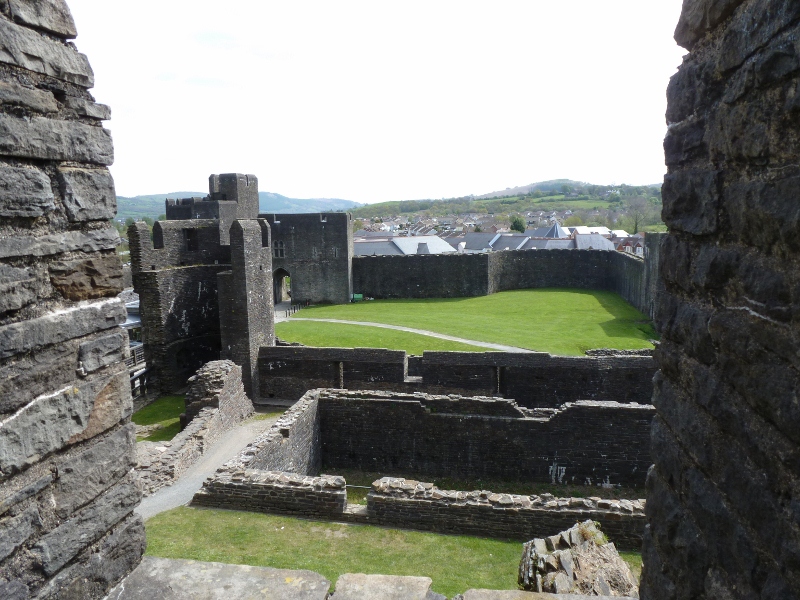
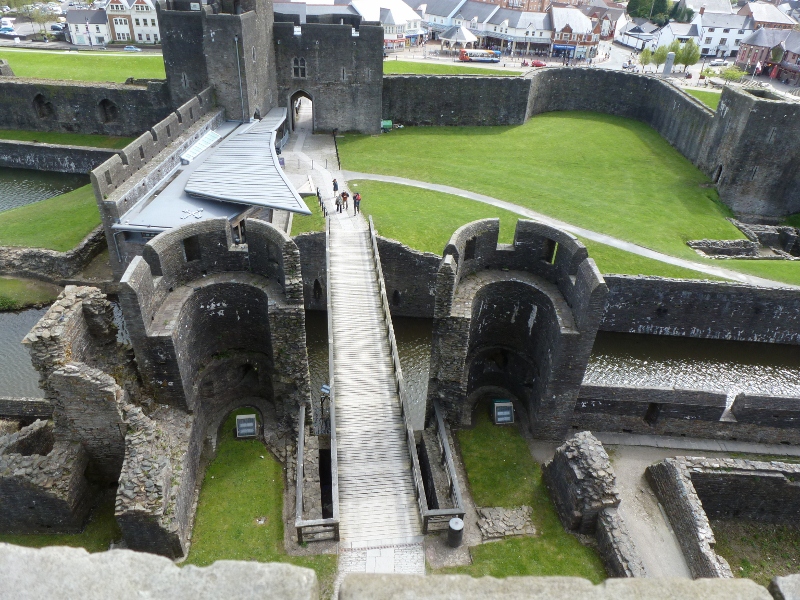
Views from the Castle's Keep Views from the Castle's Keep

Views from the Castle's Keep

A Welshman once told me that the only real castles are those in ruins.  Ones like Cardiff Castle that have been fixed-up, renovated, or refurbished in any way are not real.  I thought that he would have approved of Caerphilly Castle.

When I finished exploring every corner of the castle, I returned to the town looking for cheese and lunch.  There were no signs of Caerphilly Cheese anywhere.  There were lots of tourist-y areas and signs directing the way to tourist-like attractions, but none mentioned cheese.  Wikipedia claims that there is a cheese sculpture somewhere in town, but I didn’t see it.  I ended up choosing a quaint little diner (of the early 20th century style, not the 1950s/60s style we think of in the US) as the place to eat my lunch in the hopes that perhaps they used Caerphilly Cheese on their sandwiches, but they did not.

Feeling let down in my hunt for cheese, I returned to Cardiff shortly after my lunch.  Caerphilly’s castle was well worth the trip, but I was beginning to believe that Caerphilly Cheese was a myth.

….

Seven months later, my family and I were visiting New York City for Christmas.  On our last day, we made the requisite visit to Zabar’s.  I had been particularly looking forward to this stop on our trip as the last time I was in Zabar’s I was a kid who knew that there was something special about the shop, but didn’t understand why as I thought the height of culinary perfection was Kraft Mac’N’Cheese.

The first thing that caught my eye on entering Zabar’s was the cheese display.  I quickly went over and scanned the names of all the various cheeses, looking for the exotic one that I was going to take home to try.  Most had names that sounded familiar.  On my second look through, my heart stopped.  There on the shelf right in front of me was Caerphilly Cheese!!

I was shocked.  I had gone to Caerphilly to get their cheese and been disappointed.  Now, months later on the other side of the ocean, in a small store in NYC, I’d found it.  Needless to say, I purchased a brick.  It was a nice cheese, almost like a cross between a mozzarella and a mild cheddar: smooth, almost creamy, with a slight hint of the cheddar kick.

Sandwich Shops

While in London last spring, I discovered a sandwich shop chain that I fell absolutely in love with: Pret a Manger.  I ended up eating lunch most days at one of their many locations around the city.  The food was great.  They had sandwiches on small baguettes, in wraps, and between two “normal” square slices of bread (which have been cut into triangles, as everyone knows triangle sandwiches taste better).  The flavors of sandwiches included ham and cheese, egg salad, and brie, tomato and basil.  The ingredients were fresh and real–meaning ham of the bone, not sliced deli ham, and arugula instead of shredded, nondescript “lettuce.”  And then the sides to go with the sandwich were interesting, exciting, and tasty.  The chip flavors I remember were “cheddar and red onion” and “sea salt and apple cider vinegar.”  Both delicious!  I was also attracted to the Pret sodas (I normally skip the soda options at restaurants).  I enjoyed the Grape & Elderflower, Apple, and Ginger Beer sodas.

Pret was the first place I had lunch in London and from the first bite, I couldn’t wait to come back and try another flavor of their sandwiches, chips, and drinks.  On my third day in London, I was ready for lunch, but could not find a Pret anywhere near where I was, so I went to another sandwich chain that I had been seeing around.  The style of this other place, the name of which I forget, was similar to Pret, but the taste was no comparison.  After trying this other place, I made sure that I was near a Pret at lunchtime for the remainder of my trip.

Besides the taste, I also enjoyed the convenience of the chain.  All the sandwiches are premade, so all you have to do is grab-and-go.  You don’t have a clerk staring you down while you decide what flavor you want today and you don’t have to wait for it to be made once you’ve made the decision.  All of which suits my personality better.

I cannot think of a sandwich shop in the US that has premade sandwiches.  It seems to me that one of the things the Subways, Quiznos, and the others are after with the don’t make it until it’s order deal is to prove that their food is fresh.  Blimpie’s for example doesn’t even slice the meat and cheese until you’ve put your order in.  Despite being premade, the sandwiches at Pret always tasted fresh and satisfying because they were made with solid food such as dense, but small bread, and chunks of chicken meat.  The chain’s website explains the secret: “Pret opened in London in 1986. College friends, Sinclair and Julian, made proper sandwiches avoiding the obscure chemicals, additives and preservatives common to so much of the ‘prepared’ and ‘fast’ food on the market today….They created the sort of food they craved but couldn’t find anywhere else.”  “Our partners drop off the very best ingredients to our shops everyday. We don’t mind that good, natural food goes off quickly. We don’t keep our sandwiches, baguettes and wraps overnight.”

One of my biggest disappointments on returning home was that I might never get another Pret sandwich (unless they’re still there the next time I’m in London) and instead the only options for buying sandwiches out would be places like Subway and Quiznos.  It was quite devastating.  Like the partners who started the Pret chain, I was going to be craving fresh, “proper” food, but unable to find it anywhere….

But then, I went to New York City for Christmas.  Walking around the first night there, I was thrilled to spot not one, but two Prets.  Needless to say, I went there every opportunity I got.  The options were somewhat different, particularly the chips–there were only boring, regular American flavors and styles to choose from (though they still weren’t national brands like Lays)–but the food was still good.  The egg salad wrap was melt-in-your-mouth delicious.  The roast beef, arugula, mustard-mayo and chicken, bacon, mayo baguettes were also yummy.  They also had the Pret Ginger Beer Soda, which tasted as yummy as the Ginger Beer I had in London, both Pret and non-Pret.  I’ve found Ginger Beer in Pittsburgh, but it’s just not the same.

It turns out that Pret a Manger has set up locations in New York, Boston, Chicago, and Washington, D.C.  As Chicago is one of the next US Cities I hope to visit, I know I will be getting another Pret sandwich soon.  I wonder though, if the large, diverse populations of these cities are necessary for a place like Pret a Manger to be successful.  Is it possible for a truly fresh sandwich shop to succeed (and set up multiple branches) in a smaller, less diverse city like Pittsburgh?

Isolated Waterfronts

In October 2012, I spent a few days in Erie, PA, to attend a conference.  Before arriving, I had looked at the map to figure out how to get from the bus station to my accommodations to the convention center.  On the map it looked pretty straight forward and simple.  All the places I had to get were within a mile of each other—piece of cake.  I often walk that far just to get to a bus in Pittsburgh.  Shortly after arriving in Erie, I realized that purely considering distance does not capture the true picture.  The seemingly short mile-long paths that I had to take included significant geographical and man-made barriers.

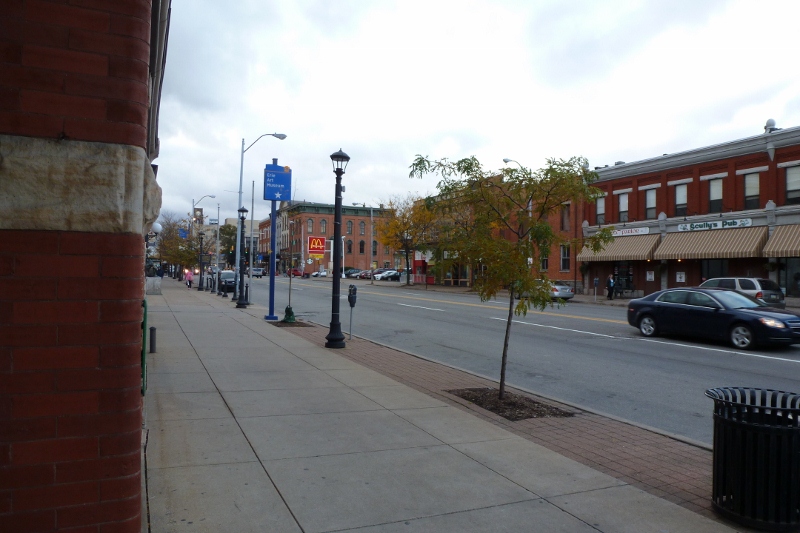
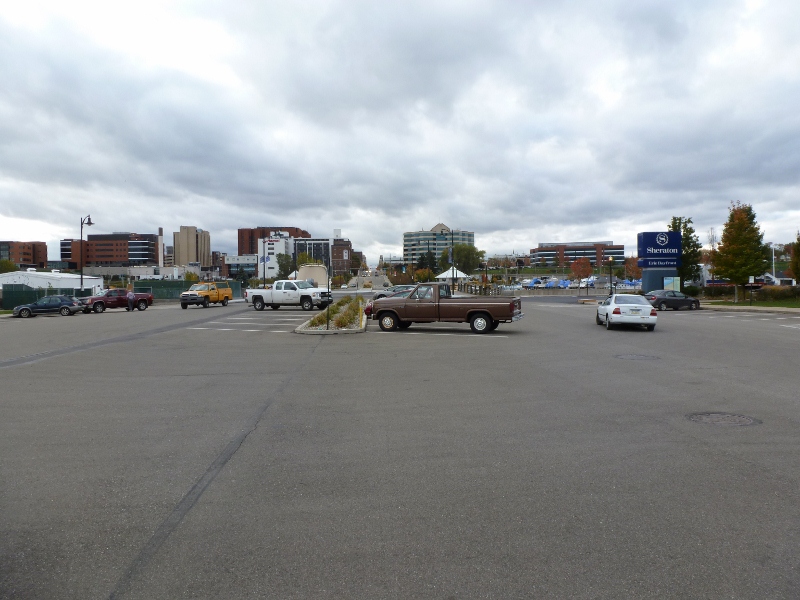
The main drag ran up through the town and straight out to the waterfront ending at the convention center hotel.  From the town square (6th Street), most of the buildings are flush with the sidewalk, except for the parking-lot-centric McDonald’s in the middle of these older buildings.  At 3rd Street, this changes.  The next two blocks are dominated by the campus of a UPMC hospital.  Then the barriers come.

First there is a small hill down toward the waterfront, then a wide parkway, followed by a barren strip of land on one side of the road and a marina on the other.  Finally, there is the convention center hotel.  Of course you have to pass the long parking garage, the lobby and rooms of the hotel, go up an elevator across a pedestrian bridge over the entrance to the marina, and down another elevator before you get to the convention center.

I was staying in a Bed and Breakfast near the town square, so several times a day I walked back and forth along this route to attend the conference events.  Even though the walk was only about a mile long, it seemed to take forever because of the barriers of the hill, road, vacant land, and water.  After going back and forth a few times, I realized that the set up was not much different from what I had seen in Cleveland this summer.  That city also has a major roadway cutting off the town from the shores of Lake Erie.  This road of course was much bigger than the one in Erie as the city is correspondingly bigger.

Despite the fact that there is a major freeway dividing the waterfront from downtown Cleveland, I still felt welcome to cross this barrier to reach the waterfront park or the Rock ‘n’ Roll Hall of Fame.  In Erie, I got a very clear impression that the downtown residents were not welcome to cross the barriers to get to the convention center/hotel or the little public jetty next to it and that the visitors at the hotel/conference center were not encouraged to explore into downtown Erie.  This situation seems to defeat part of the purpose of convention centers to bring economic benefits to the surrounding area, by bringing in more people to use local services.

Adaptively Rebuilt Church

The Spire House is perhaps my favorite of all the adaptively reused churches I found in London.  Originally built as Christ Church Lancaster Gate in the 1850s and 1860s, the building has since been adapted to housing.  As I walked around the building, I thought it might have been one of the ones damaged during the war, but according to a website about the building most of the structure was demolished in the 1970s because of decay and fungus.

The reason why I liked this building was that despite the fact that most of it was demolished, part of it was saved and the rebuilt structure recalls the former design.  I particularly liked the “flying buttresses.”

I agree that there are times when a building can no longer function well, in this case because of decay and fungus, but buildings tell a lot about a society and its history and when they are demolished something gets lost.  The Spire House found a compromise between these two and it tells a lot about the city.  From the way this building was designed, it is apparent that this society is moving forward and changing, but still respects its past and its religion.  There other signs of this throughout the city, such as the church tower in the middle of a road.

Adaptive Reuse of Churches: London

When I started planning on going to London this year, my first idea was to go for a month or so to study the adaptive reuse of churches in that city.  I thought London would be a good place to see a wide variety of adaptions as the UK has been working with the problem of redundant churches for about a hundred years.  As I was pursuing this idea I found a book from 1977 which addresses this problem across Great Britain.  (I have not come across any book publications on the adaptive reuse of church buildings in the US.)  This book “Chapels and Churches: Who Cares?” includes a discussion of what had been done up until that point in time in the adaptive reuse of church buildings.  I compiled a list of 76 different uses that these buildings have been adapted to from the book.  In my observations in the Pittsburgh area, I have seen less than ten types of new use for church buildings with housing being the most common.

There was one factor about the church buildings in London that I found fascinating, perhaps in part because it is not a factor in Pittsburgh, or any US city for that matter.  Many churches sustained damage during WWII and The Blitz.  The churches damaged during the war were demolished, rebuilt, adaptively reused, or memorialized, resulting in some unique (at least to me) situations.

I ended up not going to London to complete a research project on the adaptive reuse of church buildings, but instead went to the city for a few days and explored as much of the city as I could in that time.  This included looking for a few of the adaptively reused churches I had learned about in my preliminary research.  In the process of looking for the ones I knew about and simply walking around the city, I found some other adaptively reused churches.

Tower Bridge

The last bridge in London I walked over was the Tower Bridge.  It is by far the most elaborate bridge across the Thames.  I had assumed it was also the oldest of the bridges I walked in London.  It turns out that this was a false assumption.  The current Tower Bridge was built in the 1890s.  According to the dates I found online, Southwark Bridge (see Aug 5 post)  is the oldest existing bridge I walked having opened in 1819.

The Tower Bridge is the last bridge across the Thames before it empties into the sea.  The view downstream gives some indication of this as there are no bridges in sight and the views from all the other bridges showed either another vehicular bridge, underground bridge, or pedestrian bridge.  That the Tower Bridge is the end of the bridges over the Thames is somewhat surprising to me because as the crow flies the mouth of the river is nearly forty miles away and as the river flows is even farther.  There are some tunnels under the river between the Tower Bridge and the sea, including at least one pedestrian tunnel.  I considered walking the pedestrian tunnel, but the idea of walking through a tunnel under a river seemed long, dark, and scary, and as I had already walked myself off my feet, I chose not to.

Some of the oldest parts of the city are near the Tower Bridge.  The northern shore is where the infamous Tower of London is located.  The Tower itself was built in 1078.  Crossing the bridge and turning right are several very narrow, medieval-like lanes.  Yet right near this old fabric is a very new development, situated almost directly across the Thames from the Tower of London, which from this view seems to include the controversial Shard skyscraper.  The Shard is located near the end of the London Bridge so I believe there must be some separation between the new buildings in the foreground and the skyscraper.  I understand that there is some controversy over the building as many people believed it was too close to the older fabric of the city where they wanted to maintain the historical building heights.  In the midst of the historic neighborhoods I observed this skyscraper looms up as the current tallest building in Europe.  According to an article about the official opening of the building on July4, one of the many features of this building is “double-decker lifts.”  I feel like that is the kind of thing that I’m going to have to see it to believe it.  How would a two-story elevator work?  And why would you want a two-story one?  I think it would only complicate things.

So ends the story of my journey walking across 13 bridges in London.  Hope you’ve enjoyed it!  For those interested in bridges, stay tuned as I continue to walk bridges in Pittsburgh and other cities.  For those interested in London, I plan to post about the adaptively reused churches I found in London in the near future.

London Bridge

London Bridge, perhaps the most famous of the bridges I walked because it fell down, rivaled the Waterloo Bridge for boring-ness (see July 29 post).  Both were similarly plain concrete structures.  The London Bridge is slightly more interesting for having a dedicated bus lane, but I can’t stand the maroon color of the bus lanes.  Luckily the surroundings were more interesting than those at the Waterloo Bridge.

I loved the geometry of these buildings visible from the London Bridge.  I went onto Google Maps to try and discover what they are as I did for Lambeth Bridge (see June 28, and Maps are Awesome! posts), but when I did, I found that Google Maps has the London Bridge miss-labeled.  The pinpoint for London Bridge sits right on top of the Tower Bridge.  As I mentioned in my Waterloo Bridge post, I had also at one time mistaken the Tower Bridge for the London Bridge.  While the London Bridge is the most famous in song, the Tower Bridge is the most famous in images.  I believe that it for this reason–that both bridges are the most famous in London, but in different media–that they get mistakenly identified.  (For some reason it is hard to imagine that there might be more than one famous bridge in London.)

The pointy building in the background is the London offices of Zurich, an insurance company.  The blue glass building houses Northern and Shell, a media company.  Next to that building and lower down is the Old Billingsgate Market, which used to house the largest fish market in the world (the market moved to Canary Wharf area, but is still the largest in the UK based on its website).

A battleship was parked in between the London and Tower bridges.  At first, I thought it was the battleship I saw on the news in the days before walking the bridge as the one moving up the Thames in an exercise to practice for the Olympic security measures.  Afterwards, I realized that this one (the HMS Belfast) was probably a permanent fixture and had not just traveled up the Thames.  It turns out I was correct the second time as the HMS Belfast is now part of the Imperial War Museums.

Southwark Bridge

After three mono-color bridges (see Jubilee Bridge, Waterloo Bridge, and Millennium Bridge posts), the Southwark Bridge returned to using the unique color schemes that I came to expect of London bridges after walking the first few (see Battersea Bridge, Albert Bridge, Chelsea Bridge, Vauxhall Bridge, Lambeth Bridge, and Westminster Bridge posts).

The Southwark Bridge had the most, or at least slowest, vehicular traffic of any of the bridges I walked in London.  It was also the only one with a painted bike lane.  I believe this lane is part of London’s Cycle Superhighway system.  These bike lanes are intended to make bike travel to central London from the surrounding areas easier (see website).  I really liked the bright blue color of these lanes.  It is highly visible and makes it quite clear this is not a place for cars.  Of course I am sure it costs a lot to paint miles of bike lanes solid.

The little domes on this building had been visible to me long before I saw the rest of the building.  I was in anticipation for several days to learn what it was.  I assumed it would be something really interesting like a church built by Eastern European immigrants, in which case its prominent location on the waterfront would led to a fascinating story, I’m sure.  Consequently I was a little disappointed to learn that it was only a train station.  (Note: I learned what the building was while on the Southwark Bridge, but the view above was taken from the London Bridge on the other side of the station from Southward Bridge.)

In this view upstream, the Millennium Bridge, which was so photogenic from the other angles (see Aug 2 post), becomes invisible against the background of the Blackfriar’s Rail Station spanning the Thames (see Blackfriar’s Bridge post).

Millennium Bridge

The Millennium Bridge is the first of two pedestrian bridges that cross the Thames.  The second, the Jubilee Bridge (click to see post), opened 3 years later in 2003.  While the Millennium Bridge is sadly only one color, I think it was probably the most photogenic bridge I walked in London.  Although I like the picture above less for the bridge and more for the buildings behind it, which show the city’s transition from a time when church steeples were the tallest thing around to today when that honor belongs to the skyscrapers.

The location of the bridge was very good.  It leads directly to St. Paul’s Cathedral.  In some ways I am surprised that it wasn’t until 2000 that a bridge was built at this location.  (I picked up some souvenir maps while in London depicting the city in 1520, 1666, 1843 and 1902 and none have a bridge or even ferry boat at this location.)  On the other hand, the other side of the bridge connects to the Tate Modern, which didn’t open as the international modern and contemporary art museum until 2000.  Before then the site was a power plant from 1947 until 1981 when it became redundant and closed, remaining vacant until the Tate took it.

The views from the Millennium Bridge show two things of interest related to the other city bridges.  First, upriver is a view of the first rail station to span the Thames and the longest solar bridge in the world (see July 31 post).  Downriver, the Tower Bridge, which I believe is the most iconic London bridge, comes into view for the first time.

I started this post by claiming that the Millennium Bridge was the most photogenic of the London bridges.  The views of it above are pretty interesting, but the best shot was the one I took from the top of St. Paul’s Cathedral looking down.

Jubilee Bridge

The Jubilee Bridge is quite unique, at least compared to the other bridges in London.  First, it is the newest bridge I crossed–Her Royal Highness Princess Alexandra dedicated the bridge on July 2, 2003.  Second, it is one of only two pedestrian bridges.  Third, it crosses the Thames twice.

Built on either side of one of the underground bridges which connects to the Embankment station, this bridge is really two bridges.  Particularly for my project, it was very thoughtful of the builders to put a bridge on either side of the underground one so that pedestrians can choose which view of the river they get.

Downriver shows a great view of the changing skyline of London Town.  St. Paul’s Cathedral still dominates its part of the skyline, but more towers are popping up around it.  It almost seems like there are more cranes than buildings in this view of London.

The upriver span of the bridge provides an excellent view of the London Eye and the Houses of Parliament.  And speaking of Parliament, I recently saw that Big Ben has been renamed Elizabeth Tower (see article in the BBC news).  While I agree that it is a great accomplishment for Queen Elizabeth to have reached her 60th year on the throne, I am quite dismayed by the decision to rename Big Ben.  Big Ben is such an iconic and catchy name.  I don’t see how Elizabeth Tower could possibly catch on.  It is one thing to rename the King’s Tower as Victoria Tower, but quite another to rename Big Ben.  It seems like there surely must be something else that Parliament could rename to honor the Queen.