The World’s Tallest Church Building

Chicago Temple

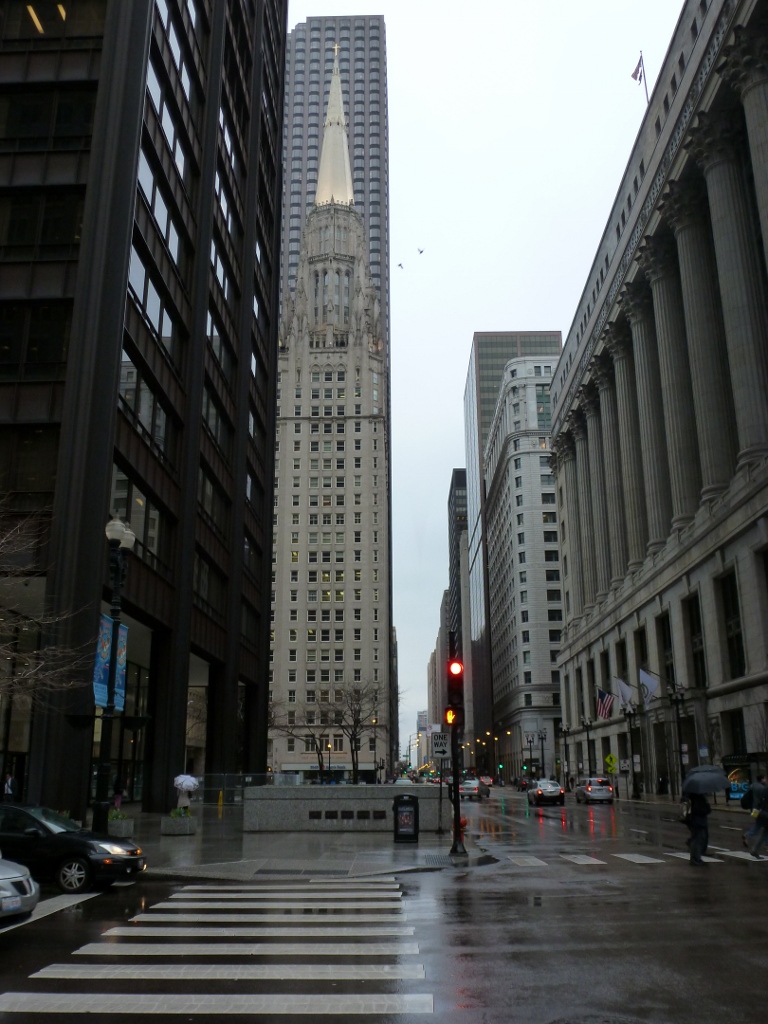
Everything in Chicago is stretched–even churches.  My eye was caught by this building as I looked to cross a street in Chicago and saw the steeple on top of this skyscraper a couple blocks down.  I was very confused at first, trying to figure out why an office building had a steeple on top of it.  Then I saw the name of the church, First United Methodist Church, carved into the side of the building.  The only other indication on the exterior visible from a distance that suggested the religious use of the interior was the doorway.
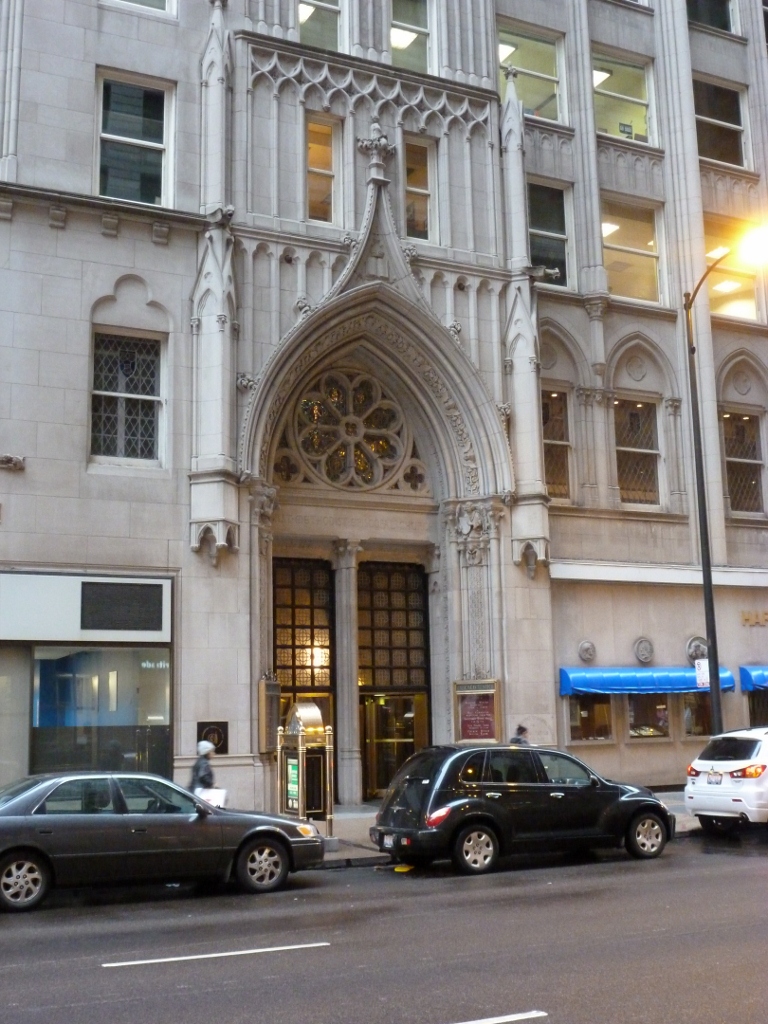
Chicago Temple Doorway

This building is also known as the Chicago Temple.  The congregation was founded in 1831 and has been worshiping at this site since 1838.  The current building was built in 1924 and has 23 floors.

One of my souvenirs from Chicago was the book “City of the Century” by Donald L. Miller, which describes the history of Chicago up to the 1893 World’s Fair.  So it doesn’t talk about the building of this church building, but it does describe the building of the Auditorium–Chicago’s multipurpose Opera House.  The book notes “there was no government support of the arts in the United States, so the Auditorium would have to pay for itself” (361).  As a result the theater was enclosed in a office/hotel complex.

It seemed like there might have been similar thinking in the design of this church building–as real estate was expensive downtown, covering the church with office space could help it afford its location.  However, if that is why the building is mixed-use, it was not inspired by the Auditorium, which was built in the late 1880s.  According the history page of the church’s website, there has been a multipurpose church building on this site since 1858.  The first one was a 4-story structure with stores and businesses on the first two floors and the church above.
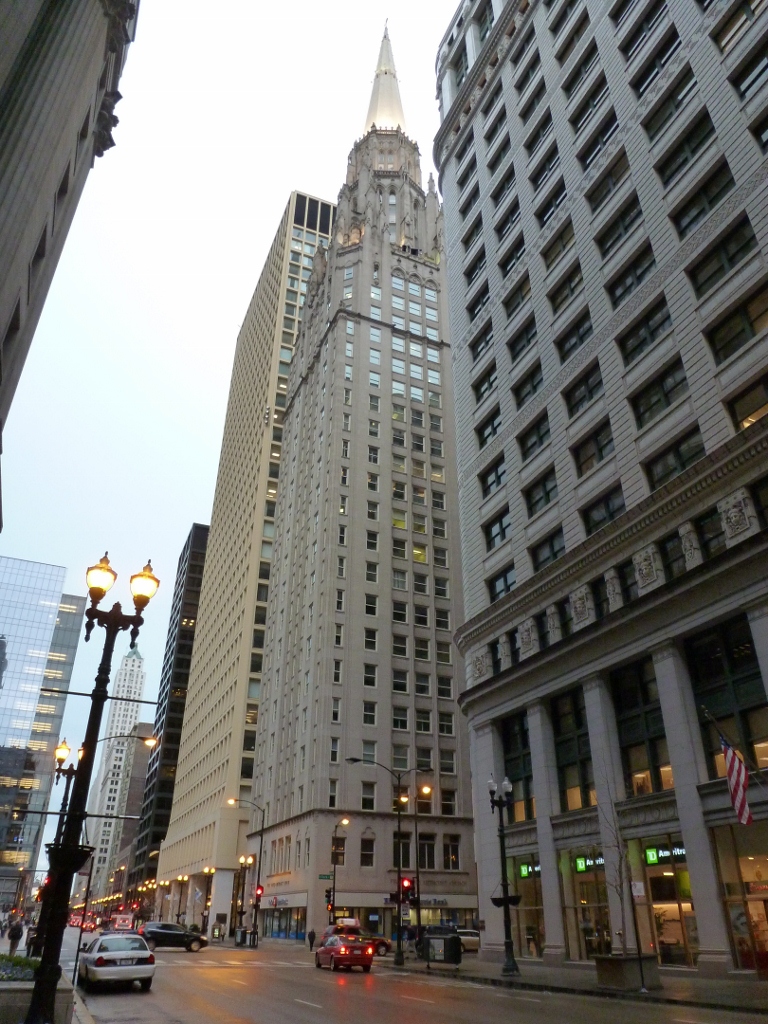
First Methodist Church

The new building has a two-story sanctuary on the first floor.  Accounts differ as to how many this can hold (500, 1000, 1200 people).  The second floor has another smaller sanctuary.  Floors three and four hold the accessory rooms–classrooms, meeting rooms, etc.  The parson’s house is also located in the building.  The remaining floors are office space.  The crowning jewel, is a small chapel underneath the steeple.

I regret that I did not take the time to stop and investigate whether I could explore the inside of the building.  As I was focused on a specific task when I came upon the building, I did not even think about trying to see inside.  If you are interested, I found a YouTube video that shows what I take to be the first floor sanctuary and the small chapel under the steeple.

A Picture for Posterity

Meter Row

As I was walking down Penn Avenue this week, I stopped to take this picture before it was gone forever.  Pittsburgh is joining the ranks of cities that use multispace meter systems.  The city’s individual parking meters are slowly disappearing as they are replaced by the multispace system.  Yet even before the transition began, Pittsburgh’s parking meters were suffering.  A complete row of intact meters marching off into the distance, such as those pictured, has been a rare sight in the city for years.  Usually there are at least a few with their heads chopped off or their stalks bent.  On close inspection, this row did have graffiti on many of the heads and at least one meter was out of order.  However, in the spring sunshine, these meters looked almost pristine with their gold heads gleaming.

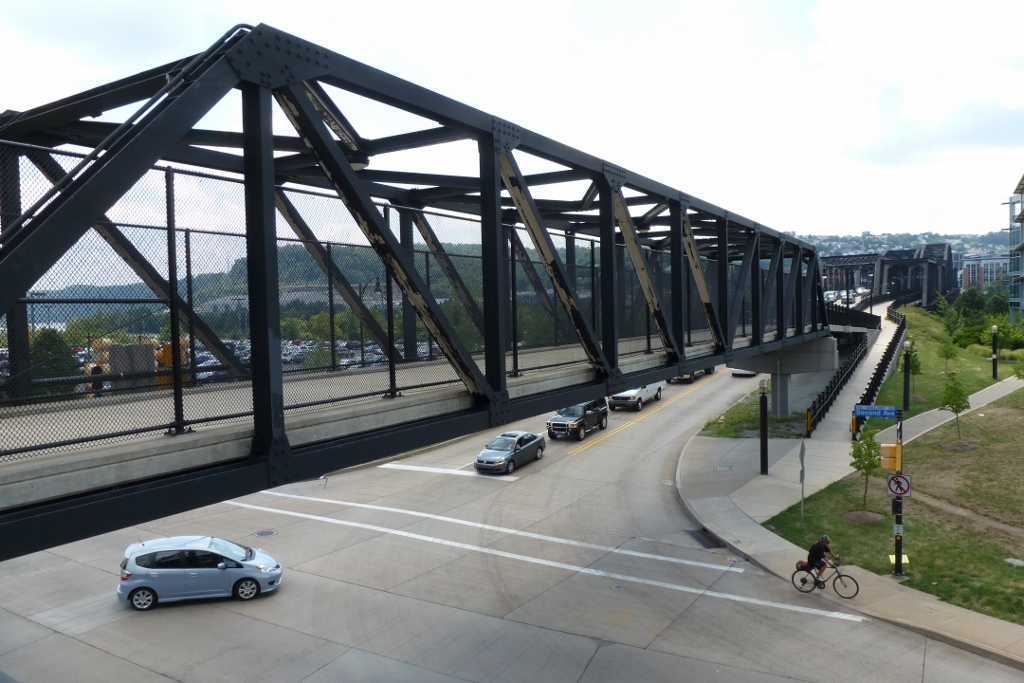
Hot Metal Bridge

After walking the Hot Metal Bridge, I realized that it is really three separate bridges.  One of the bridges is the bike/pedestrian bridge pictured above that crosses over Second Avenue.  The other two are in the background of the image above–one carries all vehicular traffic while the other carries all pedestrians and bicycles.  The bridge pictured above is not structurally connected with either of the other bridges.  The two bridges that span the Monongahela River were built at different times.  While at this end (north) the bridges are at the same level, they are at two different elevations on the other side of the river.

The Hot Metal Bridge is one of the more locally famous and popular bridges in the city.  In my experience of participating in and overhearing people’s conversations locally about Pittsburgh bridges, the Hot Metal and Smithfield Street bridges are the two that come up the most as fun to use and interesting.  In the case of the Hot Metal Bridge, this is perhaps because it used to be a set of railroad bridges which have now been converted.  They were built and used by the Jones & Laughlin Company to connect its sites on opposites of the river.  The name of the bridge (Hot Metal) came from the fact that the trains were carrying molten metal from one factory to another.  There are, or at least there were, placards along Water Street along the South Side Works that describe the history of the J&L steel company on this site and on the bridge.  I don’t know if they are still up as there is currently construction going on in this area.

According to the description attached to the oldest image of the bridge on Historic Pittsburgh, the bridge was built in 1887.  This image, as well as PGHbridges.com’s page for the bridge, identifies the names of the two structures as the Monongahela Connecting Railroad Bridge (now the vehicular bridge) and the Hot Metal Bridge (now the pedestrian bridge).  The G.M. Hopkins maps tell a slightly different story.  As early as 1882, the maps show a bridge at this location.  That map and the 1889 map identify the bridge as the East End Bridge.  All the maps from 1890 through 1923 of this site call it the Jones & Laughlins Bridge.  Up until 1904, the bridge is depicted as carrying a single track, which I assume would be the bridge that is now the pedestrian bridge.  Starting in 1910, the bridge is depicted with three railroad tracks, meaning the current vehicular bridge was added in that time.

It is amazing to me that as late as 1998 this part of the city was still dominated by steel mill buildings as illustrated by this photo.  I suppose this means that I did not come to this part of the city then.  As the South Side Works mall did not exist yet, I guess there was no reason for me to come over here.  According to PGHbridges.com, the conversion of the bridges began in 1998, but the larger of the two bridges didn’t open until 2000 while the pedestrian bridge opened in 2007.

My final comment on this bridge is that there is a nice view of downtown from here, although the buildings don’t form any interesting patterns and clusters like they did in the views from the Allegheny River bridges (see 16th Street Bridge post for an example of this).

Millennium Bridge

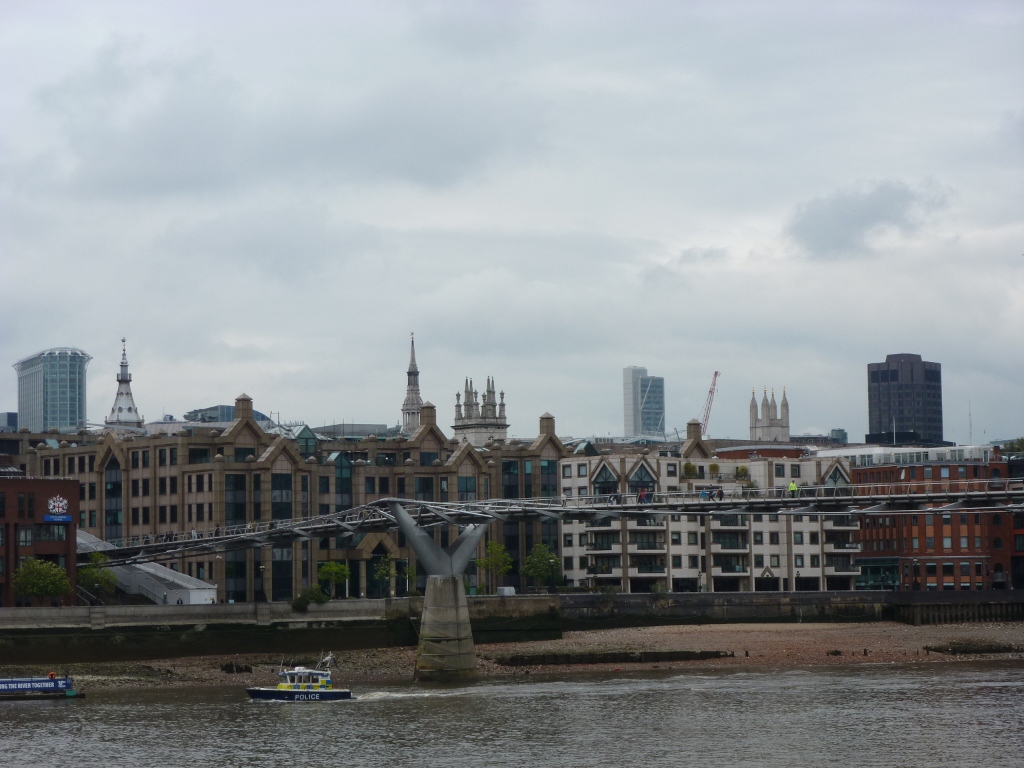
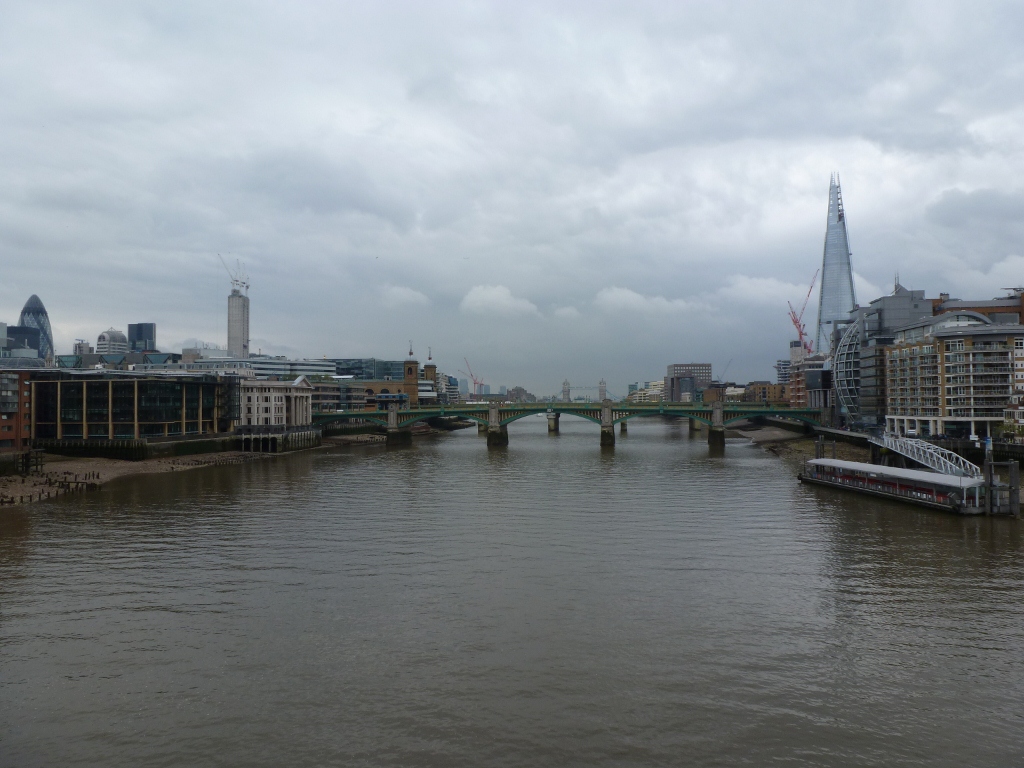
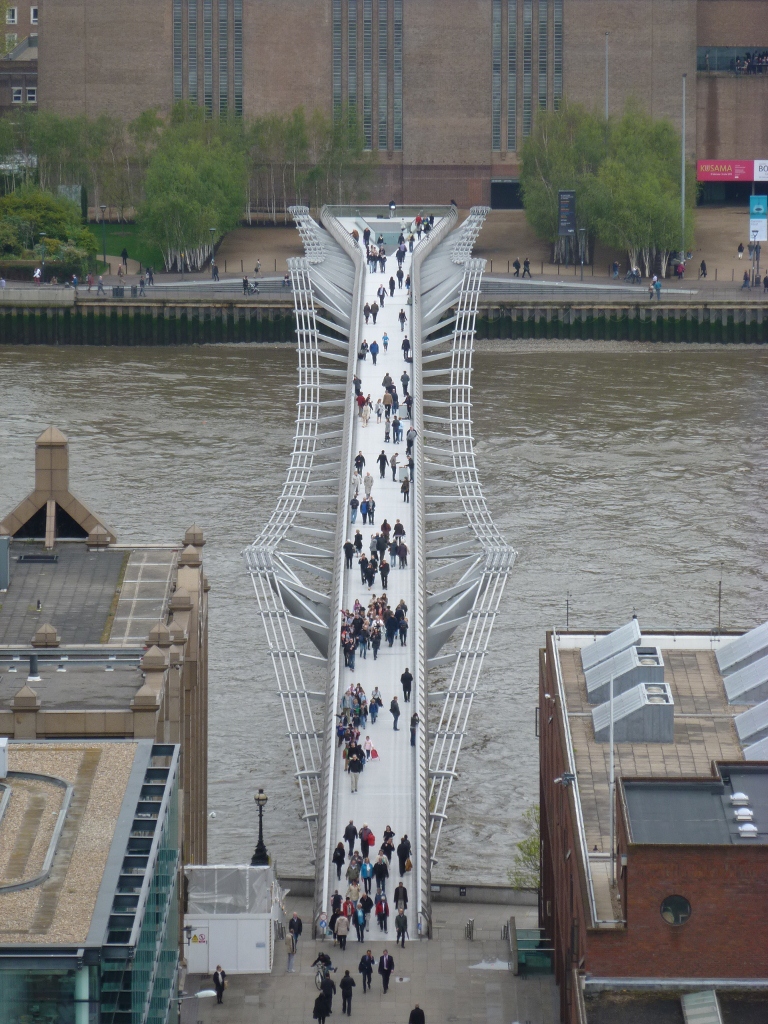
The Millennium Bridge is the first of two pedestrian bridges that cross the Thames.  The second, the Jubilee Bridge (click to see post), opened 3 years later in 2003.  While the Millennium Bridge is sadly only one color, I think it was probably the most photogenic bridge I walked in London.  Although I like the picture above less for the bridge and more for the buildings behind it, which show the city’s transition from a time when church steeples were the tallest thing around to today when that honor belongs to the skyscrapers.

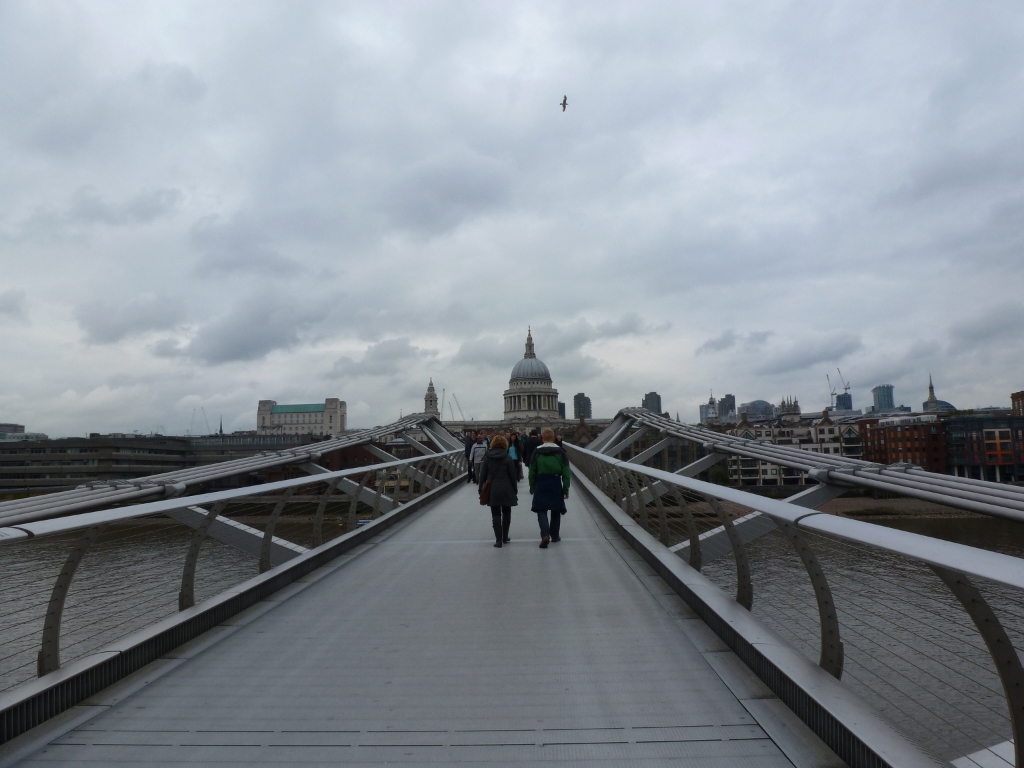
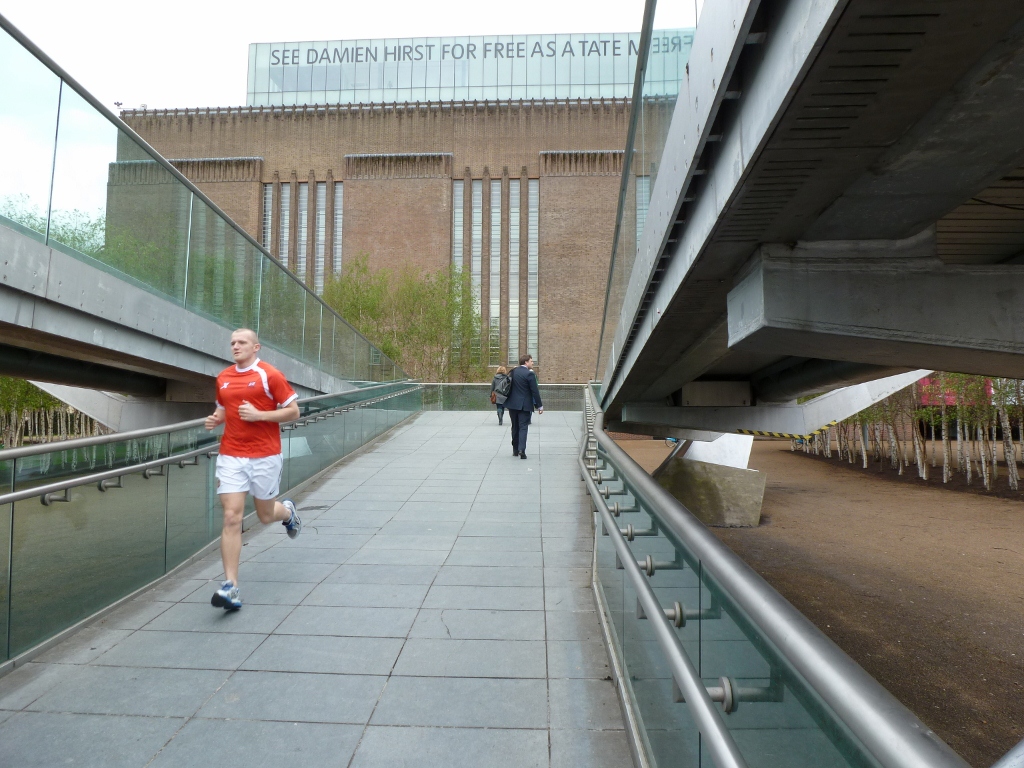
The location of the bridge was very good.  It leads directly to St. Paul’s Cathedral.  In some ways I am surprised that it wasn’t until 2000 that a bridge was built at this location.  (I picked up some souvenir maps while in London depicting the city in 1520, 1666, 1843 and 1902 and none have a bridge or even ferry boat at this location.)  On the other hand, the other side of the bridge connects to the Tate Modern, which didn’t open as the international modern and contemporary art museum until 2000.  Before then the site was a power plant from 1947 until 1981 when it became redundant and closed, remaining vacant until the Tate took it.

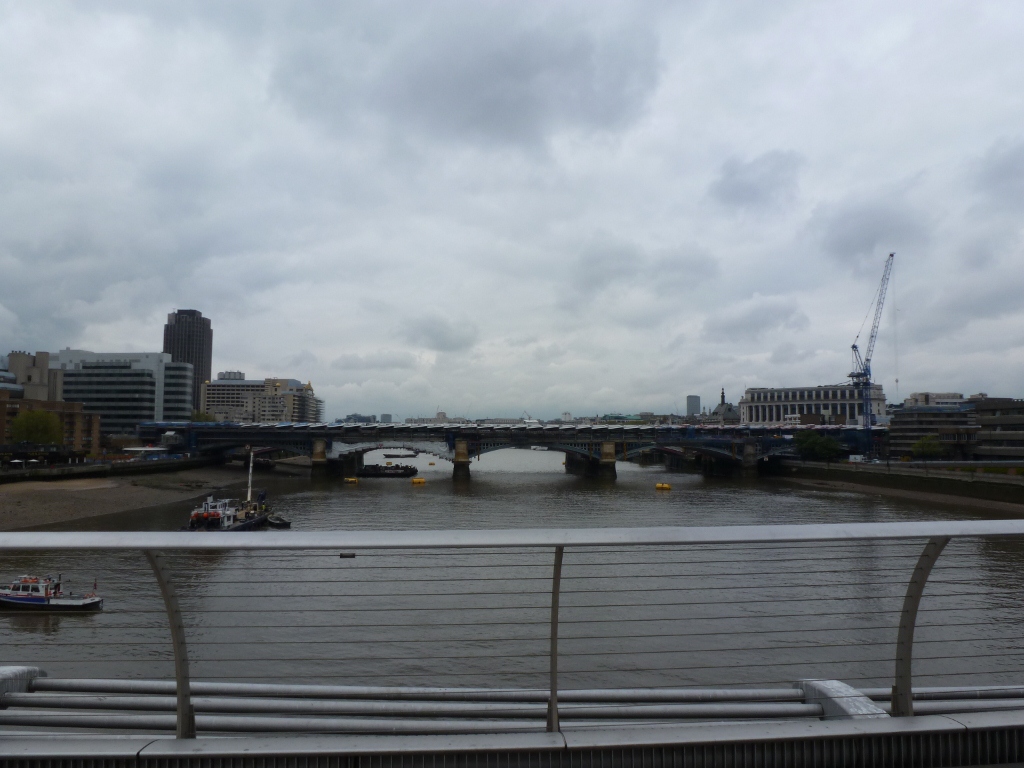
The views from the Millennium Bridge show two things of interest related to the other city bridges.  First, upriver is a view of the first rail station to span the Thames and the longest solar bridge in the world (see July 31 post).  Downriver, the Tower Bridge, which I believe is the most iconic London bridge, comes into view for the first time.

I started this post by claiming that the Millennium Bridge was the most photogenic of the London bridges.  The views of it above are pretty interesting, but the best shot was the one I took from the top of St. Paul’s Cathedral looking down.

16th Street Bridge-Developments


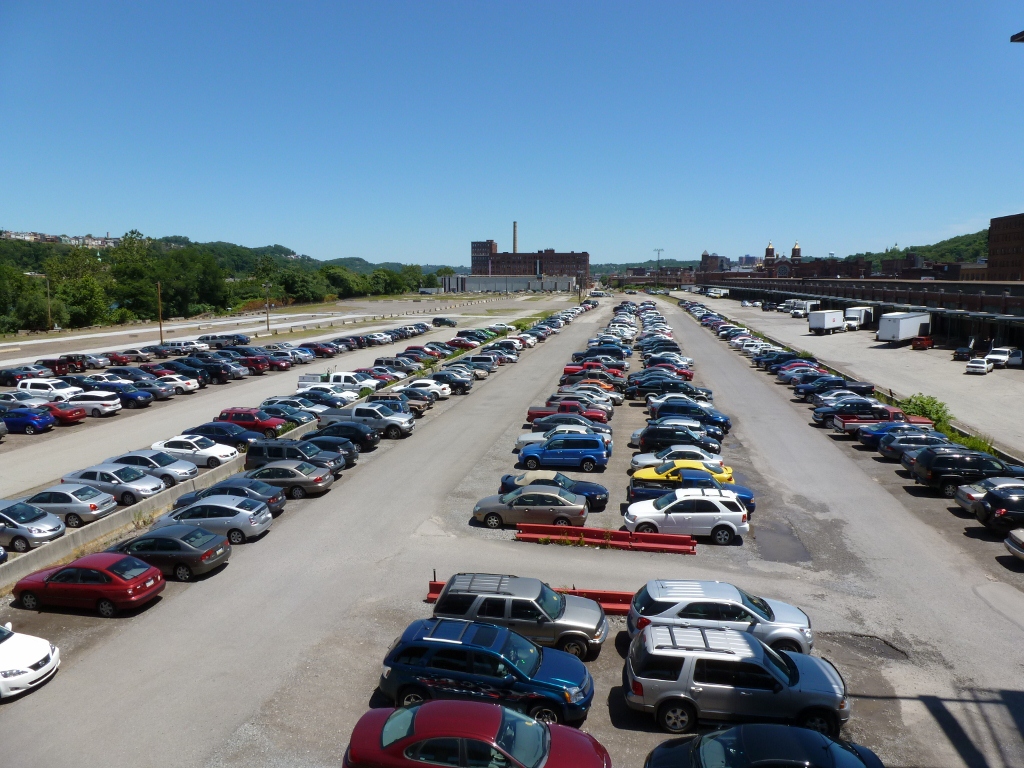
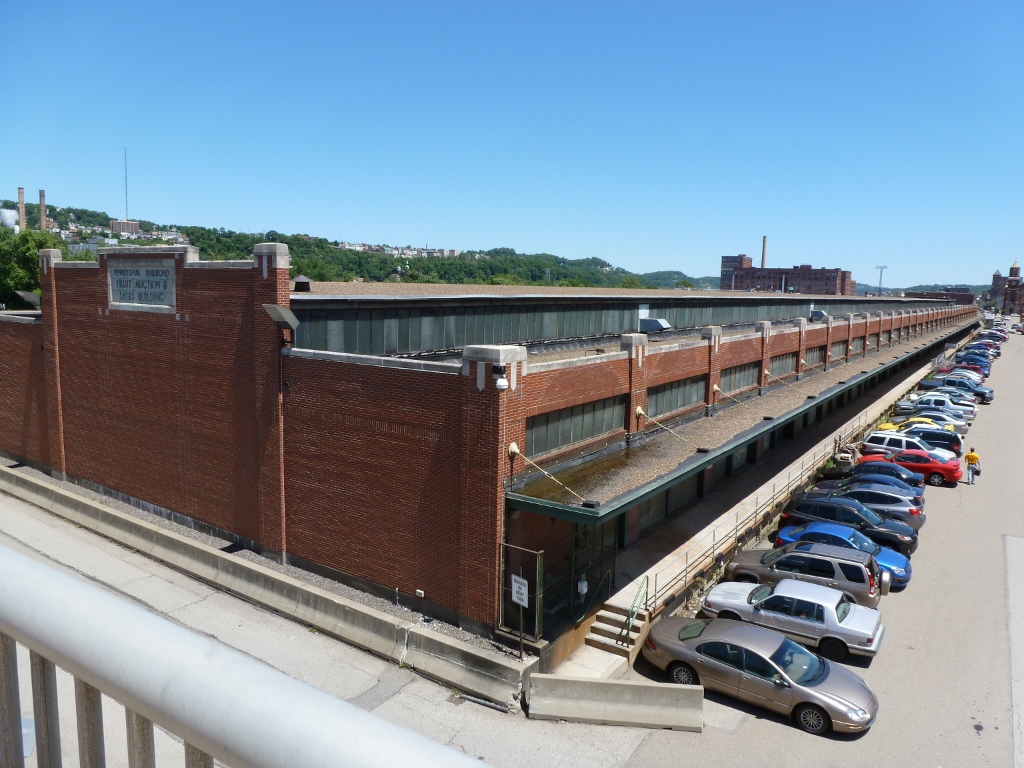
The southern end of the 16th Street Bridge soars over an area that is currently provoking controversy in the city.  It is a site where there are what feels like be miles of barren (although used) parking lots right up against the river on either side of the bridge.  It is a very un-pedestrian-friendly area and a very unattractive place.  Alongside these parking lots on one side of the bridge is the historically significant produce terminal building.  While a developer has put forward a plan to redevelop the area, connecting the existing Strip District to the Allegheny River and adding new mixed development in place of the parking lots, part of the plan requires a partial demolition of the produce terminal.  (A description of this intended development can be read in the article linked here.)

In the beginning of June, City Councilman Dowd began holding up funding for the project, saying he wanted more information about how the funding was to be used (see article).  Then about a week ago, two more councilmen voiced their wish for more information about the use of the funding as well as other aspects of the project such as how the community has been engaged (see article).  Another newspaper article from a few days ago, describes a lawsuit being filed about the property and the development.  This article explains, “The lawsuit alleges that the city is not following its own stormwater management program nor that of the federal Environmental Protection Agency in allowing the project.”

Based on what I’m learning in my internship this summer, this seems like the opposition against, or at least concerns, about the project are piling high enough to prevent the development from happening.  As I am not a fan of harsh, stark parking lots currently in place, it would be a shame for the project to fall through.  However, if the claims of the opposition are true, then it seems we need to find someone else to develop the site.  As awful as the parking lots are, their removal is not worth the price of poorly spent funds, no community engagement, and poor storm water management.  The last concern is the most significant given the fact that the city’s storm water management already causes problems.  (For more related to this issue seen my Heth’s Run Bridge post.)

Maps are Awesome!

While talking with someone recently, we discovered we shared a seemingly rare love of maps.  Maps are truly awesome and useful tools and not just for figuring out how to get from one place to another.  Maps provide insight into what a place looks like, giving clues about the layout and geography of a place you’ve never been.  Street names and other labels can hint at the history of the place.  Historical maps show what a place looked like in times past.

I have used maps several times to help me with writing my blog and there are many more times when I should have gone to a map first. As I mentioned in the first Heth’s Run Bridge post, the G.M. Hopkins maps on Historic Pittsburgh are probably my favorite resource for Pittsburgh.  Heth’s Run Bridge presented many puzzles that the maps helped me understand.  I realized yesterday that I probably should have gone to these maps first when wanting to figure out which bridge remnant I saw from the Fort Duquesne Bridge (see June 19’s post).  While writing that post, I did a search on the internet, but came up with nothing.  The G.M. Hopkins maps came to the rescue, although there are two possibilities for which bridge the remnant belonged to.  The first possibility I found on the 1900 map.  This one was called the Union Bridge.  By 1929, the Union Bridge was gone and another bridge connected the Point to the North Side.  This one was called Manchester Bridge.  This bridge was demolished in 1970, by which time the Fort Duquesne Bridge was built (see June 19th post).  I made a few other discoveries about Pittsburgh while looking at the 1929 map.  First, Penn and Liberty avenues used to come straight through to Water Road which ran along the northern shore of the Monongahela River.  Today these avenues stop much further inland.  The second major discovery was that Point Park already existed in 1929.  It was significantly smaller than it is today, but it is there.

Google Maps helped me with identify the buildings near Lambeth Bridge (see June 28th post) that I didn’t take the time to stop and investigate while I was walking the bridge.  Several of the buildings I was able to identify from labels that Google Maps conveniently placed on the map.  The Parliament View Apartments weren’t labeled, but using Google Maps’s other wonderful feature–Street View–I was able to find a sign on the building identifying it.

The image leading this post is of another highly convenient map.  On my recent trip to Cleveland, I arrived Downtown 2 hours before the person I was visiting finished work.  We arranged to meet at their place of work, but I was only familiar with two or three of the streets in downtown Cleveland, and the meeting place wasn’t on any of them.  I had just decided to use my skills of logic to find it (which would have been feasible in this case as one of the cross streets was a numbered street and the other was called Lakeside) when I came across this map on a street corner.  It turns out that these maps are posted regularly around downtown Cleveland, which I thought was very considerate of the city.  It made the city feel like it welcomed visitors with open arms, engaging them in being engaged in the city.  Even though I had a plan for finding where I was going without a map, I prefer being safe rather than sorry, so I took the easy way out and used the map to figure out where I was supposed to end up.  I also used it to plot out how I could spend the time I had until my friend got out of work to cross at least one of Cleveland’s bridges over the river Cuyahoga.  I ended up getting distracted from this goal, but that is a story for another day….(see July 9 post)….

Heth’s Run Bridge Part II

I have a few thoughts to add about Heth’s Run Bridge.  First is the map above which identifies the location of the Bridge compared to downtown.  Second is the bridge’s condition.  There recently has been a lot of buzz around town about the terrible condition of all the bridges in Pittsburgh and Allegheny County as well as many in the rest of Pennsylvania.  This gossip tends to give the impression that most of our bridges are ready to collapse at any moment.  Transportation for America’s website describes a report on deficient bridges, which is probably what fueled the gossip above, however the report presents a slightly more favorable picture.  While the Pittsburgh Metro area is identified as the metro area with the highest percentage of deficient bridges in the US, it turns out that only 30% of the bridges are deficient.  While I am unable to comment on the structural integrity of Heth’s Run Bridge or even if there is any need for it to be structural sound (I don’t think the ravine has been completely filled in under the bridge, but I can’t be sure), I can attest to the condition of the sidewalks.

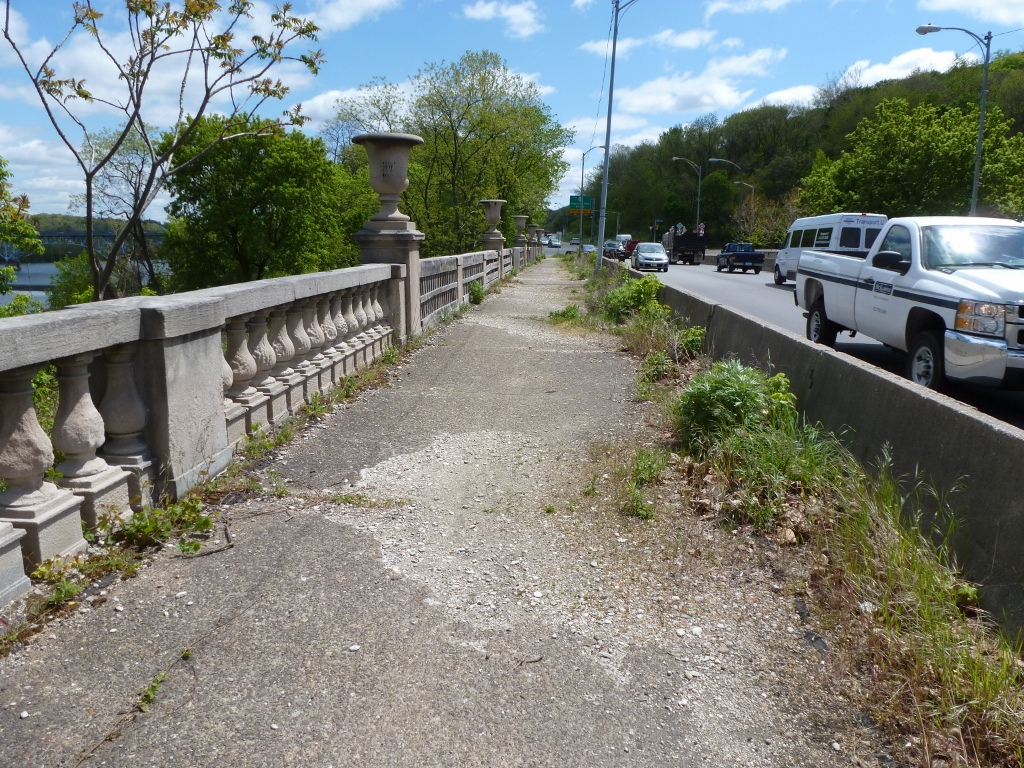
The sidewalk is quite wide, but as the image above shows, it is deteriorated with weeds growing however they please.  The sidewalk on the other side is in similar condition.  The first time I walked this bridge I could not understand why the sidewalk was so wide, particularly as on the other side, the sidewalk narrows considerably.  Across the bridge I’d guess the sidewalk is over 10 feet wide, but once across it is only a couple feet wide, with only about a foot of usable space due to dirt and overgrown weeds.  Clearly this is not an area that the city considers to have a high enough volume of foot traffic to warrant good sidewalk maintenance.  As there often is high vehicular traffic in this area, I say the city should make the sidewalks across the bridge much narrower so that they can add another car lane.  The riverside traffic has two lanes before the bridge and two lanes after, but narrows considerably to make room for a useless wide and deteriorating sidewalk.

In writing the first post on Heth’s Run Bridge (see May 31 post), I believe I discovered the reason for this unusually wide sidewalk that today essentially goes nowhere (at least nowhere that the average pedestrian would wish to go).  The 1911 map of the bridge and surrounding area shows that the bridge connected Butler Street and Washington Boulevard (today’s Allegheny River Blvd), both of which were lined with houses and other buildings.  There is even a school on Washington Boulevard.  As such it was probably only natural that when the current bridge was built in 1914 it would have large sidewalks to help facilitate the movement of people before the prevalence of the car between the houses, businesses, and schools that lined these roads.  Today all the buildings that lined Washington Boulevard at this point do not exist.  The land they once stood on is all wilderness and on the landward side of the road is incorporated into Highland Park.  The large, deteriorating sidewalk of Heth’s Run Bridge is the only reminder of a time when this area was probably busy and vibrant.

Heth’s Run Bridge

Heth’s Run Bridge as seen today presents many mysteries.  Digging into the mysteries uncovers a interesting story.  I have crossed Heth’s Run Bridge many times, usually in a car on the way to the Zoo, but it was only in recent years that I realized it was a bridge.  When looking toward the zoo parking lot from the bridge (as in the picture below) it does not appear that the height of the road differs enough from the surrounding landscape to be a bridge.  However, in the view above (taken from the Zebra Ice Station parking lot on the river side of the road) it looks like a bridge.  The G.M. Hopkins Maps, one of my all-time favorite resources available on the Historic Pittsburgh website, explains the history of and the reason for this bridge.

The 1899 map identifies a bridge in this location called High Bridge, indicating that there was a significant difference in elevation at this point.  A 1912 photograph shows that this was indeed a high bridge, quite unlike the current bridge and its surroundings.  This would have been caused by a small stream called Haight’s Run which flowed under the bridge into the Allegheny River.  By 1911, most of this stream was covered over and Haight’s Avenue ran along its path.  The 1939 map shows no evidence of Haight’s Run, the name on the road and the bridge is now Heth’s, and the road is marked “not open.”  Also in this map, the bridge appears to be a different width than in the others, this is because the current structure was built in 1914, more technical and historical information about the bridge can be found here.  1939 is the most recent year for the G.M. Hopkins Maps.  I speculate that the bridge would still have been raised over the surrounding landscape at that time, based on the similarities in the surroundings between the 1911 and 1939 maps.  However, sometime between then and now, Haight’s/Heth’s Run was filled in and the zoo parking lots built on top, level with the height of Heth’s Bridge.

If I had not passed this way on foot, I doubt that would have realized that this was in fact a bridge or that once not long ago (in geological terms) a stream flowed along this way.  There is a tendency in urban areas for nature to be ignored or in this case built over, which sometimes causes catastrophic results.  Not far from Heth’s Run is Negley Run, another stream that was buried under a road.  The burial of this stream likely contributed to the tragic flood on Washington Boulevard last summer that resulted in several deaths.  I look forward to the day when all our roads and sidewalks will be made of permeable material, allowing for more natural absorption of rain water and reducing flooding.