Caerphilly, Castles and Cheese

Caerphilly Castle

When I arrived in the UK last spring, I realized I had one major flaw in my trip: I hadn’t planned to visit any castles.  Cardiff has a castle in the center of town and my hotel was right across the street from it.  However, I visited this castle on my last trip and remembered much of it: the Roman wall in the basement, the ornate room in the clock tower, the nursery painted with scenes from fairy tales, and the view from the keep.  Looking for a new castle to visit, my guidebook recommended Caerphilly.

Caerphilly is a twenty minute train ride north of the center of Cardiff.  It is a small town and features a castle begun in 1268.  In addition, the guidebook noted that the town is noted for Caerphilly Cheese, a mild relative of cheddar cheese.  As I love cheese, especially cheddar, Caerphilly was an appealing destination to satiate my interest in castles and cheese.

So one morning, I went down to the Central Cardiff station, purchased an open, round-trip ticket to Caerphilly for just a few pounds and enjoyed the short train ride through the Welsh country-side.  Cardiff is very flat, but Caerphilly and the surrounding area are quite hilly.  The castle wasn’t visible from the train station, so I started walking in what seemed the most promising direction: downhill on the main commercial street.  After a short walk, the road made a bend and the shops stopped on one side, leaving a wide view over a green park to the castle and the valley and hills beyond.
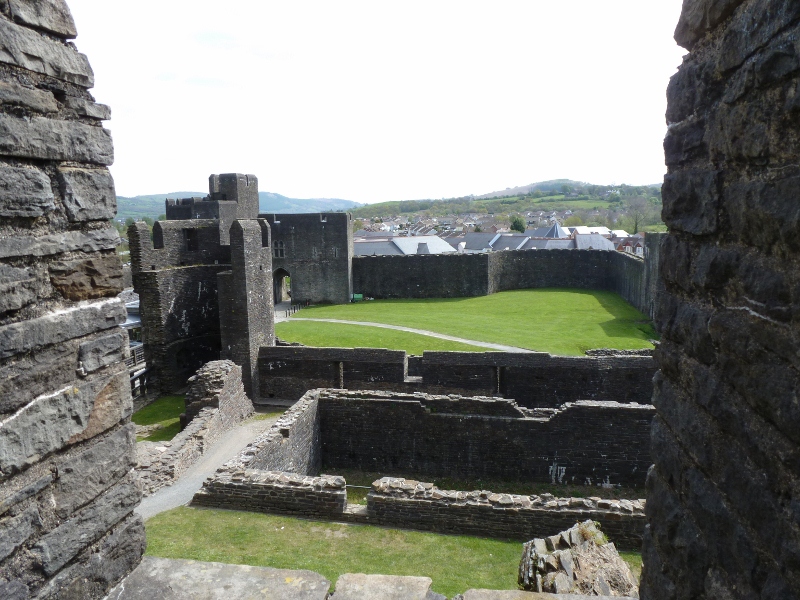
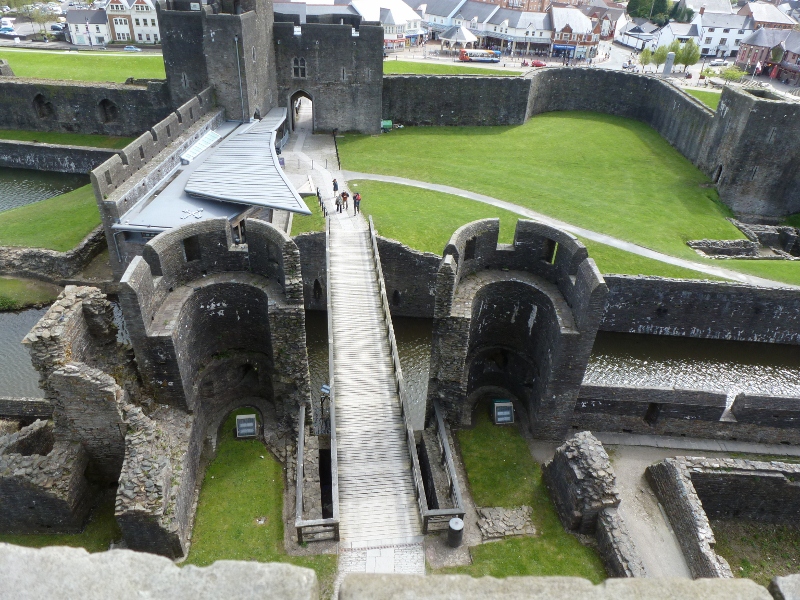
Views from the Castle's Keep Views from the Castle's Keep

Views from the Castle's Keep

A Welshman once told me that the only real castles are those in ruins.  Ones like Cardiff Castle that have been fixed-up, renovated, or refurbished in any way are not real.  I thought that he would have approved of Caerphilly Castle.

When I finished exploring every corner of the castle, I returned to the town looking for cheese and lunch.  There were no signs of Caerphilly Cheese anywhere.  There were lots of tourist-y areas and signs directing the way to tourist-like attractions, but none mentioned cheese.  Wikipedia claims that there is a cheese sculpture somewhere in town, but I didn’t see it.  I ended up choosing a quaint little diner (of the early 20th century style, not the 1950s/60s style we think of in the US) as the place to eat my lunch in the hopes that perhaps they used Caerphilly Cheese on their sandwiches, but they did not.

Feeling let down in my hunt for cheese, I returned to Cardiff shortly after my lunch.  Caerphilly’s castle was well worth the trip, but I was beginning to believe that Caerphilly Cheese was a myth.

….

Seven months later, my family and I were visiting New York City for Christmas.  On our last day, we made the requisite visit to Zabar’s.  I had been particularly looking forward to this stop on our trip as the last time I was in Zabar’s I was a kid who knew that there was something special about the shop, but didn’t understand why as I thought the height of culinary perfection was Kraft Mac’N’Cheese.

The first thing that caught my eye on entering Zabar’s was the cheese display.  I quickly went over and scanned the names of all the various cheeses, looking for the exotic one that I was going to take home to try.  Most had names that sounded familiar.  On my second look through, my heart stopped.  There on the shelf right in front of me was Caerphilly Cheese!!

I was shocked.  I had gone to Caerphilly to get their cheese and been disappointed.  Now, months later on the other side of the ocean, in a small store in NYC, I’d found it.  Needless to say, I purchased a brick.  It was a nice cheese, almost like a cross between a mozzarella and a mild cheddar: smooth, almost creamy, with a slight hint of the cheddar kick.
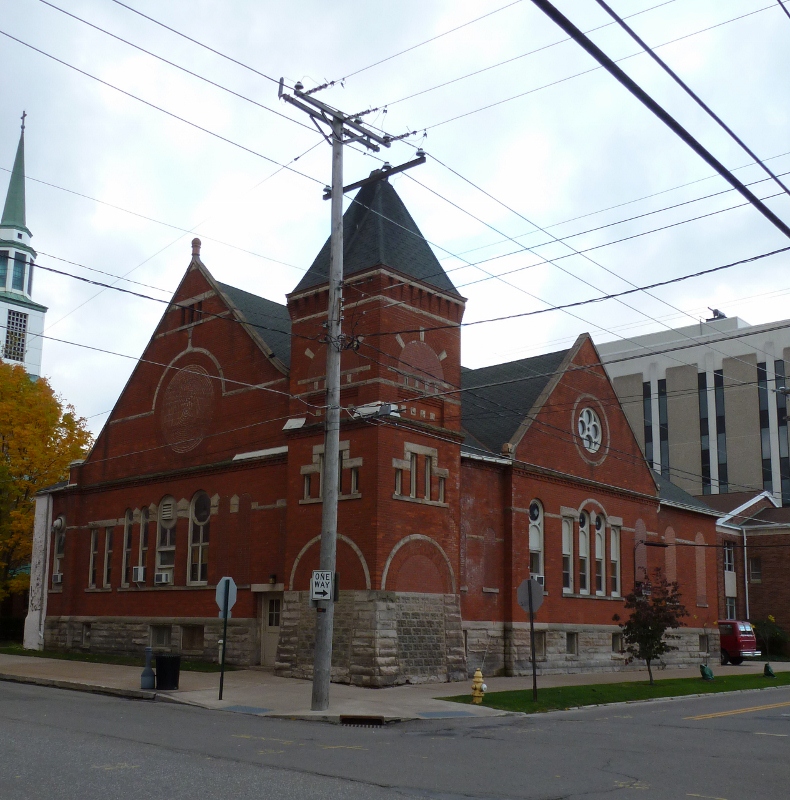
Erie Churches

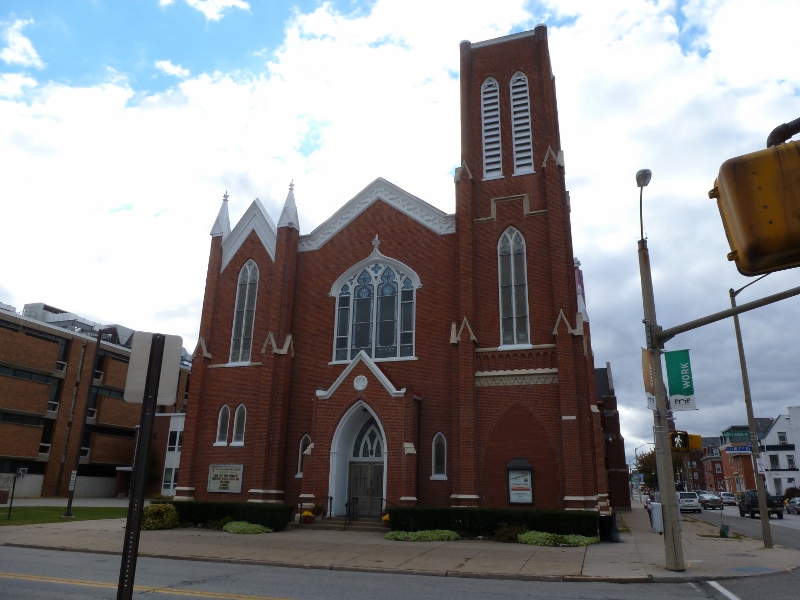
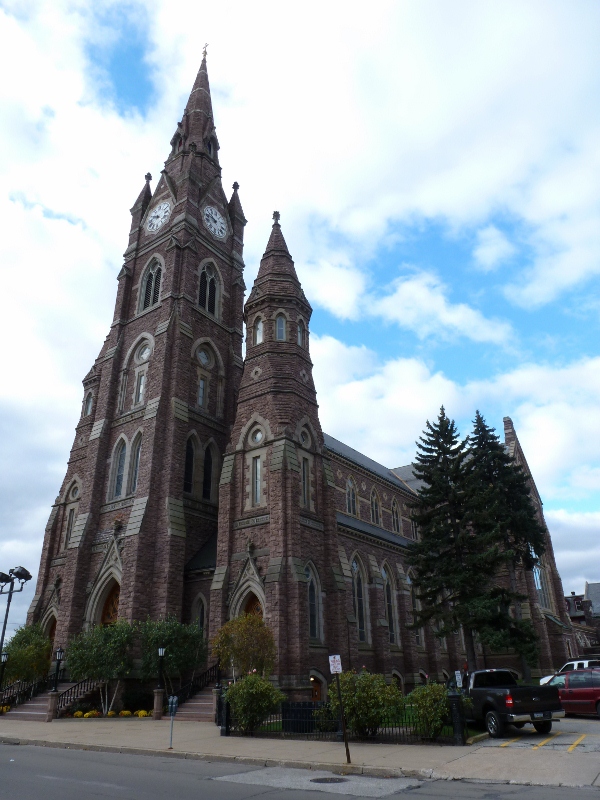
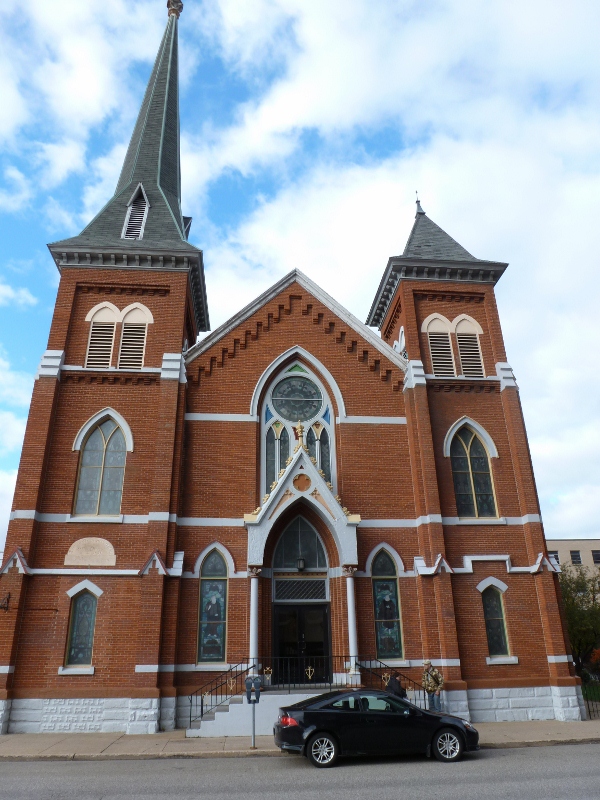
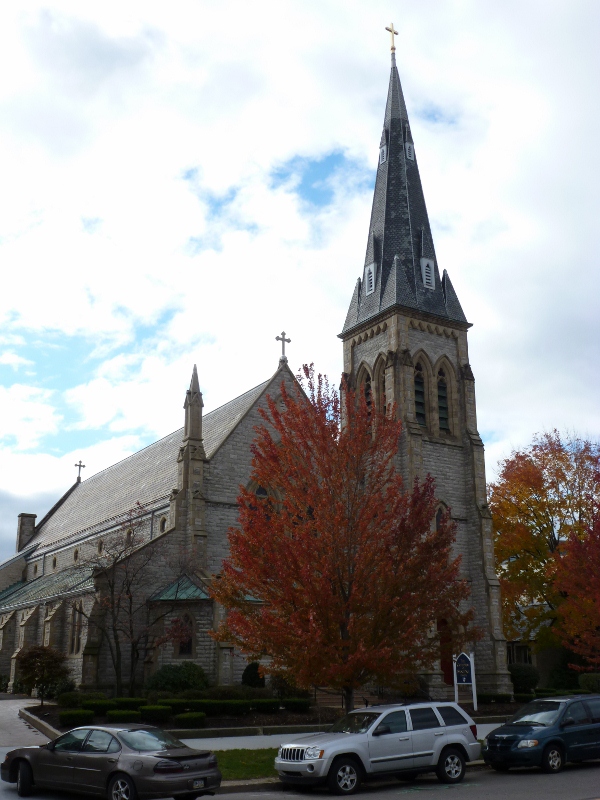
Erie has a variety of attractive church buildings.  As I walked around admiring them, I was surprised to see that they were all still used as churches.  I did not find a single adaptively reused church building.  Given Erie’s location, relatively close to Cleveland, Buffalo, and Pittsburgh, I assumed it had similar significant population loss creating a need to either abandon, demolish or adapt some church buildings.  It turns out, that at least on the county level, this assumption was false.  Since 1900, the population of Erie County has grown every decade, except from 1980 to 1990 when there was a slight (1.5%) population loss, from 98,509 to 280,843 (2000’s population).  Allegheny County (Pittsburgh’s county), on the other hand saw growth from 775,058 in 1900 to 1,628,587 in 1960 after which the population has declined steadily to 1,223,348 in 2010.

I could not find statistics for the population change of the city of Erie; it is possible that there was a different trend within the city.  There were signs of abandonment and decay in other buildings and aspects of the town.  Yet the churches are still intact and appear to be thriving.  In fact, one of the larger churches was undergoing a major renovation while I was there.

Whatever the reason for the churches’ continued use, I enjoyed my treasure hunt chasing down as many steeples as I could in two hours:

Unknown

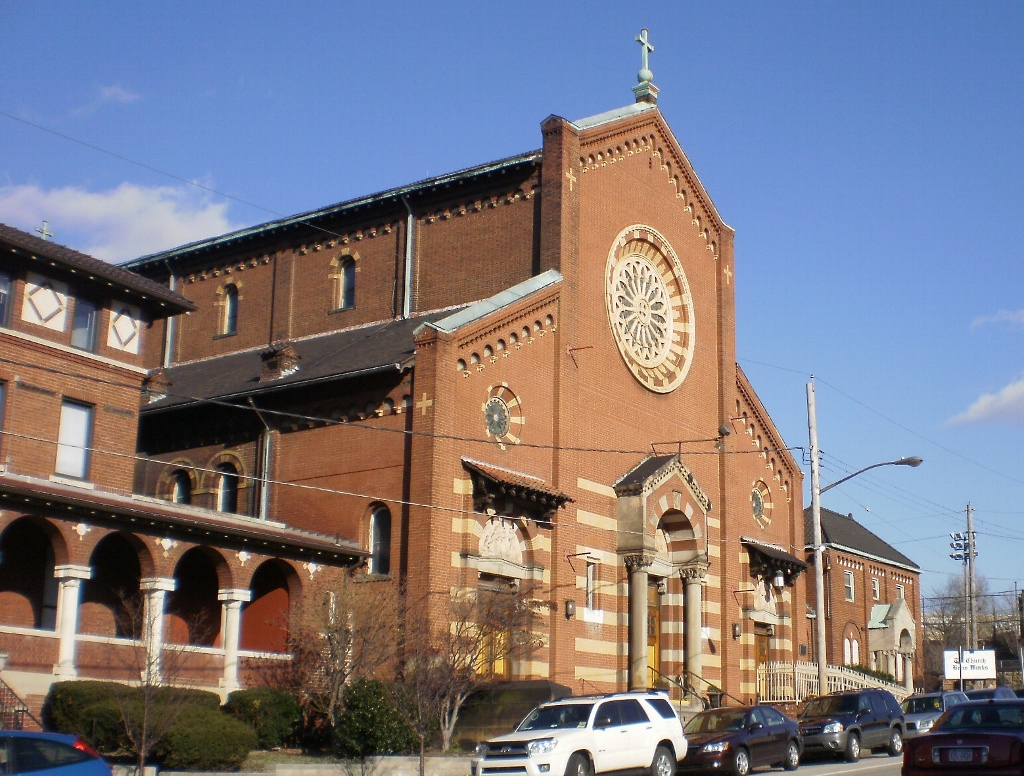
St. Patrick's Church 1903

Russian Old Believers Church of the Holy Trinity 1984

Russian Orthodox Church of the Nativity of Christ (Old Rite) 1987

Unknown

St. Peter Cathedral 1872

Cathedral School

St. Paul's United Church of Christ

Unknown

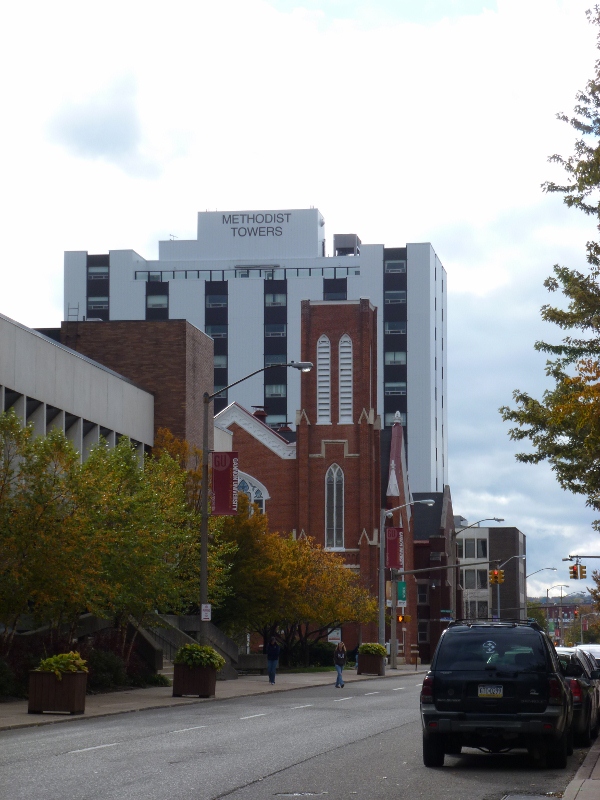
Methodist Church

First United Presbyterian Church of the Covenant 1929

The Union Project: Engaging Community

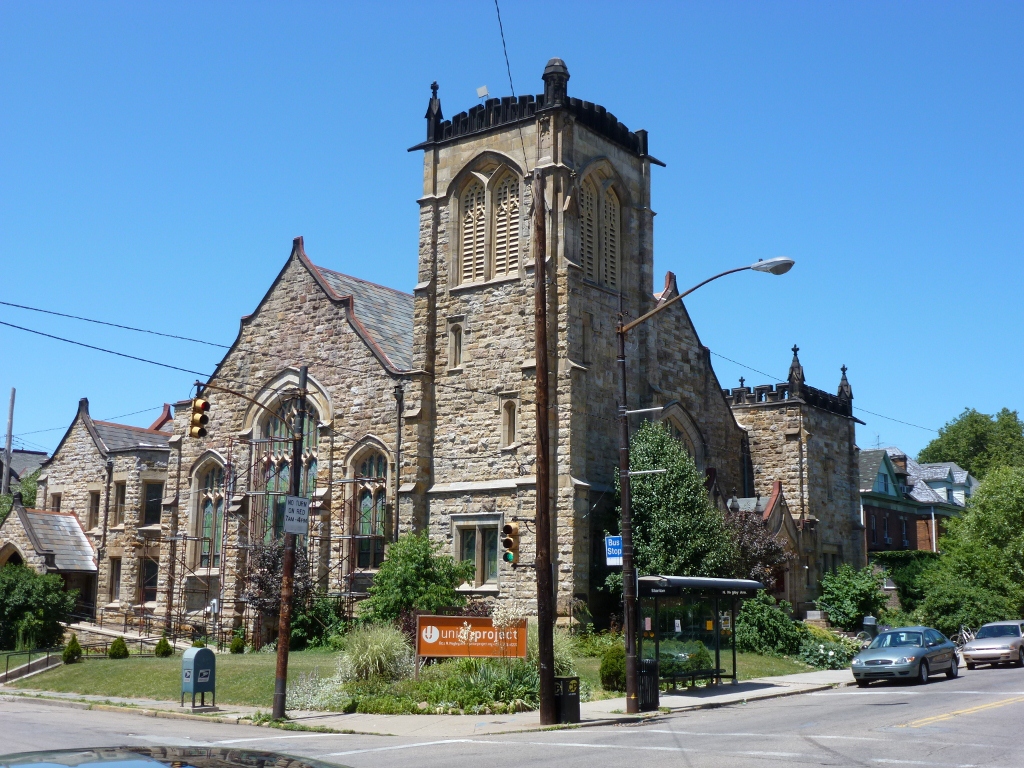
The Union Project

Every adapted church building I’ve come across has something that makes it unique.  Of all the ones I’ve come across so far, the Union Project used the most creative method in restoring/adapting the building.

In the late 1990s, a small group of people came together and said that they wanted a “space for art and faith” in their neighborhood.  (The quotes in this post are from one of the founding members, who I interviewed for a school project.)  By 2001, this group and this sentiment had grown and they purchased the vacant, former Union Baptist Church at the intersection of Negley and Stanton Avenues, two major roads in the East End of Pittsburgh, to convert it into a community center.

When the community center acquired it, the church was still considered active, but it had not been used regularly for two to four years.  The building was in very poor condition: the roof leaked, there were broken windows, and pigeons and rodents lived inside.  It took four years to prepare the building for occupancy and an additional six years to completely restore the structure.

The part that I like the most about how this building was adapted, was the alternative method they came up with for restoring the stained glass windows of the structure.  All the windows needed restoration, which I’m sure would have added up to a colossal expense.  Instead of giving up or attempting to raise all the funds to pay for a professional restoration, they offered community classes in stained glass restoration using the church’s windows as the class materials.  Some of the windows needed to be completely reconstructed in which case the instructor, a stained glass professional, created the new windows.  Beside these, all the windows were restored by community members at the classes.

Stain Glass Restoration

Stain Glass Restoration

I took one of the classes a few summers ago.  It was a lot of fun and quite interesting to learn how stained glass windows are put together.  At least a couple of the people in my class were taking the course so they would be able to restore the stained glass windows in their homes.  Much of the housing stock in the neighborhoods surrounding the building feature at least one stained glass window, so this was a useful skill for the local homeowners to learn.  A 2012 article in the Post-Gazette announces the completion of this restoration project.

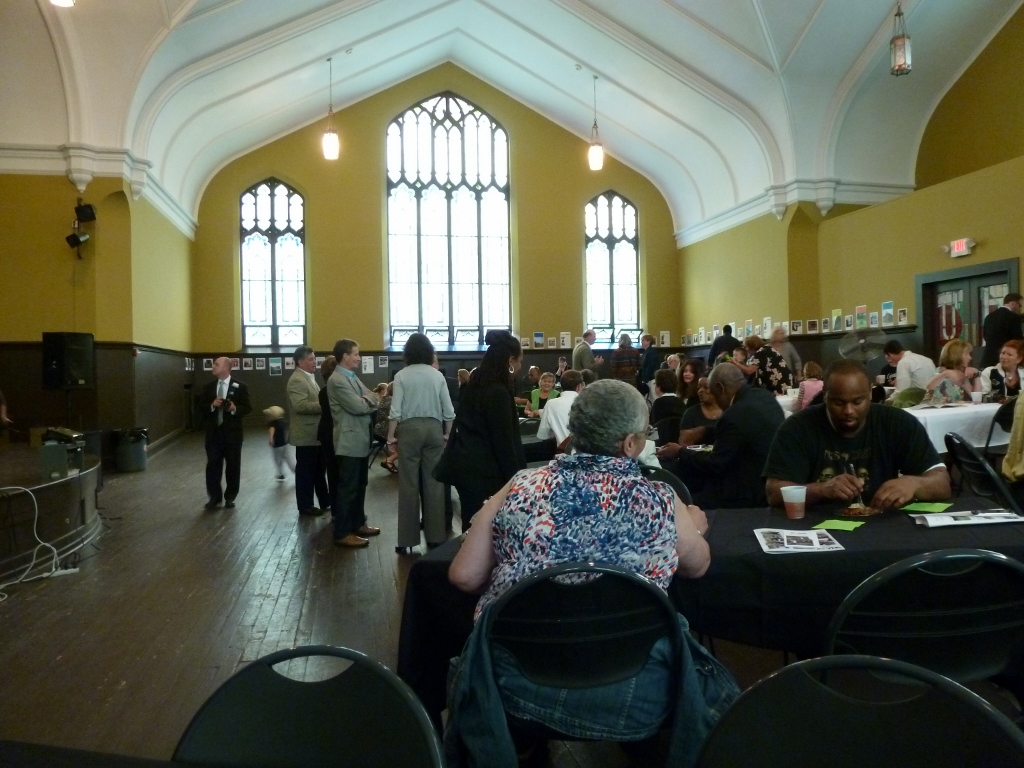
Over the years since the Union Project began, the building has slowly been restored one piece at a time.  The former classrooms behind the sanctuary were restored first and converted into office space.  Several of these offices are used for the administration of the Union Project, while the rest are rented out to other community groups including a church group.  The basement was converted into an art space.  This is where the stained glass restoration classes were held.  There is also a pottery studio which offers classes.  Hula-hooping classes are held in the atrium, or out on the lawn in nice weather.  The sanctuary is used as a rental hall for receptions, community events and the like.  The narthex is a little coffee shop.

Restored Sanctuary

By the summer 2012, the building finally looked like a completed project: the stained glass windows were restored, the sanctuary was finally completely repainted, and the black soot was cleaned off the stone façade.  Because of Pittsburgh’s past as a major industrial city, all stone façade buildings collected black soot–many of these buildings have been cleaned in the last ten to twenty years.  In cleaning the soot off the Union Project, the crenellations on top of the towers were left black, leaving a respectful reminder of the past, while the change from a black building to white brightened up this corner of the neighborhood.

This is a project that showed me, and the group who completed it, that “anything is possible.”

Church Brew Works

Church Brew Works

January 8, 2013, has been declared by City Council as Church Brew Works Day in the city of Pittsburgh to recognize the work of the restaurant’s founder/president, head brewer, and staff.  Council’s proclamation highlights the success of this group in adapting a vacant church “into a premiere, nationally recognized craft brewery, neighborhood fixture, and regional asset.”

The Church Brew Works is probably the most infamous of Pittsburgh’s adaptively reused churches.  Its notoriety stems from the fact that the brew house is located in the former altar.  A friend of mine told me that this positioning bothers her and if she eats at the Church Brew Works, she has to sit with her back to the altar.  I have heard that other people consider it sacrilegious to have the brew house on the former altar area and that these people refuse to patronize the restaurant.

This building was formerly an Eastern European Catholic Church and was purchased in 1996 to be converted into a restaurant and brewery.  I interviewed the founder/president for a paper on adaptively reused church buildings in Pittsburgh.  He explained that the idea for the restaurant started in 1994.  The first building selected for the project was an old fire hall two blocks away from the church.  The church was chosen in the end because of the availability of parking and the “great architecture.”  It was also easily accessible by car, which he felt was important for the success of the restaurant as Pittsburgh “lacks good public transit.”  Five months after the purchase was completed, the restaurant opened.

The church had been empty for two years by the time it was purchased in 1996.  The school attached to the church had been closed for twenty-five years.  The president felt that this added to the decrease in the congregation.  The closing of the mills drove church members away to search for new jobs while the closing of the school drove them away to find a new school for their children.  As a result of these pressures, the congregation dropped from 2000 to 200 parishioners.  When acquired for the restaurant, the church was “worn out” from a lack of reinvestment over the years and there was additional damage as a result of being completely closed for two years.  While the initial renovations of the building were completed in five months, paving the parking lot and completing the patio took longer.  Fifteen years later, work is still being done because of the “age of the building.”

Church Brew Works Sign

Much of the original building was reused or adapted in the conversion from a church to a restaurant.  The history section of the restaurant’s website explains how the pews were reused as benches for the tables and the bricks from the confessional that was taken down were used to create the pillars for the restaurant’s sign outside.  The original floor and lanterns were restored.  The result is a beautiful and unique interior for this restaurant.  To see what the interior looks like, check out the website or stop by for a meal.  I’ve enjoyed the food the few times I’ve eaten here.

Sandwich Shops

While in London last spring, I discovered a sandwich shop chain that I fell absolutely in love with: Pret a Manger.  I ended up eating lunch most days at one of their many locations around the city.  The food was great.  They had sandwiches on small baguettes, in wraps, and between two “normal” square slices of bread (which have been cut into triangles, as everyone knows triangle sandwiches taste better).  The flavors of sandwiches included ham and cheese, egg salad, and brie, tomato and basil.  The ingredients were fresh and real–meaning ham of the bone, not sliced deli ham, and arugula instead of shredded, nondescript “lettuce.”  And then the sides to go with the sandwich were interesting, exciting, and tasty.  The chip flavors I remember were “cheddar and red onion” and “sea salt and apple cider vinegar.”  Both delicious!  I was also attracted to the Pret sodas (I normally skip the soda options at restaurants).  I enjoyed the Grape & Elderflower, Apple, and Ginger Beer sodas.

Pret was the first place I had lunch in London and from the first bite, I couldn’t wait to come back and try another flavor of their sandwiches, chips, and drinks.  On my third day in London, I was ready for lunch, but could not find a Pret anywhere near where I was, so I went to another sandwich chain that I had been seeing around.  The style of this other place, the name of which I forget, was similar to Pret, but the taste was no comparison.  After trying this other place, I made sure that I was near a Pret at lunchtime for the remainder of my trip.

Besides the taste, I also enjoyed the convenience of the chain.  All the sandwiches are premade, so all you have to do is grab-and-go.  You don’t have a clerk staring you down while you decide what flavor you want today and you don’t have to wait for it to be made once you’ve made the decision.  All of which suits my personality better.

I cannot think of a sandwich shop in the US that has premade sandwiches.  It seems to me that one of the things the Subways, Quiznos, and the others are after with the don’t make it until it’s order deal is to prove that their food is fresh.  Blimpie’s for example doesn’t even slice the meat and cheese until you’ve put your order in.  Despite being premade, the sandwiches at Pret always tasted fresh and satisfying because they were made with solid food such as dense, but small bread, and chunks of chicken meat.  The chain’s website explains the secret: “Pret opened in London in 1986. College friends, Sinclair and Julian, made proper sandwiches avoiding the obscure chemicals, additives and preservatives common to so much of the ‘prepared’ and ‘fast’ food on the market today….They created the sort of food they craved but couldn’t find anywhere else.”  “Our partners drop off the very best ingredients to our shops everyday. We don’t mind that good, natural food goes off quickly. We don’t keep our sandwiches, baguettes and wraps overnight.”

One of my biggest disappointments on returning home was that I might never get another Pret sandwich (unless they’re still there the next time I’m in London) and instead the only options for buying sandwiches out would be places like Subway and Quiznos.  It was quite devastating.  Like the partners who started the Pret chain, I was going to be craving fresh, “proper” food, but unable to find it anywhere….

But then, I went to New York City for Christmas.  Walking around the first night there, I was thrilled to spot not one, but two Prets.  Needless to say, I went there every opportunity I got.  The options were somewhat different, particularly the chips–there were only boring, regular American flavors and styles to choose from (though they still weren’t national brands like Lays)–but the food was still good.  The egg salad wrap was melt-in-your-mouth delicious.  The roast beef, arugula, mustard-mayo and chicken, bacon, mayo baguettes were also yummy.  They also had the Pret Ginger Beer Soda, which tasted as yummy as the Ginger Beer I had in London, both Pret and non-Pret.  I’ve found Ginger Beer in Pittsburgh, but it’s just not the same.

It turns out that Pret a Manger has set up locations in New York, Boston, Chicago, and Washington, D.C.  As Chicago is one of the next US Cities I hope to visit, I know I will be getting another Pret sandwich soon.  I wonder though, if the large, diverse populations of these cities are necessary for a place like Pret a Manger to be successful.  Is it possible for a truly fresh sandwich shop to succeed (and set up multiple branches) in a smaller, less diverse city like Pittsburgh?

Isolated Waterfronts

In October 2012, I spent a few days in Erie, PA, to attend a conference.  Before arriving, I had looked at the map to figure out how to get from the bus station to my accommodations to the convention center.  On the map it looked pretty straight forward and simple.  All the places I had to get were within a mile of each other—piece of cake.  I often walk that far just to get to a bus in Pittsburgh.  Shortly after arriving in Erie, I realized that purely considering distance does not capture the true picture.  The seemingly short mile-long paths that I had to take included significant geographical and man-made barriers.

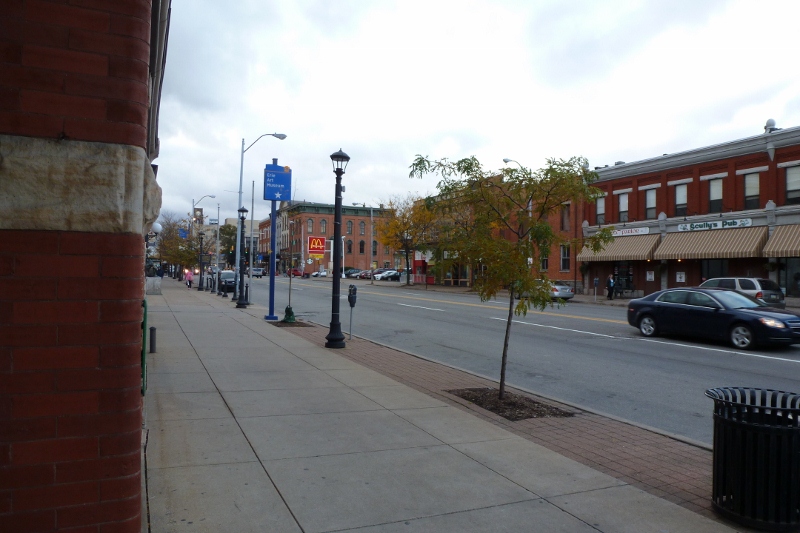
The main drag ran up through the town and straight out to the waterfront ending at the convention center hotel.  From the town square (6th Street), most of the buildings are flush with the sidewalk, except for the parking-lot-centric McDonald’s in the middle of these older buildings.  At 3rd Street, this changes.  The next two blocks are dominated by the campus of a UPMC hospital.  Then the barriers come.

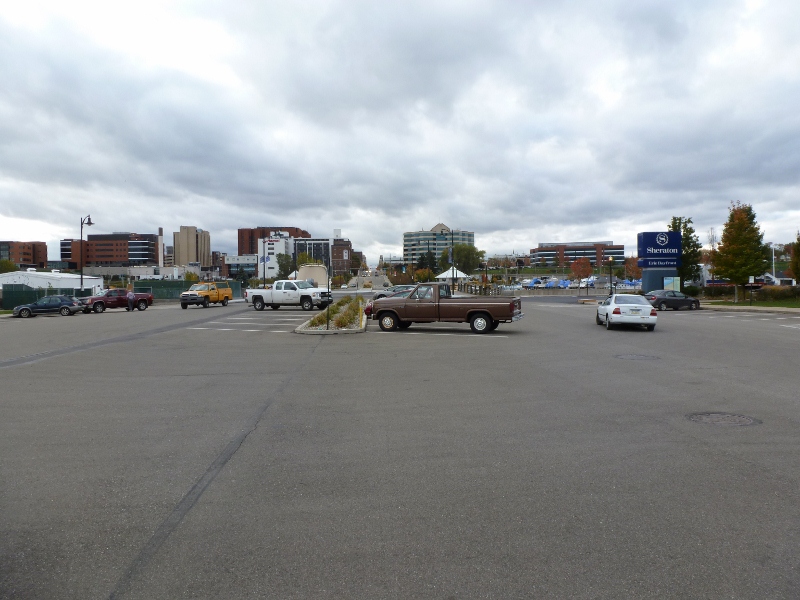
First there is a small hill down toward the waterfront, then a wide parkway, followed by a barren strip of land on one side of the road and a marina on the other.  Finally, there is the convention center hotel.  Of course you have to pass the long parking garage, the lobby and rooms of the hotel, go up an elevator across a pedestrian bridge over the entrance to the marina, and down another elevator before you get to the convention center.

I was staying in a Bed and Breakfast near the town square, so several times a day I walked back and forth along this route to attend the conference events.  Even though the walk was only about a mile long, it seemed to take forever because of the barriers of the hill, road, vacant land, and water.  After going back and forth a few times, I realized that the set up was not much different from what I had seen in Cleveland this summer.  That city also has a major roadway cutting off the town from the shores of Lake Erie.  This road of course was much bigger than the one in Erie as the city is correspondingly bigger.

Despite the fact that there is a major freeway dividing the waterfront from downtown Cleveland, I still felt welcome to cross this barrier to reach the waterfront park or the Rock ‘n’ Roll Hall of Fame.  In Erie, I got a very clear impression that the downtown residents were not welcome to cross the barriers to get to the convention center/hotel or the little public jetty next to it and that the visitors at the hotel/conference center were not encouraged to explore into downtown Erie.  This situation seems to defeat part of the purpose of convention centers to bring economic benefits to the surrounding area, by bringing in more people to use local services.

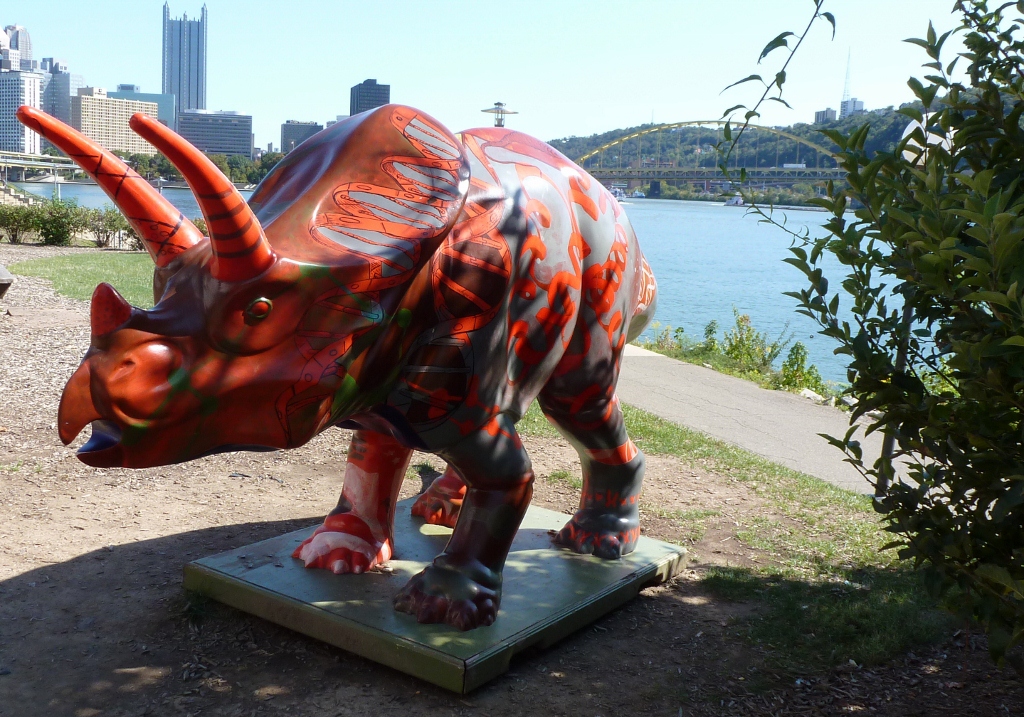
Science Dino – Pittsburgh DinoMite Parade 1

While walking the Three Rivers Trail System on my way to the West End Bridge (post to come), I found a dinosaur that I had not seen before.  As I mentioned in my Cleveland Guitar post, Pittsburgh has dinosaurs like this spread out across the city.  It has been another idea of mine to try and find them all, but for now I’m just stumbling upon them on my other explorations of the city.  Like most of the dinosaurs I’ve come across, this one is appropriately located.  The science theme of the dinosaur’s design fits with its location next to the Carnegie Science Center.

10th Street Bridge

The 10th Street Bridge (which a reader pointed out is nicknamed the Phillip Murray Bridge after the first president of the United Steelworkers of America) was the last of the bridges over the Monongahela River for me to walk.  Or so I thought.  It turns out that the Liberty Bridge also has a sidewalk despite the fact that it is a freeway bridge like the Veteran’s Bridge (see post).  So I’ll have to come back to the Liberty Bridge at some point.

I delayed my walk of the 10th Street Bridge in part because it seemed like an awkward one to get to and from.  One end is in the middle of the South Side, but the other connects to the Armstrong Tunnel, which would obviously not be pedestrian friendly.  Last week, I finally went out and walked it and as I hoped, it turns out there is a pedestrian access over the hill to the high-bus-traffic corridor of Fifth and Forbes avenues in the form of a giant staircase that I will address in another post.  This end of the 10th Street Bridge was more well-connected than I had anticipated.  Not only do the stairs provide access to the top of the hill when Duquesne University sits, but there is also access to a parking lot down by the river which also connects to the Three Rivers Trail System.  The best proof of this bridge’s connectivity is the number of other pedestrians I saw walking the bridge.  While I did not keep a count, I noticed that there was a comparatively high level of pedestrian traffic.  It certainly wasn’t as much as the Smithfield Street Bridge (see post), but it was comparable to or higher than that on the other downtown bridges.

My favorite part about this bridge was the dinosaurs painted at the top of the southern tower.  I couldn’t tell if they were official or freelance graffiti, but it seemed appropriate given that Pittsburgh is famous for dinosaurs.  Andrew Carnegie brought the first dinosaur skeletons on display anywhere in the world to his natural history museum.  I found someone else wrote a post about the dinosaurs on the bridge, which the artist apparently calls geese, which suggests that the painting may not have been officially sanctioned.

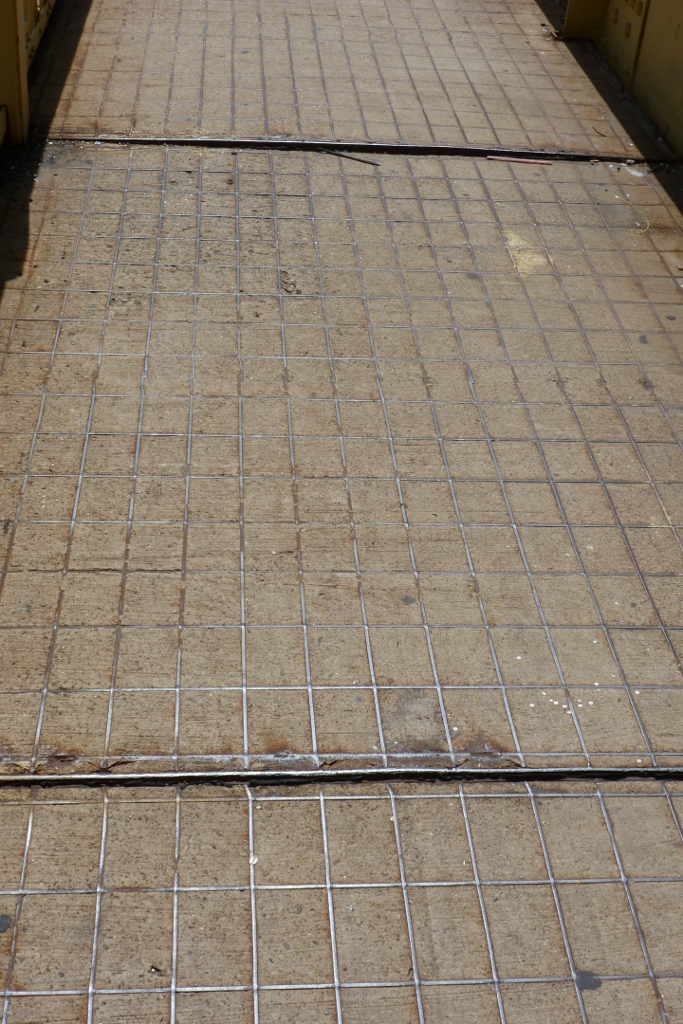
The post mentioned above about the dinosaurs also comments on the “rusty” condition of the bridge.  While I didn’t notice the rust much (it wasn’t nearly as bad as the 28th Street Bridge), I did notice the condition of the sidewalk.  I thought my theory that the top of the sidewalk had worn away to expose the metal framework supporting the structure rather farfetched, as how could the entire sidewalk (on both sides as far as I could tell) wear out so evenly.  Yet, I cannot think of any other sidewalk I’ve walked that looks like this and given the other bloggers comments on the poor physical condition of the bridge, perhaps my idea isn’t totally crazy?

Adaptively Rebuilt Church

The Spire House is perhaps my favorite of all the adaptively reused churches I found in London.  Originally built as Christ Church Lancaster Gate in the 1850s and 1860s, the building has since been adapted to housing.  As I walked around the building, I thought it might have been one of the ones damaged during the war, but according to a website about the building most of the structure was demolished in the 1970s because of decay and fungus.

The reason why I liked this building was that despite the fact that most of it was demolished, part of it was saved and the rebuilt structure recalls the former design.  I particularly liked the “flying buttresses.”

I agree that there are times when a building can no longer function well, in this case because of decay and fungus, but buildings tell a lot about a society and its history and when they are demolished something gets lost.  The Spire House found a compromise between these two and it tells a lot about the city.  From the way this building was designed, it is apparent that this society is moving forward and changing, but still respects its past and its religion.  There other signs of this throughout the city, such as the church tower in the middle of a road.

Adaptive Reuse of Churches: London

When I started planning on going to London this year, my first idea was to go for a month or so to study the adaptive reuse of churches in that city.  I thought London would be a good place to see a wide variety of adaptions as the UK has been working with the problem of redundant churches for about a hundred years.  As I was pursuing this idea I found a book from 1977 which addresses this problem across Great Britain.  (I have not come across any book publications on the adaptive reuse of church buildings in the US.)  This book “Chapels and Churches: Who Cares?” includes a discussion of what had been done up until that point in time in the adaptive reuse of church buildings.  I compiled a list of 76 different uses that these buildings have been adapted to from the book.  In my observations in the Pittsburgh area, I have seen less than ten types of new use for church buildings with housing being the most common.

There was one factor about the church buildings in London that I found fascinating, perhaps in part because it is not a factor in Pittsburgh, or any US city for that matter.  Many churches sustained damage during WWII and The Blitz.  The churches damaged during the war were demolished, rebuilt, adaptively reused, or memorialized, resulting in some unique (at least to me) situations.

I ended up not going to London to complete a research project on the adaptive reuse of church buildings, but instead went to the city for a few days and explored as much of the city as I could in that time.  This included looking for a few of the adaptively reused churches I had learned about in my preliminary research.  In the process of looking for the ones I knew about and simply walking around the city, I found some other adaptively reused churches.