16th Street Bridge-Developments


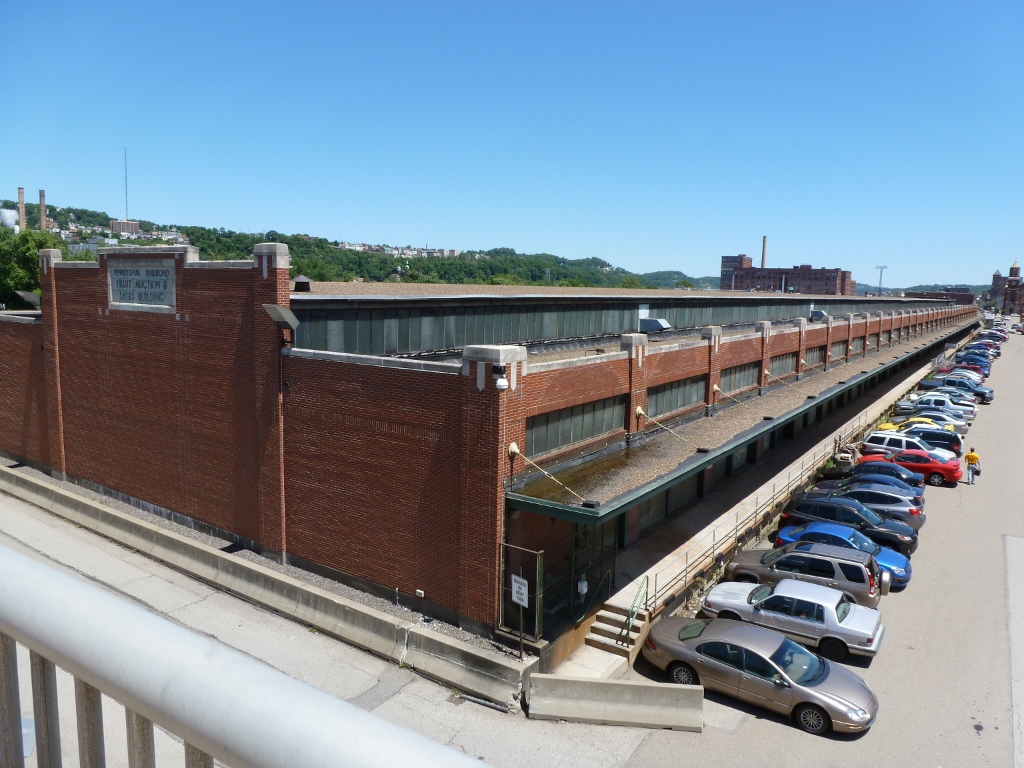
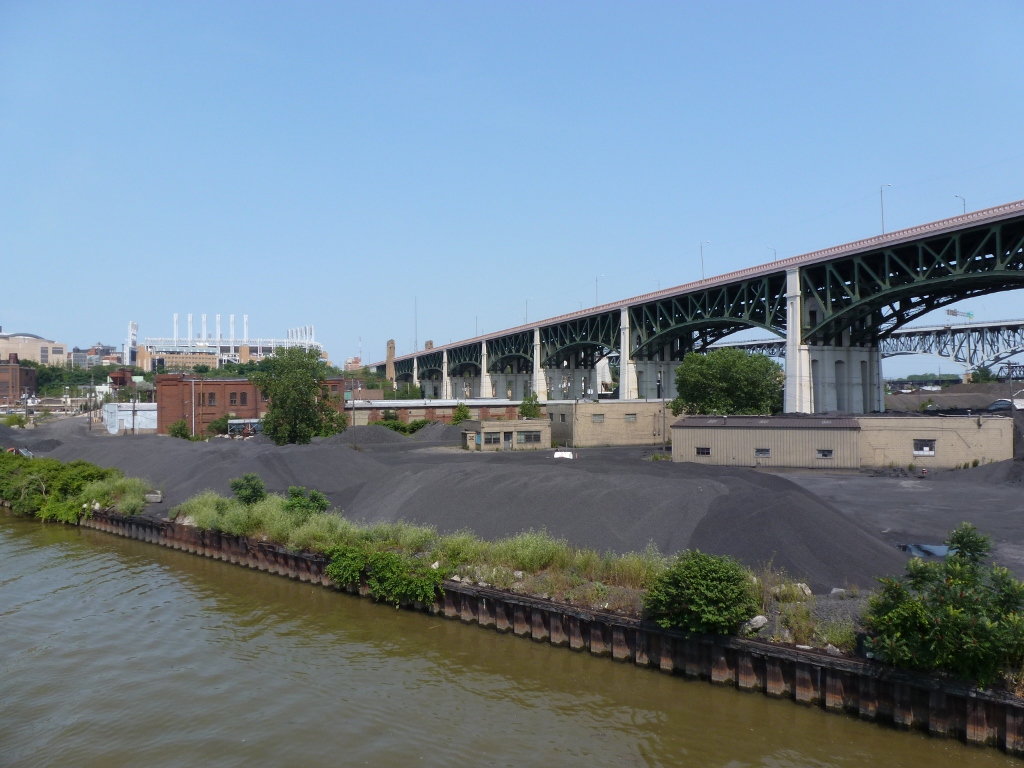
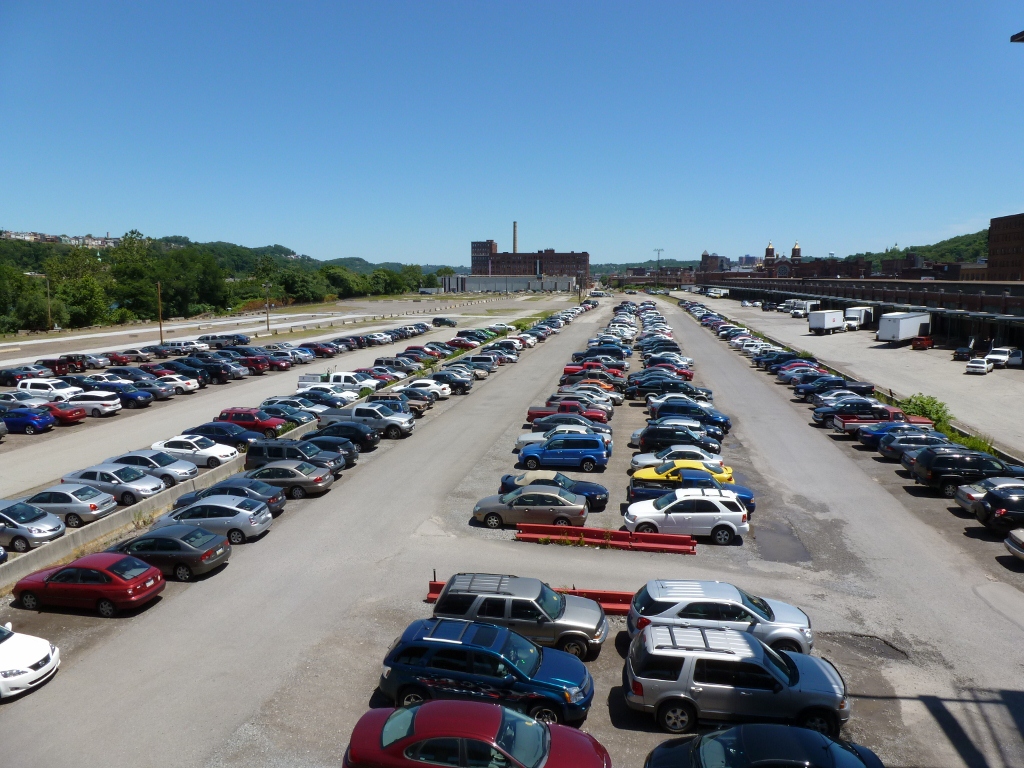
The southern end of the 16th Street Bridge soars over an area that is currently provoking controversy in the city.  It is a site where there are what feels like be miles of barren (although used) parking lots right up against the river on either side of the bridge.  It is a very un-pedestrian-friendly area and a very unattractive place.  Alongside these parking lots on one side of the bridge is the historically significant produce terminal building.  While a developer has put forward a plan to redevelop the area, connecting the existing Strip District to the Allegheny River and adding new mixed development in place of the parking lots, part of the plan requires a partial demolition of the produce terminal.  (A description of this intended development can be read in the article linked here.)

In the beginning of June, City Councilman Dowd began holding up funding for the project, saying he wanted more information about how the funding was to be used (see article).  Then about a week ago, two more councilmen voiced their wish for more information about the use of the funding as well as other aspects of the project such as how the community has been engaged (see article).  Another newspaper article from a few days ago, describes a lawsuit being filed about the property and the development.  This article explains, “The lawsuit alleges that the city is not following its own stormwater management program nor that of the federal Environmental Protection Agency in allowing the project.”

Based on what I’m learning in my internship this summer, this seems like the opposition against, or at least concerns, about the project are piling high enough to prevent the development from happening.  As I am not a fan of harsh, stark parking lots currently in place, it would be a shame for the project to fall through.  However, if the claims of the opposition are true, then it seems we need to find someone else to develop the site.  As awful as the parking lots are, their removal is not worth the price of poorly spent funds, no community engagement, and poor storm water management.  The last concern is the most significant given the fact that the city’s storm water management already causes problems.  (For more related to this issue seen my Heth’s Run Bridge post.)

One River Down!!

This week I officially crossed all the pedestrian accessible bridges in Pittsburgh across the Allegheny River.  I still have a few more to post about, but I’m so excited about having reached this milestone, I had to share it with my readers.  I finished the legwork and now just need to complete the fingerwork to be geographically one-third of the way to reach my goal for the summer.

Of the 20 bridges I initially identified as pedestrian accessible over the three rivers in Pittsburgh (see May 30th post), 10 cross the Allegheny River.  It turns out one of these that I identified wasn’t actually pedestrian accessible, though I posted about it anyway (see June 24th post).  However, it turns out that I missed a bridge on the Allegheny when picking them out on the map.  So I still crossed 10 out of 20 bridges.

I have been using the term pedestrian accessible because not all of the bridges I crossed were necessarily pedestrian friendly.  From the Point downtown up to the 31st Street Bridge (see July 19 post) the bridges were mostly pedestrian friendly.  The 31st Street Bridge begins to get a little dubious.  Farther upriver, while the bridges remain accessible, they are not particularly pedestrian friendly.  See Highland Park Bridge, Washington’s Crossing Bridge and The Last Allegheny River Bridge posts.

16th Street Bridge

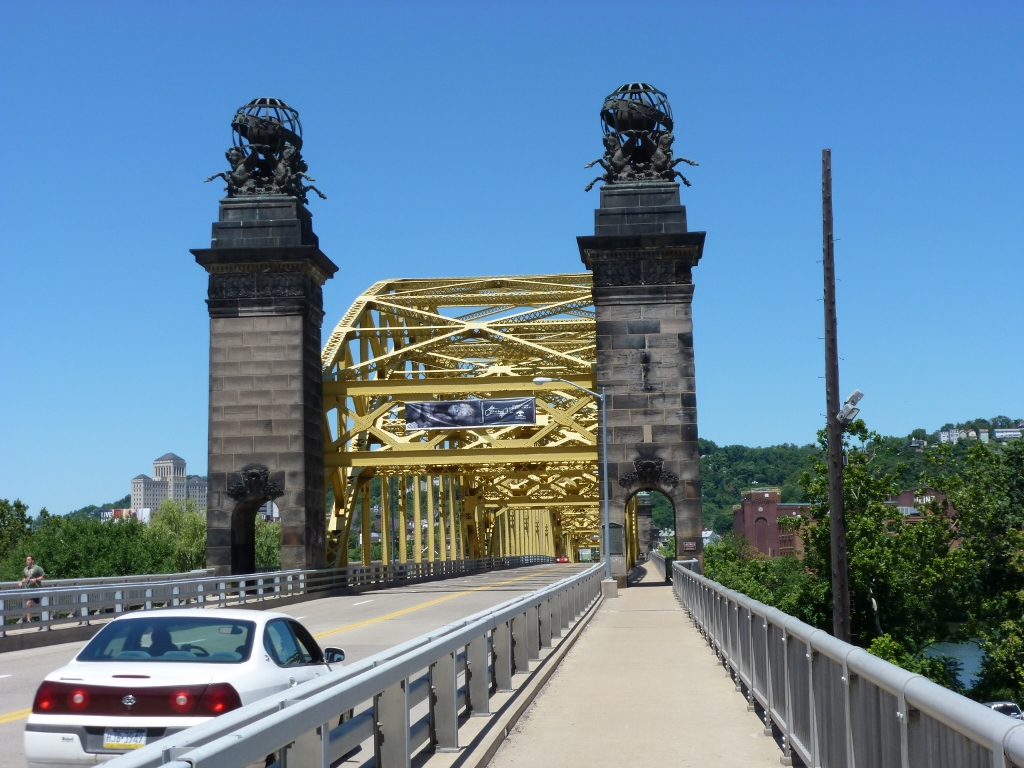
Pittsburgh’s 16th Street Bridge was quite interesting.  I was surprised by how many people were crossing it.  As there is only one pedestrian in my picture above, there obviously weren’t crowds of people, but compared to the other bridges upriver that I’ve crossed there were a lot.  I thought this bridge was far enough out from downtown that the sidewalks wouldn’t be used much.  Also there didn’t seem to me to be much development on either side of the river that would promote walking across the river.  For all the bridges downriver from this point, one side is connected to downtown and the other is connected to a sports stadium and/or large office buildings.  While at the 16th Street Bridge there are some offices near the southern end and some apartments near the northern end, there didn’t seem to be enough for people to be using the bridge so much.  One explanation I came upon was that it was lunch time and both ends of the bridge connect or almost connect with the Three Rivers Heritage Trail.  It seemed like it would be a nice loop for downtown workers to walk the trail on one side of the river, cross the 16th Street Bridge, and return to work on the other side over lunch break.


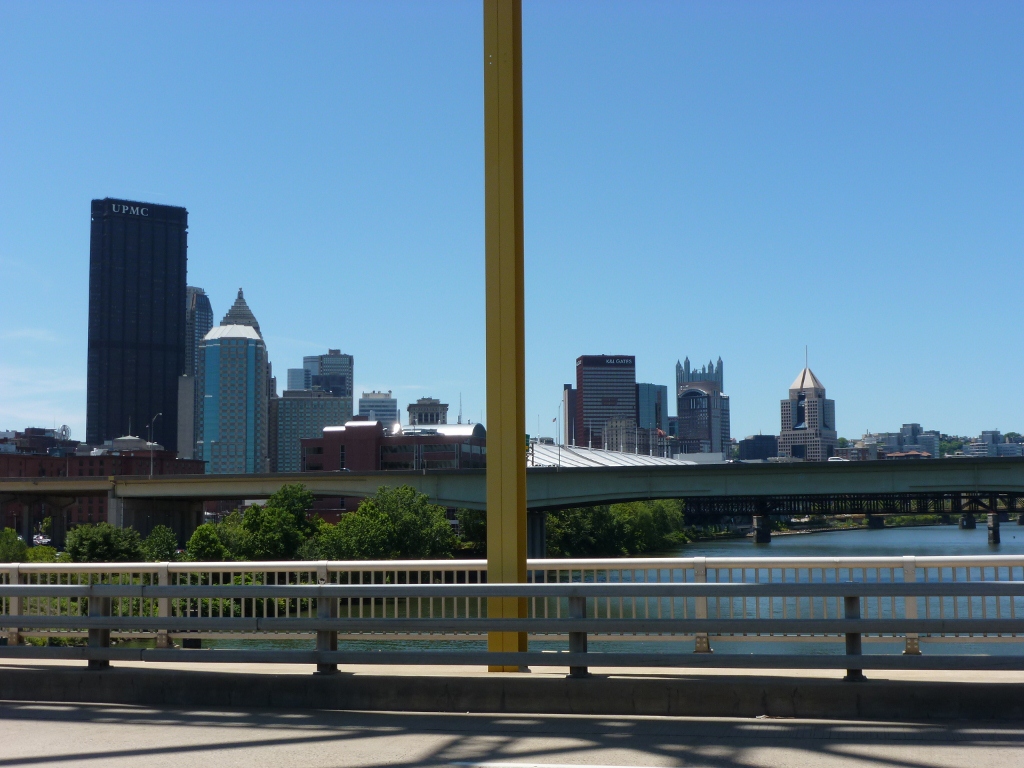
The view on the left of downtown fascinated me.  It looks like there are two clumps of tall buildings (the yellow post doesn’t block any tall buildings).  However, the view on the right supports something I heard in one of my classes which I sort of scoffed at at the time.  I don’t remember exactly how it went, but it was something like the US Steel building (now labeled UPMC) was the center point of a triangle of downtown buildings and as such had to be the tallest.  I think part of the reason I had an issue with it was because the building is located in the middle of a side of the triangle and so the term “apex” or “center point” or whatever the teacher used didn’t fit my sense of geometry.  Actually, regardless of the term used, having the center of the base of a triangle as the focal point doesn’t match my sense of geometry.  However, in the view from the 16th Street Bridge, I can accept the US Steel building as the tallest and therefore a focal point because from this view, the buildings gradually increase in height until reaching it.

This graffiti symbol was painted on the sidewalk of the 16th Street Bridge.  I will not go into a discussion about it here, as I have come across it somewhere else that provokes a much more interesting conversation about it.  I was very surprised and intrigued to see it on this bridge as well, as I have only noticed it in one other place in the city, which isn’t exactly next door.  Although now that I’ve spotted it twice, I will be keeping my eyes open for it.

Cleveland Guitars

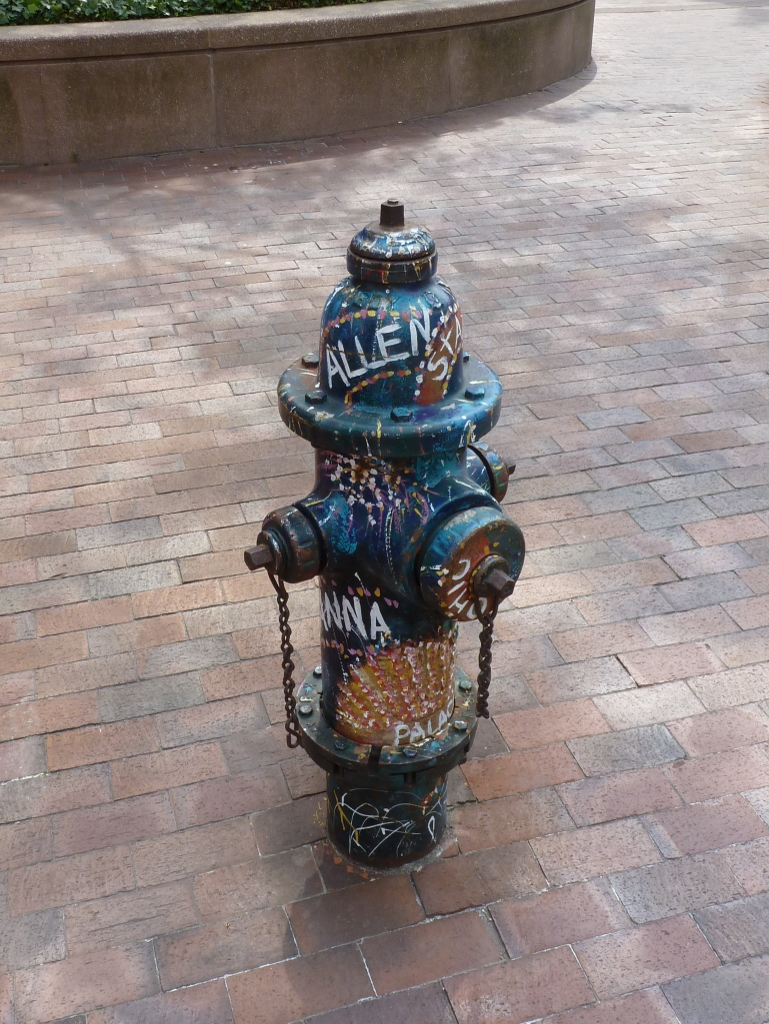
As I mentioned in my Maps Are Awesome! post, I intended to walk over some of Cleveland’s bridges, but got distracted.  First I got distracted with some of the artwork on the street, such as the sculpture and fire hydrant below.


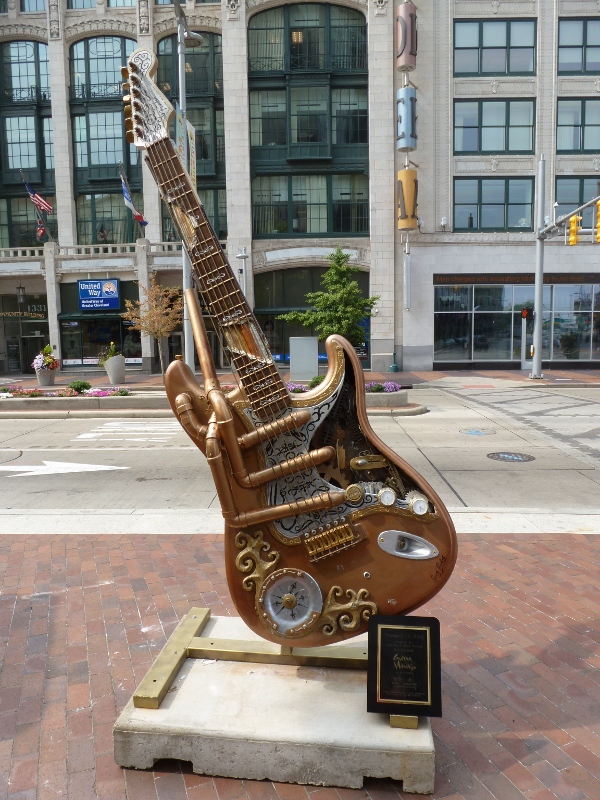
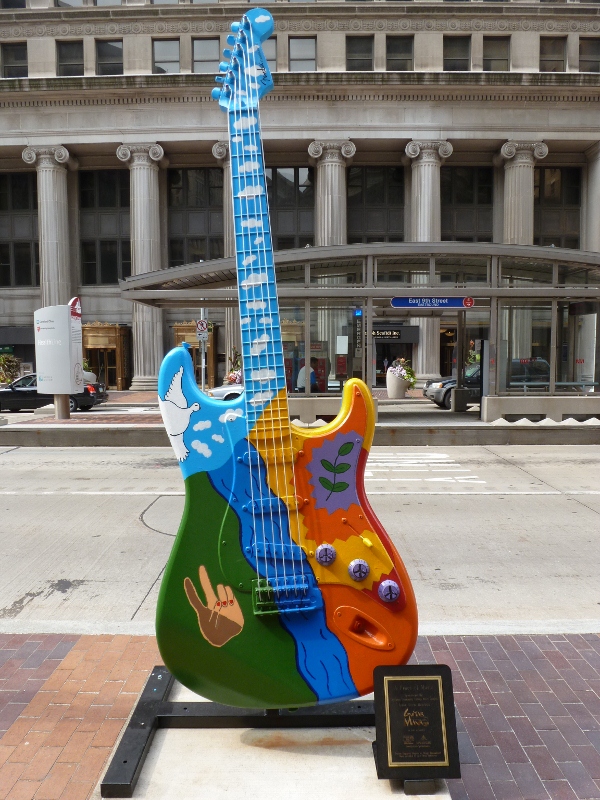
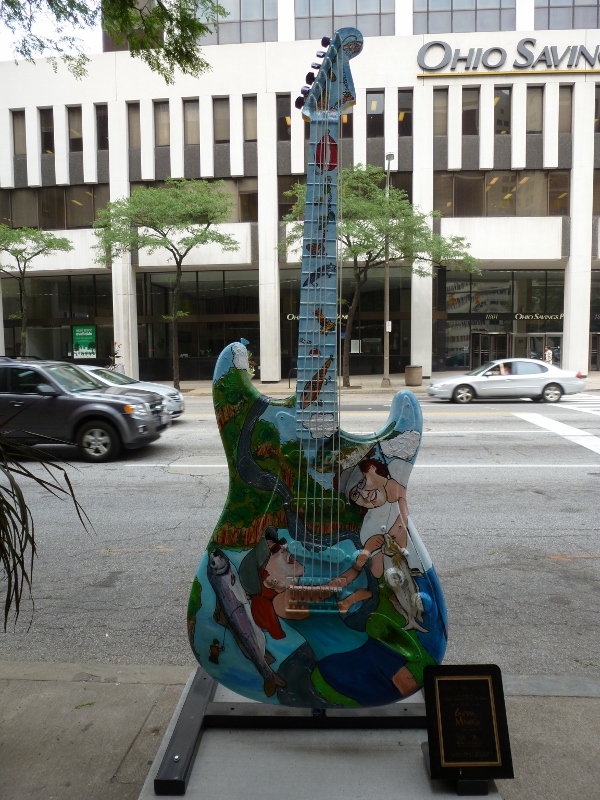
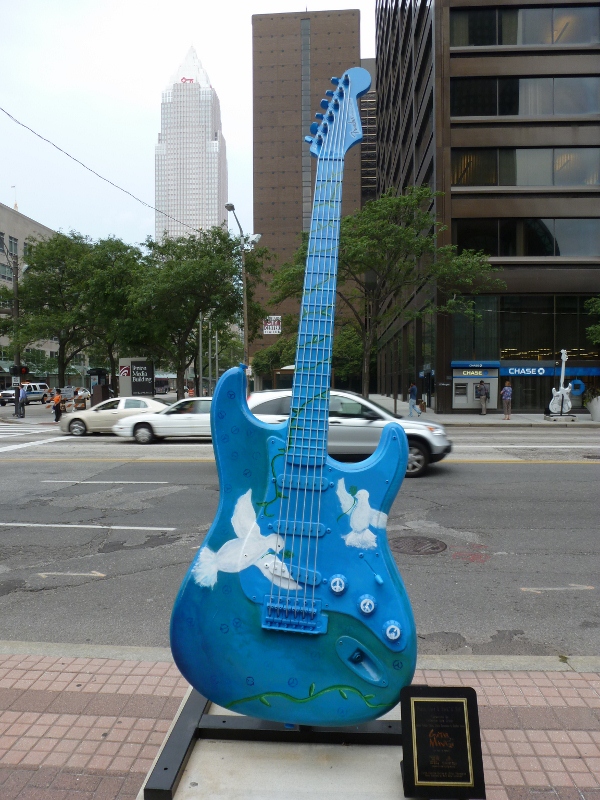
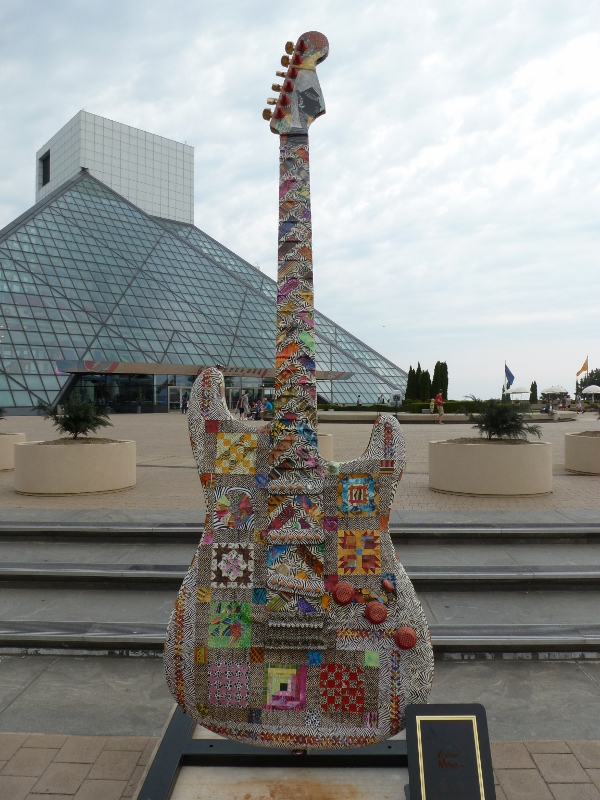
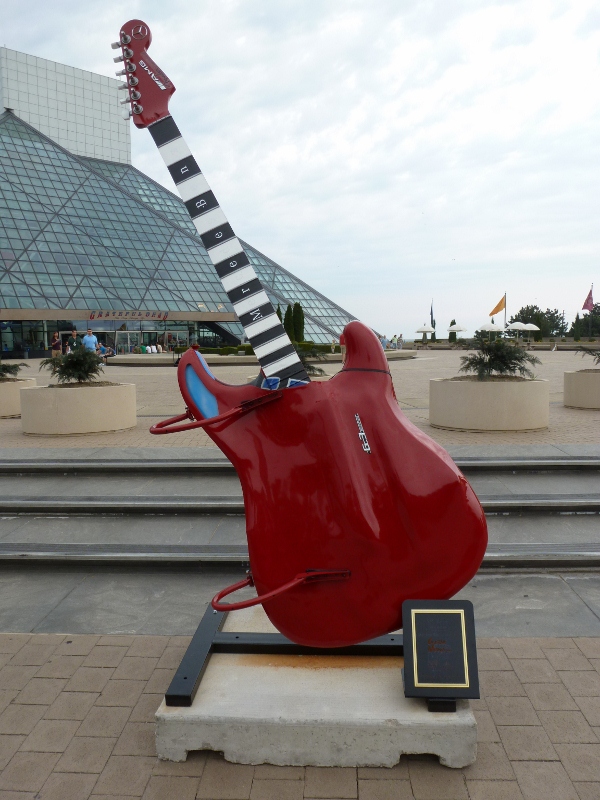
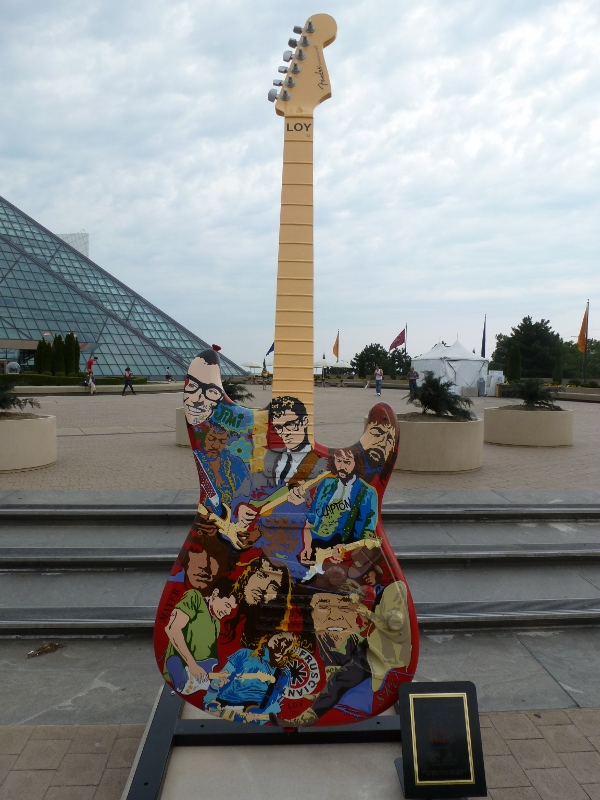
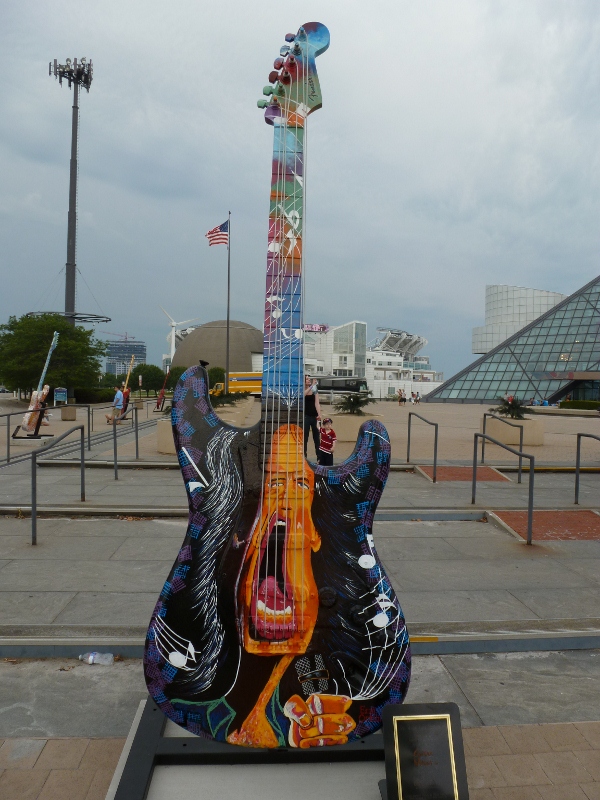
Then I got distracted by the gardens and the way the vacant property was dressed up as discussed in my Oh, Cleveland! post.  I also became fascinated by the map kiosk scattered throughout downtown (see Maps Are Awesome!).  Finally, and probably what clinched the deal, was the Guitar Mania.  Guitar Mania is one of the latest of fiberglass art fundraisers put together by a city.  In these fundraisers, a figure that is iconic to the city is chosen and artists decorate each uniquely and they are displayed all over the city.  After a certain time period of being on public display, these sculptures are auctioned off and the money goes to support charities and such.  An article I found online about Cleveland’s Guitar Mania mentions a few of the other cities that have done this, though they left out Pittsburgh.  Pittsburgh has actually done this twice now.  First was Penguins on Parade in 2002.  This was followed by DinoMite Days in 2003.  Though I haven’t seen a penguin since they were publicly on display in 2002, some of the dinosaurs can still be spotted around the city, mostly on corporate or institutional properties, but at least one is in someone’s private yard.  Other cities were I have personally experienced these kinds of events are Willimatic, CT, which had frogs sitting on spools (the city symbol due to a pre-Revolutionary War legend about frogs and the city and the city’s past as the headquarters of the largest thread company in the world) and Mystic, CT, which did whales.

However, getting back to Cleveland, this was the first time I was in a city while the statues were on public display and when I had the freedom to hunt for them.  I intended to still get to a bridge; however, I kept getting sidetracked as I spotted a guitar down one street or another.  In the end, I found 19 of the 100 guitars and photographed 18 and I decided it was a much better use of my time as the bridges will still be there the next time I’m in Cleveland, but the guitars will not be.  Later, I noticed a couple of decorated fiberglass Chinese dragon sculptures, but as I was passing in the car I was not able to take photos of them.  It turns out that Cleveland is doing a separate display of the Chinese dragons (see website, with link to locations) in addition to the guitar event.


Cleveland’s Bridges

I was surprised how many bridges there are in Cleveland, as I’ve always considered it a flat city.  There are several bridges across the Cuyahoga River which flows through the city, but there are also many bridges elsewhere in the city.  These other bridges cross over railroad tracks or the highways or are railroads and highways crossing over regular roads.  This realization (that even flat cities have can have lots of bridges) is causing me to reconsider what bridges are significant.  For instance in the claim that Pittsburgh has more bridges than Venice, if Pittsburgh has more bridges because highway overpass bridges are included in the count then is that kind of cheating as there was no geological reason for those bridges?  In other words, when cities compete for who has the most bridges, it seems like it would only be fair to count the ones that exist because of geological formations.  On the other hand, this almost sounds like I am calling some bridges more natural than others, but as they are all man-made how can any be natural?  Anyway, this is something to ponder.

In the meantime, I’ll return to Cleveland’s Bridges.  I did not cross over any of the river bridges while I was visiting recently.  Instead, I went under them on the Goodtime III boat tour of the Cuyahoga River and Lake Erie.  As seen on the map above, the boat entered the river in the upper left-hand corner, traveled downriver for over three miles (though as the bird flies it was only about 1.75 miles), and turned around in the last “corner” of the river seen in the lower right-hand corner.  In the process, we passed under 13 bridges, while a 14th bridge swung out of our way.

While I call Cleveland a flat city, there are at least two significant changes in elevation.  One is located out by University Circle and though it continues farther out, I am most familiar with it because it separates the frats and some dorms of Case Western Reserve University’s southern campus from the rest of the campus.  This is a moraine formed by glaciers during the last ice age (or so I’ve been told).  The second elevation change is next to downtown.  The Flats district along the river is significantly lower than the surrounding areas, including downtown and whatever the neighborhood on the western side of the river is.

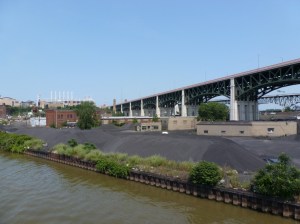
      

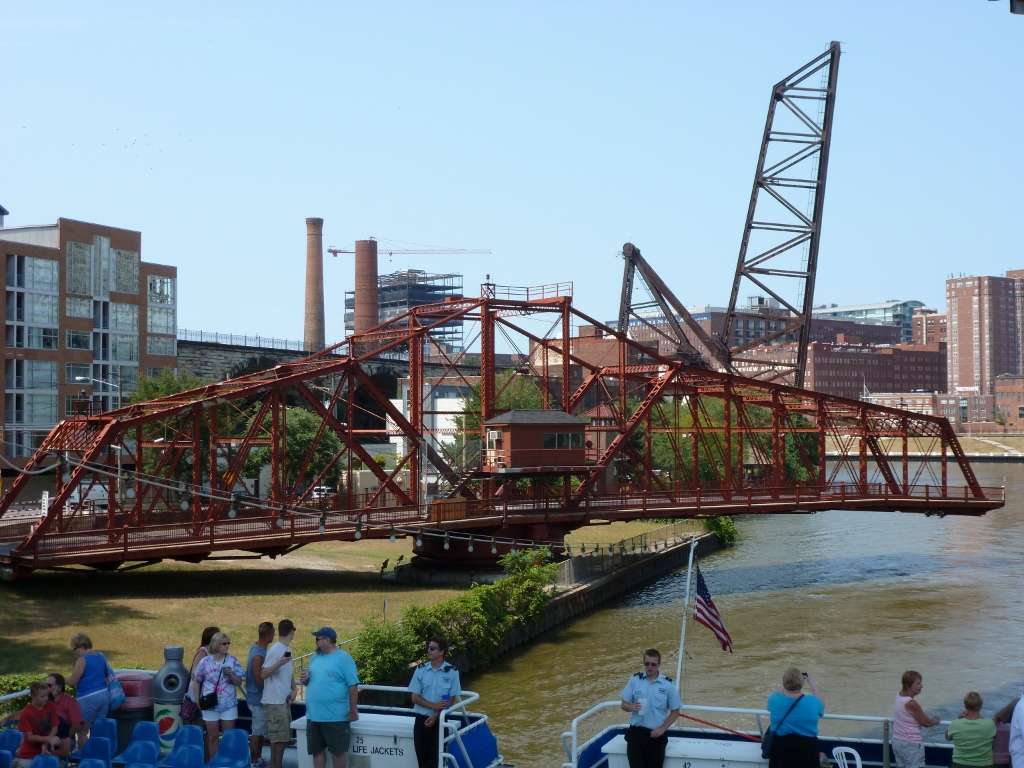
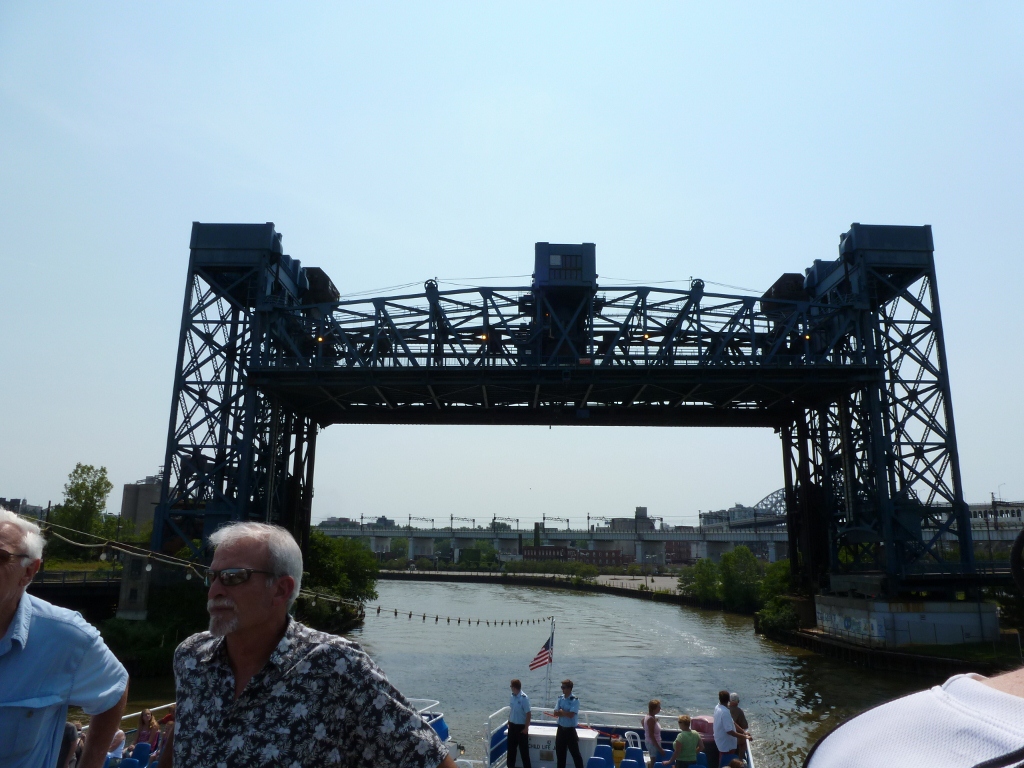
All the bridges we traveled under on the Cuyahoga River were interesting and unique, at least compared to the bridges in Pittsburgh.  About half the bridges were railroad bridges.  The railroads tended to travel along the flats and so crossed the river with very low clearance.  To allow the passage of larger vessels, such as the one we were on, these bridges raised and lowered like elevators.  On the other hand, the bridges carrying roads were very tall as they traveled at the height of downtown and the western neighborhoods.  This also meant that most of them were very long as they not only crossed the river, but also crossed the flats which were sometimes very broad.

This bridge was the only one of its kind on the river.  Instead of raising and lowering like all the other low clearance bridges, this one rotates in either direction to swing out of the way of boats.
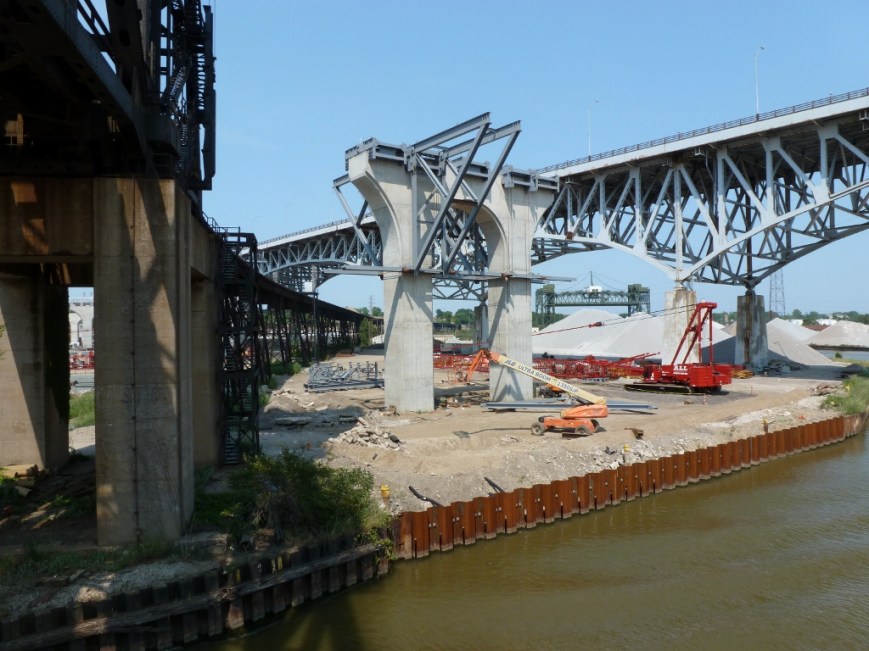
Here was a railroad bridge higher than the others.  Though it still had the mechanisms for rising up, if it needed to, it appeared that our boat was short enough to pass under without this.  A car bridge passes over this bridge before passing over the river as well, however this one will be demolished in the near future, after the one under construction is finished.
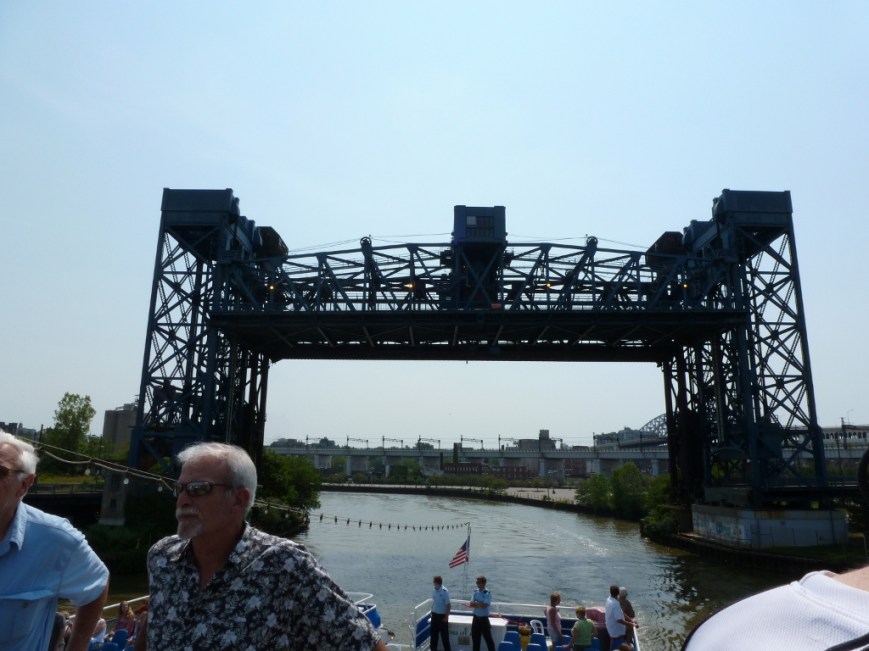
These bridges were interesting as they were two railroad bridges right next to each other, which seemed rather odd.  My theories for this are that either the tracks belong to different railroad companies or one was built first and then the railroad grew, expanding to two tracks, and instead of replacing the bridge with one for two tracks just built a second one right next to the first.  Either way, it’s a sight you don’t see every day.

Though Pittsburgh’s Fort Duquesne Bridge is nicknamed “The Bridge to Nowhere” (see June 19th post), this Cleveland bridge deserves the title more as the road or railroad it used to connect across the river no longer exists.  I wonder why they keep the bridge in place, when its purpose is gone.  It seems to me that this could easily become a hazard as the bridge weathers and there is no reason to maintain it.  In the meantime, before it comes crashing down, it does make an entertaining sight.
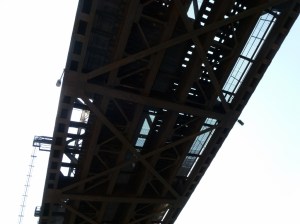


And of course, since I was passing underneath the bridges, I had to take a shot at the undersides!

Maps are Awesome!

While talking with someone recently, we discovered we shared a seemingly rare love of maps.  Maps are truly awesome and useful tools and not just for figuring out how to get from one place to another.  Maps provide insight into what a place looks like, giving clues about the layout and geography of a place you’ve never been.  Street names and other labels can hint at the history of the place.  Historical maps show what a place looked like in times past.

I have used maps several times to help me with writing my blog and there are many more times when I should have gone to a map first. As I mentioned in the first Heth’s Run Bridge post, the G.M. Hopkins maps on Historic Pittsburgh are probably my favorite resource for Pittsburgh.  Heth’s Run Bridge presented many puzzles that the maps helped me understand.  I realized yesterday that I probably should have gone to these maps first when wanting to figure out which bridge remnant I saw from the Fort Duquesne Bridge (see June 19’s post).  While writing that post, I did a search on the internet, but came up with nothing.  The G.M. Hopkins maps came to the rescue, although there are two possibilities for which bridge the remnant belonged to.  The first possibility I found on the 1900 map.  This one was called the Union Bridge.  By 1929, the Union Bridge was gone and another bridge connected the Point to the North Side.  This one was called Manchester Bridge.  This bridge was demolished in 1970, by which time the Fort Duquesne Bridge was built (see June 19th post).  I made a few other discoveries about Pittsburgh while looking at the 1929 map.  First, Penn and Liberty avenues used to come straight through to Water Road which ran along the northern shore of the Monongahela River.  Today these avenues stop much further inland.  The second major discovery was that Point Park already existed in 1929.  It was significantly smaller than it is today, but it is there.

Google Maps helped me with identify the buildings near Lambeth Bridge (see June 28th post) that I didn’t take the time to stop and investigate while I was walking the bridge.  Several of the buildings I was able to identify from labels that Google Maps conveniently placed on the map.  The Parliament View Apartments weren’t labeled, but using Google Maps’s other wonderful feature–Street View–I was able to find a sign on the building identifying it.

The image leading this post is of another highly convenient map.  On my recent trip to Cleveland, I arrived Downtown 2 hours before the person I was visiting finished work.  We arranged to meet at their place of work, but I was only familiar with two or three of the streets in downtown Cleveland, and the meeting place wasn’t on any of them.  I had just decided to use my skills of logic to find it (which would have been feasible in this case as one of the cross streets was a numbered street and the other was called Lakeside) when I came across this map on a street corner.  It turns out that these maps are posted regularly around downtown Cleveland, which I thought was very considerate of the city.  It made the city feel like it welcomed visitors with open arms, engaging them in being engaged in the city.  Even though I had a plan for finding where I was going without a map, I prefer being safe rather than sorry, so I took the easy way out and used the map to figure out where I was supposed to end up.  I also used it to plot out how I could spend the time I had until my friend got out of work to cross at least one of Cleveland’s bridges over the river Cuyahoga.  I ended up getting distracted from this goal, but that is a story for another day….(see July 9 post)….

OH, Cleveland!

I spent my freshman year of college in Cleveland, OH.  University Circle, the neighborhood my campus was in, was beautiful and pleasant, but the rest of the city stuck in my mind as rather ugly and dull.  In fact, my friends and I referred to it as “the city that always sleeps.”  Outside of campus there didn’t seem to be anything to do, particularly after 7 p.m.

I often compare Cleveland and Pittsburgh in my mind and for years, Cleveland came up the less favorable of the two.  This is in part due to the unfavorable impression I developed of downtown Cleveland while in school there and in part due to the vast fields of vacant lots that separate downtown from University Circle.  In the last couple years, I made several quick trips to Cleveland.  Every time I come home more amazed by the city.

First, I started noticing the street art and fancy trash cans.  The next trip, I was awed by Cleveland’s BRT (Bus Rapid Transit) system.  Pittsburgh’s bus system is loosing routes and cutting back on service hours and here Cleveland was able to institute a BRT with fancy new buses, new bus shelters at every stop along the BRT route that include fare boxes and electric signs that tell you how many minutes until the next bus arrives, and dedicated lanes and traffic lights for the BRT.  Last weekend when I visited was the first time I’ve spent any significant amount of time walking downtown and I was impressed with what I saw.

There is vacant property all over the city.  Cleveland’s population decline over the last 60 years was much more severe than Pittsburgh’s.  It went from a peak of around 900,000 to just under 400,000 in 2010, whereas Pittsburgh only got up to 600,000 and fell to 300,000.  Yet, downtown, the city’s managed to still look beautiful despite the vacant buildings with greenery such as the garden in the road divider above.

I saw another method for reducing the blightedness of vacant properties in another part of the city 8 miles from downtown.  Here they placed art installations in vacant lots that were for sale.

Things definitely seem to be looking up for Cleveland.  I read recently that the County Executive for Cuyahoga County (Cleveland) met with the one for Allegheny County (Pittsburgh) to pick up some tips on how to help turn a struggling rust belt region around.  However, I think that Pittsburgh/Allegheny County could pick up some tips from Cleveland/Cuyahoga County.

Istanbul Bridges

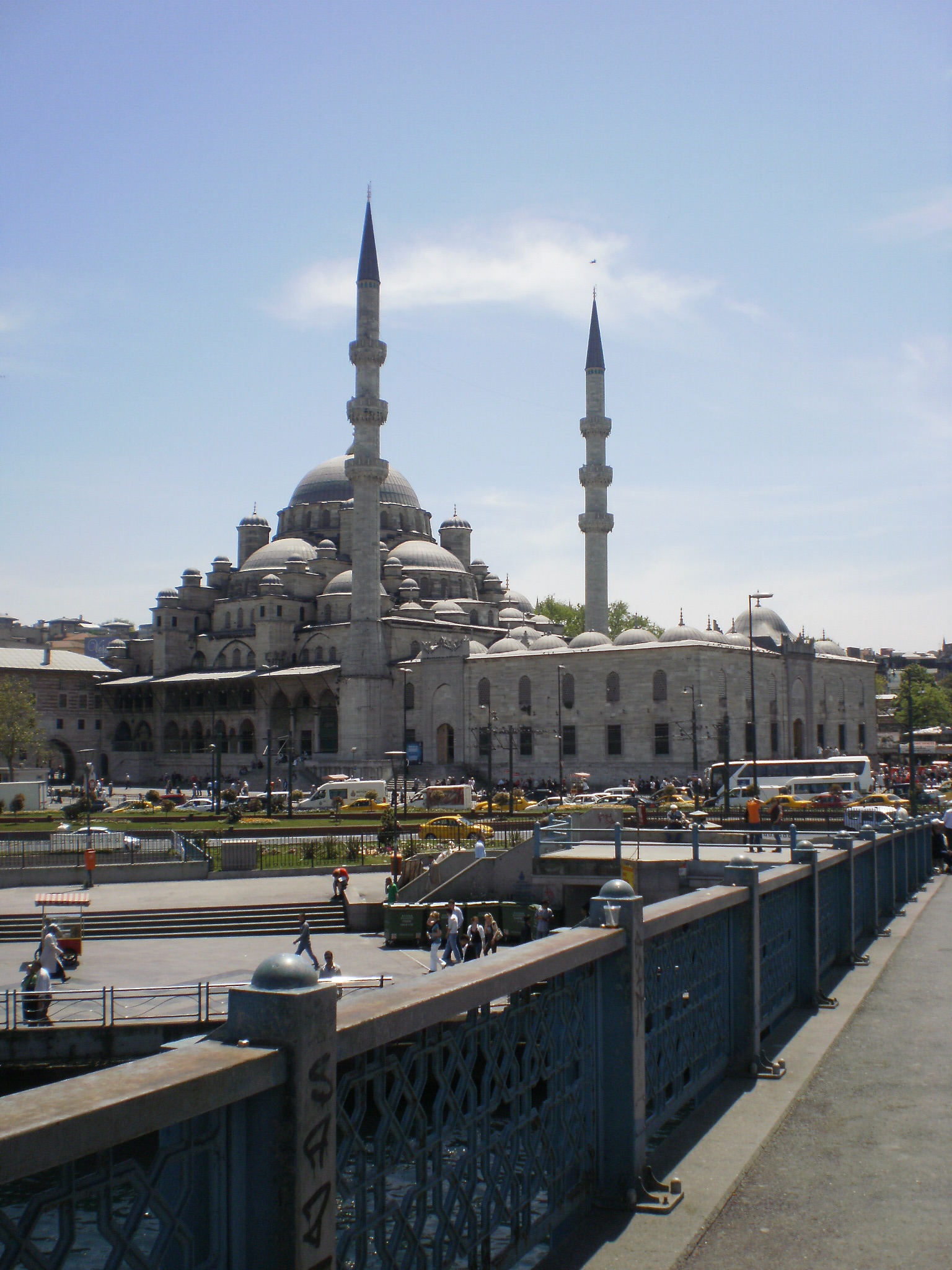
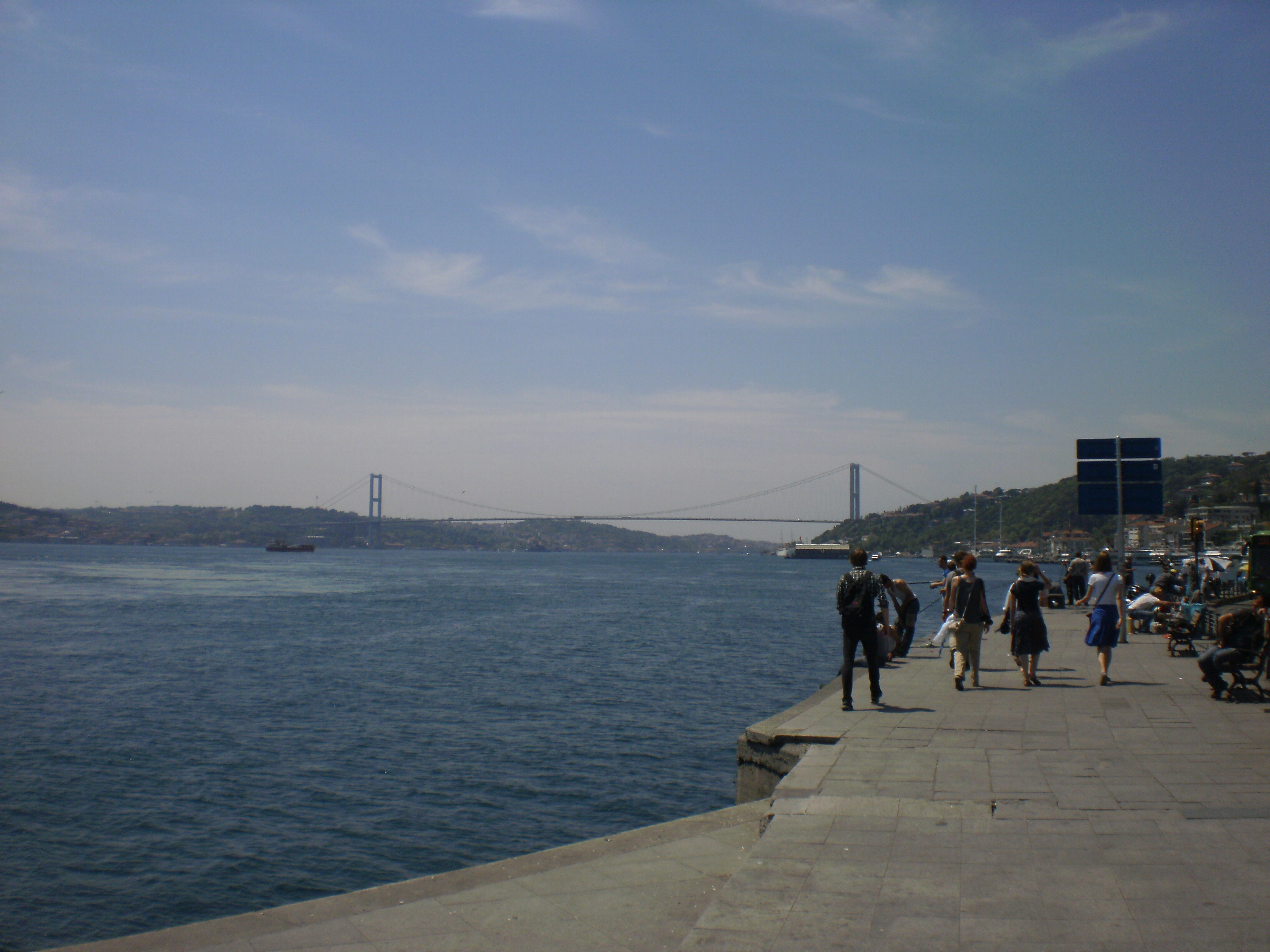
I decided it was time to add some variety to my bridges post.  Last year I spent two weeks in Istanbul.  While I was not as absorbed in my bridges quest at that time, I found that thinking about the bridges in Pittsburgh and London caused me to reflect on the bridges in Istanbul.  Considering how much water there is in Istanbul, there are very few bridges.  I can only recall seeing three: the Galata Bridge, Ataturk Bridge, and the Bosphorus Bridge.  (Apparently my memory is a little rusty as I just looked up a map of Istanbul which shows there were four bridges that I would have seen, this obviously reflects the fact that I was not in my bridges phase at that time.)  Of these four bridges, I only crossed the Galata Bridge, but I walked under the Bosphorus Bridge and took some pictures of it.

The Galata and Bosphorus bridges are very different in age and use.  There has been a Galata Bridge since the middle of the 19th century and a bridge over the Golden Horn (the body of water the Galata Bridge spans) since at least the 6th century.  The Galata Bridge has many uses.  There are wide sidewalks that accommodate pedestrians, three lanes in each direction for cars, and tracks down the middle of the bridge for the trams.  While I worked very hard not to get any of them in the picture above, the bridge is usually lined with fisherman and street vendors sell freshly caught and cooked fish.  Below the street deck are numerous restaurants.  One day, we had fish sandwiches for lunch at one of these, which were surprisingly good (I’m not much of a fish fan).  The line of one of the fisherman on the street deck above can be seen in my picture from the restaurant.  The Galata Bridge not only provides access between two points, but also provides people access to their livelihoods and to decent meals.  This shows that bridges do not have to be just about funneling traffic from one place to another; they can be a lively and interactive space in the city.


On the other hand, the Bosphorus Bridge, built in the 1970s as the first bridge to span the Bosphorus strait, is purely a funnel (as far as I observed).  It looks like it could be in New York or almost any other US city.  The purpose of the Bosphorus Bridge is like that of most of Pittsburgh’s river bridges–to provide vehicular access across a body of water.


Veterans Bridge

The Veterans Bridge is one of the bridges I will not be walking in Pittsburgh because it doesn’t have pedestrian access.  It carries another one of the freeways over the Allegheny River.  As discussed in the Fort Duquesne Bridge post, freeways and pedestrians usually don’t mix.

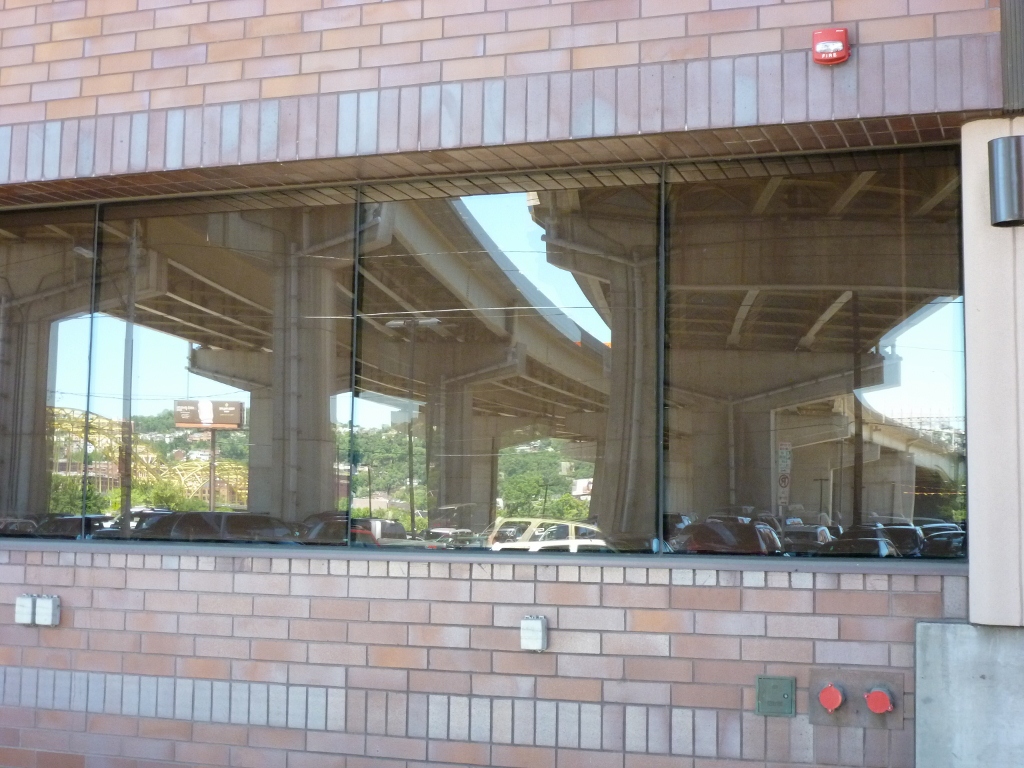
The reason that I am including a post on this bridge, as my focus is on the bridges that I walk, is that it adds to the discussion of how many bridges are there in Pittsburgh.  As the Veterans Bridge, I consider it a single bridge entity.  However, the image above shows that there are three separate entities that make up the bridge, at least as it crosses over the parking lots in The Strip (I believe at least two of these merge before the bridge crosses the river).  So the question is, do these three elevated roadways get counted as three separate bridges in addition to the bridge over the river?  If that is the case, then it is easy to see how Pittsburgh can outrank Venice in the number of bridges each city has.  Though I have yet to go to Venice, I image its bridges are more like London’s bridges where there is only one roadway and few or no elevated ramps/roadways to approach the bridge.

Three Sisters: 7th Street Bridge

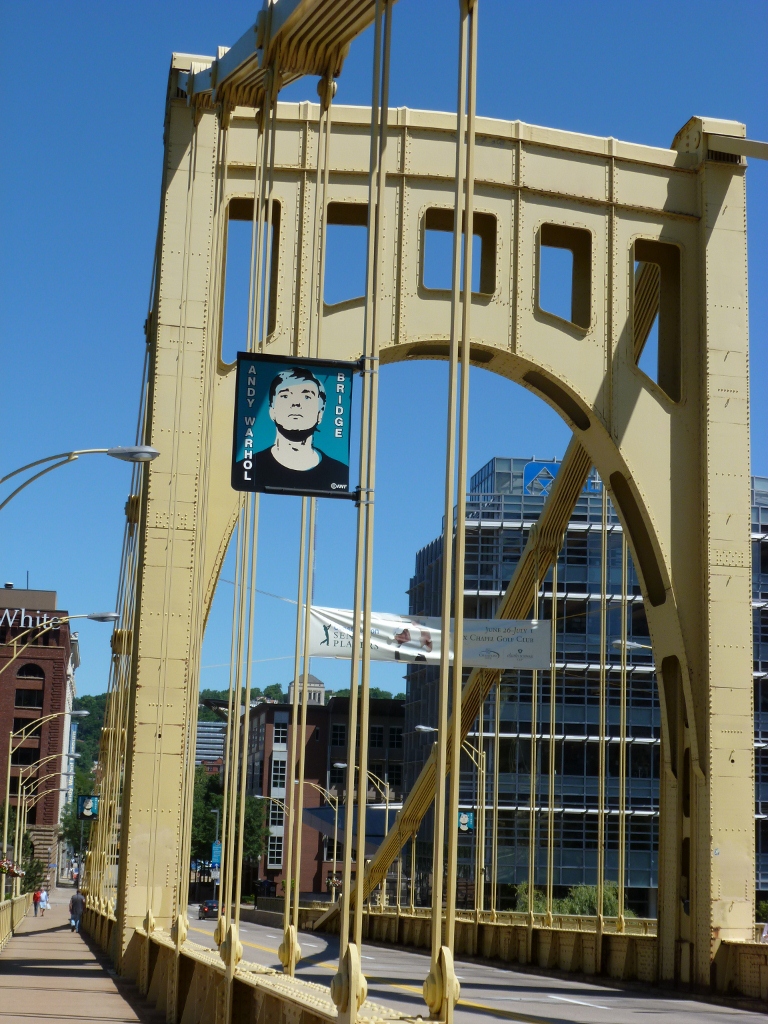
The final of the Three Sisters is the 7th Street Bridge.  This one is named after Andy Warhol, which makes since as the Andy Warhol Museum is located about two blocks from the northern end of the bridge.  Another attraction on the northern end is the “new” Alcoa building.  Alcoa, an aluminum company, moved from their skyscraper downtown to this blue glass, wavy building in 1998 (the building on the right in the picture above).  The former Alcoa Building downtown (which people still call the Alcoa Building) is unusual with its aluminum walls and pod-like windows.  It was turned over to a consortium of non-profit groups, but has lately been plagued with high vacancy rates.  A recent newspaper article announced a plan to convert the upper portion to apartments and retain the lower portion for the existing tenants.  I haven’t been inside the old building, but the new one is quite swanky.  It reminds me a bit of a building used in the first Jason Bourne film for the headquarters of a firm that sells giant yachts to billionaires.

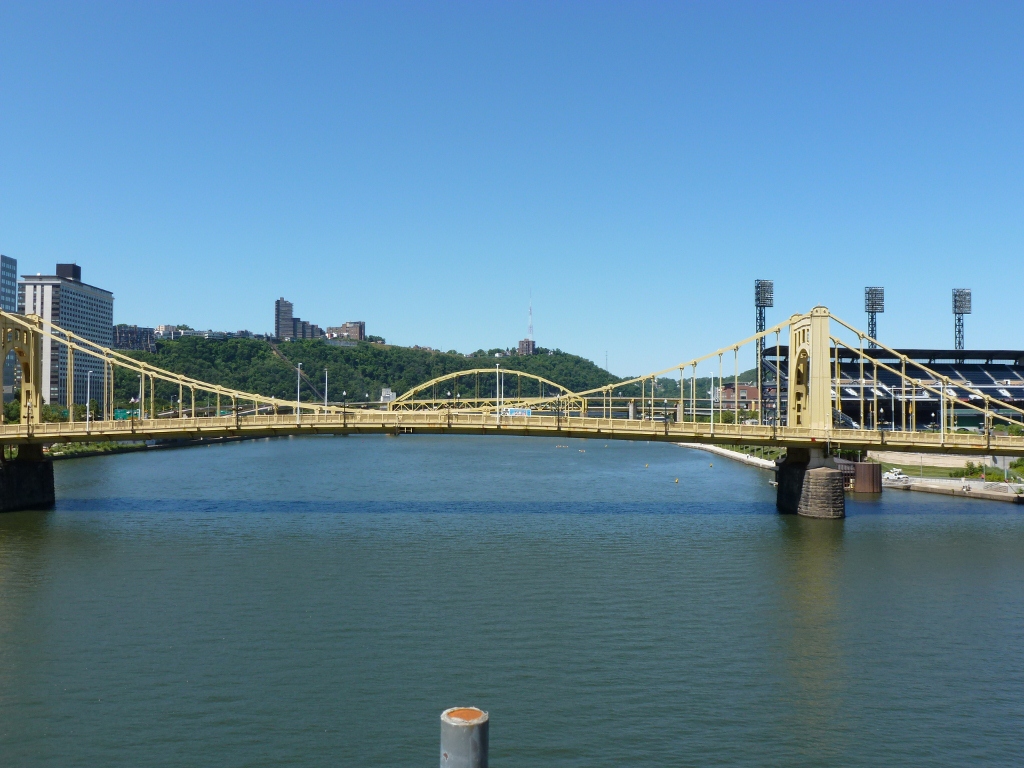
The 7th Street Bridge was the first of the Three Sisters to be built in 1926.  The 6th Street Bridge, aka Roberto Clemente Bridge, was built downriver (see June 14th post) and the 9th Street  Bridge, aka Rachel Carson Bridge, was built upriver (see June 21st post) a few years later.  Its location in-between the other two bridges means that the views from it are not much different.  The view upstream is almost identical to that from the 9th Street Bridge, except that the 9th Street Bridge is added to the mass of bridges, making the view more cluttered.  Downstream, there is still a nice view of Mt. Washington and a good view of Kayak Pittsburgh under the 6th Street Bridge.