Three Sisters: 7th Street Bridge

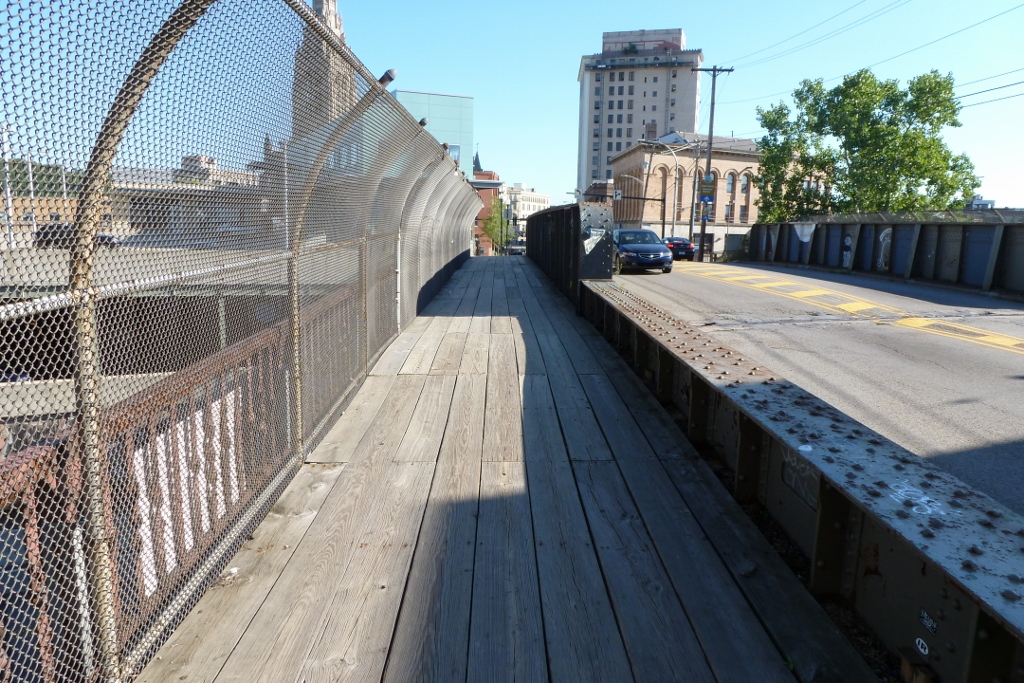
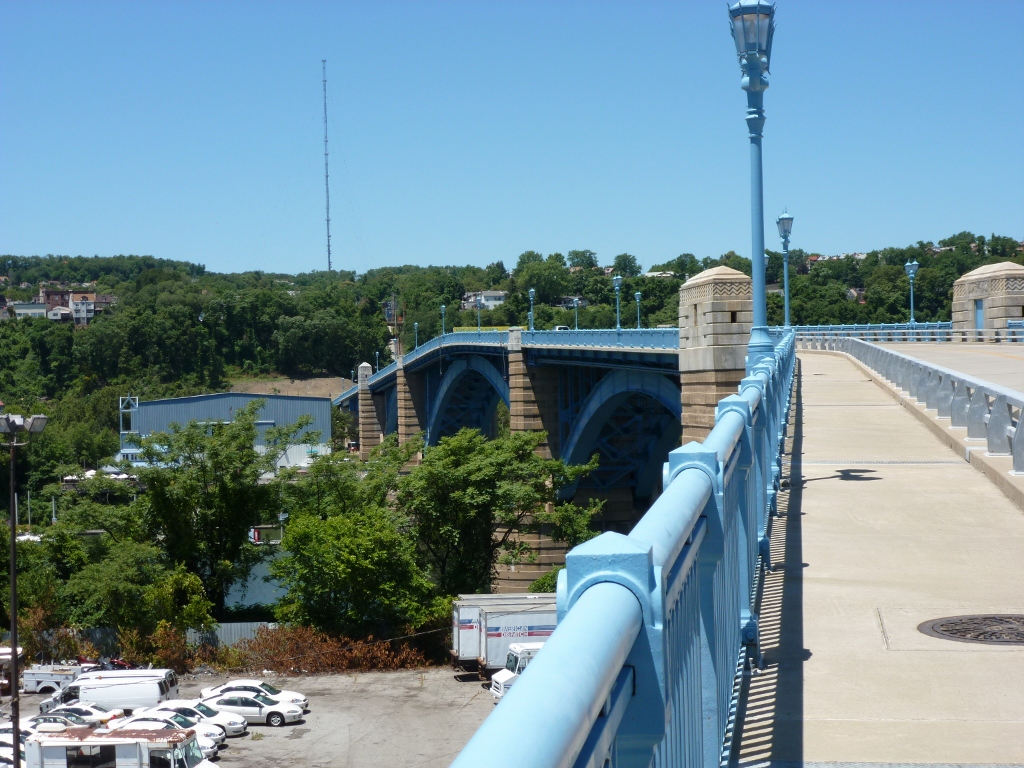
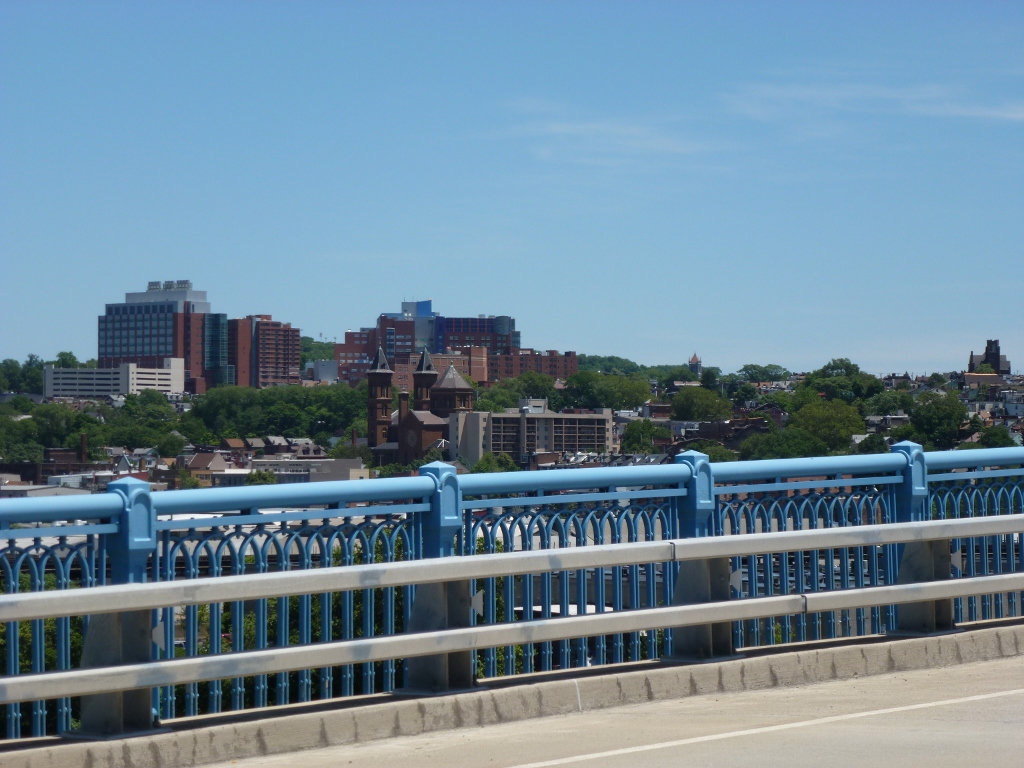
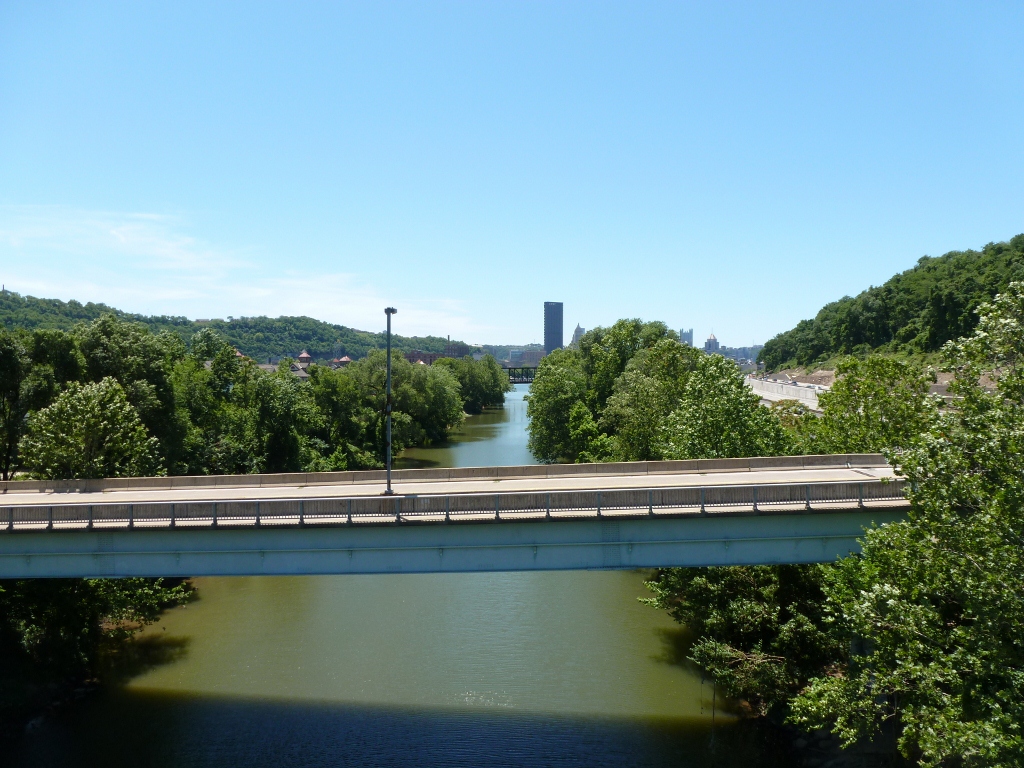
The final of the Three Sisters is the 7th Street Bridge.  This one is named after Andy Warhol, which makes since as the Andy Warhol Museum is located about two blocks from the northern end of the bridge.  Another attraction on the northern end is the “new” Alcoa building.  Alcoa, an aluminum company, moved from their skyscraper downtown to this blue glass, wavy building in 1998 (the building on the right in the picture above).  The former Alcoa Building downtown (which people still call the Alcoa Building) is unusual with its aluminum walls and pod-like windows.  It was turned over to a consortium of non-profit groups, but has lately been plagued with high vacancy rates.  A recent newspaper article announced a plan to convert the upper portion to apartments and retain the lower portion for the existing tenants.  I haven’t been inside the old building, but the new one is quite swanky.  It reminds me a bit of a building used in the first Jason Bourne film for the headquarters of a firm that sells giant yachts to billionaires.

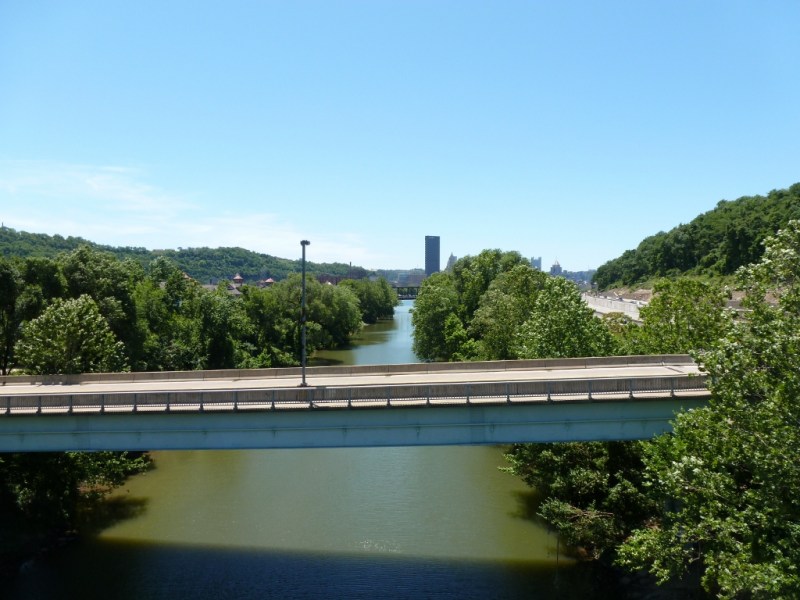
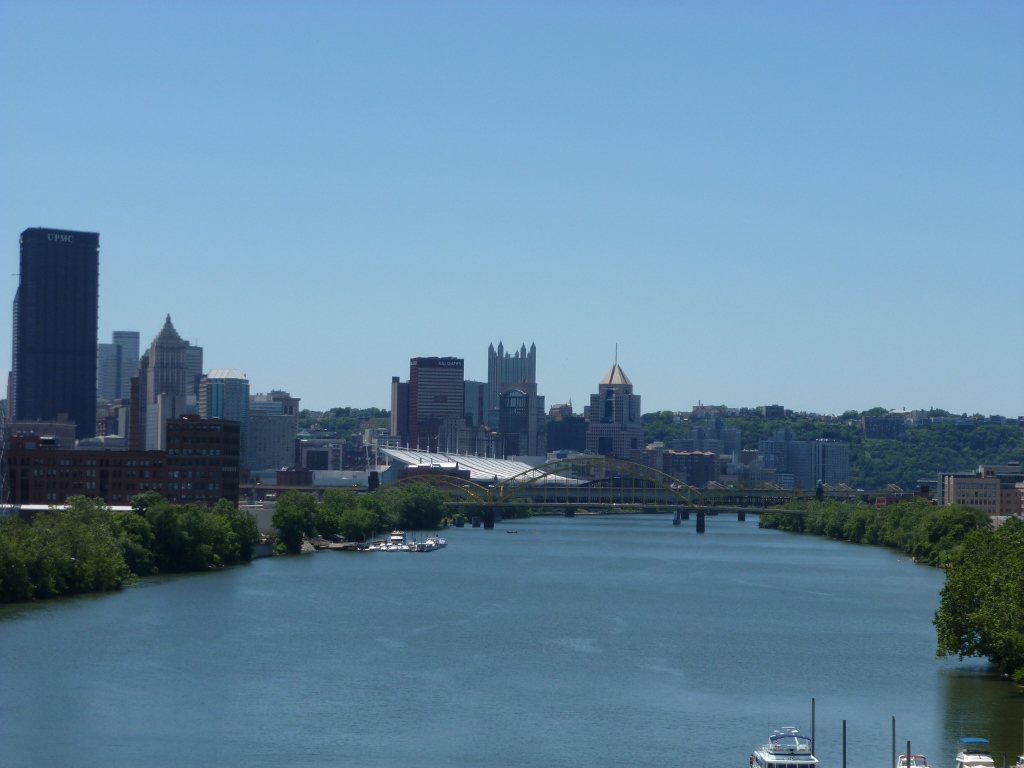
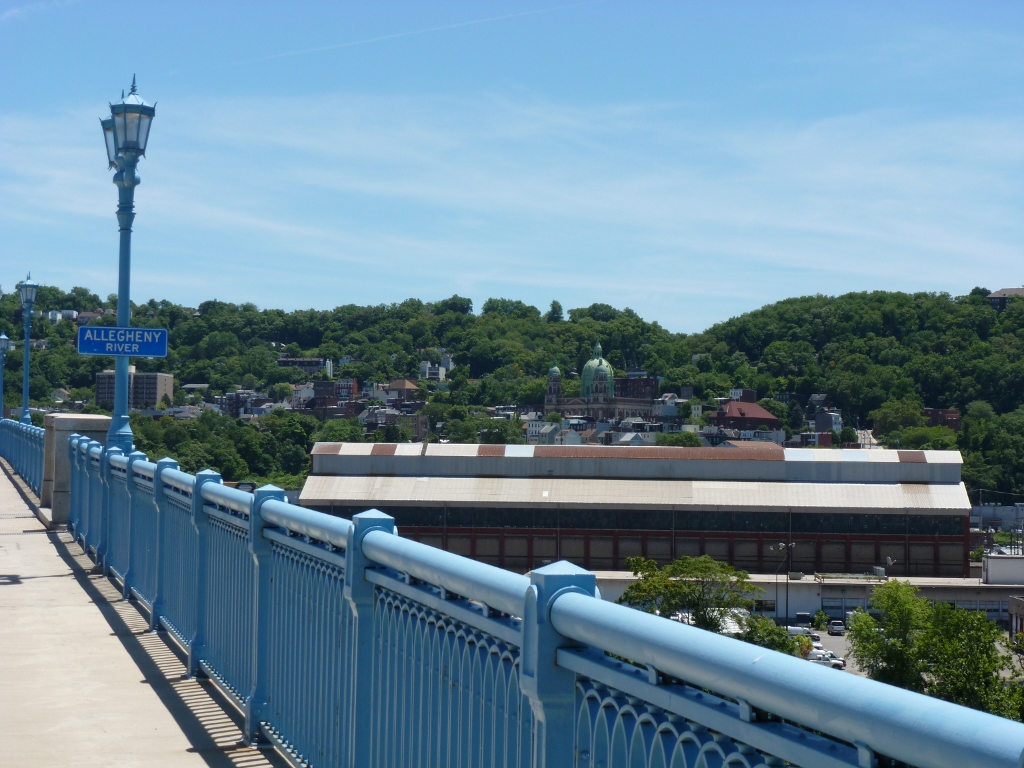
The 7th Street Bridge was the first of the Three Sisters to be built in 1926.  The 6th Street Bridge, aka Roberto Clemente Bridge, was built downriver (see June 14th post) and the 9th Street  Bridge, aka Rachel Carson Bridge, was built upriver (see June 21st post) a few years later.  Its location in-between the other two bridges means that the views from it are not much different.  The view upstream is almost identical to that from the 9th Street Bridge, except that the 9th Street Bridge is added to the mass of bridges, making the view more cluttered.  Downstream, there is still a nice view of Mt. Washington and a good view of Kayak Pittsburgh under the 6th Street Bridge.


Three Sisters: 9th Street Bridge

I decided to address each of the Three Sisters separately after all and for some reason to do it out of order (which is quite unusual for me as I am generally very methodical).  The 9th Street Bridge is also called the Rachel Carson Bridge.  Rachel Carson was an environmentalist who grew up near Pittsburgh and attended college at the forerunner of Chatham University (one of Pittsburgh’s many universities).  The bridge was named in her honor on Earth Day in 2006.  Unlike the other Three Sisters Bridges, there is no specific reason why this bridge should have been named for Rachel Carson.  The 6th Street Bridge (see June 14th post) renamed for Roberto Clemente, a former Pirates player, connects to PNC Park, the current home of the Pittsburgh Pirates, while the 7th Street Bridge renamed for Andy Warhol connects to the Andy Warhol Museum (see June 22 post).  As far as I am aware, there is no similar connection between the location of the 9th Street Bridge and its namesake.

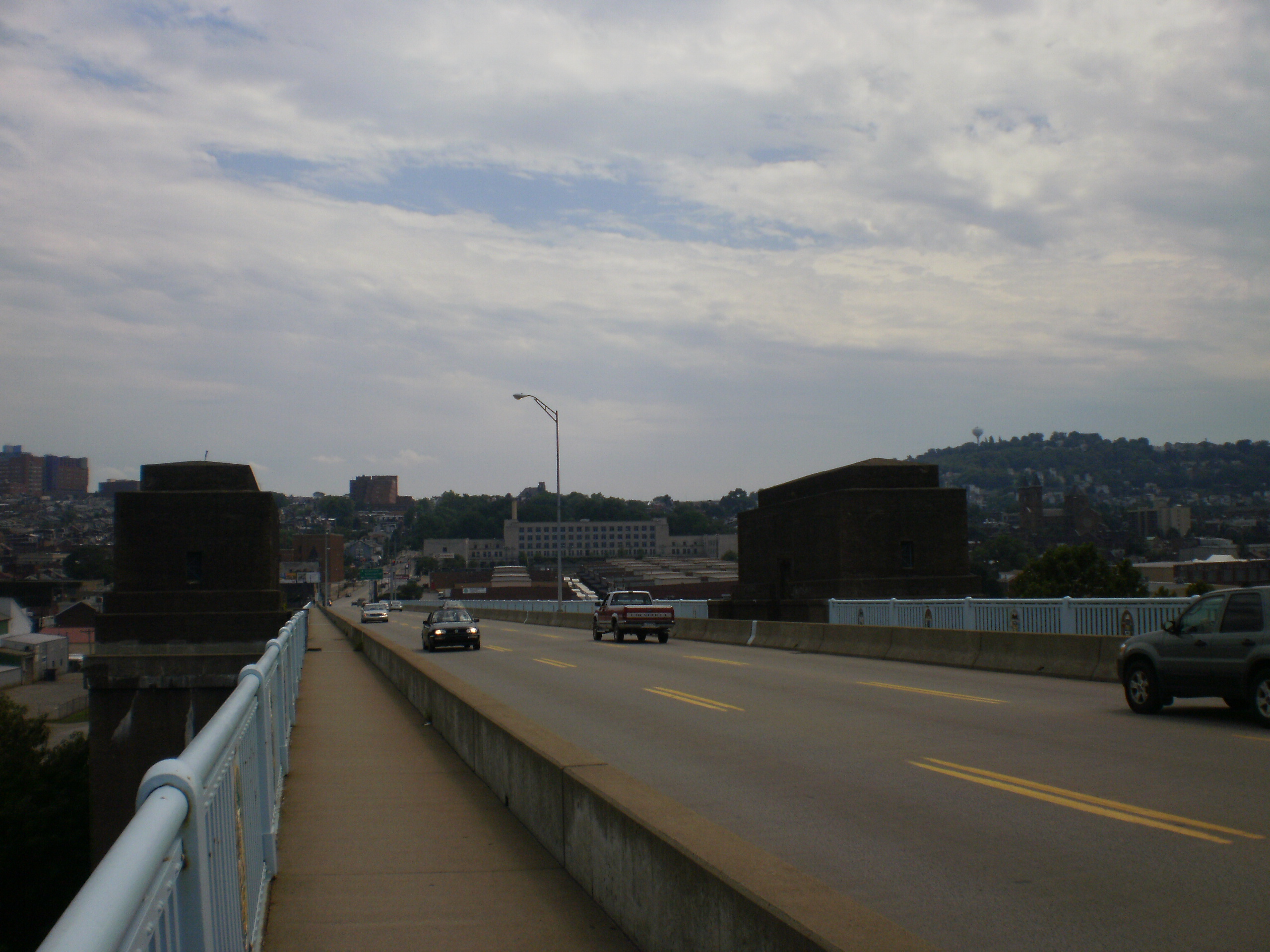
As far as my observations go, this bridge is the least used of the Three Sisters.  The south end of the bridge is near CAPA High School (for performing arts) and the Convention Center, but the north end does not connect to any buildings or sights that seem like they attract much traffic, while the north end of the other two connect to a museum and a ballpark.  In addition to the surroundings, the condition of the bridge suggested that it is not as well cared for (perhaps because there is less traffic) than the others.  There are two stone pillars at each end of each of the three bridges.  One of these on the Rachel Carson Bridge was almost completely covered in vines and weeds.  The side facing into the bridge holds the plaque identifying the bridge and was the only side not covered in growth.  On second thought, perhaps this is not due to a lack of maintenance but rather in recognition of the fact that Rachel Carson was an environmentalist.

The views up and downriver from the Rachel Carson Bridge encompass mostly the other bridges around it.  Upriver are a railroad bridge, the Veteran’s Bridge (see June 24 post), and the 16th Street Bridge (see July 13 and July 14 posts).  However, rising above these bridges is the Children’s Hospital in Lawrenceville, another iconic Pittsburgh building visible from multiple points around the city and displaying a color scheme as intriguing as any of the London bridges.

Vauxhall Bridge

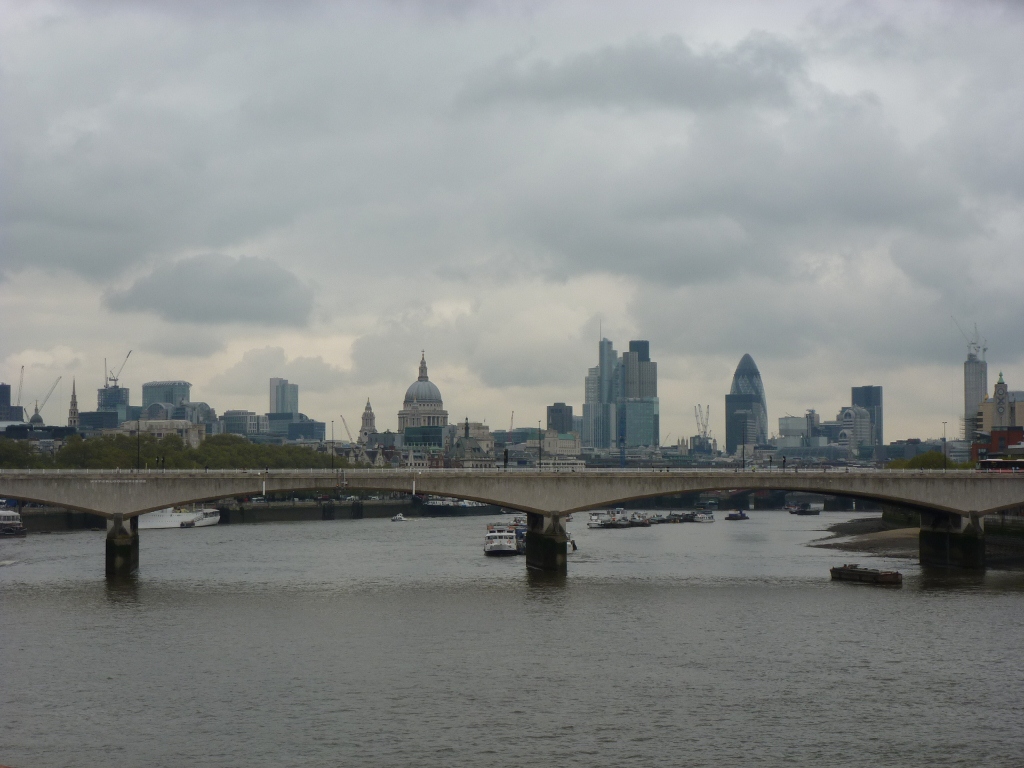
I must say that London has the most interesting and varied color schemes for its bridges of any city I have yet visited.  In Pittsburgh, for instance, the bridges that have color use only one (and that tends to be yellow).  All the examples I can think of for bridges in other US cities follow a similar color design as Pittsburgh, though not in yellow.  On the other hand, London’s Vauxhall Bridge presents yet another tri-color design scheme different from the three bridges I’ve already posted about and from the nine more to come.

Upriver from the bridge, the smoke stacks of the Battersea Power Station (see June 18 post) are still in view.  In the other direction, classic, old London architecture appears, after the views from the bridges upriver were dominated by modern architecture (when I say modern architecture I include anything from the Modern Movement beginning roughly in the 1920s through contemporary architecture).


More interesting than the color scheme of this bridge was the sculpture.  Vauxhall Bridge has five arches; there are four statues on each side of the bridge, one in-between each arch.  Each statue obviously represented what I guessed to be some form of art or industry.  The one holding the model of St. Paul’s Cathedral and the one with the scythe were easy to identify as Architecture and Agriculture respectively.  I could not immediately determine the symbolism of several of the others including the one holding the urn.  Fortunately, we have the internet, which has given me the official representation for each statue.  In order they are: Government, Education, Fine Art, Science/Astronomy, Agriculture, Architecture, Engineering, and Pottery.


For more information about Vauxhall Bridge including pictures and quotes about the previous bridge on this site, I found this website interesting.

A Sidewalk to Nowhere

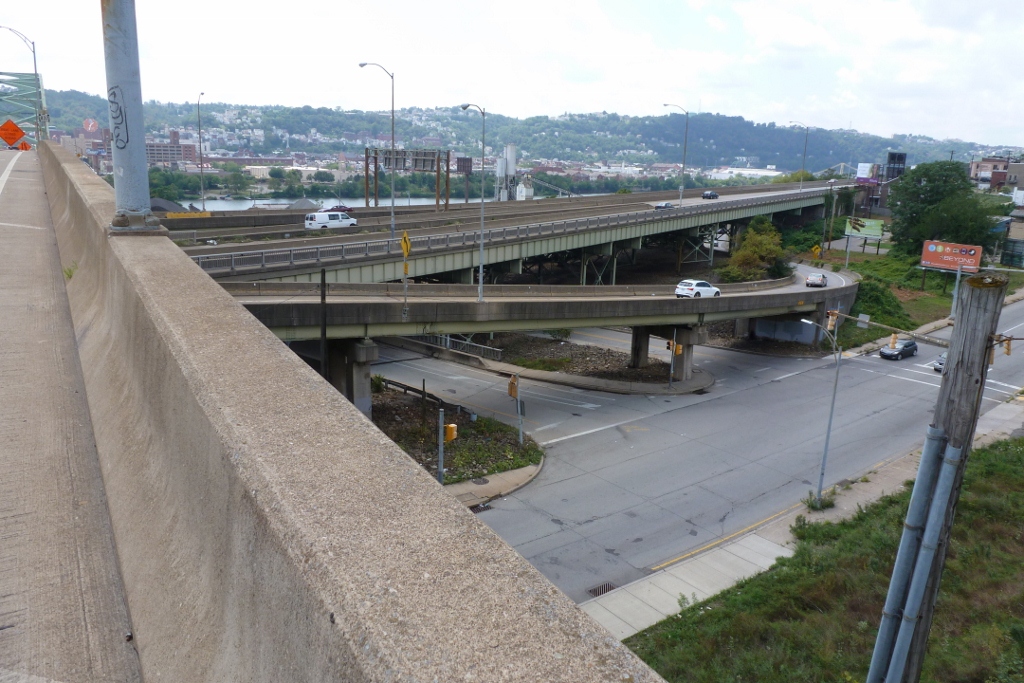
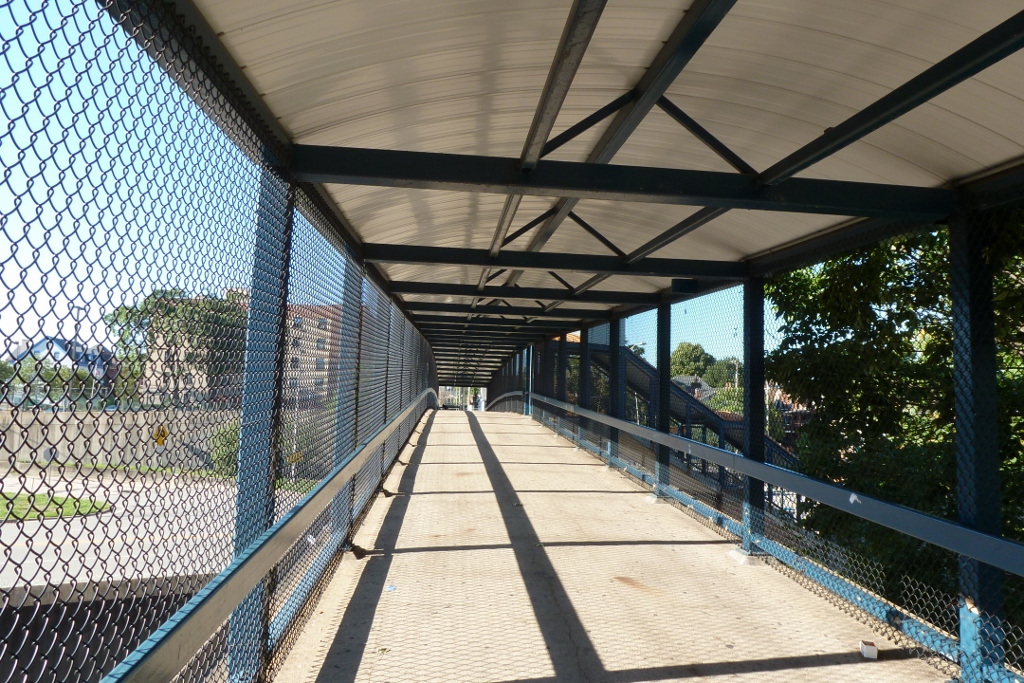
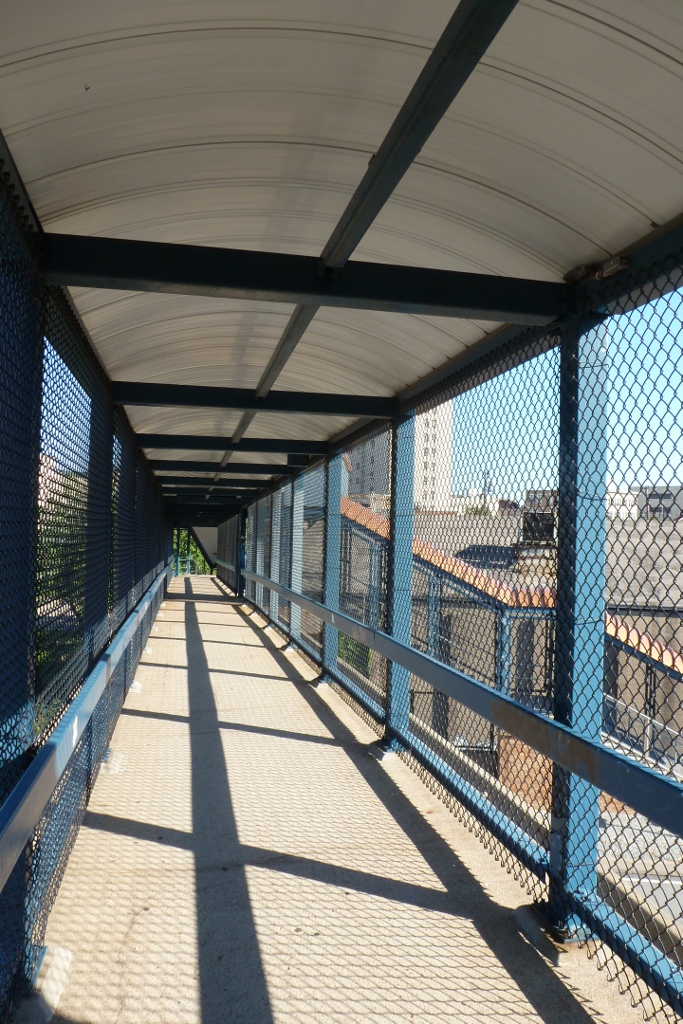
For those who may not want to walk the 6th Street Bridge (click to view June 14th’s post) to get from downtown Pittsburgh to a Steelers or Pitt football game, the Fort Duquesne Bridge provides a pleasant alternative.  As the picture above indicates, the sidewalk is not directly connected to the bridge for most of the way.  The walkway starts from a pleasant path through Point State Park (which means crossing the Bridge Under a Bridge, June 15th’s post) and ends on the North Side about halfway between PNC Park and Heinz Field.

I was surprised by how new and clean this bridge appeared.  Before crossing, I had my doubts as to whether there was a pedestrian path across the Allegheny at this point as Fort Duquesne Bridge carries one of the interstates and pedestrians and interstates do not usually go together.  At first I thought the newness of this pedestrian bridge accounted for the presence of the pedestrian access, but then I saw the sidewalk to nowhere on the Fort Duquesne Bridge itself.

This suggested that at the time the bridge was built in the late 1950s and early 1960s, people were not quite as adverse to having pedestrians and interstates share infrastructure.  However, this is evidence of the violence of the feelings against such an arrangement today.  PGHbridges.com has a picture of this severely truncated sidewalk that includes a remnant of the staircase that used to lead to it.  I do not believe that the staircase remnant exists any longer.  When I saw the sidewalk to nowhere I looked around for some sign of where it used to go and did not find any, but I cannot remember if I looked down.  I have walked around the part of Point State Park near where the staircase would have been several times and never noticed any steps.  I will look carefully the next time I am there to make sure they have been completely removed.

While I have been referring to the Fort Duquesne Pedestrian Bridge as new, it is actually over 10 years old.  Though I have not been able to find an exact date for its construction and/or opening, it was in use before the demolition of Three Rivers Stadium in 2001.  (Here are two YouTube videos of the demolition: one and two.  I find it fascinating that the demolition was celebrated with fireworks.)  A website with directions between North Side, Point State Park, and the Duquesne Incline refers to the “new pedestrian bridge” that provides access to Three Rivers Stadium accompanied by a photo of the stadium taken before the start of the construction of Heinz Field in 1999.  This website has no dates, but based on this information the pedestrian bridge must be over 13 years old, which I suppose is still fairly new for a bridge, but it is older than I had imagined.

There is a nice view downriver from this bridge.  Several famous Pittsburgh sites are included in the view: the Point, the Duquesne Incline, and Heinz Field.  Other sites of interest in this view are the Carnegie Science Center, the West End Bridge, and the remnant of a former bridge across the Allegheny.  The view upriver is partially obstructed by the wire mesh fence along the interstate bridge.  I did get a couple of shots that you can mostly make out what is there.  One shows downtown Pittsburgh and the other shows the bridges upriver including the Three Sisters (see June 14th, June 21, and June 22 post) and a railroad bridge.  There is an item of interest I want to point out in this second view: just about in the middle of the frame, the domes of the Immaculate Heart of Mary Catholic Church on Polish Hill.  This is one of my favorite buildings in Pittsburgh, because of its unique green domes that are a significant landmark visible for miles up and down the Allegheny River.


I have to add that I chose the name for this post (A Sidewalk to Nowhere) before I was aware that the Fort Duquesne Bridge’s nickname is “The Bridge to Nowhere.”  While the pedestrian bridge attachment connects two points, the Bridge itself does not directly connect any points of interest.  Instead it ferries cars from one interstate to another.  The north end of the bridge continues onto elevated ramps in between various highways and freeways.  The south end connects seamlessly to the Fort Pitt Bridge and Tunnels by way of the Portal Bridge (mentioned in June 15th’s post) and though there is also some access to downtown it is directed to the roadways along the rivers that permit cars to bypass downtown.

A power station and Sherlock Holmes

The Battersea Power Station intrigued me from the first glimpse I got of it.  The smoke stacks first entered my frame of view at the Battersea Bridge (see June 15th post).  I kept my eyes on the building as I got closer to it and was thrilled to get such a close view.  I couldn’t tell from the early views of it that it was on the river.  It was obviously empty as I could see sky through some of the windows.  However I did not know what it was.  While large, empty, industrial buildings intrigue me, I don’t know enough about them to identify their previous purposes.  This one used to be a power station built in the 1930s and closed over the 1970s and 1980s.  The National Heritage website indicates that building was to be adapted to new uses starting in 2005 and a BBC article said the building was to open as a new shopping and etc. complex in 2009.  I did not see any signs of any use of the building when I passed, so I’m assuming these projects have yet to come to fruition.

After returning home from my trip to the UK, I received Sherlock Season 2 on DVD.  One of the best parts of the season was in the first episode “A Scandal in Belgravia” where a sequence took place at the Battersea Power Station, which I instantly recognized, from having spent so much time staring at it while walking past it along the River Thames.  This has been one of my favorite parts about my trip to the UK, now when I watch my British TV or read my British literature I recognize and understand the locations more from having seen them in person.

I did have a false call with this over the weekend.  I was reading “For all the Tea in China” by Sarah Rose which talked about the Chelsea Physic Garden.  I immediately said, “I know that place, I remember walking past it.”  However, when looking at pictures of it online, I realized that I passed by the Physic Garden completely oblivious to its presence.  What I remembered walking past was the Chelsea Flower Show grounds, which were being set up for a big show, that the gardeners were a little concerned about due to the excess rain the UK experienced this spring.

Chelsea Bridge, London


The part I most enjoyed about the Chelsea Bridge was the four golden ships, two at each end of the bridge.  I only took two pictures of these ships.  I originally was only going to take one as I assumed that they were all different, but I took a second when I noticed the coat of arms below the ships were different on each side.  The first one is the coat of arms of London and the other one is the coat of arms of one or some of the boroughs.  Like the Albert Bridge, the 19th century Chelsea Bridge had structural issues.  Unlike the Albert Bridge, the Chelsea Bridge was demolished and rebuilt in the 1930s.  The red and white color scheme, while not as striking as the Albert Bridge’s pink, green, and blue scheme, does also catch the eye.  I suppose this may serve a similar purpose of making the bridge visible under challenging visual conditions.

Similar to the Albert Bridge, the view from the Chelsea Bridge encompassed mostly modern buildings among the trees lining the river embankments.  The Battersea Power Station, now vacant, was one of the oldest buildings visible from the bridge.  (Watch for an up-coming post with more on the power station and Sherlock Holmes.)


An interesting tidbit I discovered while looking up the Chelsea Bridge online is that Billy Strayhorn composed a song entitled Chelsea Bridge.  Apparently the piece is misnamed as Strayhorn was inspired by the image of the Battersea Bridge, which he identified at the Chelsea Bridge.  While I am not familiar with Strayhorn’s work, I am intrigued by this connection as Strayhorn went to high school in Pittsburgh and started his career here.  A local theater, the Kelly-Strayhorn Theater, is named in his and Gene Kelly’s honor.  (Gene Kelly also went to high school and college in Pittsburgh.)

Albert Bridge

The Albert Bridge, opened 1874, was my favorite London bridge.  Who came up with the idea to paint a bridge pink?  The color scheme looks perfect for a nursery and really bizarre for a bridge particularly one named after Prince Albert.  According to Wikipedia, this color scheme is rather new, the bridge having been painted pink, green, and blue in 1991 to increase the visibility of the bridge in foggy and other low visibility conditions.  This is one of those incidents where the facts are disappointing–I had been imagining all sorts of reasons for the color scheme, including that these three colors were Prince Albert’s favorite or that these colors were chosen specially to symbolize aspects of Prince Albert’s personality or accomplishments.

As this sign indicates, the Albert Bridge is not the most structurally sound and the force of troops marching in step could be enough to bring the bridge down.  Despite the structural deficiency of the bridge, it is one of the only bridges across the Thames in London to be still the original structure (more or less).  It has been renovated and reinforced on multiple occasions, but never demolished and rebuilt.

It seems possible to create a convincing argument for how the Albert Bridge symbolizes Prince Albert.  The bridge is unstable and the colors are not traditionally considered masculine.  Prince Albert was a man who struggled as the husband of Queen Victoria.  This marriage suffered from tensions between the idea that the man was the “head” and “ruler” of the family and the fact that in this case the woman was the head and ruler of an entire empire, so how could her husband be the head and ruler of her? (Particularly since he was German and the ruling British classes were very suspicious of and against any influence from the Germans.  “Victoria and Albert” (2001) is a good film about the love and tension in this marriage.)  Prince Albert had to deal with feeling less manly and powerful, at times, than he wished, while the bridge named after him is less strong and serious-looking than most other bridges.

Most of the buildings visible from the Albert Bridge were of new or modern construction and appeared to be used mostly for residential or office use.  One industrial site was visible to the west past the Battersea Bridge in the form of a factory near Chelsea Harbor.  There were also many boats parked in the Thames near the Albert Bridge; I don’t know if they were houseboats, fishing boats, or something else.


A Bridge under a Bridge

This pedestrian bridge is located in downtown Pittsburgh.  As best as I can tell, this bridge was built in the early 1960s.  The upper bridge is called the Portal Bridge, carries one of the interstates over the Point, and does not have pedestrian access so I will not be walking it or posting about it.  The pedestrian bridge does not have its own name and is not included in PGHbridges.com’s list of bridges in Pittsburgh.  It crosses over a reflecting pool to connect the two parts of Point State Park which are divided by the highway.  It is the only access point from downtown to the park.

The Point hosted both British (Fort Pitt) and French (Fort Duquesne) forts early in its European history.  (The outlines of these forts are laid out on the grounds of the park.)  This area became a railroad and warehouse district before the first (we are apparently now on our third) “Pittsburgh Renaissance” in the 1930s/40s/50s at which time it was turned into a park with the interstate transecting it.

The view above is looking toward the pedestrian bridge and the park away from downtown.  This side of the bridge is a large, unexciting field.  During festivals and events there will often be tents and kiosks here.  On the other side of the bridge are the interesting parts of the park.  My favorite feature is the fountain, which unfortunately has been turned off and under reconstruction for the last three years.  According to a press release, the fountain will be back in working order next summer and better than ever.  Also found on the other side of the pedestrian bridge is the Fort Pitt Museum (which I believe I went to once and keep saying I should visit again), the steps along the Allegheny River used for watching boat races and the Three Rivers Regatta which will be held June 30-July 4 this year, and some tree-lined walks.


Battersea Bridge

The Battersea Bridge was the first bridge in London that I walked across.  The bridge, built in 1890, connects the London neighborhoods of Kensington & Chelsea (north of the river) and Wandsworth (south of the river).  The north side had traditional, classic architecture, but the south side had some newer developments.  From the bridge looking west, I saw a bridge for the tube and several modern developments.  To the east, I saw the Albert Bridge, the Battersea Power Station, and the Shard tower then under construction.

I enjoyed this bridge.  I appreciated its simple, yet stately design.  The traffic was low, though this might have had more to do with the time of day (Sunday afternoon) than any other factor.  There were two sights near the bridge that particularly caught my attention.  The first was a statue of Sir Thomas More on the north side, with gilded face and hands, a style not familiar to me.  The second was a seemingly random statue of a flying goose just off the south end of the bridge.

The name of Battersea intrigued me, so I did a Google search to try and find the origin of the name.  The result was that there is no known origin.  The possibilities included an Anglo-Saxon term meaning Badric’s Island, battles that were fought in the river at low tide when the river was fordable, and an evolution of spellings from a term meaning St Peter’s water or river.

Three Sisters: 6th Street Bridge

Originally, I thought I would write one post about the Three Sisters Bridges in Pittsburgh as they look identical and are so close together that their views of the city would not vary much.  However, after walking them, I decided that the 6th Street Bridge has enough going for it to deserve its own post.  (The other two Sisters are the 7th and 9th Street Bridges.)

The 6th Street Bridge is very active (much more so than its two sister bridges) and as such, I have walked over it multiple times.  It connects Downtown to the North Shore right next to PNC Park (the Pirates baseball stadium).  On game days the bridge is often closed to vehicular traffic, so that people who park, live, or work downtown as well as those who take public transit downtown can walk to the stadium across the bridge without crowding the sidewalks.  I believe this is true for baseball games as well as football games, both University of Pittsburgh and Steelers, down river at Heinz Stadium.  This bridge is also closed off to vehicles as part of the route for Pittsburgh’s annual Turkey Trot, which I participated in last year with several members of my family.

In my walk across the Three Sisters, I found additional reasons beyond the special closings of the bridge for writing about the 6th Street Bridge separately from the other two.

First, I discovered that the bridges are not completely identical.  In 1928, the 6th Street Bridge won the Most Beautiful Steel Bridge Award.  After crossing the Three Sisters, I agree that the 6th Street Bridge truly is the most beautiful (at least of the three).  This is because of the light fixtures.  The 7th and 9th Street Bridges have normal, ordinary street lights painted yellow, whereas the 6th Street Bridge has classic black posted street lamps (see image below).  Though all three had hanging flower baskets, the difference in the lamps made the flowers on the 6th Street Bridge look more vibrant and beautiful than those on the other two bridges.

The second reason for discussing the Three Sisters Bridges separately is because they each have alternate names.  The 6th Street Bridge is also called the Roberto Clemente Bridge.  The bridge was renamed in the late 1990s.  Roberto was a former Pirates player, who I remember learning about in elementary school as being an important force in combating racism in sports.  There is a plaque honoring Roberto on the bridge.

Another piece of interest about the 6th Street Bridge is that Kayak Pittsburgh is located underneath the bridge on the north side.  Ever since I moved to Pittsburgh, I’ve heard of Kayak Pittsburgh and its location, but I could never truly understand where it was.  The hut on the water near the bridge that I thought was Kayak Pittsburgh for years is actually the shed for river emergency services.  When I walked over the 6th Street Bridge this time, I approached it from the Three Rivers Trail on the north side, and finally saw Kayak Pittsburgh.  The last time and perhaps only time I was on that part of the trail was the middle of winter, so there weren’t any kayaks or kayakers to see.