The Last Allegheny River Bridge

The last bridge across the Allegheny I needed to cross was the 62nd Street Bridge.  While the approach to the bridge less than inviting, the bridge itself was surprisingly pleasant to cross.  The approach was a skinny sidewalk overgrown and broken in spots connected directly to a very fast-paced road.  This approach is similar to the one for the Highland Park Bridge (see June 10 post).  For this reason and because the 62nd Street and Highland Park bridges are the two farthest from downtown on the Allegheny, I compared the experience of walking across these two bridges.  The 62nd won by a long shot.  Its sidewalk is much wider and it has sidewalk on both sides.  The Highland Park Bridge has a high mesh fence enclosing you in, while the 62nd Street Bridge has a shorter waist-/chest-height railing similar to those on the 31st and 40th Street bridges (see July 19 and July 20 posts).  The traffic was also much lighter on the 62nd compared to the Highland Park Bridge, although I imagine that at rush hour the 62nd might get busier than when I crossed it.

I was surprised that there is still a good view of downtown from the 62nd Street Bridge.  The river bends quite a bit before getting to 62nd Street, so much so that the 40th Street Bridge is not visible from the 62nd.  However, there is a significant stretch of flat land on the southern shore which permits the view of downtown from the northern end of the bridge, by the middle of the bridge only part of downtown is visible, and by the southern end downtown is hidden from sight.

While most of the area surrounding the bridge is industrial or former industrial, the northern end connects to the edge of Sharpsburg, PA, which has a couple interesting looking churches and likely housed industrial workers for many years.
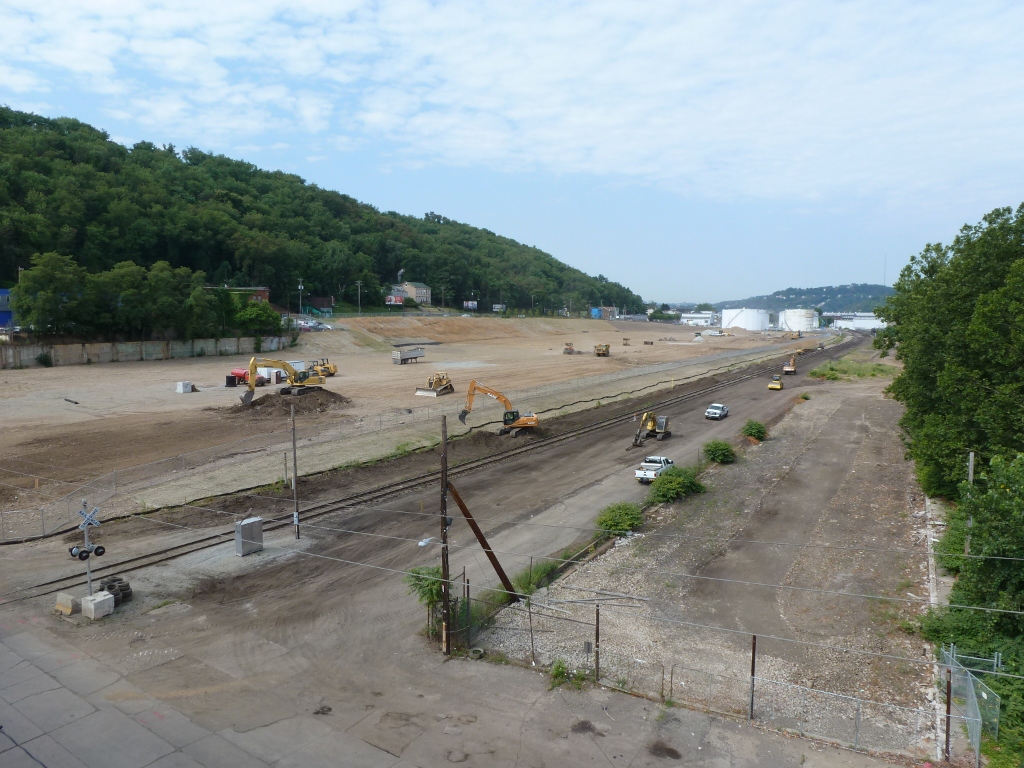
The 62nd Street Bridge also passes by a future site of redevelopment.  I thought I read somewhere last summer about something interesting that was planned for this site, yet when I searched for it today, I could not find what I thought I was looking for.  However, there looks like there is a different interesting story connected with this site.  It seems the site is being considered for a distribution center for the company trying to redevelop the parking lots and produce terminal near the 16th Street Bridge (see July 14 post).  The Post-Gazette has an article explaining that not only does Councilman Dowd have issues with the redevelopment in the Strip (the 16th Street Bridge area), but he also has issues with this redevelopment scheme.  I was sorry to learn that the plans for the site are leaning away from something interesting and more publicly accessible such as a park/retail area.  However based on the surrounding area, it makes sense.  There are only a very few residences nearby and what traffic that does come by is looking for a quick way to get between other points in the city and surrounding region.  Also, there is very minimal bus access to the site.  (There used to be more when the site belonged to the bus company, see article.  There are still bus stop signs along Butler Street from this time.)

Here’s one final note on the 62nd Street Bridge.  Like many of the numbered street bridges, this bridge has an alternative name (see posts on 6th Street, 7th Street, 9th Street, and 40th Street bridges).  The 62nd Street Bridge is also known as the R.D. Fleming Bridge.  For years, I have assumed that R.D. Fleming was in the medical profession, he name suggested medical to me when I was in grade school and the idea has stuck for years.  It would make sense as Pittsburgh has a good reputation for things medical.  However, it turns out that R.D. Fleming was a Republican senator whose district included the region near the bridge.  I could not find an explanation for why this former senator, of all the former senators Pittsburgh has had, was honored by having a bridge named after him.  If anyone knows what made him unique, please share.

OH, Cleveland!

I spent my freshman year of college in Cleveland, OH.  University Circle, the neighborhood my campus was in, was beautiful and pleasant, but the rest of the city stuck in my mind as rather ugly and dull.  In fact, my friends and I referred to it as “the city that always sleeps.”  Outside of campus there didn’t seem to be anything to do, particularly after 7 p.m.

I often compare Cleveland and Pittsburgh in my mind and for years, Cleveland came up the less favorable of the two.  This is in part due to the unfavorable impression I developed of downtown Cleveland while in school there and in part due to the vast fields of vacant lots that separate downtown from University Circle.  In the last couple years, I made several quick trips to Cleveland.  Every time I come home more amazed by the city.

First, I started noticing the street art and fancy trash cans.  The next trip, I was awed by Cleveland’s BRT (Bus Rapid Transit) system.  Pittsburgh’s bus system is loosing routes and cutting back on service hours and here Cleveland was able to institute a BRT with fancy new buses, new bus shelters at every stop along the BRT route that include fare boxes and electric signs that tell you how many minutes until the next bus arrives, and dedicated lanes and traffic lights for the BRT.  Last weekend when I visited was the first time I’ve spent any significant amount of time walking downtown and I was impressed with what I saw.

There is vacant property all over the city.  Cleveland’s population decline over the last 60 years was much more severe than Pittsburgh’s.  It went from a peak of around 900,000 to just under 400,000 in 2010, whereas Pittsburgh only got up to 600,000 and fell to 300,000.  Yet, downtown, the city’s managed to still look beautiful despite the vacant buildings with greenery such as the garden in the road divider above.

I saw another method for reducing the blightedness of vacant properties in another part of the city 8 miles from downtown.  Here they placed art installations in vacant lots that were for sale.

Things definitely seem to be looking up for Cleveland.  I read recently that the County Executive for Cuyahoga County (Cleveland) met with the one for Allegheny County (Pittsburgh) to pick up some tips on how to help turn a struggling rust belt region around.  However, I think that Pittsburgh/Allegheny County could pick up some tips from Cleveland/Cuyahoga County.

A Bridge under a Bridge

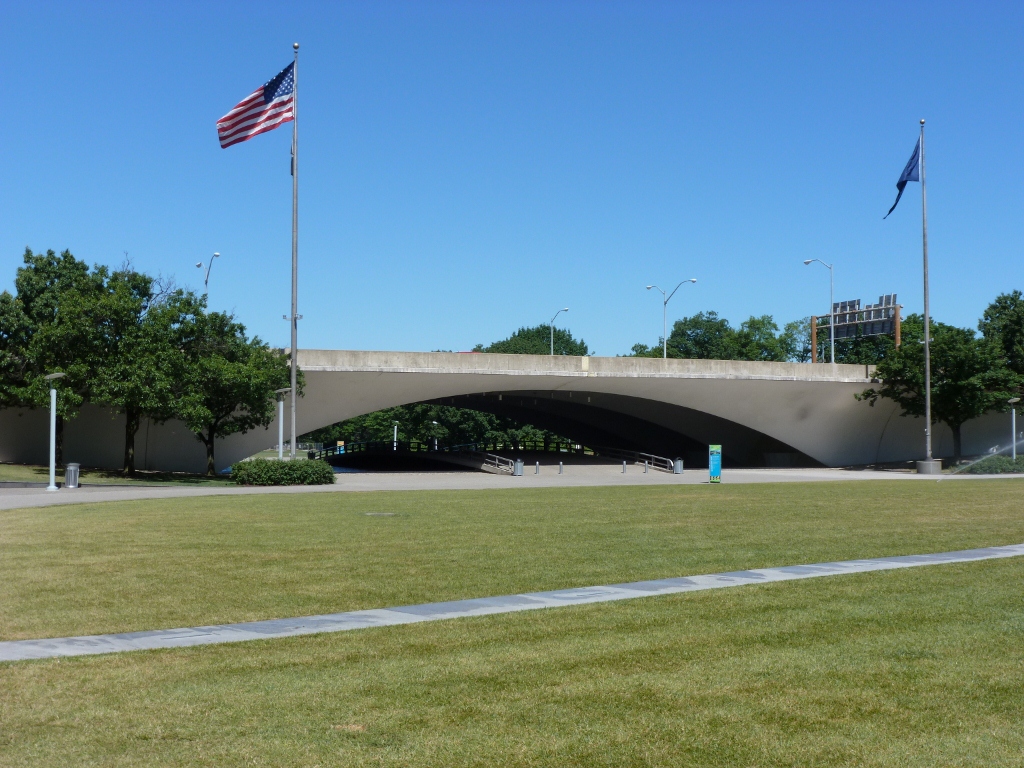
This pedestrian bridge is located in downtown Pittsburgh.  As best as I can tell, this bridge was built in the early 1960s.  The upper bridge is called the Portal Bridge, carries one of the interstates over the Point, and does not have pedestrian access so I will not be walking it or posting about it.  The pedestrian bridge does not have its own name and is not included in PGHbridges.com’s list of bridges in Pittsburgh.  It crosses over a reflecting pool to connect the two parts of Point State Park which are divided by the highway.  It is the only access point from downtown to the park.

The Point hosted both British (Fort Pitt) and French (Fort Duquesne) forts early in its European history.  (The outlines of these forts are laid out on the grounds of the park.)  This area became a railroad and warehouse district before the first (we are apparently now on our third) “Pittsburgh Renaissance” in the 1930s/40s/50s at which time it was turned into a park with the interstate transecting it.

The view above is looking toward the pedestrian bridge and the park away from downtown.  This side of the bridge is a large, unexciting field.  During festivals and events there will often be tents and kiosks here.  On the other side of the bridge are the interesting parts of the park.  My favorite feature is the fountain, which unfortunately has been turned off and under reconstruction for the last three years.  According to a press release, the fountain will be back in working order next summer and better than ever.  Also found on the other side of the pedestrian bridge is the Fort Pitt Museum (which I believe I went to once and keep saying I should visit again), the steps along the Allegheny River used for watching boat races and the Three Rivers Regatta which will be held June 30-July 4 this year, and some tree-lined walks.