Pittsburgh’s Bragging Rights

I mentioned previously that I totally geek out over maps.  I recently came across a fascinating “new” map called The “Z” Atlas & Map of Pittsburgh, PA, and Mount Oliver, PA.  I am adding it to the Sanborn Maps and GM Hopkins Maps as a go-to for studying the changes Pittsburgh went through in the 20th Century.  The “Z” Atlas was published in 1952.  There are two things about this map that caught my eye as setting it apart from others during my initial perusal.

First, in the street index, it identifies which streets have unusual addressing.  Pittsburgh is known for some unique addressing situations.  For example, there is a block where houses built before WWII have 1300 numbers and the ones built after WWII have 1400 numbers, even though they are intermixed.  This atlas shows that the post WWII houses were built after 1952 because the address numbers on that street weren’t wonky yet.

Second, this map claims that “Pittsburgh has more streets than any City in the World. You will find EVERY ONE of them in this ‘Z’ Atlas and Map!”

“Preposterous,” I said, when I first read that claim.  Pittsburgh’s land area is small compared to other large metropoles.  It does not make Wikipedia’s current list of the 150 largest US cities by land area.  Without digging into census data, I assume that many of the old cities (ex. New York City, Chicago, Cleveland), if not most of the 150 listed, likely were of a similar size in the 1950s as today.  How could it be possible for Pittsburgh to have more streets than these cities that are significantly larger?

Then it hit me.  It is possible by the same token that makes it possible for Pittsburgh to have more bridges than any other city in the world, more steps than any other city, and the steepest paved street in the world: topography.

Pittsburgh’s many hills, ravines, cliffs, and rivers mean there are few long streets and many short streets.  Maybe after all, Pittsburgh did have more streets than any other City in the World in 1952.  Reading more of the “Z” Atlas, it elsewhere explains that Pittsburgh had over 6,000 streets at the time of the map’s publication.  That number does include the numerous “paper” streets that were surveyed and mapped, “but never built or even marked in the dirt.”

Many of these paper streets still exist today causing headaches for the City and its citizens, but some have been vacated and turned over to private ownership.  Between that and the rise of mega-cities since the 1950s, I won’t say that Pittsburgh can still claim more streets than any other city.  A quick Google search showed that the question of what city has the most number of streets is not as well discussed as what city has the most bridges.  Perhaps a more ambitious person than myself could run an analysis to see whether Pittsburgh still has more streets than any other City in the World.  (Don’t forget to count the step streets!)

Flood Measures

P1060955

There is an enormous floodwall on the Covington, KY, side of the Roebling bridge, which spans the Ohio River.  It shocked me to see such a huge wall when I was there last year.  I wondered if there couldn’t have been some other means of flood control that would not have produced such a large barrier.  It reminded me of the significant physical barriers to the waterfront that I observed in Erie, Pittsburgh, Homestead, PA, and Cleveland.  Unlike Erie, Homestead, and Cleveland, Covington did not have any significant economic drivers separated from the town by the barrier wall.  The river side only had a small park and parking lot.

In addition to acting as a barrier, the sheer massiveness of the flat concrete wall bothered me.  I wanted to see it broken up into staggered segments, even though I knew that would not be useful in a structure intended to block the path of water.  However, Covington handled the flat wall with style by turning it into a canvas for a giant mural.  Almost as long as the wall itself, this mural depicts the history of the crossing at this location from 8000 BCE to the present day.  While the mural did not help with the scale of the wall, it broke the monotony while turning it into a destination for its own sake.

In the back of my mind, this wall continued to bother me until observing the effects of the significant flooding experienced in Pittsburgh this year at the forks of the Ohio River (see Checking on the Rivers and The Aftermath).  A google search showed me that the flooding Pittsburgh experienced in February this year also affected the Covington-Cincinnati region in the worst flood in that area since 1997.  The concept of a wall still bothers me, but this one probably prevents a lot of property damage and Covington has taken steps to soften its negative effects.

Engaging Riverfronts

P1060986

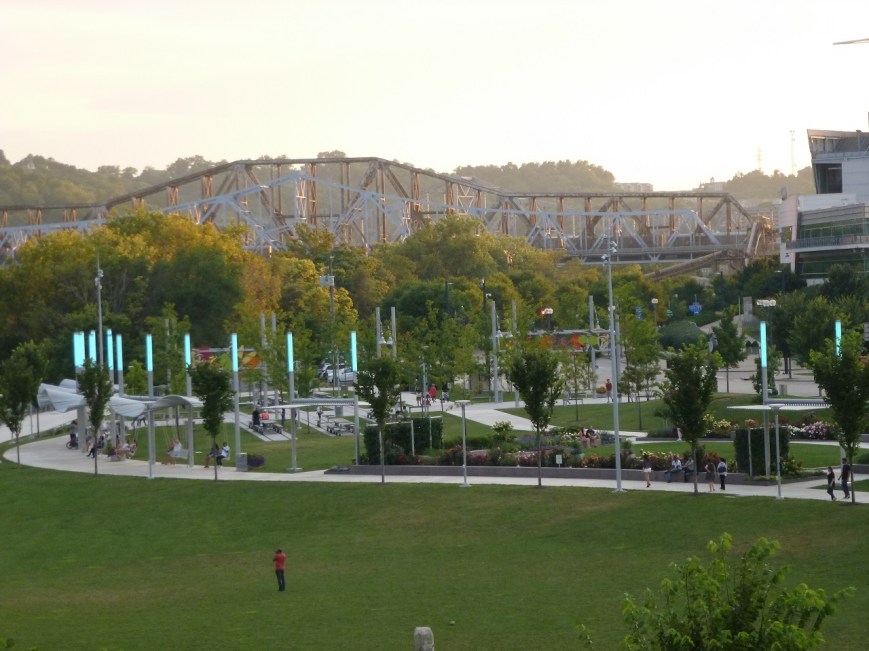
Cincinnati’s riverfront park with swings

There is a proposal in Pittsburgh to introduce a new feature to its riverfronts: swings.  I am excited about this possibility as a swing lover and as someone who wants to see more welcoming and engaging spaces along Pittsburgh’s rivers.  One of the inspirations for this idea are swings found in Cincinnati’s riverfront park.  Last summer, I happened upon that park in a search for bridges by Roebling.  On an ordinary summer evening, this enormous riverfront park was filled with people of all ages enjoying the various activities from walking paths to playgrounds to interactive art installations.

Previously, when walking around Istanbul, I experienced jealousy at seeing the number of parks with adult exercise equipment installed.  This sort of acknowledgement that adults enjoy playing outdoors as much as children seemed lacking in parks across the United States.  Cincinnati’s park showed me that inviting adults to play outside is embraced in some parts of our country.

Pittsburgh has kayak and bike rentals for adults to play outside.  The walking trails, Fountain at the Point, and Watersteps attract people to enjoy the outdoors and the rivers.  However, if this swing proposal pans out, Pittsburgh may move up into the next tier of engaging outdoor spaces with the introduction of free play equipment for adults on par with Cincinnati and Istanbul.

Checking on the Rivers


20180220_131344

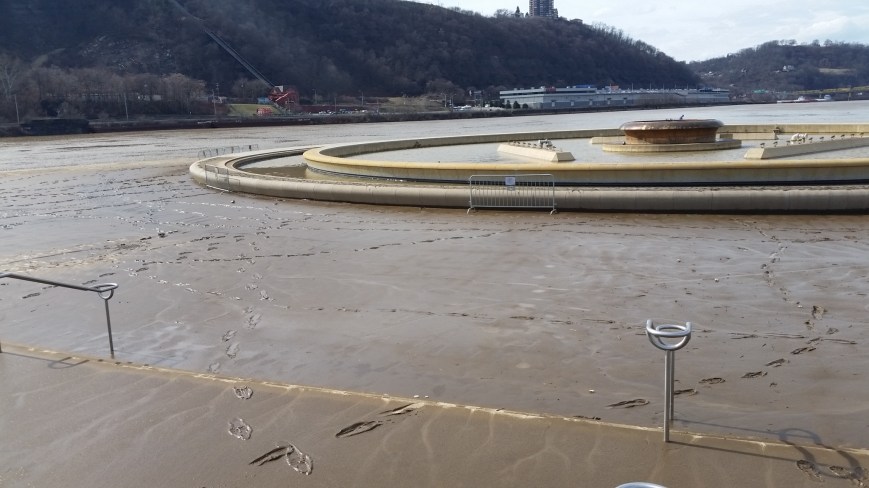
Silt deposit after the flooding rivers receded enough to uncover the fountain at The Point (February 20, 2018)


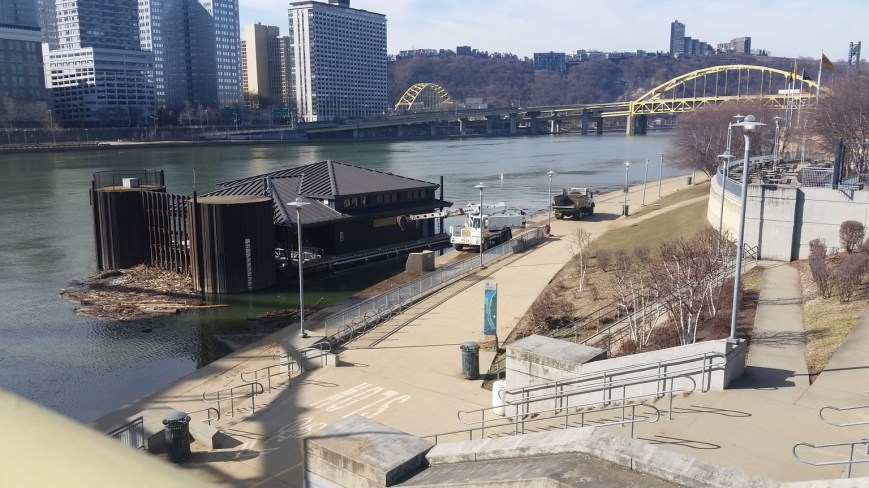
Over the last few years, I have developed a habit of “checking on the rivers” regularly by crossing them on my way to various activities or eating my lunch on their shores.  This habit started as a way to get a break from the office and clear my mind.  After having read several books by John Muir and James Fennimore Cooper, I found a deeper meaning in these “check-ups”.  Both authors wrote wonderfully descriptive passages of nature scenes and kayaking on rivers and oceans.  While crossing the Allegheny one day, something about the view recalled some of these passages.  I was filled with a sense of wonder and awe that this river running through the heart of our city is still the same force of nature described by Muir and Cooper in other locations, despite the man-made attempts at controlling it through dams and bridges and concrete lining the shores.

This winter, the weather patterns are reinforcing the power of nature as exhibited by the rivers.  During our cold snap over MLK Jr Day weekend, the rivers froze.  The Allegheny had some pockets of open water surrounded by thick ice, but the Monongahela froze all the way across.  Commercial traffic on the Monongahela started up again on Tuesday, breaking a path through the ice along the shipping lane, but on the coldest days that week, the channel remained clogged with chunks of ice that appeared to be refreezing together between shipments.  As the weather warmed up slightly, the rest of the river remained frozen, but the shipping lane cleared of ice, until it got cold again and refroze.

Marveling at the sight of the frozen rivers, I found myself beset by the feeling that impels people to walk across frozen bodies of water without knowing whether or not the ice is actually thick enough to hold you.

Since then, an extended period of unseasonably high temperatures and record pushing rainfall has brought on over a week of flooding and high water on the rivers. The fountain at The Point is supposed to have gone underwater at least twice in that time. Multiple roads and ramps downtown have been forced to close off and on due to high water. The highest I saw the water, a few hours before it’s first peak, it appeared to be within a few feet of the base of PNC Park.

Every time I pass by one or the other, I compare the water height against the familiar features. On the Monongahela, several of the trees lining the shore have been standing in water for days. I wonder how long they will hold out before they join the other logs floating down the middle of the swollen torrent. On the Allegheny, the trails on both sides of the river are either more or less under water. As I look down from the high perch of the bridges or the sidewalk along Fort Duquesne Blvd, I am amazed at how effortless it seems the water just slips over the edge of the trail. Whenever I’ve walked that same path, the water always seemed far below.

As I spent my lunch breaks this week running from one to another of the rivers to check on the effects of all this water, I laughed at my eager curiosity to explore these flooded shores compared to the terror I experienced as a kid when my Dad took my brother and I along on similar exploration of the flooded Delaware River. My heart clutched as the waters of the Delaware bubbled and gurgled inches from the road we traveled. When we pulled off to park and watch the water a uniformed personnel directed us to move to higher ground. That area was being evacuated due to the rupture of an ice dam upstream that released a 50 ft high wall of water expected to hit that part in 10-20 minutes. My Dad got us back in the car and headed up the road again at what seemed to me to be a snail’s pace. My eyes detected signs of the water being even closer to the level of the road as we went back the way we came. I only breathed freely again, when we reached a lookout off the Appalachian Trail hundreds of feet above the bed of the river. We waited and watched for a long time, but never saw the promised wall of water.

Ever since that day, my mind has contemplated the idea of a wall of water traveling down a river with interest trying to picture and understand how that would work. The extreme variations in the heights of Pittsburgh’s three rivers the last couple weeks are the closest real-life examples I’ve had of massive amounts of extra water flowing downriver. My curiosity is teased by this, impelling me to explore, urging me to go on, go closer. Yet, the fear of the water’s power still remains tucked up in the corners of my mind. It mingled with wonder and awe as I stood at the edge of the silt deposited by the rivers around the fountain at The Point.


Market St, Steubenville


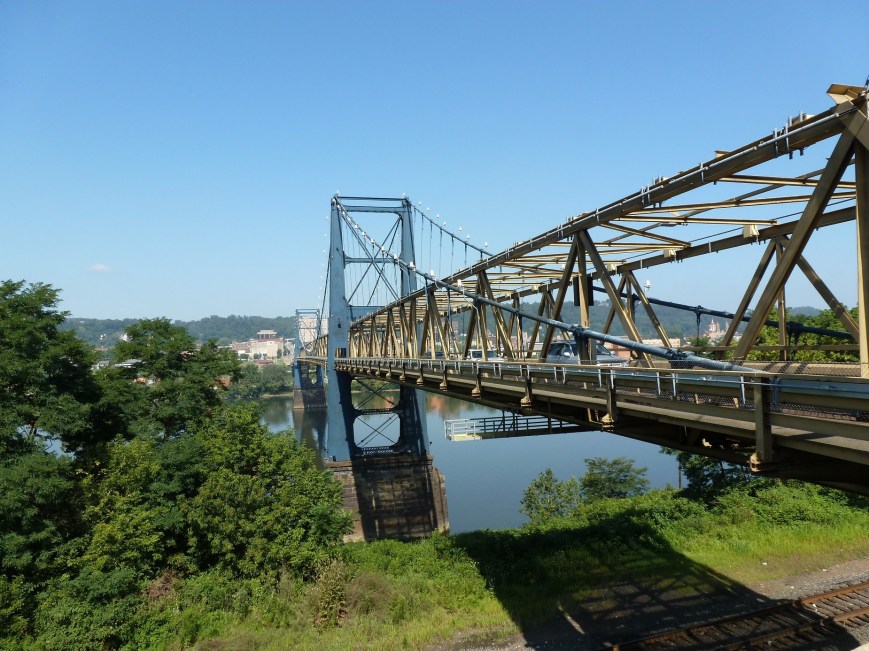
Market St Bridge

On a road trip this summer, one of the goals was to search out and walk interesting bridges.  The first bridge we stopped at was an unplanned eye-catcher.  We went to Steubenville in order to drive across the iconic Veteran’s Memorial Bridge.  Heading south from that bridge, our eyes were caught by this one.  So we took an unscheduled stop to walk across.

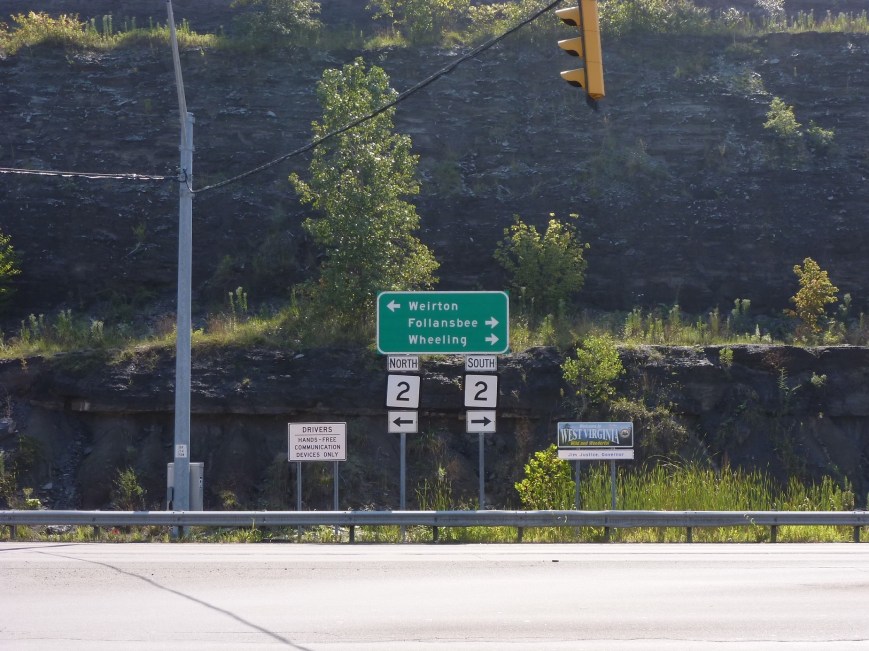
This is the Market Street Bridge in Steubenville, OH.  The best part about this bridge was that it marked the first time I walked across a state line by bridge.

West Virginia sign

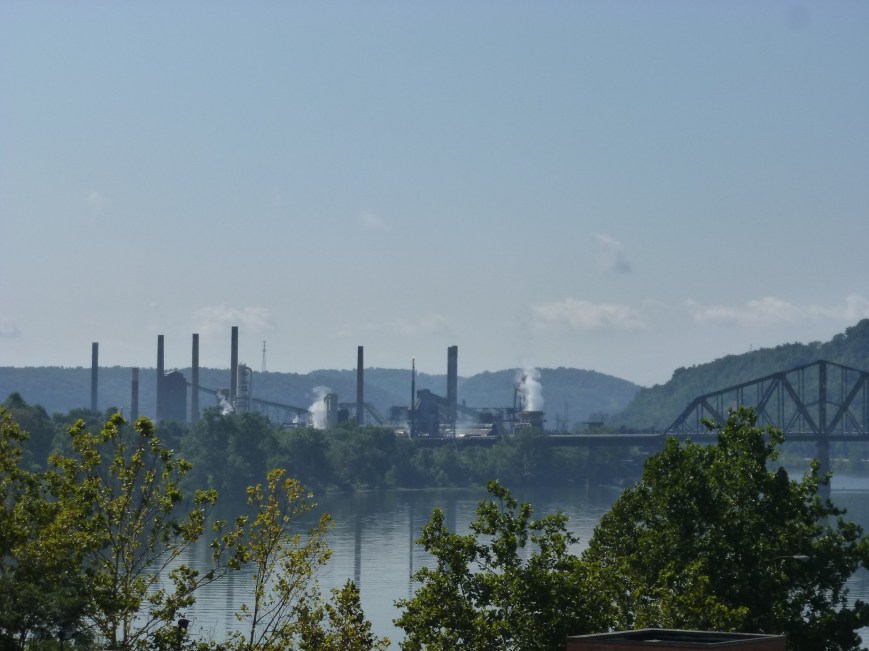
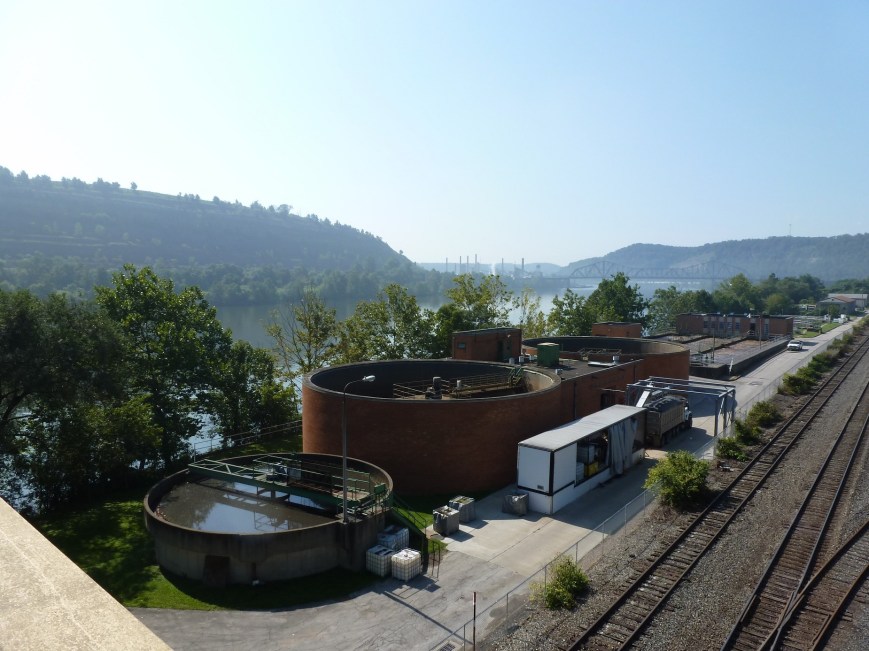
The other thing that fascinated me while walking this bridge was the uses on along the river.  On the West Virginia side, it was all wilderness at the end of the bridge, but further downriver an active mill could be seen.

Mill view

On the Ohio side, the feature river-side uses were the sewage treatment plant and the jail.

Sewage Plant view

Jail view

The innocent looking brick building is the Jefferson County Justice Center and Jail.  While I can image the sewage plant was probably a long standing use on the river side, the jail appears to be of more recent construction.  After a short internet search, I wasn’t able to find the date of construction of this building, but did find out that this was the third jail.  The second jail was built around 1950 and converted to offices when this building was constructed.  If I were to hazard a guess, I would say this third jail was probably built around the time that the Allegheny County Jail was built on riverside property in the Pittsburgh, PA.  That jail opened in 1995.

I find it fascinating that riverfront property has been used more than once to locate a jail.  Historically, industry settled along the rivers because that was either its main transportation or power source.  Recently, cities have been taking strides to reclaim their riverfront properties as economic boosters in the form of parks and entertainment venues or housing.  In both these scenarios, the uses are placed on the rivers due to the greater economic benefit to be gained from the interaction between the use and the river.  Placing a jail on a river seems contradictory to the view of rivers as the heart of a city’s economy (previously industrially based, now tourist based).

However, the rivers may confer a benefit of another sort to the use of the property as a jail.  When I was recently confined to a hospital room for a week, the sight of the small sliver of river that I could see from my window went a long way toward helping me stay sane.  It also prompted some more contemplation about the siting of hospitals in a way I had never considered before.  The view I had of the river was beyond a sea of parking associated with the hospital and partially blocked by the buildings for a water treatment facility.  There was little of interest to see in the immediate vicinity.  I hope that in the case of the jails, the river view windows are for rooms and the non-river view windows are for offices and/or back-of-house operations.