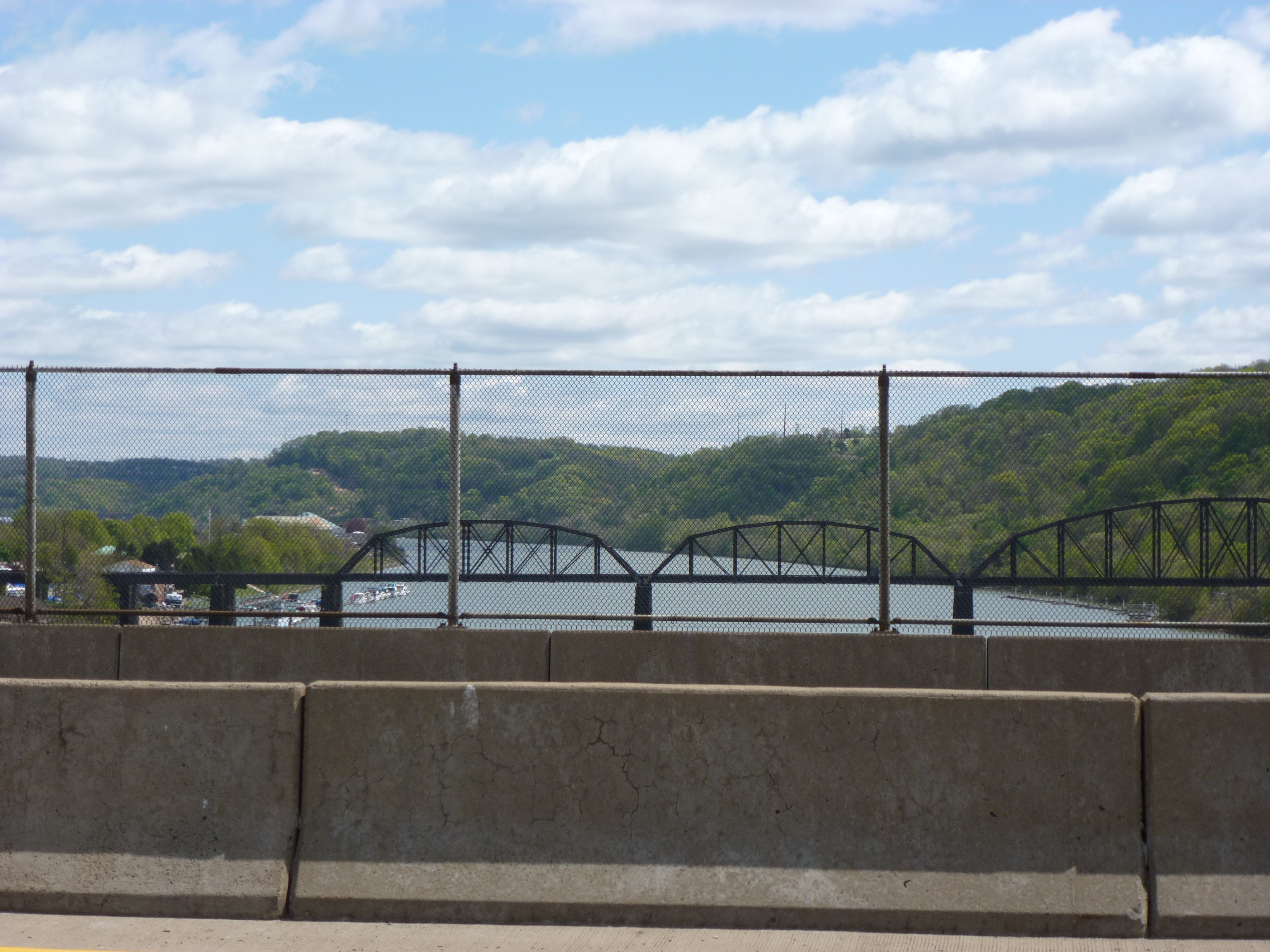
Isolated Waterfronts

In October 2012, I spent a few days in Erie, PA, to attend a conference.  Before arriving, I had looked at the map to figure out how to get from the bus station to my accommodations to the convention center.  On the map it looked pretty straight forward and simple.  All the places I had to get were within a mile of each other—piece of cake.  I often walk that far just to get to a bus in Pittsburgh.  Shortly after arriving in Erie, I realized that purely considering distance does not capture the true picture.  The seemingly short mile-long paths that I had to take included significant geographical and man-made barriers.
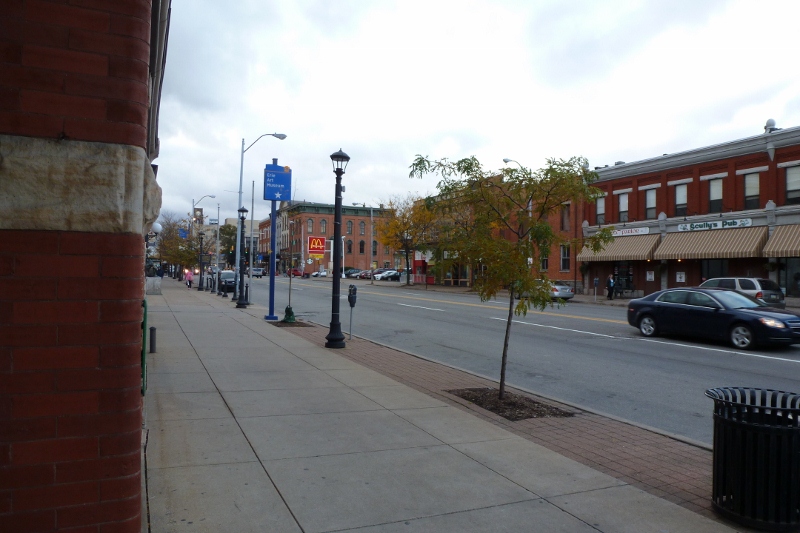
The main drag ran up through the town and straight out to the waterfront ending at the convention center hotel.  From the town square (6th Street), most of the buildings are flush with the sidewalk, except for the parking-lot-centric McDonald’s in the middle of these older buildings.  At 3rd Street, this changes.  The next two blocks are dominated by the campus of a UPMC hospital.  Then the barriers come.
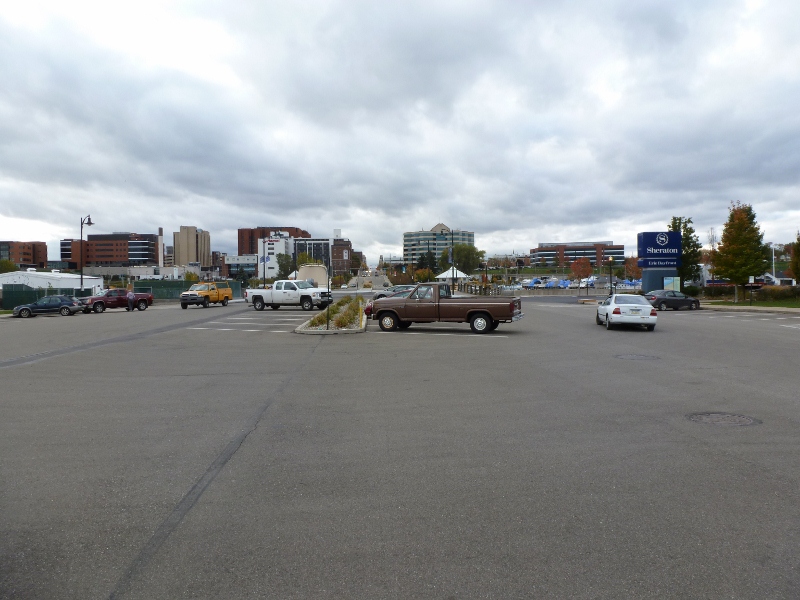
First there is a small hill down toward the waterfront, then a wide parkway, followed by a barren strip of land on one side of the road and a marina on the other.  Finally, there is the convention center hotel.  Of course you have to pass the long parking garage, the lobby and rooms of the hotel, go up an elevator across a pedestrian bridge over the entrance to the marina, and down another elevator before you get to the convention center.

I was staying in a Bed and Breakfast near the town square, so several times a day I walked back and forth along this route to attend the conference events.  Even though the walk was only about a mile long, it seemed to take forever because of the barriers of the hill, road, vacant land, and water.  After going back and forth a few times, I realized that the set up was not much different from what I had seen in Cleveland this summer.  That city also has a major roadway cutting off the town from the shores of Lake Erie.  This road of course was much bigger than the one in Erie as the city is correspondingly bigger.

Despite the fact that there is a major freeway dividing the waterfront from downtown Cleveland, I still felt welcome to cross this barrier to reach the waterfront park or the Rock ‘n’ Roll Hall of Fame.  In Erie, I got a very clear impression that the downtown residents were not welcome to cross the barriers to get to the convention center/hotel or the little public jetty next to it and that the visitors at the hotel/conference center were not encouraged to explore into downtown Erie.  This situation seems to defeat part of the purpose of convention centers to bring economic benefits to the surrounding area, by bringing in more people to use local services.
Pedestrian Bridges: Bigelow Blvd

There is a pedestrian bridge across Bigelow Boulevard at the Bloomfield Bridge.  I walked this bridge before I started this blog and didn’t think to take a picture of the bridge itself.  Its appearance is similar to the Graham Street Pedestrian Bridge (see post) except that the fencing doesn’t connect overhead and does continue along the stairs.

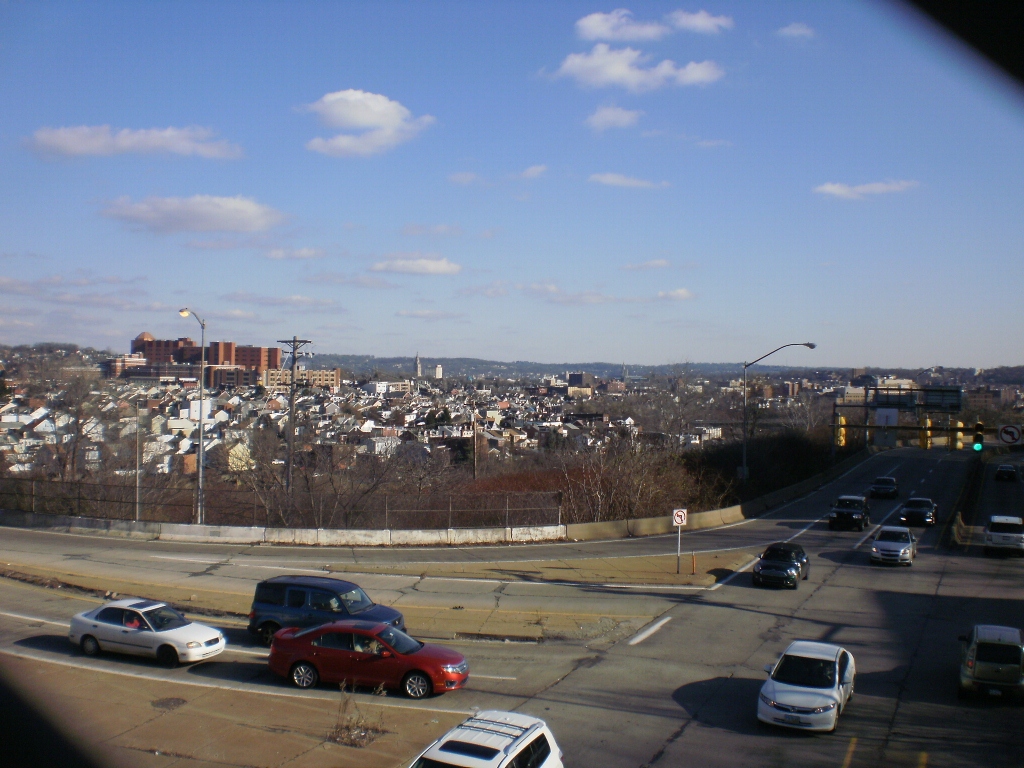
The picture above is from the Bigelow pedestrian bridge looking out over Pittsburgh’s East End.  The large brownish building on the left is West Penn Hospital in Bloomfield.  In the middle of the frame are two white points standing above the other buildings.  These are the steeple of East Liberty Presbyterian Church on the left and the Highland Building, also in East Liberty and designed by Daniel Burnham, on the right.

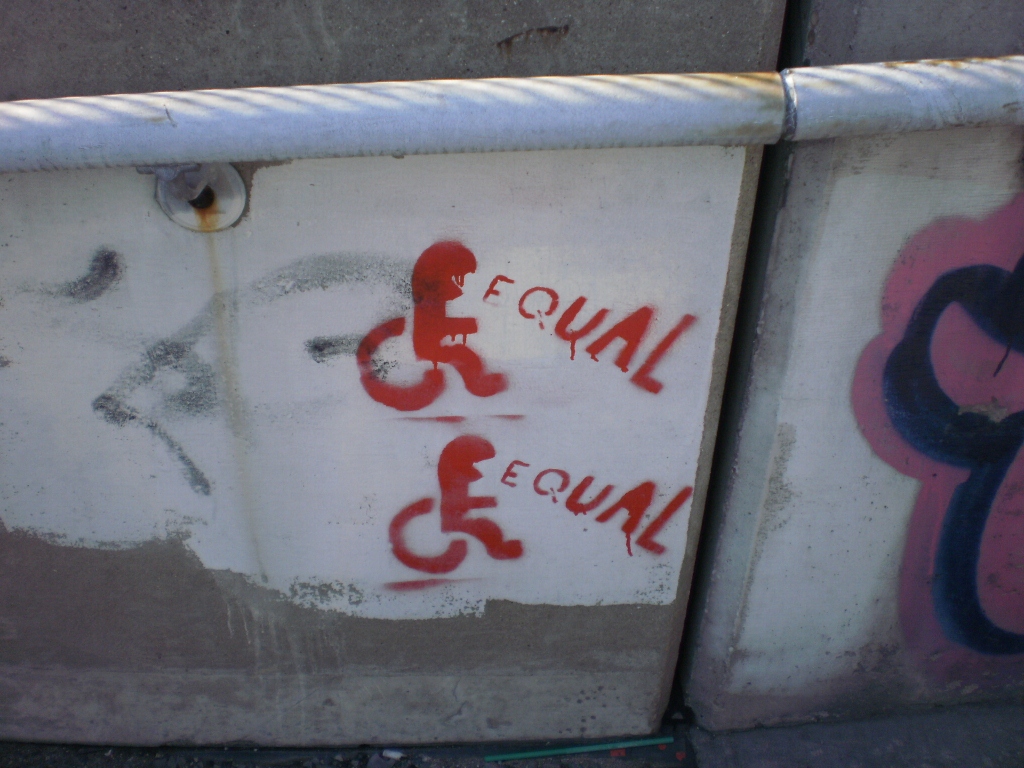
When I saw this symbol on the pedestrian bridge, I stopped to consider it.  This was the first time I had ever seen this symbol.  I thought whoever put it on this bridge had a very good point.  The only way to access the Bloomfield Bridge from Oakland and the uphill side of Bigelow Boulevard is by the pedestrian bridge, which is only accessible by a set of stairs on either side.  As such anyone with a mobility disability is barred from using the Bloomfield Bridge as a pedestrian.  The way the intersection of the bridge and the boulevard is set up now, it would not be safe for any pedestrian to attempt to cross the streets, let alone one with a disability.  This is a unequal and limiting situation.  There is a grocery store across from the other end of the bridge and a drug store and restaurants within another block.  Up the hill from this side of the bridge is a residential area.  The other end of the Bloomfield Bridge is the residents closest area for essentials found at grocery and drug stores as well as entertainment found at restaurants and bars.  It would be highly convenient for the residents on the hill to be able to walk to this area; however the current situation limits who is able to use this resource.  (Not to mention the ugliness of the bridge and the intersection which probably discourages many people from even considering the short walk across the Bloomfield Bridge.)

The second time I saw this graffiti symbol was on the 16th Street Bridge (see post).  I could not figure out what statement, if any, the 16th Street Bridge one was trying to communicate.  As far as I could tell, that bridge is accessible to any pedestrian with or without mobility issues.  At least there are no stairs to contend with at either end.

16th Street Bridge-Developments


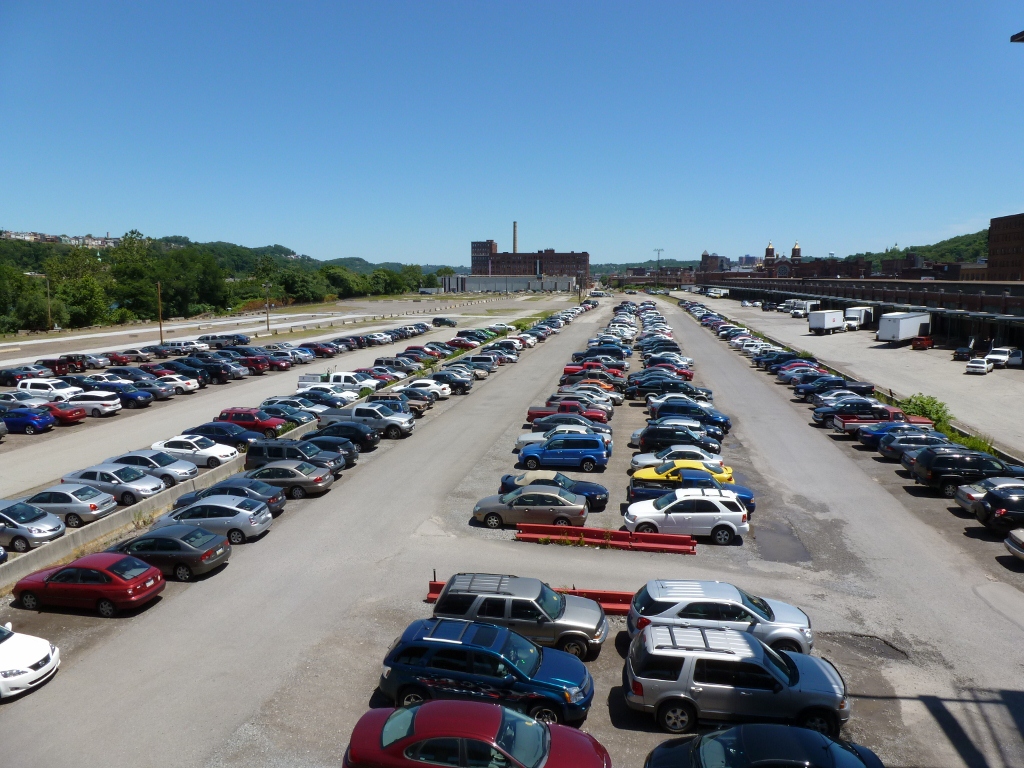
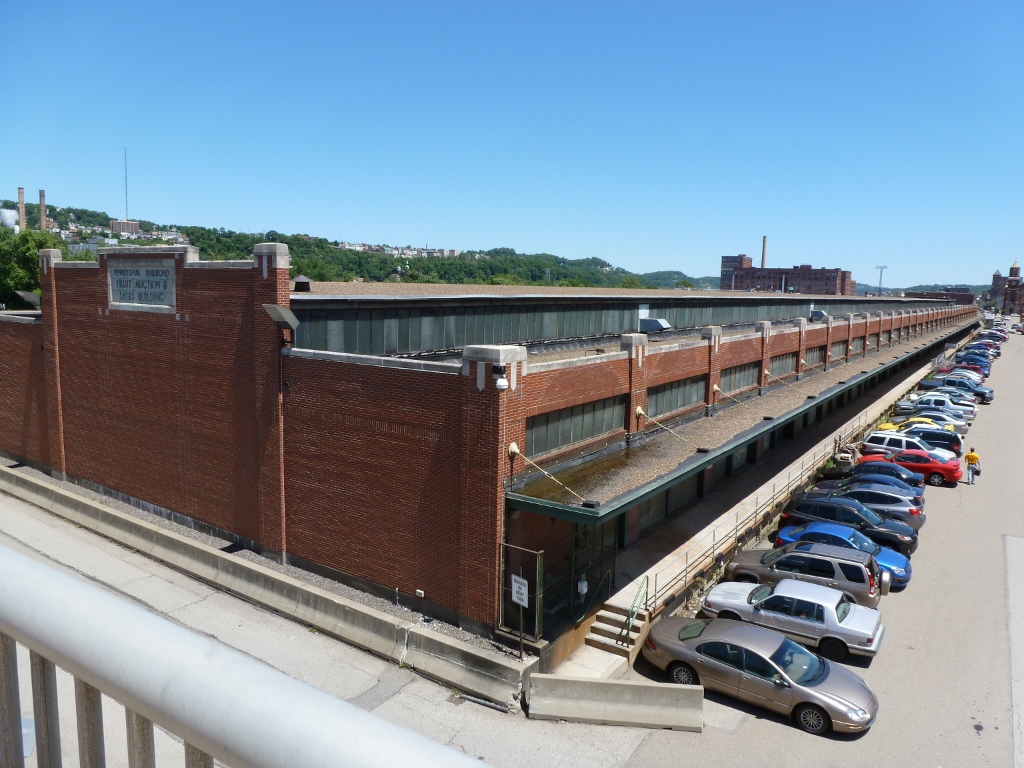
The southern end of the 16th Street Bridge soars over an area that is currently provoking controversy in the city.  It is a site where there are what feels like be miles of barren (although used) parking lots right up against the river on either side of the bridge.  It is a very un-pedestrian-friendly area and a very unattractive place.  Alongside these parking lots on one side of the bridge is the historically significant produce terminal building.  While a developer has put forward a plan to redevelop the area, connecting the existing Strip District to the Allegheny River and adding new mixed development in place of the parking lots, part of the plan requires a partial demolition of the produce terminal.  (A description of this intended development can be read in the article linked here.)

In the beginning of June, City Councilman Dowd began holding up funding for the project, saying he wanted more information about how the funding was to be used (see article).  Then about a week ago, two more councilmen voiced their wish for more information about the use of the funding as well as other aspects of the project such as how the community has been engaged (see article).  Another newspaper article from a few days ago, describes a lawsuit being filed about the property and the development.  This article explains, “The lawsuit alleges that the city is not following its own stormwater management program nor that of the federal Environmental Protection Agency in allowing the project.”

Based on what I’m learning in my internship this summer, this seems like the opposition against, or at least concerns, about the project are piling high enough to prevent the development from happening.  As I am not a fan of harsh, stark parking lots currently in place, it would be a shame for the project to fall through.  However, if the claims of the opposition are true, then it seems we need to find someone else to develop the site.  As awful as the parking lots are, their removal is not worth the price of poorly spent funds, no community engagement, and poor storm water management.  The last concern is the most significant given the fact that the city’s storm water management already causes problems.  (For more related to this issue seen my Heth’s Run Bridge post.)

Istanbul Bridges

I decided it was time to add some variety to my bridges post.  Last year I spent two weeks in Istanbul.  While I was not as absorbed in my bridges quest at that time, I found that thinking about the bridges in Pittsburgh and London caused me to reflect on the bridges in Istanbul.  Considering how much water there is in Istanbul, there are very few bridges.  I can only recall seeing three: the Galata Bridge, Ataturk Bridge, and the Bosphorus Bridge.  (Apparently my memory is a little rusty as I just looked up a map of Istanbul which shows there were four bridges that I would have seen, this obviously reflects the fact that I was not in my bridges phase at that time.)  Of these four bridges, I only crossed the Galata Bridge, but I walked under the Bosphorus Bridge and took some pictures of it.

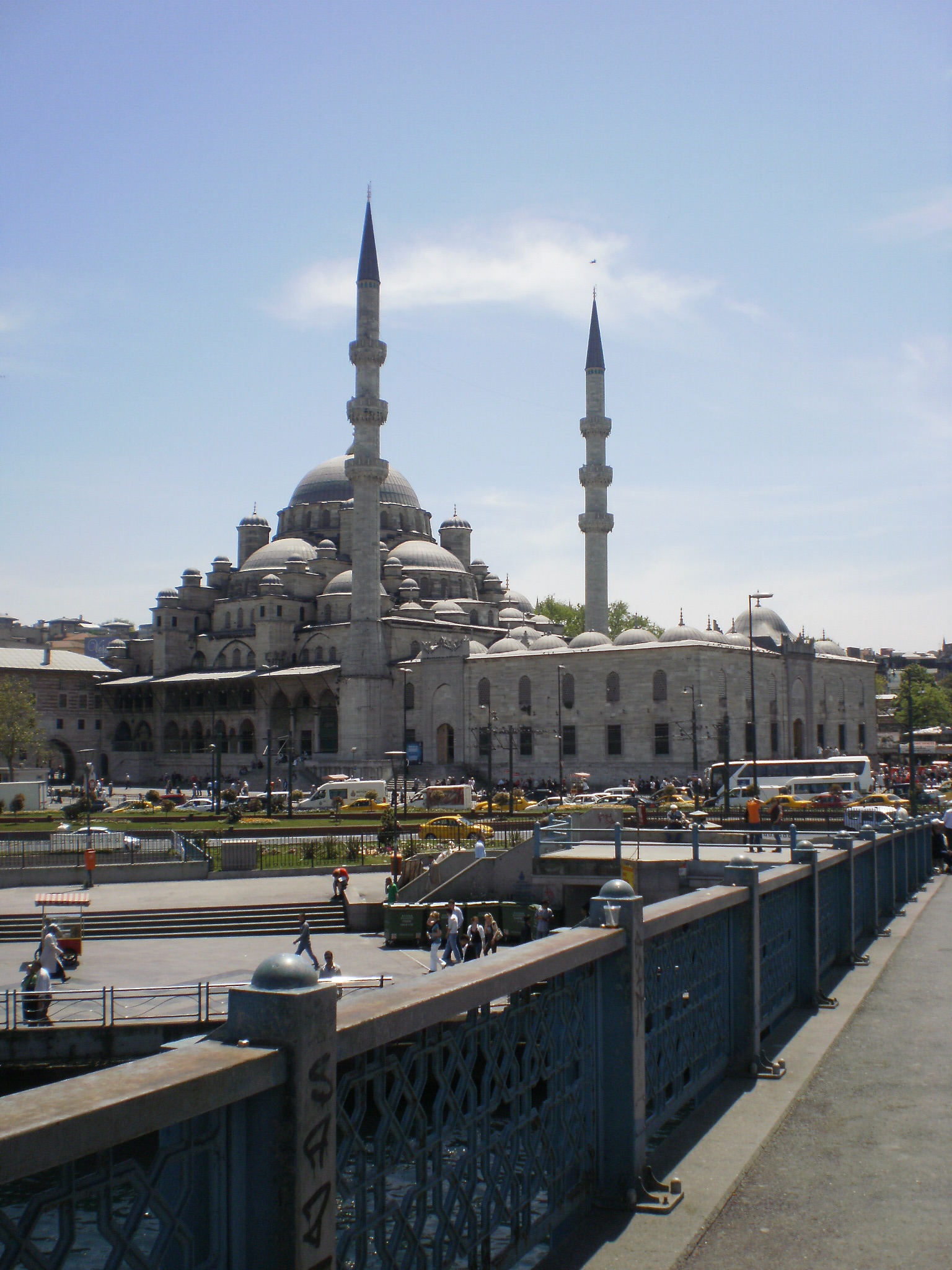
The Galata and Bosphorus bridges are very different in age and use.  There has been a Galata Bridge since the middle of the 19th century and a bridge over the Golden Horn (the body of water the Galata Bridge spans) since at least the 6th century.  The Galata Bridge has many uses.  There are wide sidewalks that accommodate pedestrians, three lanes in each direction for cars, and tracks down the middle of the bridge for the trams.  While I worked very hard not to get any of them in the picture above, the bridge is usually lined with fisherman and street vendors sell freshly caught and cooked fish.  Below the street deck are numerous restaurants.  One day, we had fish sandwiches for lunch at one of these, which were surprisingly good (I’m not much of a fish fan).  The line of one of the fisherman on the street deck above can be seen in my picture from the restaurant.  The Galata Bridge not only provides access between two points, but also provides people access to their livelihoods and to decent meals.  This shows that bridges do not have to be just about funneling traffic from one place to another; they can be a lively and interactive space in the city.


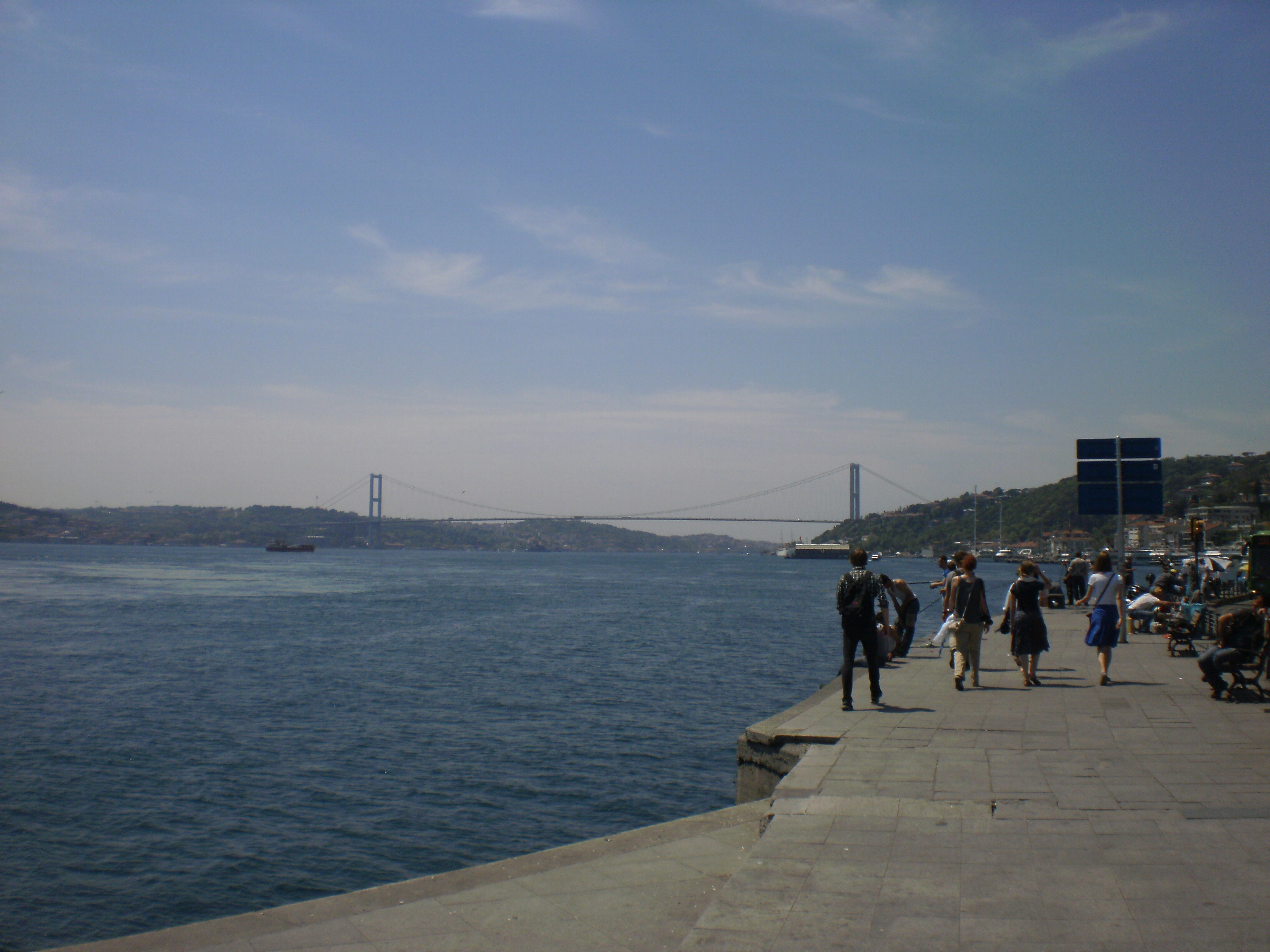
On the other hand, the Bosphorus Bridge, built in the 1970s as the first bridge to span the Bosphorus strait, is purely a funnel (as far as I observed).  It looks like it could be in New York or almost any other US city.  The purpose of the Bosphorus Bridge is like that of most of Pittsburgh’s river bridges–to provide vehicular access across a body of water.


Highland Park Bridge

The Highland Park Bridge, built 1938 (technical information can be found here), connects Pittsburgh’s Highland Park neighborhood to Route 28, Apsinwall, Sharpesburg, and the Waterworks Mall.  As a pedestrian this bridge is awkward at best.  There is sidewalk only on the western, down-stream side of the bridge, with a cement divider between the sidewalk and the road with the cars passing at around 45 mph and a metal, mesh fence keeping whoever’s using the sidewalk on the bridge.  The sidewalk is pretty narrow and is decorated with dirt and liter.  The best pedestrian approach to the bridge from the city side of the river starts at the intersection of Baker and Butler Streets.  It is a simple t-intersection with a light and a cross-walk on one side.  I believe it is technically possible to cross to the river side of Butler at One Wild Place, but the intersection there is far more complicated with no visible crosswalk and I doubt drivers even consider the possibility of pedestrians crossing at this point.

Once across Butler (from the intersection at Baker), turn right and cross Heth’s Run Bridge (see June 9 post for description of sidewalk conditions, see May 31 post for more info on this bridge).  As mentioned in the June 9 post on Heth’s Run Bridge, the sidewalk narrows considerably at this point and is broken and half covered in weeds and dirt.  For over 500 feet from the end of this bridge to the ramp for the Highland Park bridge there is no divider between the sidewalk and the street where cars tend to travel quickly.  On the ramp, the weeds go away and the cement divider starts.  At the other end of the bridge, there is a small gap in the divider for pedestrians to cross one of the on ramps for the bridge.  The view of on-coming traffic is often impeded by overgrown weeds/bushes.  Once across this lane, the sidewalk follows another on/off ramp of the bridge around 360 degrees to meet up with Freeport Road which passes underneath the bridge.  While this is the most pleasant part of the bridge as the area inside the circle is a well-maintained grassy spot, it feels a bit ridiculous as a pedestrian to walk around in such a wide circle.

I have walked this bridge several times now, in part because bus service between the East End (which includes Highland Park) and the Waterworks Mall was severely cut a few years ago.  A runner once passed me and bicyclists have passed me multiple times, however I have never encountered (or observed while driving across) any other pedestrians on the Highland Park Bridge.

There a couple of sights of interest from the bridge.  First is the lock.  Quite serendipitously the day I brought my camera to document my crossing of the Highland Park Bridge was the only time I’ve crossed when the lock was in use. The one thing I couldn’t figure out is how they would get the first barge out of the lock when the tug boat is on the higher level water with the second barge.

This is the second sight of interest is pictured above. If there was a place in Pittsburgh that would produce a comic book superhero, it would be here.  The hole in the picture above often gets filled with rainwater that stagnates and on some occasions turns an eerie, neon-like green color–the perfect toxic dump to produce superpowers.  I assume this site is some sort of scrap metal processing place.  A search on Google did not come up with any satisfactory responses.  One day when I walked past, a magnet was lifting up pieces and dropping them down repeatedly.  Whatever the site is, it is one of the reminders of Pittsburgh’s nitty-gritty industrial past.


The upstream and downstream photos present a snapshot of what this part of the city looks like.  Downstream, the 62nd Street Bridge, aka R.D. Fleming Bridge, (see July 24 post) downtown Sharpsburg, Six Mile Island, and lots of trees are visible.  Upstream, trees, a railroad bridge, a dock for personal boats, and the roof of one of the waterworks processing buildings are visible.  Overall there is a very rural feeling six miles up the Allegheny from downtown.