

I’ve written before about how some bridges pay homage to the ones they replaced. Pittsburgh’s Greenfield and Heth’s Run Bridges did this. When writing about those bridges, I assumed that this approach might reassure a community by honoring the local memory and thereby maintaining a sense of stability. However, this was only a guess. While I had used the old Heth’s Run Bridge hundreds of times, I didn’t know it was a bridge until shortly before its replacement and most of its characteristics features had been removed, buried, or eroded long before. I don’t know if I had ever been on the Greenfield Bridge before the day I intentionally walked it for this blog. So I had no emotional connection to that bridge. Therefore, I cannot speak personally about the homage these bridges paid to the past.
When I arrived in East Stroudsburg, the blood-red, rounded through-truss bridge was no longer there (officially, it was a Warren pony truss style). This bridge had been an important landmark for me as a child, probably because its design was distinctive. It made me smile when I saw the new bridge had paid homage to the shape of the former truss. While the change of color and style of the bridge was significant, I felt a sense of comfort at the continuity created by the way the new design acknowledged the former bridge.
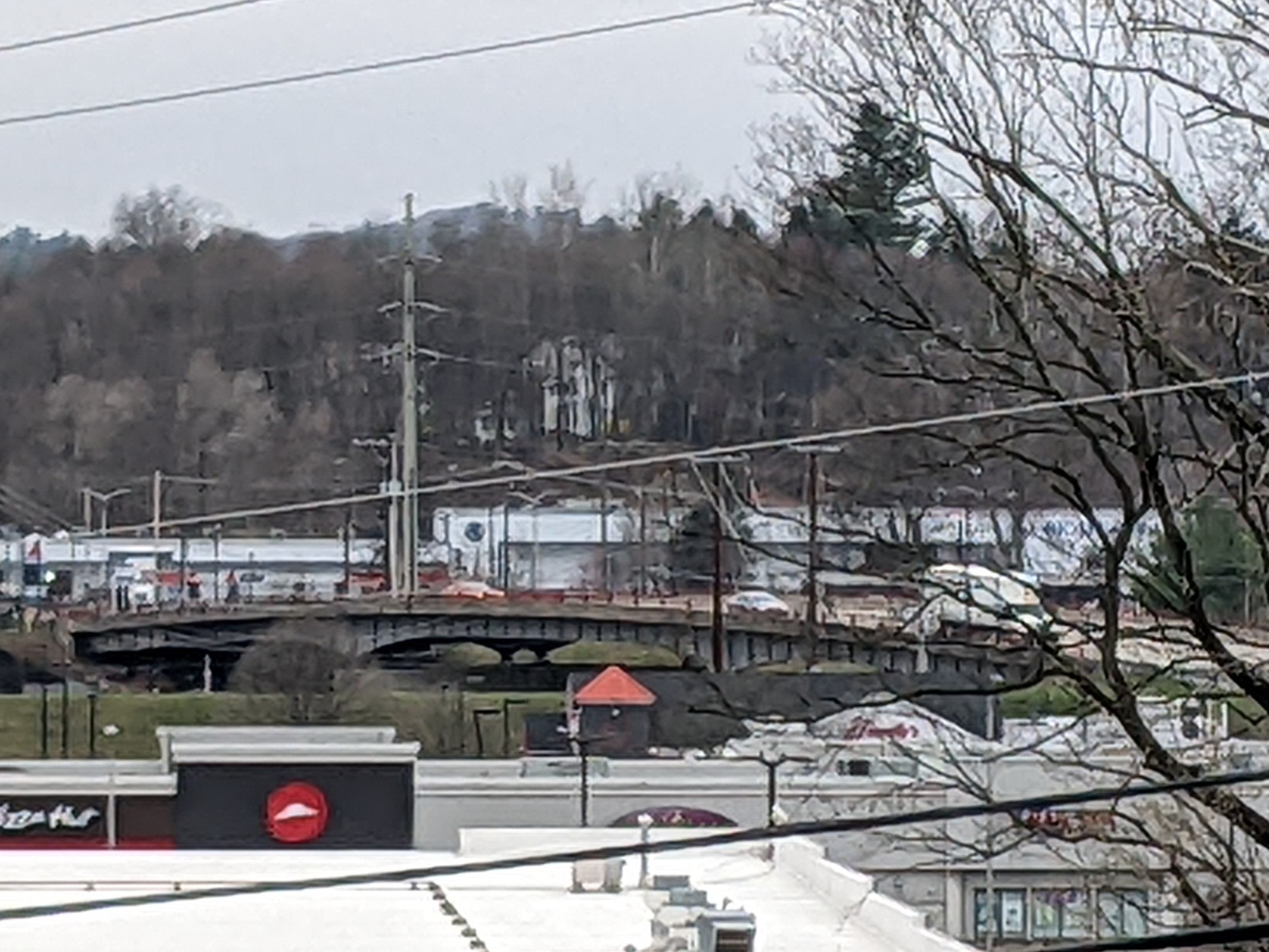
Down the hill from this bridge is the Interborough Bridge. This bridge connecting East Stroudsburg and Stroudsburg used to be a through-truss, possibly also a Warren pony truss bridge. When it was destroyed by a flood in 1955, the replacement did not pay homage to the past. The plain replacement bridge is very utilitarian and not much else. My foot had reached the end of its stamina before I was able to walk across it on this trip – which was actually a relief. I walked across it at least once when I was a kid. I remember it feeling unpleasant. There are sidewalks, but the proportion of vehicles lanes is quite large, cars move fast, and either end features auto-oriented uses. The one nice feature of the bridge are the views of Brodheads Creek, but there are plenty other more pleasant vantage points to view the creek.
In another form of homage, Brodheads Creek, the dividing line between East Stroudsburg and Stroudsburg, is named after Daniel Brodhead. On this trip, I learned that in 1737 Daniel was the first white settler in the area to purchase his land from the descendants of William Penn instead of the Lenni Lenape, the indigenous people who still lived on the land. Although, Penn began purchasing the land that the King of England had given him from the Lenape in 1683, it seems that the area around East Stroudsburg and Stroudsburg had not been purchased by the Penn family before they started selling it to settlers. The Walking Purchase of 1737 attempted to resolve this issue, though it seems the terms of the purchase were not explained clearly the Lenni Lenape beforehand. (Monroe County Historical Association, November 11, 2005; Pennsylvania Historical & Museum Commission)
 urbantraipsing