Cathedral Road, Cardiff

As I mentioned in the post on Inkspot, it felt like I had more success with repurposed churches in Cardiff than London, despite having done extensive research on the adaptive reuse of churches in London.  Perhaps this is in part because it is far more exciting and rewarding to come upon a repurposed church than to go where you already know you will find one.  My first day in Cardiff I discovered two adapted religious buildings within a few blocks of each other—thrilling!

The first of these buildings, formerly the Cardiff New Synagogue now office space.  (I am also interested in the adaptive reuse of synagogues as there are some similar issues when repurposing synagogues or churches, but I am less familiar with the architecture and interior design of synagogues and they seem less common adapted church buildings.)  The façade of this former synagogue appeared to be unaltered, however in the back there was a modern office building extension.  I could not tell from my observations whether or not part of the original building was demolished to make way for the extension.  The original building seemed a bit short, which made me think that part of it might have been demolished.  However, some of the townhouses nearby had similar additions in the back as they were now used for businesses or apartment complexes.  The depth of these buildings matched those that did not have additions and that of the original structure of the synagogue, suggesting that the synagogue may have been intact.  I found the YouTube video on the building’s website interesting as it is easy to tell which rooms are in the original building and which in the addition.

The second building was a former Presbyterian Church of Wales, now The Wallich Centre.  Their motto is “homeless people first” which gave a clear indication of their purpose, although the website suggests that this building may not be used directly for the homeless as it is identified as the administrative centre as well as a venue for hire for meetings, conferences, etc. which I don’t imagine would be used by the homeless.  There appeared to be little or no alteration to the exterior of this building, except for the glass doors inside the covered entrance.  Only a small sign (blocked by the van in the picture) indicated that this building no longer functioned as a religious institution.

Inkspot

Last month, I spent a few days each in Cardiff (the capital of Wales) and London. Before going, I had done some research on the adaptive reuse of church buildings in London, but none on Cardiff. Despite this, I almost had more success with exploring repurposed churches on the ground in Cardiff than London.

The pamphlet in my hotel room in Cardiff, highlighting things to do in the city, contained an ad for the Inkspot – a crafts store housed in a former church. This was an amazing find as not only am I into the adaptive reuse of church buildings, but I am also a craft-person. Additionally, none of the repurposed churches I have come across in Pittsburgh have a use like this. Most in Pittsburgh are adapted to housing, restaurants/bars, and community centers. So, this building showed me a new option for how a church space can be used.

As a crafts store, it was a bit disappointing. The items for sale were the same as what I would find in any crafts store in the US. Perhaps I should have expected that, as how different can paint or pencils be from country to country? I however was hoping for an experience more like going to the grocery store in the UK vs. the US. Both sell food, but the options are slightly different. First, the fruit is more naturally sized, unlike our bananas and apples on steroids. In the bakery department, I found personal-sized baguettes, brioche, and crumpets. Yogurt flavors were different–such as strawberries and clotted cream. Among the juices I found Apple & Beetroot and Grape & Elderberry flavors. I thought the crafts store would be like that, similar products, but just enough different that I would be able to find somethings I wouldn’t find in a crafts store in the US.

As a repurposed church, the Inkspot was fascinating. The owner was in while I was visiting so I was able to add some facts to my observations. The building was built in 1868. When the 100-year lease came up in 1968, the property owner refused to grant the church a renewal. The building is located on Newport Road, which at least at one time was the main road between Cardiff and Newport (another potentially important city in Wales), near two intersections. It is prime real estate and in the 60’s there was talk of the road being widened, which would have required the demolition of the church. For whatever reason, this plan did not go through and in 1995 the owner and his family purchased the building to move their crafts store into it. Upon purchasing, they were advised to tear down the building and start from scratch, but they took the risk of spending the money to repair the damage from decades of being empty.

They modified the building slightly, by making the sanctuary two stories. The first floor had paper crafts, kids’ crafts, yarn, etc., while the second floor was dedicated to painting supplies with an art gallery in the back above where the altar used to be. The downstairs felt a little claustrophobic, but the upstairs still felt huge and airy. I could not decide from just walking around and observing the building if the two-story design was original or added during the repurposing. It must have been huge inside when it was a church. In addition to the crafts supplies for sale and the art gallery, there was space for artists’ studios in what I assume must have been office space previously.

I did not feel comfortable taking pictures inside where the sale items were, but I did take the picture below of the staircase. The white walls and green carpeting were used throughout the store.

Heth’s Run Bridge

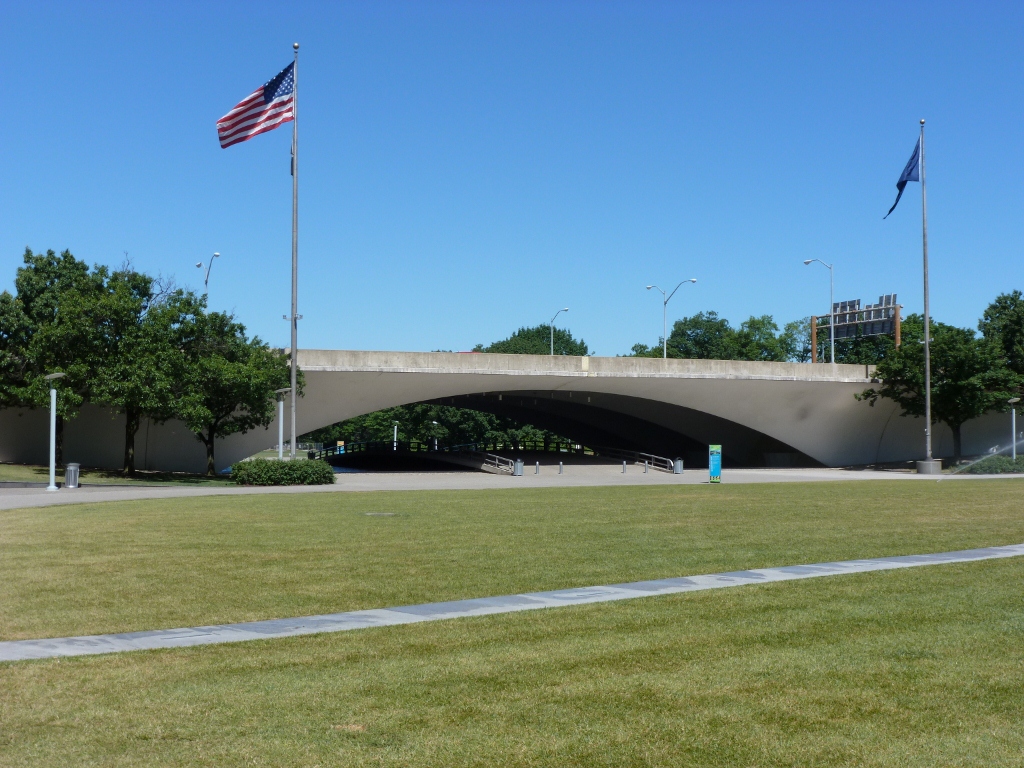
Heth’s Run Bridge as seen today presents many mysteries.  Digging into the mysteries uncovers a interesting story.  I have crossed Heth’s Run Bridge many times, usually in a car on the way to the Zoo, but it was only in recent years that I realized it was a bridge.  When looking toward the zoo parking lot from the bridge (as in the picture below) it does not appear that the height of the road differs enough from the surrounding landscape to be a bridge.  However, in the view above (taken from the Zebra Ice Station parking lot on the river side of the road) it looks like a bridge.  The G.M. Hopkins Maps, one of my all-time favorite resources available on the Historic Pittsburgh website, explains the history of and the reason for this bridge.

The 1899 map identifies a bridge in this location called High Bridge, indicating that there was a significant difference in elevation at this point.  A 1912 photograph shows that this was indeed a high bridge, quite unlike the current bridge and its surroundings.  This would have been caused by a small stream called Haight’s Run which flowed under the bridge into the Allegheny River.  By 1911, most of this stream was covered over and Haight’s Avenue ran along its path.  The 1939 map shows no evidence of Haight’s Run, the name on the road and the bridge is now Heth’s, and the road is marked “not open.”  Also in this map, the bridge appears to be a different width than in the others, this is because the current structure was built in 1914, more technical and historical information about the bridge can be found here.  1939 is the most recent year for the G.M. Hopkins Maps.  I speculate that the bridge would still have been raised over the surrounding landscape at that time, based on the similarities in the surroundings between the 1911 and 1939 maps.  However, sometime between then and now, Haight’s/Heth’s Run was filled in and the zoo parking lots built on top, level with the height of Heth’s Bridge.

If I had not passed this way on foot, I doubt that would have realized that this was in fact a bridge or that once not long ago (in geological terms) a stream flowed along this way.  There is a tendency in urban areas for nature to be ignored or in this case built over, which sometimes causes catastrophic results.  Not far from Heth’s Run is Negley Run, another stream that was buried under a road.  The burial of this stream likely contributed to the tragic flood on Washington Boulevard last summer that resulted in several deaths.  I look forward to the day when all our roads and sidewalks will be made of permeable material, allowing for more natural absorption of rain water and reducing flooding.

Urban Traipsing

Welcome to my Urban Traipsing Blog.  Join me as I wander around cities observing their various designs, what makes them similar or different, and how people use and experience them.  My current base is Pittsburgh, PA, but other cities in the US and abroad will be included as I visit them.  Currently there are two main themes directing my walking explorations: bridges and the adaptive reuse of churches.  Both themes provide insight into cities’ pasts as well as their present.  Observations outside these themes may emerge along the way.  Enjoy!

Pittsburgh Bridges

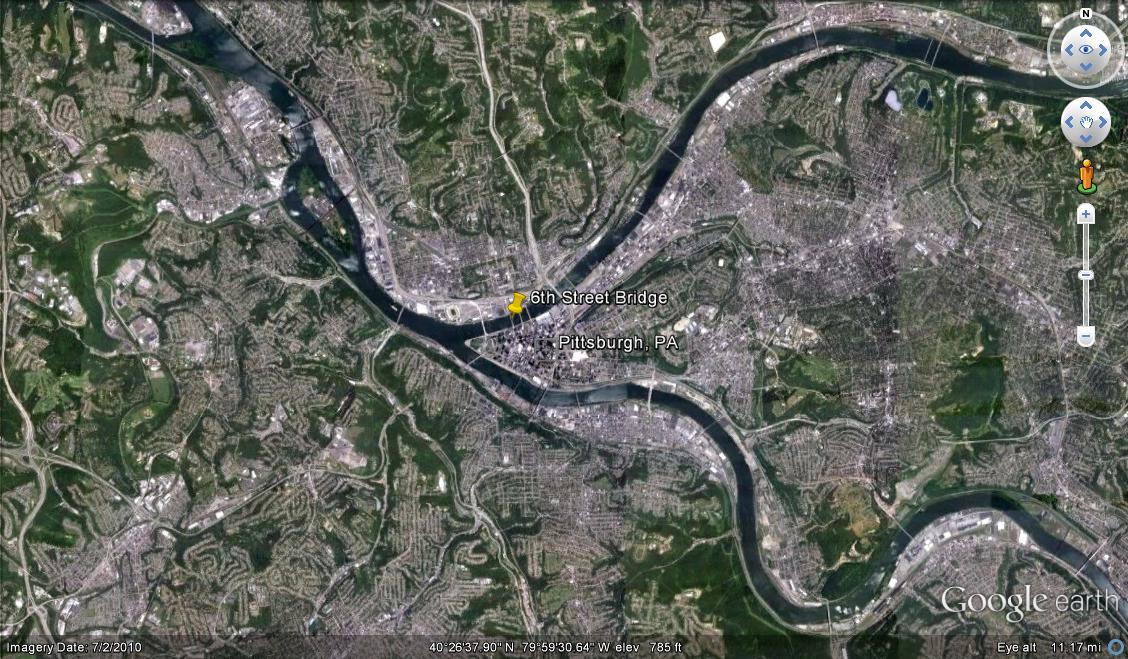
The 20 bridges that span Pittsburgh’s rivers within the city limits.

One day, while overlooking the city of Pittsburgh from Mt. Washington, I set myself the goal of walking all the bridges in Pittsburgh.  It is said that Pittsburgh has more bridges than any other city in the world including Venice.  The current count of Pittsburgh’s non-railroad bridges longer than 8 feet is 446.  Perhaps my goal is a bit too ambitious, but I intend to give it a shot.  By the end of the summer, I intend to document walks over the 20 bridges on the three rivers (Allegheny, Monongahela, and Ohio) within the city limits as well as many of the land bridges in the city between the Allegheny and Monongahela Rivers.

From the bridges I have walked so far, I am fascinated by two things.  First, I find the diversity of viewpoints on the city engaging, from the beautiful views of the bridges connected to downtown to the underbelly views seen on bridges scattered throughout the city including the Highland Park (see June 10 post) and Bloomfield (see Aug 18 post) bridges.  In addition, I am gaining a greater awareness and appreciation for the geography of the city through this project.  Attempting to identify the numerous bridges is forcing me to reconsider parts of the city that I have taken for granted through over-familiarity.  Heths Run Bridge is an example of this (see May 31 and June 9 post).