
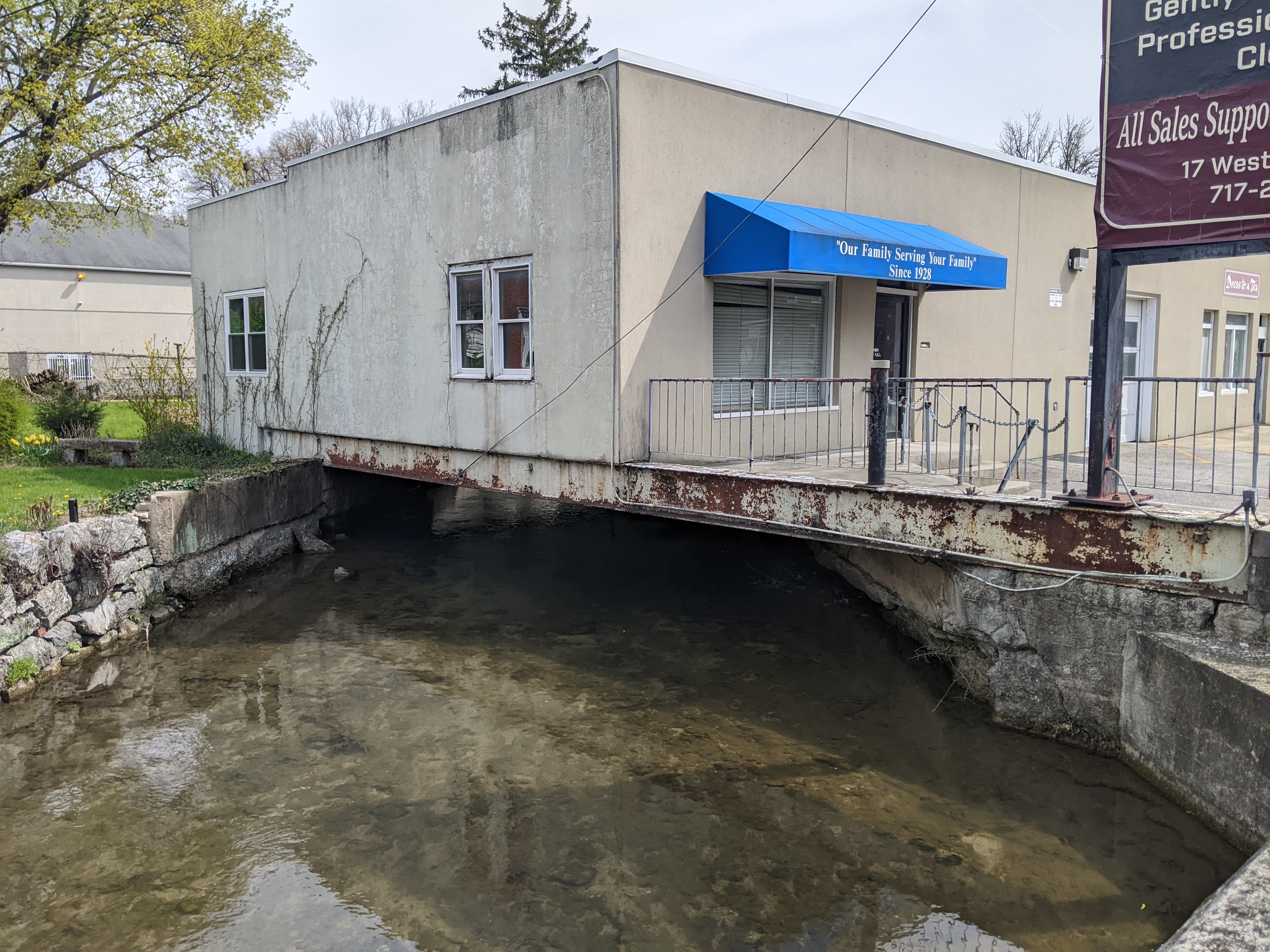
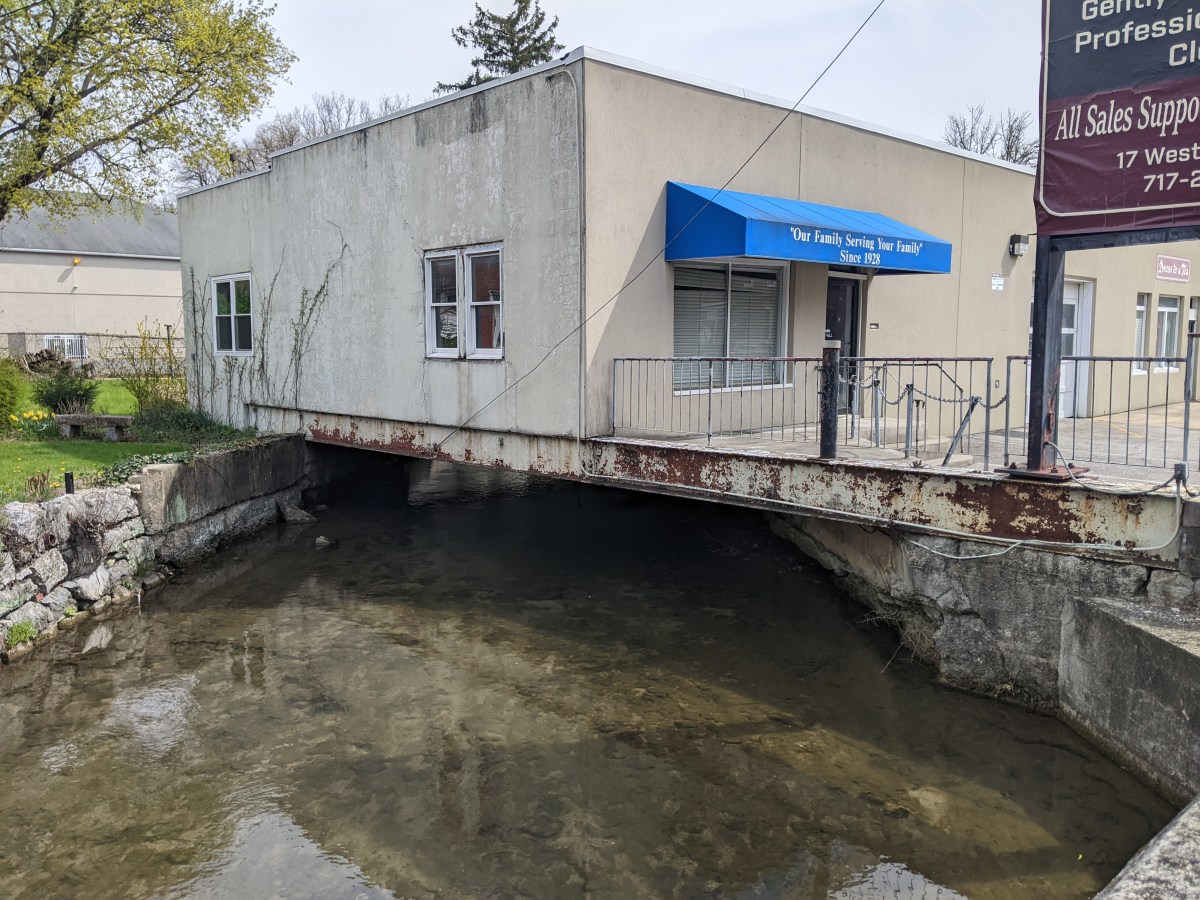
In Chambersburg, PA, a historic town along the Lincoln Highway, the question of what is a bridge comes up again. This time, the specific iteration is: “Is a building a bridge?”
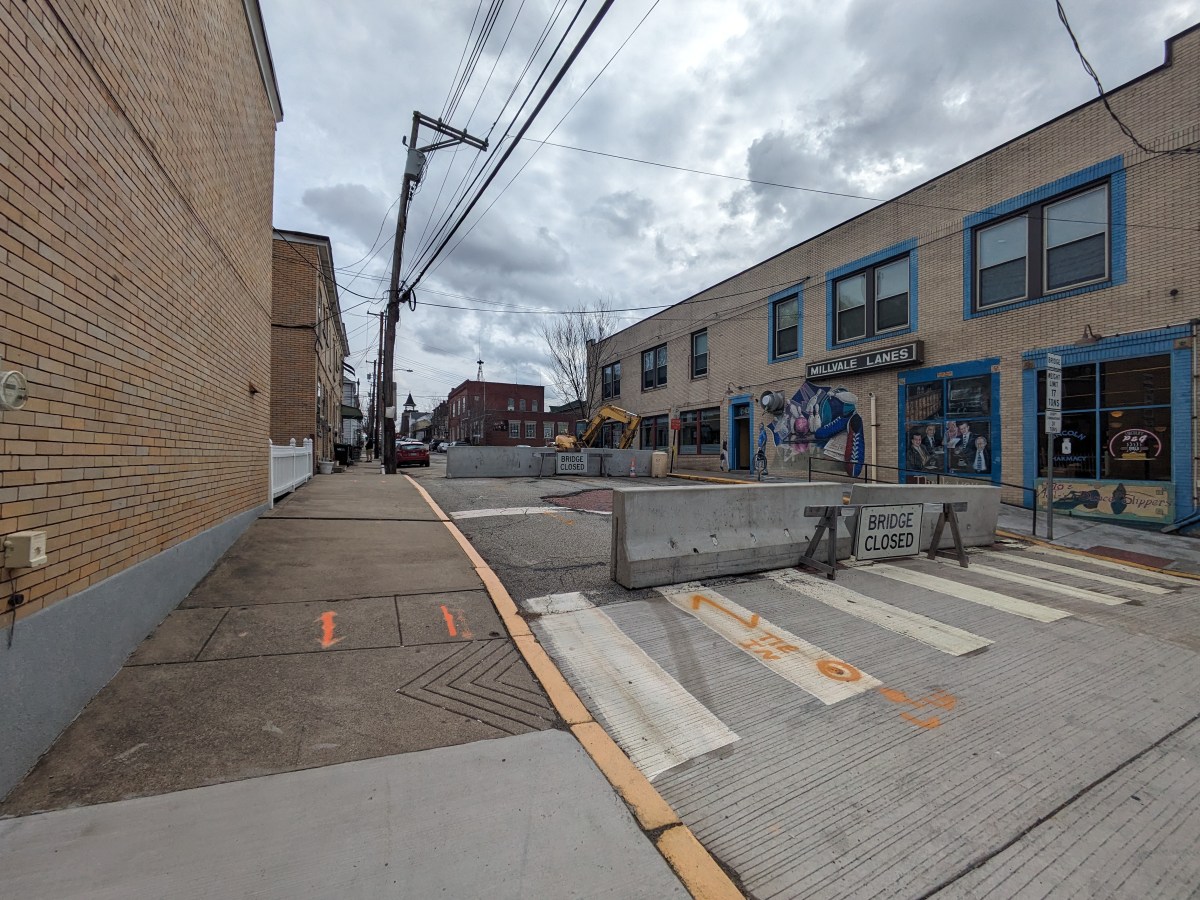
This question is a continuation of the one inspired by Millvale. When I shared my thoughts on the building/bridge and backyard/bridge in that town, I focused on the fact that those bridges were hidden from sight and are likely an important factor contributing to the town’s flooding issues.
The structure in Chambersburg, on the other hand, sits in plain view. To tackle this question, I think it is time to return to the formal definition of a bridge. I looked up a definition of a bridge for the first Pittsburgh edition of this series and seemed to accept that definition at face value. I returned to a definition of a bridge in the second Chicago definition to help define what a viaduct is. I again did not question the definition of bridge. Perhaps it is time to change that?
Merriam-Webster defines bridge as a structure carrying a pathway or roadway over a depression or obstacle.
The Oxford English Dictionary defines bridge as a structure forming or carrying a road, path, or (in later use) a railroad, etc., which spans a body of water, a roadway, a valley, or some other obstacle or gap, and allows a person or vehicle to pass unimpeded over or across it.
Both of these definitions avoid the interaction of buildings and bridges.
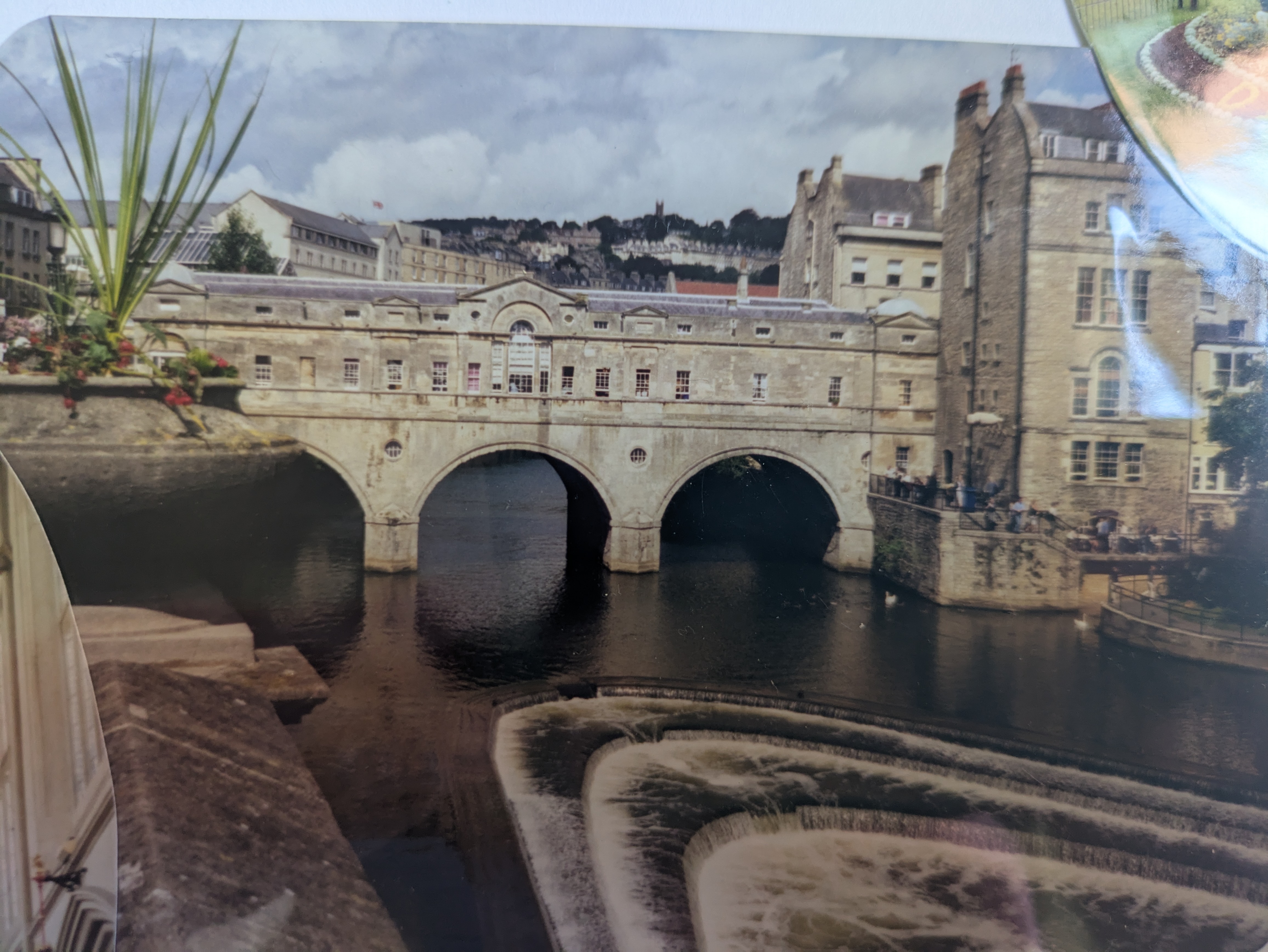
My first encounter with buildings on bridges was Pulteney Bridge in Bath, UK (photo of photo below). I was 13. It would be over a decade before I would start intentionally walking bridges. At that time, I declared, “That is one of the coolest bridges I’ve ever been on. There are shops on both sides of the road. You can’t tell you’re on a bridge.” (Notice the echoes of my later musings on the “bridges” of Chicago.)
The next most memorable building/bridge encounter was in Istanbul. The Galata Bridge is a 2-decker bridge with the lower deck full of restaurants with open seating facing the Bosphorus.
While both of these bridges also carry multi-modal roadways and therefore meet the two dictionary definitions of a bridge, they suggest the possibility of a broader definition of bridge.
As I did with viaducts, I next turned to “How to Read Bridges” by Edward Denison and Ian Stewart. Interestingly, they do not provide a definition for a bridge. They discuss bridge types – if the Chambersburg building is a bridge, it would be a beam bridge. They also discuss bridge uses. “Bridges are designed to satisfy a wide range of different uses from the obvious, such as vehicle, railroad, cycles, and pedestrian traffic, to the more obscure, such as carrying water. Many are even designed to cater to multiple uses.” (68) While they hint at “more obscure” uses, their chapter on uses goes on to talk specifically about pedestrian, water, vehicular, rail, and military uses. Buildings are missing from that list. However, their case studies do include Bath’s Pulteney Bridge and Florence’s Ponte Vecchio, which also includes buildings featuring shops and apartments on the bridge.
The Encyclopedia Britannica (Britannica.com) has the broadest definition of a bridge that I’ve encountered so far: Bridge, structure that spans horizontally between supports, whose function is to carry vertical loads. The prototypical bridge is quite simple – two supports holding up a beam – yet the engineering problems that must be overcome even in this simple form are inherent in every bridge: the supports must be strong enough to hold the structure up, and the span between supports must be strong enough to carry the loads.
By that criteria, the building/bridge in Chambersburg meets the definition of a bridge as it is a horizontal structure “whose function is to carry vertical loads.”
Moreover, this criteria suggests a broader interpretation of my framing question than I intended. “Is a building a bridge?” was intended to ask if a building built over a stream is considered a bridge. However, I wasn’t that specific in my wording and reading Britannica’s description of a bridge, it sounds like any building floor that is not the equivalent of concrete poured on the ground would count as a bridge. . . .Supports, beams, arches, piers, and cantilevers are all elements used in both bridges and buildings. . . .And so, the answer to the unintended broader question of “is a building a bridge?” may in fact be “yes.”
While there absolutely are structural similarities between buildings and bridges, I am not comfortable with a definition of bridge so broad that it includes all multi-story buildings and perhaps even some single-story ones. Perhaps a common distinguishing element between a building and a bridge is that bridges are designed to allow the free passage of air underneath the horizontal structure. That would make my working definition of a bridge: a structure that spans horizontally between supports, whose function is to carry vertical loads and that allows unobstructed passage of elements, objects, or animals, etc., underneath.
By this version of a definition of bridge, the building in Chambersburg is a bridge, the backyards and buildings in Millvale are likely bridges (assuming the stream has unobstructed passage below them all), but Heth’s Run Bridge while it was buried was not a bridge.
Additional Posts in the Series:
Discover more from urbantraipsing
Subscribe to get the latest posts sent to your email.
 urbantraipsing
Pingback: What is a Bridge? Chambersburg Edition II | urbantraipsing