Newport Road, Cardiff

The one mile walk from the city center to the Inkspot along Newport Road revealed more church buildings of interest for adaptive reuse and the history of the city. (Newport Road is so named as it was the main road from Cardiff northeast to Newport before the highway came along.)

The first building of interest that I came across was just off Newport Road. My observations indicated that this building was a former church probably adapted to a new use similar to the Wallich Centre (see post on Cathedral Road, Cardiff) but with a strong religious component. A sign on the building read “UCKG Help Centre,” which suggested that it provided help to those in need. My ideas for the possible targeted audience included people experiencing homelessness, depression, or low-income. I identified the Centre’s religious focus from a sandwich board in front of the entrance advertising holy/healing oil.

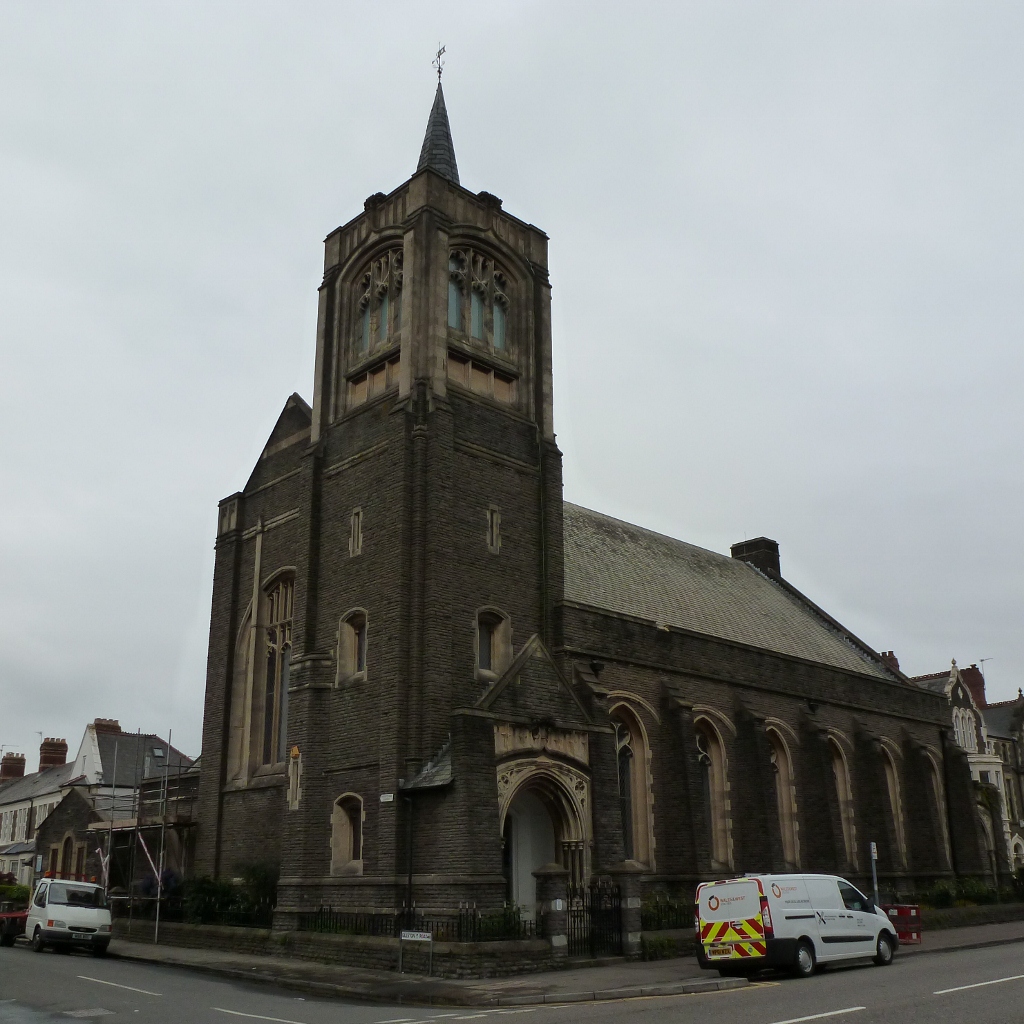
I was correct in my supposition that the building’s original use was a church (after I discovered I mistakenly identified two other buildings as former churches I began to doubt my guess with this building). It was built as a Unitarian Church in the 1880s. However, I was mistaken in the new use. It turns out that UCKG stands for the Universal Church of the Kingdom of God and therefore the building is still being used as a church, just not its original denomination.

The second building appeared permanently closed when I passed. This one clearly used to be a church.  The building appeared to be secure and in good condition, which is beneficial for any potential reuse.  This building was built as the Church of St James the Great in the 1890s and closed in 2006. A newspaper article from 2008 announces the redevelopment of the church’s spire into a seven-story flat (flat=apartment, please excuse my British vocab and spellings, such as centre, while I discuss British places).  The rest of the structure would be converted into 11 other one- and two-bedroom flats. However, there was no indication when I was passing that this has occurred or was in the process of occurring. There is no further mention of this redevelopment online, suggested it either fell through or is being held up.

I passed one more church building on Newport Road, one still used for religious worship, before reaching the Inkspot. This building interested me as it was a larger church complex than any of the others I passed, was a block away from the Inkspot, and part of a complex blocked off for construction work of some unknown sort.

Passing four church buildings, three of which were no longer housing their original uses, intrigued me. Coming from Pittsburgh, my immediate assumption was that Cardiff must have experienced a significant population loss. After all it used to be a major port—exporting more coal than probably any other port in the world. The port closed some time ago and Cardiff stopped exporting coal. I imagined this change resulted in the loss of many jobs and therefore a significant population loss followed. Yet, the population statistics for Cardiff over the last 200 years destroyed this theory. The population dipped slightly from 1971 to 1981, but by 1991 Cardiff had more residents than ever (see Cardiff Timeline for population statistics). The port closing may have influenced the dip in population, but net population loss cannot be the cause of the closed and adaptively reused religious buildings I observed in Cardiff.

I cannot verify my second theory for the reason these buildings lost their original uses. This theory is a change in the religious views of the population. This can go two ways. The first idea is that people are becoming less religious (this is how the Dutch explain their large number of churches adapted to new uses). I found a few articles that identify a similar trend in all of Britain (Number of Christians falls, Muslims pass on faith at higher rates than Christians). The second idea is that while the overall population is growing, people are still moving out and those that are moving in are of a different demographic or religion and therefore do not want the same religious institutions as those that came before them. Both theories are mostly speculation as I haven’t found detailed statistics on religious beliefs and practices in Cardiff, Wales, or Britain.
Cathedral Road, Cardiff

As I mentioned in the post on Inkspot, it felt like I had more success with repurposed churches in Cardiff than London, despite having done extensive research on the adaptive reuse of churches in London.  Perhaps this is in part because it is far more exciting and rewarding to come upon a repurposed church than to go where you already know you will find one.  My first day in Cardiff I discovered two adapted religious buildings within a few blocks of each other—thrilling!

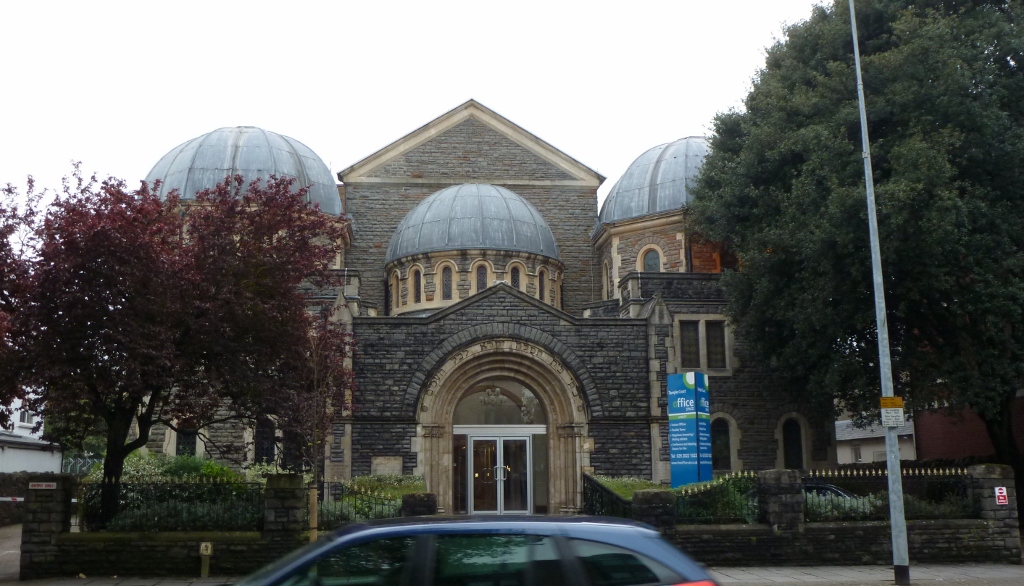
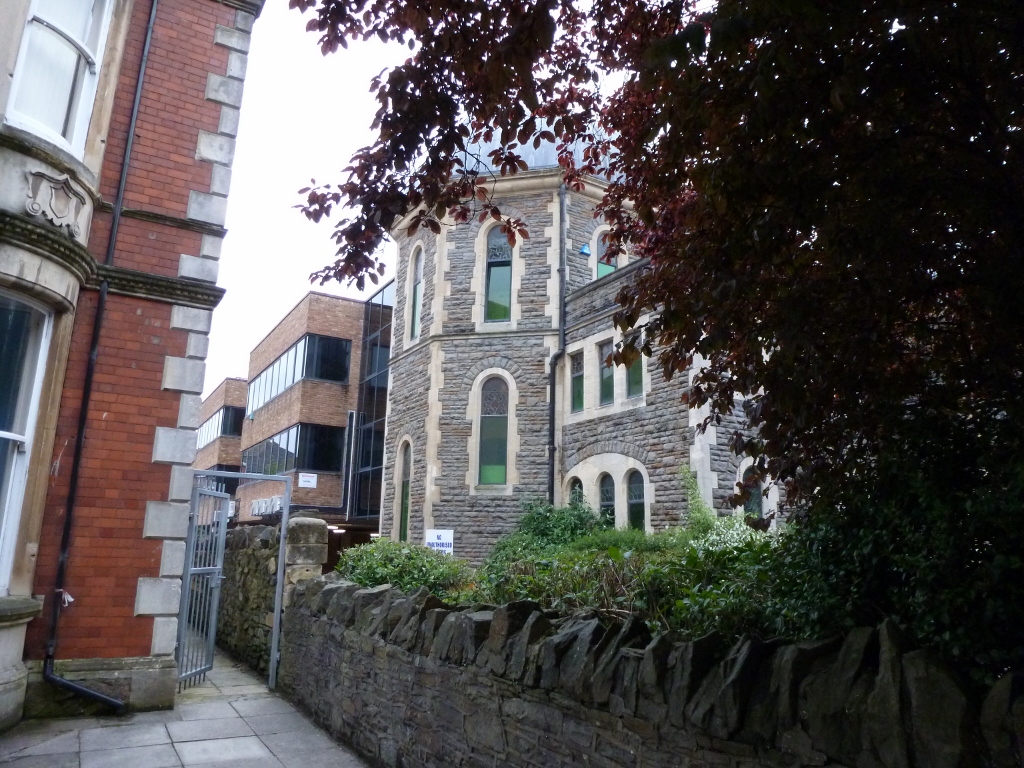
The first of these buildings, formerly the Cardiff New Synagogue now office space.  (I am also interested in the adaptive reuse of synagogues as there are some similar issues when repurposing synagogues or churches, but I am less familiar with the architecture and interior design of synagogues and they seem less common adapted church buildings.)  The façade of this former synagogue appeared to be unaltered, however in the back there was a modern office building extension.  I could not tell from my observations whether or not part of the original building was demolished to make way for the extension.  The original building seemed a bit short, which made me think that part of it might have been demolished.  However, some of the townhouses nearby had similar additions in the back as they were now used for businesses or apartment complexes.  The depth of these buildings matched those that did not have additions and that of the original structure of the synagogue, suggesting that the synagogue may have been intact.  I found the YouTube video on the building’s website interesting as it is easy to tell which rooms are in the original building and which in the addition.

The second building was a former Presbyterian Church of Wales, now The Wallich Centre.  Their motto is “homeless people first” which gave a clear indication of their purpose, although the website suggests that this building may not be used directly for the homeless as it is identified as the administrative centre as well as a venue for hire for meetings, conferences, etc. which I don’t imagine would be used by the homeless.  There appeared to be little or no alteration to the exterior of this building, except for the glass doors inside the covered entrance.  Only a small sign (blocked by the van in the picture) indicated that this building no longer functioned as a religious institution.

Inkspot

Last month, I spent a few days each in Cardiff (the capital of Wales) and London. Before going, I had done some research on the adaptive reuse of church buildings in London, but none on Cardiff. Despite this, I almost had more success with exploring repurposed churches on the ground in Cardiff than London.

The pamphlet in my hotel room in Cardiff, highlighting things to do in the city, contained an ad for the Inkspot – a crafts store housed in a former church. This was an amazing find as not only am I into the adaptive reuse of church buildings, but I am also a craft-person. Additionally, none of the repurposed churches I have come across in Pittsburgh have a use like this. Most in Pittsburgh are adapted to housing, restaurants/bars, and community centers. So, this building showed me a new option for how a church space can be used.

As a crafts store, it was a bit disappointing. The items for sale were the same as what I would find in any crafts store in the US. Perhaps I should have expected that, as how different can paint or pencils be from country to country? I however was hoping for an experience more like going to the grocery store in the UK vs. the US. Both sell food, but the options are slightly different. First, the fruit is more naturally sized, unlike our bananas and apples on steroids. In the bakery department, I found personal-sized baguettes, brioche, and crumpets. Yogurt flavors were different–such as strawberries and clotted cream. Among the juices I found Apple & Beetroot and Grape & Elderberry flavors. I thought the crafts store would be like that, similar products, but just enough different that I would be able to find somethings I wouldn’t find in a crafts store in the US.

As a repurposed church, the Inkspot was fascinating. The owner was in while I was visiting so I was able to add some facts to my observations. The building was built in 1868. When the 100-year lease came up in 1968, the property owner refused to grant the church a renewal. The building is located on Newport Road, which at least at one time was the main road between Cardiff and Newport (another potentially important city in Wales), near two intersections. It is prime real estate and in the 60’s there was talk of the road being widened, which would have required the demolition of the church. For whatever reason, this plan did not go through and in 1995 the owner and his family purchased the building to move their crafts store into it. Upon purchasing, they were advised to tear down the building and start from scratch, but they took the risk of spending the money to repair the damage from decades of being empty.

They modified the building slightly, by making the sanctuary two stories. The first floor had paper crafts, kids’ crafts, yarn, etc., while the second floor was dedicated to painting supplies with an art gallery in the back above where the altar used to be. The downstairs felt a little claustrophobic, but the upstairs still felt huge and airy. I could not decide from just walking around and observing the building if the two-story design was original or added during the repurposing. It must have been huge inside when it was a church. In addition to the crafts supplies for sale and the art gallery, there was space for artists’ studios in what I assume must have been office space previously.

I did not feel comfortable taking pictures inside where the sale items were, but I did take the picture below of the staircase. The white walls and green carpeting were used throughout the store.