


Walking toward the spires in Scranton, PA, I started and ended in Downtown and explored a portion of the Medical and University neighborhoods. Like Pittsburgh and Buffalo, the few religious buildings I found in the heart of downtown remained active. In the adjoining neighborhoods, I found several active religious buildings and others that had been converted to new uses.
Of the 10 total buildings built for religion that I encountered, six remained active while four had been converted to secular uses. One former synagogue is now used for housing. Two former churches are now university buildings. One former church is now a children’s library. This sampling seemed representative enough to contribute to my observations on trends in adaptive reuse and population change. Scranton has experienced a 47% drop in population since its peak population in the 1930s. Based on this information, I expected to find several vacant and reused religious buildings. The surprise finding was that none of them appeared vacant when I got out on the ground.
I also noticed several religious buildings as I drove through the southern neighborhoods on my way home. Because I was driving, I didn’t have the ability to stop and take notes or photos of these buildings, but those that I noticed appeared to be either active religious buildings or active in a secular reuse.
The lack of vacant buildings may perhaps be explained by the recent population trends. While overall, the population is significantly down from the peak, in the last couple decades the decline in population has slowed and the 2020 census showed a miniscule increase in population. It is, so far, the only one of my comparison cities that had a major population drop and a recent increase in population. While Bethlehem and Stroudsburg also saw population increases in the 2020 census, they did not have the same steep drop since the peak population that Scranton and most of the other cities in this survey did.
| City | Population Loss Since Peak (Peak Year) | Population Change in 2020 | Status of Religious Buildings |
| Bethlehem | 1% (1960) | 0.86% | Primarily active sacred uses |
| Erie | 26% (1960) | -6.82% | Primarily active sacred uses |
| Homestead | 85% (1920) | -9.04% | Significant numbers closed or converted to secular uses |
| Pittsburgh | 55% (1950) | -0.96% | Significant numbers closed or converted to secular uses |
| Scranton | 47% (1930) | 0.30% | Significant numbers converted to secular uses |
| Stroudsburg | 14% (1950) | 6.47% | Primarily active sacred uses |
| Wilkinsburg | 49% (1950) | -10% | Significant numbers closed or converted to secular uses |
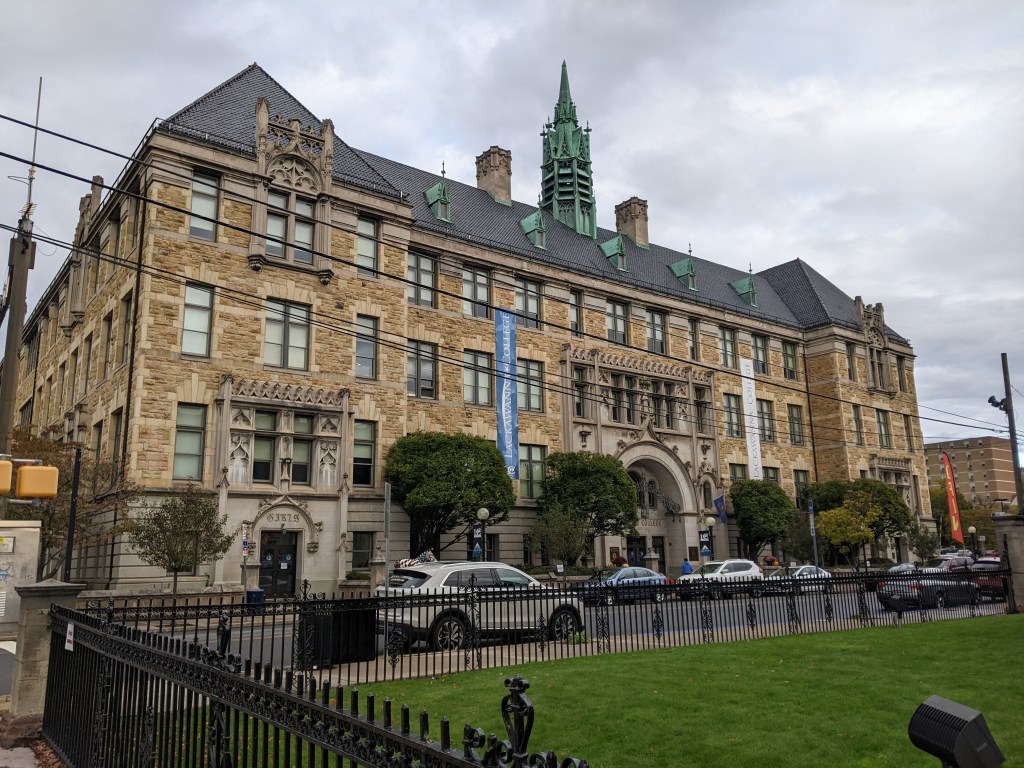
In addition to the religious and former religious buildings, I found 2 civic buildings and 1 school that sported spires.


Discover more from urbantraipsing
Subscribe to get the latest posts sent to your email.
 urbantraipsing
Tacoma is about to lose the red brick Holy Rosary Catholic church whose spire is visible from afar due to its setting.
Around 15 years ago we lost the domed 1st Methodist Church downtown.
Costs of retrofitting for safety are prohibitive to dwindling congregations.
I fear for more large historic church buildings.
What hits home to me is this: the modern style Mason Methodist church, where my mother attended and was escorted to at age 97 with her oxygen recently, is slated for removal. A stack and pack apartment will replace it ..half a block from my little home!
The church is trying for some amenities such as garden plots and a labyrinth. My little old fashioned commercial neighborhood has been overwhelmed by medium rise stack and packs. A a once lovely neighborhood is congested and foreign. Several more are slated. I do not know anywhere safe from overdevelopment unless saved by a lack of ability to sustain the high rents required by the building owners.
Thank you for sharing these stories of what is happening in Tacoma. Unfortunately, it echoes much of what I see and read about elsewhere in the country. I wonder what our cities, towns, and rural areas would look like if people and community were the core values we built upon.