Three Sisters: 6th Street Bridge

Originally, I thought I would write one post about the Three Sisters Bridges in Pittsburgh as they look identical and are so close together that their views of the city would not vary much.  However, after walking them, I decided that the 6th Street Bridge has enough going for it to deserve its own post.  (The other two Sisters are the 7th and 9th Street Bridges.)

The 6th Street Bridge is very active (much more so than its two sister bridges) and as such, I have walked over it multiple times.  It connects Downtown to the North Shore right next to PNC Park (the Pirates baseball stadium).  On game days the bridge is often closed to vehicular traffic, so that people who park, live, or work downtown as well as those who take public transit downtown can walk to the stadium across the bridge without crowding the sidewalks.  I believe this is true for baseball games as well as football games, both University of Pittsburgh and Steelers, down river at Heinz Stadium.  This bridge is also closed off to vehicles as part of the route for Pittsburgh’s annual Turkey Trot, which I participated in last year with several members of my family.

In my walk across the Three Sisters, I found additional reasons beyond the special closings of the bridge for writing about the 6th Street Bridge separately from the other two.

First, I discovered that the bridges are not completely identical.  In 1928, the 6th Street Bridge won the Most Beautiful Steel Bridge Award.  After crossing the Three Sisters, I agree that the 6th Street Bridge truly is the most beautiful (at least of the three).  This is because of the light fixtures.  The 7th and 9th Street Bridges have normal, ordinary street lights painted yellow, whereas the 6th Street Bridge has classic black posted street lamps (see image below).  Though all three had hanging flower baskets, the difference in the lamps made the flowers on the 6th Street Bridge look more vibrant and beautiful than those on the other two bridges.

The second reason for discussing the Three Sisters Bridges separately is because they each have alternate names.  The 6th Street Bridge is also called the Roberto Clemente Bridge.  The bridge was renamed in the late 1990s.  Roberto was a former Pirates player, who I remember learning about in elementary school as being an important force in combating racism in sports.  There is a plaque honoring Roberto on the bridge.

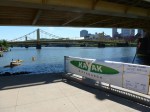
Another piece of interest about the 6th Street Bridge is that Kayak Pittsburgh is located underneath the bridge on the north side.  Ever since I moved to Pittsburgh, I’ve heard of Kayak Pittsburgh and its location, but I could never truly understand where it was.  The hut on the water near the bridge that I thought was Kayak Pittsburgh for years is actually the shed for river emergency services.  When I walked over the 6th Street Bridge this time, I approached it from the Three Rivers Trail on the north side, and finally saw Kayak Pittsburgh.  The last time and perhaps only time I was on that part of the trail was the middle of winter, so there weren’t any kayaks or kayakers to see.


Heth’s Run Bridge Part II

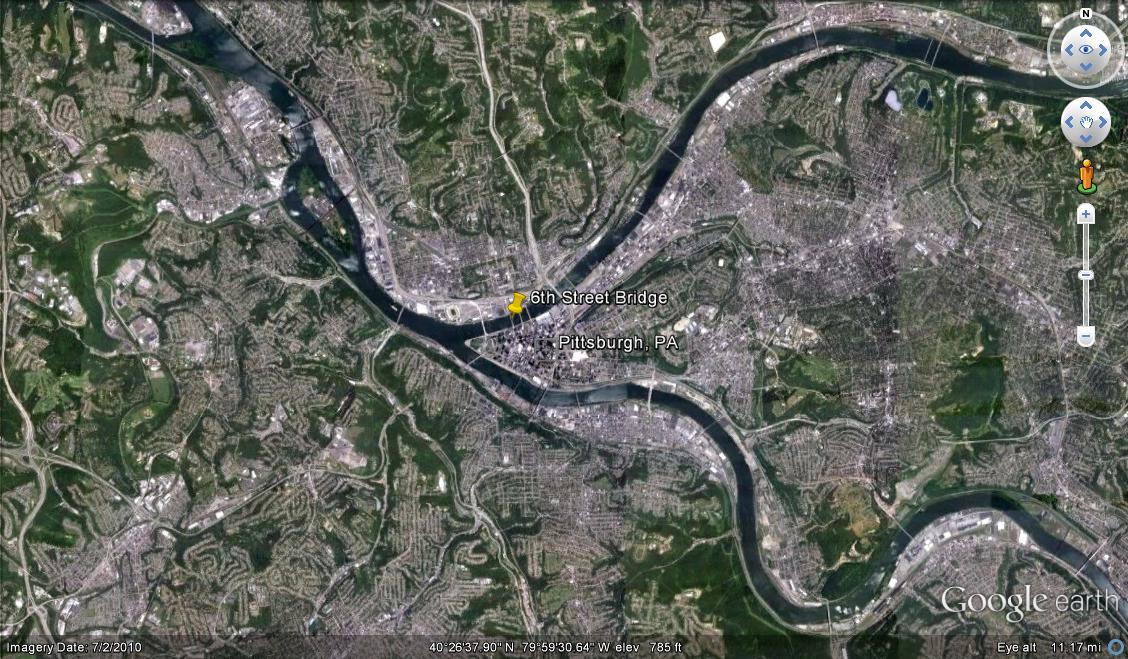
I have a few thoughts to add about Heth’s Run Bridge.  First is the map above which identifies the location of the Bridge compared to downtown.  Second is the bridge’s condition.  There recently has been a lot of buzz around town about the terrible condition of all the bridges in Pittsburgh and Allegheny County as well as many in the rest of Pennsylvania.  This gossip tends to give the impression that most of our bridges are ready to collapse at any moment.  Transportation for America’s website describes a report on deficient bridges, which is probably what fueled the gossip above, however the report presents a slightly more favorable picture.  While the Pittsburgh Metro area is identified as the metro area with the highest percentage of deficient bridges in the US, it turns out that only 30% of the bridges are deficient.  While I am unable to comment on the structural integrity of Heth’s Run Bridge or even if there is any need for it to be structural sound (I don’t think the ravine has been completely filled in under the bridge, but I can’t be sure), I can attest to the condition of the sidewalks.

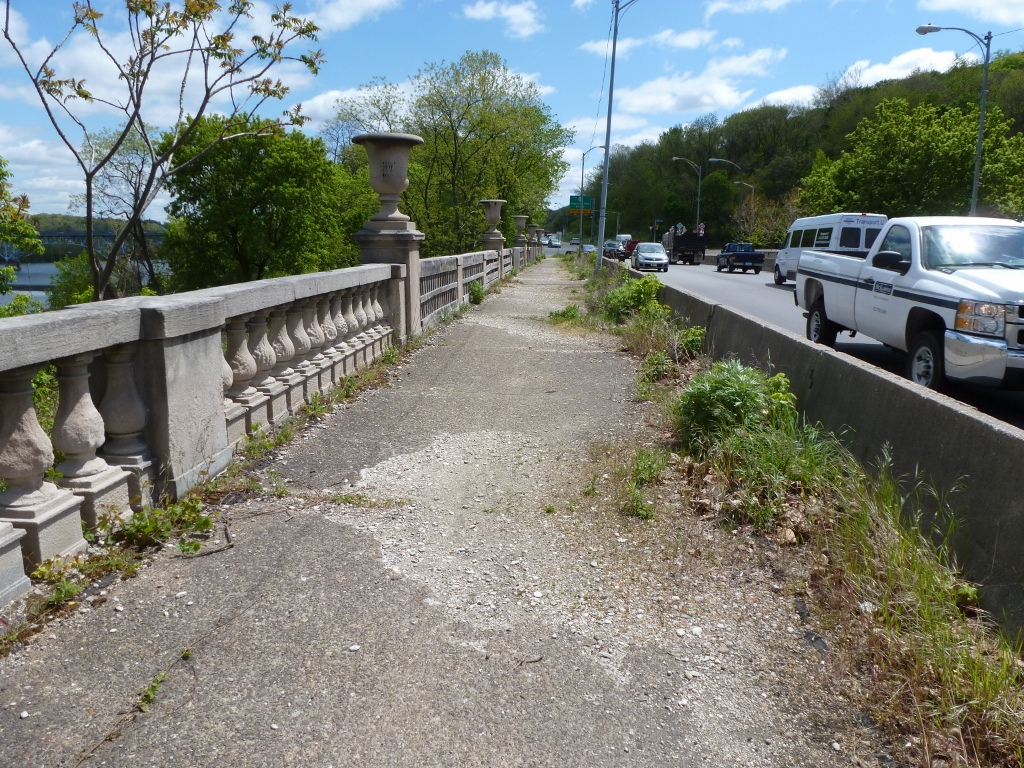
The sidewalk is quite wide, but as the image above shows, it is deteriorated with weeds growing however they please.  The sidewalk on the other side is in similar condition.  The first time I walked this bridge I could not understand why the sidewalk was so wide, particularly as on the other side, the sidewalk narrows considerably.  Across the bridge I’d guess the sidewalk is over 10 feet wide, but once across it is only a couple feet wide, with only about a foot of usable space due to dirt and overgrown weeds.  Clearly this is not an area that the city considers to have a high enough volume of foot traffic to warrant good sidewalk maintenance.  As there often is high vehicular traffic in this area, I say the city should make the sidewalks across the bridge much narrower so that they can add another car lane.  The riverside traffic has two lanes before the bridge and two lanes after, but narrows considerably to make room for a useless wide and deteriorating sidewalk.

In writing the first post on Heth’s Run Bridge (see May 31 post), I believe I discovered the reason for this unusually wide sidewalk that today essentially goes nowhere (at least nowhere that the average pedestrian would wish to go).  The 1911 map of the bridge and surrounding area shows that the bridge connected Butler Street and Washington Boulevard (today’s Allegheny River Blvd), both of which were lined with houses and other buildings.  There is even a school on Washington Boulevard.  As such it was probably only natural that when the current bridge was built in 1914 it would have large sidewalks to help facilitate the movement of people before the prevalence of the car between the houses, businesses, and schools that lined these roads.  Today all the buildings that lined Washington Boulevard at this point do not exist.  The land they once stood on is all wilderness and on the landward side of the road is incorporated into Highland Park.  The large, deteriorating sidewalk of Heth’s Run Bridge is the only reminder of a time when this area was probably busy and vibrant.