Heth’s Run Bridge Part II

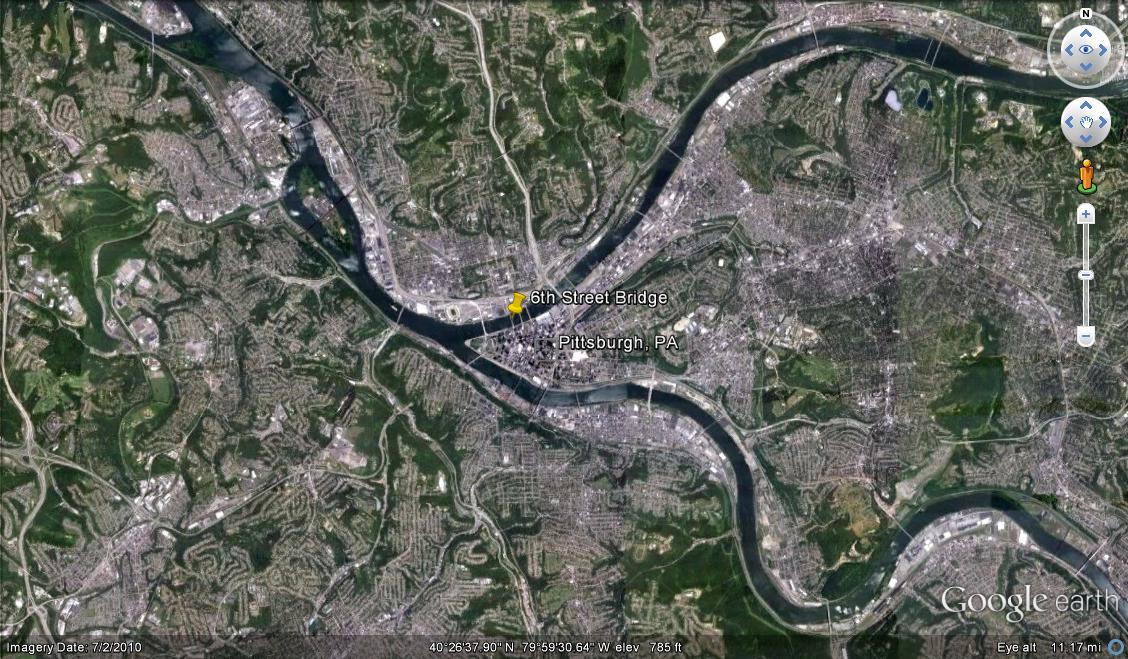
I have a few thoughts to add about Heth’s Run Bridge.  First is the map above which identifies the location of the Bridge compared to downtown.  Second is the bridge’s condition.  There recently has been a lot of buzz around town about the terrible condition of all the bridges in Pittsburgh and Allegheny County as well as many in the rest of Pennsylvania.  This gossip tends to give the impression that most of our bridges are ready to collapse at any moment.  Transportation for America’s website describes a report on deficient bridges, which is probably what fueled the gossip above, however the report presents a slightly more favorable picture.  While the Pittsburgh Metro area is identified as the metro area with the highest percentage of deficient bridges in the US, it turns out that only 30% of the bridges are deficient.  While I am unable to comment on the structural integrity of Heth’s Run Bridge or even if there is any need for it to be structural sound (I don’t think the ravine has been completely filled in under the bridge, but I can’t be sure), I can attest to the condition of the sidewalks.

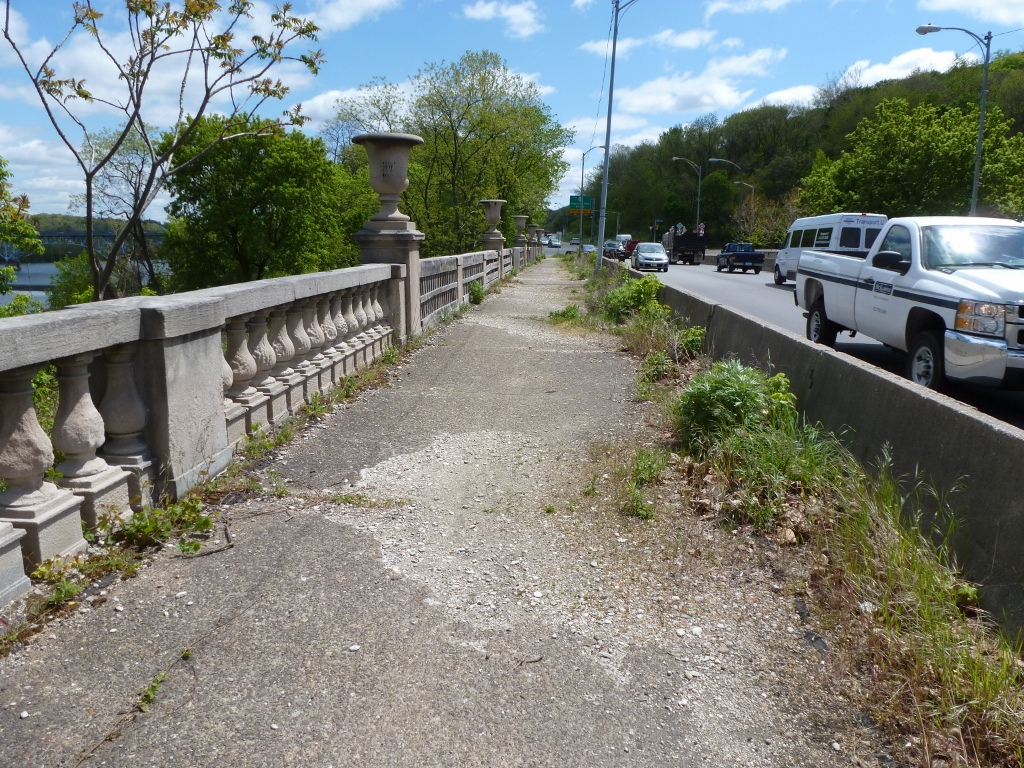
The sidewalk is quite wide, but as the image above shows, it is deteriorated with weeds growing however they please.  The sidewalk on the other side is in similar condition.  The first time I walked this bridge I could not understand why the sidewalk was so wide, particularly as on the other side, the sidewalk narrows considerably.  Across the bridge I’d guess the sidewalk is over 10 feet wide, but once across it is only a couple feet wide, with only about a foot of usable space due to dirt and overgrown weeds.  Clearly this is not an area that the city considers to have a high enough volume of foot traffic to warrant good sidewalk maintenance.  As there often is high vehicular traffic in this area, I say the city should make the sidewalks across the bridge much narrower so that they can add another car lane.  The riverside traffic has two lanes before the bridge and two lanes after, but narrows considerably to make room for a useless wide and deteriorating sidewalk.

In writing the first post on Heth’s Run Bridge (see May 31 post), I believe I discovered the reason for this unusually wide sidewalk that today essentially goes nowhere (at least nowhere that the average pedestrian would wish to go).  The 1911 map of the bridge and surrounding area shows that the bridge connected Butler Street and Washington Boulevard (today’s Allegheny River Blvd), both of which were lined with houses and other buildings.  There is even a school on Washington Boulevard.  As such it was probably only natural that when the current bridge was built in 1914 it would have large sidewalks to help facilitate the movement of people before the prevalence of the car between the houses, businesses, and schools that lined these roads.  Today all the buildings that lined Washington Boulevard at this point do not exist.  The land they once stood on is all wilderness and on the landward side of the road is incorporated into Highland Park.  The large, deteriorating sidewalk of Heth’s Run Bridge is the only reminder of a time when this area was probably busy and vibrant.

Heth’s Run Bridge

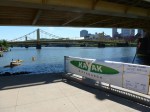
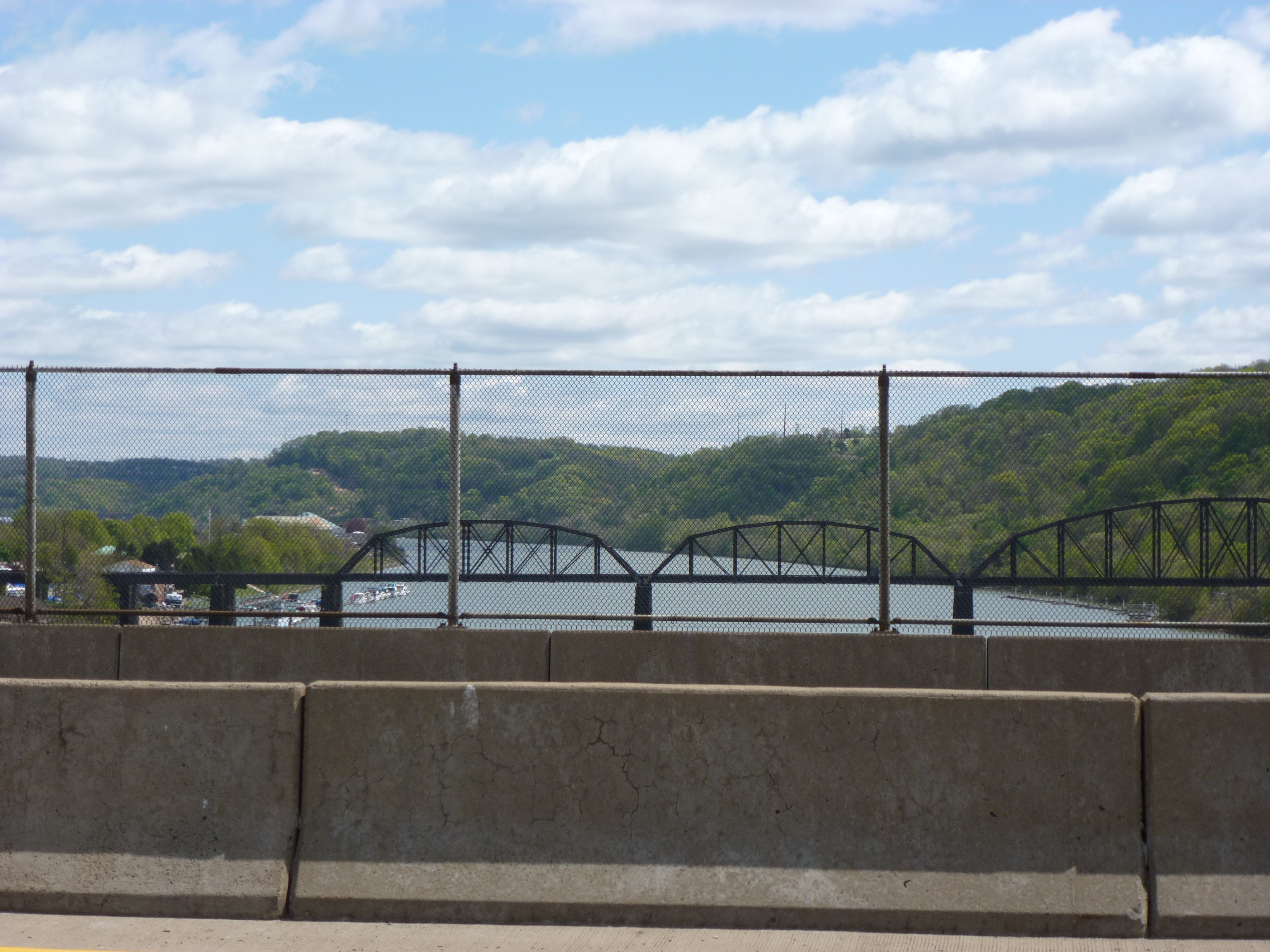
Heth’s Run Bridge as seen today presents many mysteries.  Digging into the mysteries uncovers a interesting story.  I have crossed Heth’s Run Bridge many times, usually in a car on the way to the Zoo, but it was only in recent years that I realized it was a bridge.  When looking toward the zoo parking lot from the bridge (as in the picture below) it does not appear that the height of the road differs enough from the surrounding landscape to be a bridge.  However, in the view above (taken from the Zebra Ice Station parking lot on the river side of the road) it looks like a bridge.  The G.M. Hopkins Maps, one of my all-time favorite resources available on the Historic Pittsburgh website, explains the history of and the reason for this bridge.

The 1899 map identifies a bridge in this location called High Bridge, indicating that there was a significant difference in elevation at this point.  A 1912 photograph shows that this was indeed a high bridge, quite unlike the current bridge and its surroundings.  This would have been caused by a small stream called Haight’s Run which flowed under the bridge into the Allegheny River.  By 1911, most of this stream was covered over and Haight’s Avenue ran along its path.  The 1939 map shows no evidence of Haight’s Run, the name on the road and the bridge is now Heth’s, and the road is marked “not open.”  Also in this map, the bridge appears to be a different width than in the others, this is because the current structure was built in 1914, more technical and historical information about the bridge can be found here.  1939 is the most recent year for the G.M. Hopkins Maps.  I speculate that the bridge would still have been raised over the surrounding landscape at that time, based on the similarities in the surroundings between the 1911 and 1939 maps.  However, sometime between then and now, Haight’s/Heth’s Run was filled in and the zoo parking lots built on top, level with the height of Heth’s Bridge.

If I had not passed this way on foot, I doubt that would have realized that this was in fact a bridge or that once not long ago (in geological terms) a stream flowed along this way.  There is a tendency in urban areas for nature to be ignored or in this case built over, which sometimes causes catastrophic results.  Not far from Heth’s Run is Negley Run, another stream that was buried under a road.  The burial of this stream likely contributed to the tragic flood on Washington Boulevard last summer that resulted in several deaths.  I look forward to the day when all our roads and sidewalks will be made of permeable material, allowing for more natural absorption of rain water and reducing flooding.

Pittsburgh Bridges

The 20 bridges that span Pittsburgh’s rivers within the city limits.

One day, while overlooking the city of Pittsburgh from Mt. Washington, I set myself the goal of walking all the bridges in Pittsburgh.  It is said that Pittsburgh has more bridges than any other city in the world including Venice.  The current count of Pittsburgh’s non-railroad bridges longer than 8 feet is 446.  Perhaps my goal is a bit too ambitious, but I intend to give it a shot.  By the end of the summer, I intend to document walks over the 20 bridges on the three rivers (Allegheny, Monongahela, and Ohio) within the city limits as well as many of the land bridges in the city between the Allegheny and Monongahela Rivers.

From the bridges I have walked so far, I am fascinated by two things.  First, I find the diversity of viewpoints on the city engaging, from the beautiful views of the bridges connected to downtown to the underbelly views seen on bridges scattered throughout the city including the Highland Park (see June 10 post) and Bloomfield (see Aug 18 post) bridges.  In addition, I am gaining a greater awareness and appreciation for the geography of the city through this project.  Attempting to identify the numerous bridges is forcing me to reconsider parts of the city that I have taken for granted through over-familiarity.  Heths Run Bridge is an example of this (see May 31 and June 9 post).