Out of Sight…

20180614_155542 (2)

Trash Train Passing through Pittsburgh

Once a week, I put a bag of trash out at the curb before going to bed.  When I leave for work in the morning, it’s gone.  Poof!

Yesterday, while enjoying the beautiful summer day, the stench of garbage made me look up.  Crossing the railroad bridge, chugged a train full of trash.  I couldn’t see either engine or caboose, only car upon car upon car full of trash.  As I passed under it, smelling the breadth of the aura of stink surrounding the train, my mind imagined all the homes, parks, farms, mountains, forests, and prairies that would be polluted by this rotting mass before it reached its final destination.  A destination that is forever polluted.

I don’t litter.  I recycle when possible (or easy).  I don’t have a newspaper delivered as most of it ends up going straight to my recycle bin, wasting energy and resources.  I try to buy yogurt by the quart instead of single serve to reduce the amount of plastic used.  I plan to compost, one day.  Yet, I had no qualms setting out a bag of garbage every week.

In a corner of my mind, I knew that a truck comes and takes the garbage away to something called a landfill.  And that the garbage will sit there…forever.
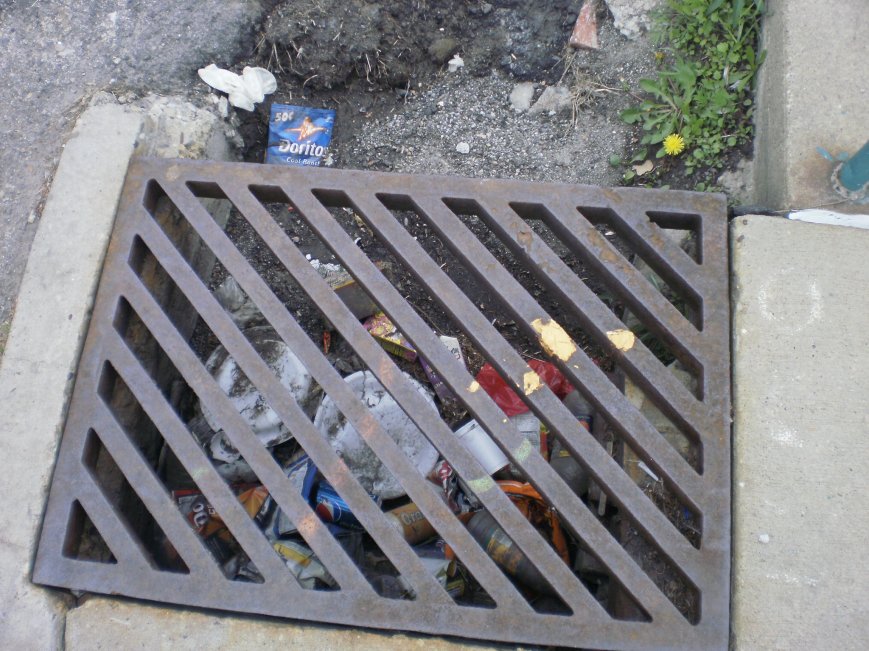
OLYMPUS DIGITAL CAMERA

A Storm Drain Treated as a Trash Can

Today, that image of the trash train is causing me to question my behavior.  Is my habit of collecting all my “garbage” in a plastic bag and setting it at my curb for it to find its way to this train and then to a landfill really any better than the person whose habit is to drop their trash on the ground or down a storm drain?  Is a landfill really any better than the Great Pacific Garbage Patch?

Social media is filled with indignation over the trash vortex floating in our ocean, but maybe there should be more discussion and awareness about the rest of our trash: where it goes and what alternatives we have.

Busway Bridges: Millvale Avenue

When I crossed the Millvale Avenue Bridge over the busway, I was thinking a lot about the “caged” aspect of many of Pittsburgh’s bridges.  I wrote about this idea in my Highland Park Bridge, Taking the Long Way Round, and Busway Bridges: East Liberty posts.  While a lot of bridges in Pittsburgh have the mesh fencing, which often makes me as a pedestrian feel caged in, there are several that do not.  As I prepared to cross this bridge I wondered why that is.

I wondered if perhaps it was to prevent people from jumping off the bridges.  This theory did not make sense though.  First, if that is the case shouldn’t all the bridges have the fences?  One of the times I crossed the Birmingham Bridge, I witnessed a scene that I believe was a group of people working to dissuade a jumper.  The Birmingham Bridge is one of the bridges without a fence.  The second reason this theory doesn’t fit is that on the Millvale Bridge, the fencing is only along part of it.  There is a significant stretch not fenced with a big drop.  The part that is fenced is the stretch over the railroad tracks and the busway.

My next ideas were that perhaps the fences are meant to stop litter from blowing off the bridge and onto the tracks/road/river below or to stop people from throwing things over the bridge.  Again, these don’t make sense.  Litter can blow in from any direction and could blow over the fence.  There is also a parking lot under the Millvale Bridge, so if the concern is about people tossing things over the bridge, why isn’t the fence extended to protect the cars in the lot?

I mention in Busway Bridges: Baum-Centre Corridor that most of the bridges across the busway between Penn Avenue and the Bloomfield Bridge are ugly and unpleasant.  Millvale Avenue Bridge is mostly exempted from this.  The design of the bridge is more aesthetically pleasing than the concrete of the Baum and Centre bridges and the rusty metal of the Highland and Negley bridges.  The area surrounding this bridge is also more residential and less used than the commercial arteries of Baum and Centre.

I thought the aesthetic difference might be explained by the years in which the bridges were built, but that is not the case.  The Highland, Negley, Aiken, Baum, and Millvale bridges across the busway were built in the 1910s or 1920s.  They were all reconstructed while the Penn, Centre, and Bloomfield bridges were all built in the 1960s, ’70s, or ’80s.  The Negley and Aiken bridges also connect with residential areas, so the land use around the bridge cannot explain the slightly different and better design of the Millvale Bridge.